“I felt my lungs inflate with the onrush of scenery—air, mountains, trees, people. I thought, “This is what it is to be happy.”
― Sylvia Plath, The Bell Jar

Dallas Museum of Art, Dallas, Texas
“I felt my lungs inflate with the onrush of scenery—air, mountains, trees, people. I thought, “This is what it is to be happy.”
― Sylvia Plath, The Bell Jar
Dallas Museum of Art, Dallas, Texas
“Letting go gives us freedom, and freedom is the only condition for happiness. If, in our heart, we still cling to anything – anger, anxiety, or possessions – we cannot be free.”
― Thích Nhất Hạnh, The Heart of the Buddha’s Teaching: Transforming Suffering into Peace, Joy, and Liberation

Dallas Museum of Art, Dallas, Texas
“They’re in love. Fuck the war.”
― Thomas Pynchon, Gravity’s Rainbow

Dallas Museum of Art
Dallas, Texas
The old couple, carved from the earth like the first man, sit there, decade after decade, while people walk by and stare at them. It’s been going on so long, they are getting pretty sick of it. It shows in their faces.
“There is an hour when you realize: here is what you have been given. More than this, you won’t receive. And what this is, what your life has come to, will be taken from you. In time.”
― Joyce Carol Oates, Wild Nights!: Stories About the Last Days of Poe, Dickinson, Twain, James, and Hemingway
“When he shall die,
Take him and cut him out in little stars,
And he will make the face of heaven so fine
That all the world will be in love with night
And pay no worship to the garish sun.”
― William Shakespeare, Romeo and Juliet

(click to enlarge)
Chihuly Glass
Dallas Museum of Art
Dallas, Texas
“Masquerades disclose the reality of souls. As long as no one sees who we are, we can tell the most intimate details of our life. I sometimes muse over this sketch of a story about a man afflicted by one of those personal tragedies born of extreme shyness who one day, while wearing a mask I don’t know where, told another mask all the most personal, most secret, most unthinkable things that could be told about his tragic and serene life. And since no outward detail would give him away, he having disguised even his voice, and since he didn’t take careful note of whoever had listened to him, he could enjoy the ample sensation of knowing that somewhere in the world there was someone who knew him as not even his closest and finest friend did. When he walked down the street he would ask himself if this person, or that one, or that person over there might not be the one to whom he’d once, wearing a mask, told his most private life. Thus would be born in him a new interest in each person, since each person might be his only, unknown confidant.”
― Fernando Pessoa
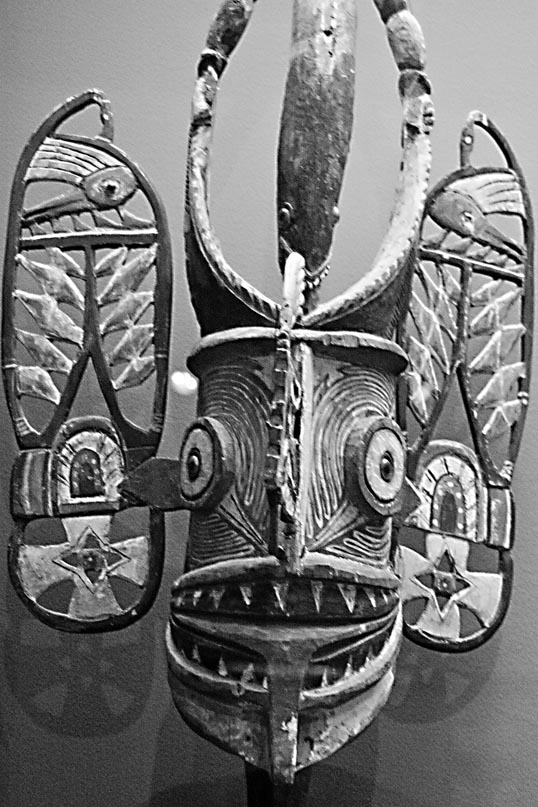
Dallas Museum of Art
Dallas, Texas
Sometimes I like to go to the Art Museum when there is a jazz combo playing. Most people get a table in the atrium, buy a glass of wine, meet some friends… and sip, chat, and nod their heads.
However, I usually end up walking the galleries, listening to the music and gazing at the art. It’s an interesting intersection of the visual and auditory creative channels. Unfortunately, the sound of jazz doesn’t carry all that well and I am restricted to the nearby areas… mostly ancient sculpture of the Americas.
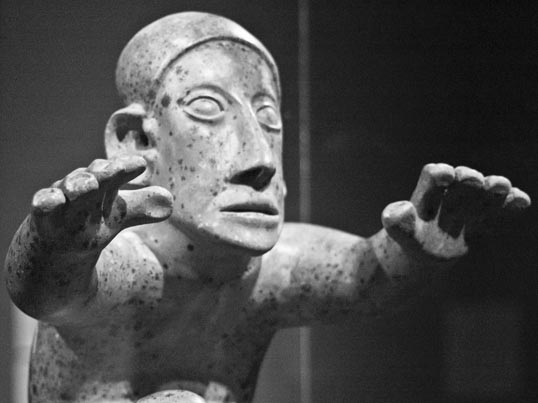
“If you have to ask what jazz is, you’ll never know.”
― Louis Armstrong
Lead them beside still waters because you know how badly they need still waters.
–Tennessee Williams, The Night of the Iguana

Fort Worth Zoo
Fort Worth, Texas
“When words become unclear, I shall focus with photographs. When images become inadequate, I shall be content with silence.”
― Ansel Adams

Silence
Antoine-Augustin Préault
Dallas Museum of Art
Dallas Museum of Art
Dallas, Texas
(label text)
Antoine-Augustin Préault
French, 1809-1879
Silence
c. 1842
Patinated plaster
Anonymous gift and General Acquisition Fund, 2014.10
French sculptor Antoine-Augustin Préault created eerie contrasts of shadow and light in this composition featuring merely a face and a hand. Linear drapery enshrouds the androgynous figure’s face, drawing attention to its gaunt features, half-closed eyes, and skeletal hand. A finger lifted to the lips is a gesture commonly found in ancient funerary sculptures that glorified the dead. Portraiture or reliefs bearing images of the deceased performing this gesture were intended to conjure pleasant memories, but Silence, with its brutal evocation of frailty and death, breaks from the well-established canon.
Préault designed Silence for Jacob Roblès’ tomb at Père Lachaise Cemetery in Paris, which is the city’s largest and most famous burial ground. The medallion’s compositional elements combine to convey a somber nature perfect for the purpose of a tomb. Its superb round, dark hardwood frame with a deep ogee, or S-shaped molding, enhances the sculpture’s dimensionality and melancholy theme.
“Does not everything depend on our interpretation of the silence around us?”
― Lawrence Durrell, Justine
“It’s not what I’d want for at my funeral. When I die, I just want them to plant me somewhere warm. And then when the pretty women walk over my grave I would grab their ankles, like in that movie.”
― Neil Gaiman, American Gods

Funerary Figure (tau-tau)
Dallas Museum of Art
Dallas, Texas
Dallas Museum of Art
Dallas, Texas
(label text)
Funerary figure (tau-tau)
Indonesia: South Sluawesi, Sa’dan Toraja People
19th century or earlier
Wood
The Eugene and Margaret McDermott Art Fund, Inc. 1980.2 McD
The Toraja carve tau-tau, smaller than life-size funerary figures, to commemorate the deceased when a high-ranking funeral is held. Only members of the highest-ranking aristocracy are permitted to have permanent tau-tau. This unusually small funerary figure appears to be archaic in style and probably predates even the oldest effigies seen beside Toraja tombs today.
The bun or hair knot at the back of the head of this tau-tau indicates that it represents a female. Her mouth is open and may remind one of The Scream, a modern painting by Edvard Munch. The expression is not precisely understood, but it may have been meant to capture bearing of an authoritative aristocratic woman accustomed during her lifetime to public speaking and giving orders, as this tau-tau appears to be doing
“I am the twentieth century. I am the ragtime and the tango; sans-serif, clean geometry. I am the virgin’s-hair whip and the cunningly detailed shackles of decadent passion. I am every lonely railway station in every capital of Europe. I am the Street, the fanciless buildings of government. the cafe-dansant, the clockwork figure, the jazz saxophone, the tourist-lady’s hairpiece, the fairy’s rubber breasts, the travelling clock which always tells the wrong time and chimes in different keys. I am the dead palm tree, the Negro’s dancing pumps, the dried fountain after tourist season. I am all the appurtenances of night.”
― Thomas Pynchon, V.
I was waiting with my bicycle at the Galatyn Park DART train station for some friends to arrive when I noticed patterns, codes obviously, cut into the steel of the railing by the station artist, Jim Cinquemani.

Galatyn Park DART Station, Richardson, Texas
The first one was easy. That’s Morse Code. I don’t know it by heart, but I know how it works. It spells out the name of the place, Galatyn Park.
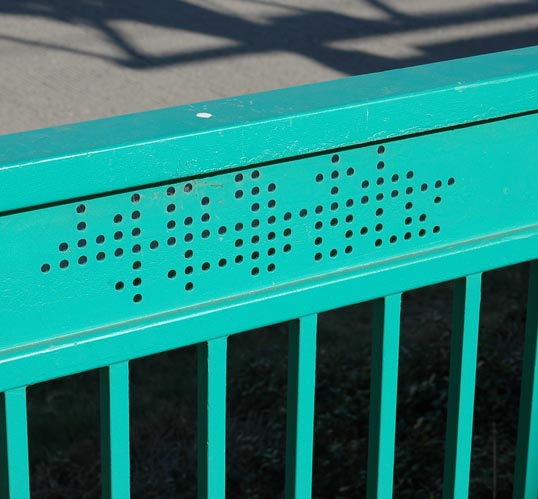
Galatyn Station, DART, Richardson Texas
So I confidently dove in to the puzzle of the second missive. It’s obviously some sort of Teletype Code. Since I already knew what it probably said, I thought it would be easy. A seven bit code (ASCII is usually seven bits) – but what is that one bit that is always on? And the message is twenty-six characters long… There are so many different codes, with strange encoding patterns and a lot of mysterious control codes.
I’m old enough to have worked with paper tape – back when kilobytes of information were all we had to work with. This looks like computer paper tape – but it might be an even older technology.
I never was able to figure it out. I’ll work on it awhile – and then maybe email the sculptor and see if he will tell me.
Finally, the last two codes:

Fence at Galatyn Park Sation.
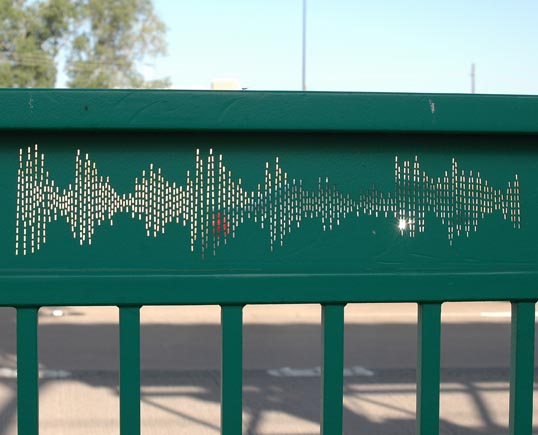
Galatyn Park DART Station – with car passing behind.
These are obviously analog output. Maybe voice recordings? No way to decode – but they do look cool.
“It’s been a prevalent notion. Fallen sparks. Fragments of vessels broken at the Creation. And someday, somehow, before the end, a gathering back to home. A messenger from the Kingdom, arriving at the last moment. But I tell you there is no such message, no such home — only the millions of last moments . . . nothing more. Our history is an aggregate of last moments.”
― Thomas Pynchon, Gravity’s Rainbow
 Bill Chance