A Month of Short Stories 2014, Day 30 – A Horseman in the Sky

A year ago, for the month of June, I wrote about an online short story each day for the month. It seemed like a good idea at the time. My blog readership fell precipitously and nobody seemed to give a damn about what I was doing – which was a surprising amount of work.

Because of this result, I’m going to do it again this year.

Today’s story, for day thirty – A Horseman in the Sky, by Ambrose Bierce

Read it online here:

A Horseman in the Sky

When I think of Ambrose Bierce, I think of carefully written, exquisitely detailed military stories – with the wild addition of fanciful magic realism. I suppose that, today, well over a century after he lived and wrote, his most well-known tale, An Occurence at Owl Street Bridge, fits that description.

He also wrote The Devil’s Dictionary – which is a little dated today – but is still valid in its bitter satire on life and its foibles.

To wit:
From The Devil’s Dictionary”

LIFE, n. A spiritual pickle preserving the body from decay. We live in daily apprehension of its loss; yet when lost it is not missed. The question, “Is life worth living?” has been much discussed; particularly by those who think it is not, many of whom have written at great length in support of their view and by careful observance of the laws of health enjoyed for long terms of years the honors of successful controversy.

“Life’s not worth living, and that’s the truth,”
Carelessly caroled the golden youth.
In manhood still he maintained that view
And held it more strongly the older he grew.
When kicked by a jackass at eighty-three,
“Go fetch me a surgeon at once!” cried he.
—Han Soper

or, from the “S”:

SAUCE, n. The one infallible sign of civilization and enlightenment. A people with no sauces has one thousand vices; a people with one sauce has only nine hundred and ninety-nine. For every sauce invented and accepted a vice is renounced and forgiven.

(this is a fact that I agree with)

There is much to say about today’s short and simple story… but I want to point out one simple aspect. The story has, among other things, a surprise or twist ending.

This sort of story is hard to pull off. A successful surprise ending really has to be no surprise at all – at least no surprise after you have read it. Though you should not be able to see it coming, after it has passed you have to realize that things could not be any other way.

Bierce does all this in today’s. Through careful manipulation of point of view, time shifting, and judicious information release by the omniscient narrator the ending is concealed until the end, yet is foreshadowed to the extent that the reader knows that no other plot direction would be possible.

That’s especially tricky because this is the most common and hoary of all twist endings, still being done to this day.

Hope I didn’t ruin it for you. It’s still a cool story.

For an instant Druse had a strange, half-defined feeling that he had slept to the end of the war and was looking upon a noble work of art reared upon that eminence to commemorate the deeds of an heroic past of which he had been an inglorious part. The feeling was dispelled by a slight movement of the group: the horse, without moving its feet, had drawn its body slightly backward from the verge; the man remained immobile as before. Broad awake and keenly alive to the significance of the situation, Druse now brought the butt of his rifle against his cheek by cautiously pushing the barrel forward through the bushes, cocked the piece, and glancing through the sights covered a vital spot of the horseman’s breast. A touch upon the trigger and all would have been well with Carter Druse. At that instant the horseman turned his head and looked in the direction of his concealed foeman–seemed to look into his very face, into his eyes, into his brave, compassionate heart.

A Month of Short Stories 2014, Day 15 – Train

A year ago, for the month of June, I wrote about an online short story each day for the month. It seemed like a good idea at the time. My blog readership fell precipitously and nobody seemed to give a damn about what I was doing – which was a surprising amount of work.

Because of this result, I’m going to do it again this year.

Today’s story, for day fifteen – Train, by Alice Munro

Read it online here:

Train

There is no greater master of the short story than Alice Munro. I’ve pretty much read everything she has written (more or less) and, although I didn’t remember specifically reading today’s entry, Train, once I was a few paragraphs in, I remembered reading it – though it, like all of her work, is complex and subtle enough it was as good the second time around.

As a matter of fact, it is a story that I think needs to be read twice… with a gap of time in between. It is a story that is told in the details – details conveyed in otherwise throwaway lines of text, lines you won’t notice the first time through.

I have been thinking about one aspect of the story – one that bothers me a little. That’s the idea of a coincidence.

A lot of stories have coincidences – old friends meet, an important item goes unseen until it is needed, disparate paths cross…. That’s fine – you can always say, “the coincidence is needed, without the coincidence there is no story.” Coincidences happen.

However, I think that by this rule, you are limited to one coincidence. One coincidence makes a story – two or more make a manipulation by the author trying to drive a plot.

And I think this story might have two.

There is the big, obvious one. Jackson is working at the apartment building when Ileane comes by looking for her daughter. Read the story to find what the connection between the two is – it’s the relationship that drove the opening scene in the story. This sort of time-shifting and echoes happening across entire lifetimes are specialities of Alice Munro.

But, earlier in the story, Jackson stumbles across Belle. They are two of a kind and end up in a strange relationship that lasts decades. The two of them meeting like that might be a second coincidence.

Or maybe not – because if they were not so oddly and tragically well-fitted for each other Jackson would have simply passed by. I guess that is good enough.

Still, that second coincidence stuck in my craw a bit – a tiny flaw in an otherwise wonderful tale. I shouldn’t think about it so much. No use picking nits in the presence of a master.

There was a road running by. A small fenced field in front of the house, a dirt road. And in the field a dappled, peaceable-looking horse. A cow he could see reasons for keeping, but a horse? Even before the war people on farms were getting rid of them, tractors were the coming thing. And she hadn’t looked like the sort to trot round on horseback just for the fun of it. Then it struck him. The buggy in the barn. It was no relic, it was all she had.

For a while now he’d been hearing a peculiar sound. The road rose up a hill, and from over that hill came a clip-clop, clip-clop. Along with the clip-clop some little tinkle or whistling.

Now then. Over the hill came a box on wheels, being pulled by two quite small horses. Smaller than the ones in the field but no end livelier. And in the box sat a half dozen or so little men. All dressed in black, with proper black hats on their heads.

The sound was coming from them. It was singing. Discrete high-pitched little voices, as sweet as could be. They never looked at him as they went by.

It chilled him. The buggy in the barn and the horse in the field were nothing in comparison.

He was still standing there looking one way and another when he heard her call, “All finished.” She was standing by the house.

What I learned this week, March 28, 2014

Highways Are Bleeding Dallas. So Why Are You Surprised We Want to Kill One?

I-345 near downtown Dallas

I-345 near downtown Dallas

6 Freeway Removals That Changed Their Cities Forever


Fairdale Bikes in Austin has this little video to show their extensive and advanced R+D Department.


From National Review Online

The Republican Style

Barack Obama showed up at his meeting with Dutch PM Mark Rutte with his usual caravan of armored limousines and the like. Here’s how Mr. Rutte got there:

Danish PM Mark Rutte from National Review Online

Danish PM Mark Rutte
from National Review Online

But… but… the American President needs a huge entourage, of course, To Provide Security.


Stock Xootr Swift - I only added the seat bag and bottle cage (click to enlarge)

Stock Xootr Swift – I only added the seat bag and bottle cage
(click to enlarge)

Bike myths debunked


Rap Artists Wu-Tang Clan Fight Infinite Goods By Selling One Copy Of Their Next Album… For $1 Million


The Bourbon Barrel Temptress, on a Bourbon Barrel

The Bourbon Barrel Temptress, on a Bourbon Barrel

Drinking local has never been better in Texas

He also singles out several “brilliant, well-thought-out, delicious beers” from Dallas breweries: Velvet Hammer, an imperial red ale from Peticolas Brewing Co., Mosaic IPA from Community Beer Co. and Temptress, an imperial milk stout from Lakewood Brewing Co.

The man obviously knows what he’s talking about. Those three… plus Revolver’s Blood and Honey (which, I guess, isn’t really a Dallas beer) are my favorites.

A hearty cheer - for good beer.

A hearty cheer – for good beer.


The Wisdom of Mark Cuban

I’m not a huge fan of Silicon Valley. It reminds me so much of Hollywood and the movie and TV industry.
In Hollywood every one will talk and listen to you about your project. But while they are standing there, right in front of you, they are not looking at you. They are looking past you to the next project where they can raise/sell more. Where they can be a bigger star. There is always a bigger fish. Who ever is standing in front of them is hopefully just the bait.
Silicon Valley has become the exact same thing these days. No one wants to literally start from scratch in a garage and build something. No one wants to bootstrap a business to profitability. Those are such archaic notions these days.

The back to the future arbitrage of Silicon Valley and what it will take to beat it

“I’m just telling you, when you’ve got a good thing and you get greedy, it always, always, always, always, always turns on you. That’s rule number one of business.”

Dallas Mavericks owner Mark Cuban: ‘NFL is 10 years from implosion’


melancholia1

Ranking the Greats 10: Lars Von Trier’s 10 Best Films

melancholia2


Take a look at this photo from Googlemaps of an area outside of Boyers, Pa:

Boyers, PA

Boyers, PA

A huge parking lot out in the country, mostly filled with hundreds of cars. A mysterious road that trails off to an opening in the side of a mountain, leading all those people underground.

What do you think it is? Maybe a top-secret defense facility? An armored center for disaster response? The place where they keep the aliens from Area 51?

Nope, nothing like that.

Read about it and weep. It’s the dreaded

Sinkhole of Bureaucracy


Read This, Not That: Indie Alternatives to Popular Books

Read This, Not That 2: Alternatives to Popular Books

5. Instead of The Devil in the White City, read In the Heart of the Sea by Nathaniel Philbrick.

I loved Devil in the White City – so that other one must be really good. Plus, I’ve been looking for an excuse to read Speak, Memory.

Periodic Tales

From the Telegraph Review of Periodic Tales: The Curious Lives of the Elements by Hugh Aldersey-Williams:

Chemists have long had to put up with the condescension of physicists. In one especially egregious case, the physicist Robert Oppenheimer – scientific director of the Manhattan Project, which developed the atomic bomb – informed his colleague George Kistiakowsky that he was no longer classed as a “first-rate chemist”, but as a “second-rate physicist”. This, Oppenheimer assured him, was a promotion. The project’s chemists thought this insulting; the physicists thought it hilarious.

Those pesky physicists….

I remember a physics professor extolling the ultimate virtues of his science (I’m not sure if he was aware that I – a lowly chemist – was sitting in front of him… he probably was) saying that physics is the most noble of sciences because it is the most pure – the basis of all other science. I simply nodded though I thought that, using his logic, mathematics would rise high above his craft. Now, the way I looked at it, without chemistry physics is only a bunch of squiggly lines on paper.

At any rate from both these disciplines, along with the various flavors of engineering and production, computer science, marketing and what-not…. comes e-ink, and from e-ink comes e-readers.

And from e-readers come Amazon’s periodic sales, which I peruse carefully. And from one of those periodic sales, came the book Periodic Tales: A Cultural History of the Elements, from Arsenic to Zinc – delivered through the ether for only a couple bucks right into my hot little hands.

That’s the book’s name in the US – in Europe it’s called Periodic Tales: The Curious Lives of the Elements – a better title in my opinion.

To you, I’m sure the book would seem to be the most boring pile of useless words imaginable – but I thought it fun and interesting. The author has had the lifelong hobby of collecting examples of the elements. He obviously also had the hobby of collecting engaging tidbits and stories about same. One day he had the bright idea of combining the two and coming up with a book. From the way the story is laid out – he used his publisher’s advance to travel to some of the more obscure locations where some of these elements were discovered or can still be found.

So, to extract a sample of phosphorus the author started out – as the early chemists did – by collecting a large amount of pee and letting it evaporate.

Each element’s discovery is spelled out as an adventure tale – many coming on the obscure transition from Alchemy to Modern Chemistry. Many great discoveries came from very odd places. For example, Ytterby – an obscure village in Sweden that gave birth to a slew of new rare earth elements – yttrium, erbium, terbium, and ytterbium.

I’m always getting yttrium and ytterbium mixed up.

I read the book through – though I wanted to slow down and take notes. You never know what interesting conversational anecdotes you may need to impress beautiful women in bars.

  • Dried blood is slightly attracted to magnets because of its iron content.
  • At one time radium was added to many products, especially those that supposedly had a therapeutic effect: Radium Butter, Radium Chocolate, Radium Beer, Radium Condoms, Radium Suppositories, Radium was put in Chicken Feed in hopes of producing Self-Incubating if not Self-Cooking Eggs.
  • The French Scientist Vauquelin isolated chromium by crushing emeralds and rubies. He proved the same element colored both.
  • Jezebel, from the Bible, used compounds of antimony as dark eye makeup.
  • Extremium and Ultimium were proposed as the name of a new element – Plutonium was used instead.
  • In Jean Cocteu’s 1949 film Orphee, Orpheus enters the underworld by passing through a mirror. This shot is achieved by having the actor push his hands into a pool of mercury that is disguised as glass.


from Orphee - the hands (protected by latex gloves) push through the mirror of mercury.

from Orphee – the hands (protected by latex gloves) push through the mirror of mercury.

Every page is chock-a-block with interesting tidbits like these.

The only letdown of the book was at the end, when the author tried vainly to sum up and leave the reader with an emotional connection with the periodic table. He should have simply run out of elements.

Now, again, I’m a chemist, not a physicist. But I do know physics. I was able to pass three semesters of physical chemistry… which I consider one of the greatest achievements of my life. With that knowledge, I realized that the author also left out one of the most interesting, if technically challenging aspects of his subject. He treats the very periodicity of the periodic table as a great mystery, one that was figured out by long scientific research but never completely explained.

He doesn’t talk about the electron shell model or atomic orbitals. That’s a shame. When you understand this concept, even without the daunting math involved, suddenly it all makes sense. A handful of simple laws are what define the outer-shell electron configuration of every element and that is what makes our world possible. It’s really amazing – if you do the work to understand it.

There are a surprising number of books on the periodic table and I have read a few in the past (Uncle Tungsten: Memories of a Chemical Boyhood by Oliver Sachs is a favorite) – but Periodic Tales is among the most entertaining and readable.

Finally, as a chemist, a book on the elements ignores the most fascinating aspect of chemistry. It will be, almost by definition, limited to describing Inorganic Chemistry. Carbon is given short-shrift in the book. He talks about it mostly in terms of charcoal and the carbon oxygen cycle.

But it is Organic Chemistry that most people find so fascinating. I still remember the thrill I felt when I was first learning how to manipulate matter, not by the elements it contained, but by arranging the shape of a compound made of a single element (with a few other contaminants maybe thrown in for variety) – how the pattern made by its versatile bonds could give rise to an unlimited cornucopia of new compounds, with wild and outlandish properties….

But that’s a whole ‘nother book.

Life After High School

I read a lot of short stories. A lot.

All my life I have read voraciously and read short stories particularly. After the advent of the ebook and the portable reader I have been able to kick it up a notch. My Kindle goes with me everywhere and I’m able to read in the small nooks of time that I can scare up. The short story is particularly good to gobble up in these little snips and sips. I usually read one at lunch and another before I go to sleep. That’s two short stories a day… and over a few years… over a handful of decades… they add up.

Kindle

Call Me Ishmael

Forty years ago, I had an English professor ask me about my reading habits. I told him I had gone to high school in another country and life there consisted of days of boredom sandwiched between moments of stark terror. I had picked up the habit of reading whenever I could.

“But it is mostly junk,” I said, “Cheap Science Fiction and stuff like that.”

“Your sense of story is very strong.” the professor said, “Talking to students over the years, I think that the important thing is to read and it doesn’t really matter what you read, as long as you read a lot.”

Not too long ago, on this very blog, I did my Month of Short Stories entries – where I wrote about a short story each day. I enjoyed doing that and promised to write more about particular works that caught my fancy.

The other day I finished a large collection of Joyce Carol Oates short stories called High Lonesome. It brings together her own favorites over forty years – from 1966 to 2006. Oates is a very prolific writer and it was good to peruse this sampling.

Alice Munro recently won the Noble Prize for her short stories and I like to compare the two writers. Munro is the unassailable master of the form – but on the whole, I prefer reading Oates. Munro’s writing concerns the life she has led and the people she has known and the wisdom she has acquired. Wonderful stuff and I am so happy she deservedly won the prize. However, Oates goes one step beyond – she kicks it up a notch. Oates writes about the void… the beyond… the horror that lies right on the other side of the tender membrane that divides our world from the realm of madness.

That is something I am interested in.

There are a lot of great and interesting stories in the collection, including the classic “Where are you going, Where Have You Been?” and the amazing “Heat” – which I wrote about before. Today, I want to talk about one of the later stories in the collection, “Life After High School.”

Spoilers will be written, so please, surprise everyone and read the story first. I found a PDF of it here.

“Life After High School” seems to be a popular story for school essay assignments – there is a lot written about it on this interweb thing. I looked at more than a few – and everybody seems to completely miss the point of the story.

You see… it’s really three stories in one. The first two are tricks played on the reader – then she hits you with the hammer, the third.

The first three quarters of the story is the tragic tale of unrequited love where Zachary Graff, the intelligent but socially awkward teenager falls in love with Sunny Burhman, the attractive and popular girl that everyone likes. He eventually, Senior Year, works up the nerve to propose to her and she, of course, says no. He is so heartbroken he kills himself by running his car in a closed garage. This devastates Miss Burhman, and she is “Sunny” no more.

So far, so good. An oft-told tale, one that every reader, especially a young person, will recognize and understand.

But Oates throws a twist. The story isn’t “High School” – it’s “Life After…” and, decades later a middle-aged Sunny Burhman contacts another student, Tobias Shanks, from those days. They meet for lunch and Sunny discovers that the two boys were gay lovers and that Zachary went to see him after she had rejected Zachary and, moreover, Zachary had left him a suicide note.

So now the story has morphed into one of a sensitive young man destroyed by society’s disapproval and Zachary’s proposal to Sunny was his last, futile attempt to “fit in.”

And that is where most people that read it leave the story. It is where I was ready to leave it… but not everything fit.

For example, the description that Oates provides of Zachary was a little odd. She said that most people were afraid of him. That doesn’t fit with the usual view of an odd, awkward, gay loser.

Also, Sunny says to him, “Zachary, it’s a free world.” But his response is, “Oh no it isn’t, Sunny. For some of us, it isn’t” A foreboding answer for a young person. There are plenty of other incongruities – I’ll leave some for you to find – enough to make my point clear on a second reading.

But finally, there was a detailed list of items that were found in his car at his death, it was said to be oddly littered. There was a Bible, some pizza crusts, textbooks, size eleven gym shoes, a ten foot piece of clothesline in the glove compartment, and the engagement ring in the car. (italics mine)

What was that all about? Why tell us all this? Chekhov’s gun says there has to be a reason… a good one.

So I was a little suspicious of the story. And then, I came to the last line… and the whole story changed. You see you think the story is one thing, then you think it’s another – and with the simple, final sentence it all changes, radically, for the last time.

After they have talked and read the suicide note, Sunny, almost as an afterthought, says:

“What do you think Zachary planned to do with the clothesline?”

And there it is.

Zachary wasn’t simply an awkward, misunderstood teenager… he was a killer. He didn’t propose to Sunny because he loved her (though he certainly did) – he was trying to get her into his car so he could kill her. When he failed, he went to see Tobias Shanks, his other love, and tried the same thing with him. Only then, with his homicidal needs frustrated, did he then off himself.

And the girl knew it. Sunny didn’t change her life after high school because of guilt over her rejection of Zachary. She was devastated because of the realization of how close she came to evil, how near she was to being an innocent murder victim, how thin that membrane that protects us really is.

Now… that is a story.

The funny thing is, reading what other folks thought about the tale, nobody else seemed to get it.

Here’s an analysis that is confused by the clothesline and the final line – the most important part of the story.

The clothesline is a symbol whose meaning is up for interpretation because the story does not give it a definite role. It could have been used to force Tobias or Sunny into coming with Zachary or Zachary could have planned to use it to kill himself

Here’s one that only notices the coldness of the final question (in my opinion, her detachment is her armor against the horror that lies beyond)…

Barbara Burhman’s final question in the story, “Life After High School” by Joyce Carol Oates was an appropiate closure because it is a reflection and direct unfolding of one of Barbara’s defining core characteristics and how she really truly feels about Zachary: cold-hearted indifference.

and finally, this one, simply says,

In the extract it was mentioned that Zachary had a clothesline in the glove compartment when the police found him dead in his car. It shows us that if the carbon monoxide did not work to kill him, he would have used the clothesline. It is an appropriate closure to the story because it shows Barbara and Tobias that there was nothing that they could do to save him. Zachary was determined to kill himself. I guess it shows some relief that he would have committed suicide sooner or later, if they might have saved him from the car.

Yeah, right. That’s a pretty slim reason to put that sentence in there for a writer of Oates’ skill. It’s like Chekhov included a gun so that the protagonist could have something to clean.

Am I off base here? Am I reading something into that last question that isn’t there? Is this really a tale of teenage angst, society’s rejection, and doomed love? Am I nuts to read into it a brilliant subtext of homicide and madness?

I don’t think so.

What do you think? – That’s assuming you do.

The War of the End of the World

I finished the first of the really big books I have on my list The War of the End of the World. I read it on the Kindle, but the hardback edition has 576 pages – so it isn’t the longest book in the world, but it’s long enough.

There was a ten-day setback in there when I misplaced my Kindle. I couldn’t find it for over a week and it was driving me crazy. The thing goes with me where ever I go, so I can get a little reading done in the small drips and dregs of time that are sometimes allotted to me – and that’s risky. I’ve come close to losing it twice – leaving it on a train once and on the roof of my car another time (where it fell off along a Frisco road) – but each time a good Samaritan found it, looked me up and contacted me.

This time I was pretty sure I had not left it someplace… but you never know. It turned out it was in the garage where I set it down in a dark, little-used corner when I went back there to get something.

Finding it made me happy and let me finish the book.

Kindle

Call Me Ishmael

Misplacing your portable electronic reading device is a first-world problem. The conflict at the heart of The War of the End of the World is not.

The novel is based on true events at the end of the nineteenth century in a dried up, impoverished, and forgotten stretch of worthless desert in the Brazilian state of Bahia. There, after a horrible drought that kills a good part of the population appeared a wandering preacher, Antônio Conselheiro (“the Counselor”), who went from village to village, collecting a rag-tag group of followers, repairing churches and spreading the word of God.

He eventually gained thousands of converts, and they settled on an old farmstead named Canudos – transforming it into something of a religious commune. At its peak, more that thirty thousand people called Canudos home – making it the second-largest city in Bahia. This attracted the attention of the newly-minted Republic of Brazil which did not agree with the teachings of The Counselor. The central government began sending military expeditions and then…. Well, let’s just say, things do not turn out well.

For anybody.

The book, by Peruvian novelist Mario Vargas Llosa, is a vast kaleidoscope of characters – all pulled into the firestorm of disaster that is the War of Canudos.

It was more than a little confusing at first (about half the male characters seem to have the name João or Antônio) and I put together a little crib sheet listing everybody and their relationship to the story. After a few hundred pages that wasn’t necessary – the list stops growing as fast and the denizens of the pages become burned into the reader’s mind sufficiently.

The theme of the book is the danger and the tragic results of fanaticism. Every character sees the world in an inflexible view – and pays for that in spades. The Counselor is a man of great power and wisdom and is able to attract a huge following – converting the most evil of bandits and incorrigible criminals into paragons of religious virtue and conviction. Yet, he can’t understand the implications of what he has done and the horror that will inevitably befall the faithful.

The central government does not see a religious settlement – they see foreign spies and secret plots – because that is all they are able to see. The wealthy landowners only see land and cattle thieves and can’t comprehend anything else.

It is a sad story with results that are beyond appalling.

That’s the first question that a reader must answer, “Why was Canudos destroyed?” But the answer, when you think about it, is, “How could it not?”

And that’s the mark of a mature work of fiction – the ying-yang pull of hope and the inevitable doom. You only wish that some of these people that you have spent so much time with… even some of the evil ones… are able to find some sort of justice, some closure, some comforting balm in the midst of their endless suffering and hopeless struggle.

And some do.

But it is only temporary.

Great Big Books

For a goodly period of time now I have been reading short fiction. That is a good thing – I ‘m writing a mess of short fiction and I should read material similar to what I’m working on – plus, I simply don’t have spare time to waste on anything other than a series of wordly aperitifs.

A snack is not a meal, however, and I have felt an irresistible desire to devour a more hearty course of scribbling. There is a heartiness and depth to a long book. There is a feeling of victory as you down the entire thing. And there is meaning of a subtle nature that can only be conveyed over a longer period of time and greater number of pages.

So I opened up a new Collection in my Kindle library called, simply, “big” and have been watching for sales on ebooks. Even the heaviest tome only takes up a few billion bits of electron cloud inside my Kindle – and the price can be surprisingly affordable. There is no better bargain in the entertainment world than a long book. I’ve been working on variety too, from classics to modern, to homegrown to translated – it’s not hard.

Of course, I’m (mostly)leaving out long books I’ve read before (actually, I’m leaving out books I remember reading). The two that come to mind immediately are “Gravity’s Rainbow,” and “Moby Dick.”

Kindle

Call Me Ishmael

My list so far:

  • Against the Day, Thomas Pynchon (I’ve read about a third of it in the past – will start over. That seems to be how I read Pynchon… dive in, go as far as I can, then beat a retreat until I can return to the scene and soldier on)
  • The Alexandria Quartet, Lawrence Durrell (I know, not technically a single book. I’ve read the first one in the series, but remember little. Like the Pynchon above, I’ll have to start fresh).
  • American Gods, Neil Gaiman
  • Anna Karenina, Tolstoy
  • Battle Royale, Koushun Takami (saw the film, now I want to read the book. It’s surprisingly long – there must be a lot in there that didn’t make it onto the screen).
  • The Brothers Karamazov, Dostoyevsky (I read this in school. Wrote a paper about it. Don’t remember a single thing. Have to read it again).
  • The Three Musketeers, Dumas (After reading The Club Dumas, now I want to go over the source material. It’s been filmed to death, of course, so I’m curious about the original)
  • Cryptomonicon, Neal Stephenson
  • The Golden Notebook, Doris Lessing (Started this years ago, couldn’t get going. We’ll see how it goes this time)
  • Infinite Jest, David Foster Wallace (I’m shocked I’ve never read this. Shame on me)
  • Jonathan Strange and Mr. Norrell, Susanna Clarke (I know nothing about this book. Intend to keep it that way until I start to dig in).
  • Les Misérables, Victor Hugo (I’m shocked I’ve never read this. Shame on me)
  • War and Peace, Tolstoy (I’m shocked I’ve never read this. Shame on me)
  • The Wind-Up Bird Chronicles, Haruki Murakami (I’m a big fan of Murakami. Time to tackle his Big Book)

There are two I don’t have and am waiting to pick up on sale (I have time):

  • 2666, by Roberto Bolaño (I have this one in hardback – but would like to have an electronic copy before diving in)
  • Underworld, by Don DeLillo (I’m shocked I’ve never read this. Shame on me)

And finally, I’m starting with:

The War of the End of the World, by Mario Vargas Llosa.

The Kindle gives you running percentage that shows how far you are – a very helpful goal-setting device for devouring something Big. I’m at about sixty-six percent and enjoying the tome. It’s a horrific semi-historical account of an uprising around the previous turn of the last century in a poverty-and-drought-devastated area in Brasil.

I have a method of working my way through big, long, complicated books like this. I keep a pen and paper and carefully sketch out characters as they appear. The kaleidoscope of scenes filled with picaresque folks that comes strolling across the page can get confusing and frustrating without memory aids. This one is especially difficult because many of the protagonists have the same name. Usually, once I get about halfway through, I don’t need the notes anymore, as the characters have become close acquaintances of mine… over time.

I have no idea how long this will take or whether I’ll stick to it (will probably take breaks). I hope I’m able to live long enough.

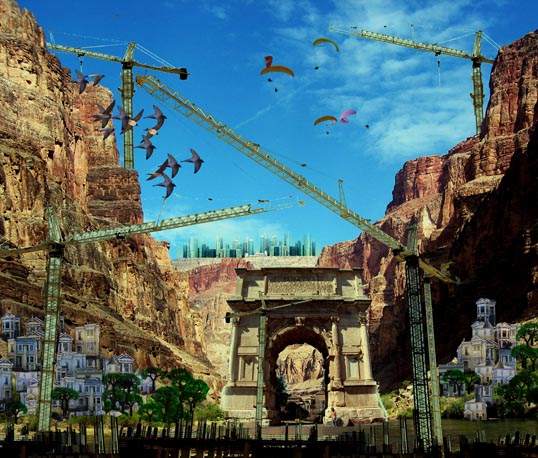
Invisible Cities

Cities & Desire 5

From there, after six days and seven nights, you arrive at Zobeide, the white city, well exposed to the moon, with streets wound about themselves as in a skein. They tell this tale of its foundation: men of various nations had an identical dream. They saw a woman running at night through an unknown city; she was seen from behind, with long hair, and she was naked. They dreamed of pursuing her. As they twisted and turned, each of them lost her. After the dream, they set out in search of that city; they never found it, but they found one another; they decided to build a city like the one in the dream. In laying out the streets, each followed the course of his pursuit; at the spot where they had lost the fugitive’s trail, they arranged spaces and walls differently from the dream, so she would be unable to escape again.

This was the city of Zobeide, where they settled, waiting for that scene to be repeated one night. None of them, asleep or awake, ever saw the woman again. The city’s streets were streets where they went to work every day, with no link any more to the dreamed chase. Which, for that matter, had long been forgotten.

New men arrived from other lands, having had a dream like theirs, and in the city of Zobeide, they recognized something from the streets of the dream, and they changed the positions of arcades and stairways to resemble more closely the path of the pursued woman and so, at the spot where she had vanished, there would remain no avenue of escape.

The first to arrive could not understand what drew these people to Zobeide, this ugly city, this trap.

—-Invisible Cities, Italo Calvino

Invisible City - Gateway to Arcturus

Invisible City – Gateway to Arcturus

Thin Cities 5

If you choose to believe me, good. Now I will tell how Octavia, the spider-web city, is made. There is a precipice between two steep mountains: the city is over the void, bound to the two crests with ropes and chains and catwalks. You walk on the little wooden ties, careful not to set your foot in the open spaces, or you cling to the hempen strands. Below there is nothing for hundreds and hundreds of feet: a few clouds glide past; farther down you can glimpse the chasm’s bed.

This is the foundation of the city: a net which serves as passage and as support. All the rest, instead of rising up, is hung below: rope ladders, hammocks, houses made like sacks, clothes hangers, terraces like gondolas, skins of water, gas jets, spits, baskets on strings, dumb-waiters, showers, trapezes and rings for children’s games, cable cars, chandeliers, pots with trailing plants.

Suspended over the abyss, the life of Octavia’s inhabitants is less uncertain than in other cities. They know the net will last only so long.

—-Invisible Cities, Italo Calvino

For a month, starting on June 1, I read a short story every day and wrote a journal entry about them. For me at least, (I don’t know about how it was for you) it was a fun, interesting, and educational experience and exercise. One thing I learned is how wide the world of short fiction is – how varied and variable, diverse and divisive the styles, techniques, and artistry.

So I vowed to continue reading widely… and that brought me to a book by Italo Calvino – Invisible Cities (PDF). Technically, it’s a novel – a short novel. However, it is made up of a long series of very short sketches, each one describing a different, fantastic city – fifty-five in total. These are framed by an outer story, where Marco Polo is talking to Kublai Khan and telling the tales, thereby describing the cities he has visited.

Kublai Khan does not necessarily believe everything Marco Polo says when he describes the cities visited on his expeditions, but the emperor of the Tartars does continue listening to the young Venetian with greater attention and curiosity than he shows any other messenger or explorer of his. In the lives of emperors there is a moment which follows pride in the boundless extension of the territories we have conquered, and the melancholy and relief of knowing we shall soon give up any thought of knowing and understanding them.
—-Invisible Cities, Italo Calvino

The descriptions can be read individually, in relation to each other, and to the deep philosophical questions raised by the framing story.

It is short and easy to read, yet complex – with hidden aspects and dimensions that have to be teased out. It is so full of unique and interesting ideas that it slowed my reading down… I’d devour a half page and then have to rest to let the concepts and thoughts born by the text stop vibrating and resonating inside my head, let it all calm down, before I could read some more.

The book shows a lot of influence of Jorge Luis Borges… and is one book that is referred to as Borgesian. It is full of self-referential conundrums, mysterious contradictions, and postmodern enigmas.

I have to be careful about what I am reading when I write, because my reading is such an influence on what I write. I put up an entry containing something I wrote, Free Breakfast, while reading Invisible Cities a few days ago.

I would love to write like Italo Calvino… though nobody would read it. His fiction is a lot of fun, but it isn’t, for example, something that will ever be as popular as, say Harry Potter.

Now that I think about it… wouldn’t that be cool? A postmodern, Borgesian Harry Potter.

It could explore the duality of Harry Potter’s life. He lives in a cupboard, ignored, miserable, and hopeless for part of the year, then spends the rest in a world of Magic… where he is the chosen one. Which life is the real one… which is the real Harry Potter? Could the dire tragic life of poor Orphan Harry be so demoralizing that it drives him crazy? – Is the whole magical world of Hogwarts born from Harry’s desperation – an imaginary world where he gains unthinkable power and importance – where he becomes the chosen warrior in a war against the ultimate evil?

And what about Voldemort? He shatters his soul into a handful of pieces and stores each one in a Horcrux. He achieves immortality, at the price of a broken soul. Do these items then become Voldemort? How can a soul exist without consciousness? The potential for paradox and existential exploration are endless.

Even something as simple as the paintings…. Dead people make an appearance in the moving, talking paintings of Hogwarts. Is this a form of limited immortality? Do the paintings know they are dead? Are they sad? Are there moving and talking paintings with subjects that were never alive? Why not? If so… what are their memories? Do the dead paintings sleep? Do they dream of the living?

That would be a book worth reading… if someone had the skill to pull it off.

Hidden Cities 1

In Olinda, if you go out with a magnifying glass and hunt carefully, you may find somewhere a point no bigger than the head of a pin which, if you look at it slightly enlarged, reveals within itself the roofs, the antennas, the skylights, the gardens, the pools, the streamers across the streets, the kiosks in the squares, the horse-racing track. That point does not remain there: a year later you will find it the size of half a lemon, then as large as a mushroom, then a soup plate. And then it becomes a full-size city, enclosed within the earlier city: a new city that forces its way ahead in the earlier city and presses its way toward the outside.

Olinda is certainly not the only city that grows in concentric circles, like tree trunks which each year add one more ring. But in other cities there remains, in the center, the old narrow girlde of the walls from which the withered spires rise, the towers, the tiled roofs, the domes, while the new quarters sprawl around them like a loosened belt. Not Olinda: the old walls expand bearing the old quarters with them, enlarged but maintaining their proportions an a broader horizon at the edges of the city; they surround the slightly newer quarters, which also grew up on the margins and became thinner to make room for still more recent ones pressing from inside; and so, on and on, to the heart of the city, a totally new Olinda which, in its reduced dimensions retains the features and the flow of lymph of the first Olinda and of all the Olindas that have blossomed one from the other; and within this innermost circle there are always blossoming–though it is hard to discern them–the next Olinda and those that will grow after it.

—-Invisible Cities, Italo Calvino

Short Story Day Thirty-One – Carnation, Lily, Lily, Rose

31. Carnation, Lily, Lily, Rose
Kelly Link
http://www.fenceportal.org/?page_id=2327

This is day Thirty-One of my Month of Short Stories – the last day – a story a day for June (and one day in July).

Carnation, Lily, Lily, Rose - by John Singer Sargent

Carnation, Lily, Lily, Rose – by John Singer Sargent

Today, for the last post of my Month of Short Stories – I present to you a story I have definitely read before. It’s been a long time, though, and I wanted you to know about this story, this book, and the writer.

I remember clearly, back then… 2002? probably… I was looking for something to read. I came across an article in Salon that listed their favorite books of the year. There, nestled in with such literary giants of our time like The Corrections, Bel Canto, and Austerlitz, was an odd looking little book of stories called Stranger Things Happen by Kelly Link. The magazine raved about it.

Surfing around the web I found plenty of other folks giving it a lot of love. So I bought the thing.

And it was amazing. The stories are best described as adult fairly tales – fantastic and imaginative – passionate and very, very odd. It lived up to expectations.

So please go out and get this book. If you are cheap, it’s available for free download – as are her other works. If you download it and like it as much as I did, you will buy a copy (I think I’ve bought three over the years). She’s coming out with a hardback special limited edition later this year – but it’s a little over my price range right now.

Today’s story, Carnation, Lily, Lily, Rose is a strange piece of fantastic fiction. A recently deceased man, stuck is some sort of odd limbo, is writing letters to his still-living wife. Unfortunately, he can’t remember her name, though he does remember a girl, Looly Bellows, that beat him up in fourth grade.

As time goes on, the scene gets stranger and stranger as his mind continues to drift further away from the mortal plane. I’m not sure if it is an accurate depiction of what happens when we die, and I don’t know if I want it to be, but it’s the sort of thing that should happen if the universe has as much of a sense of perverse humor and strange surprises in the next life as it does in this one.

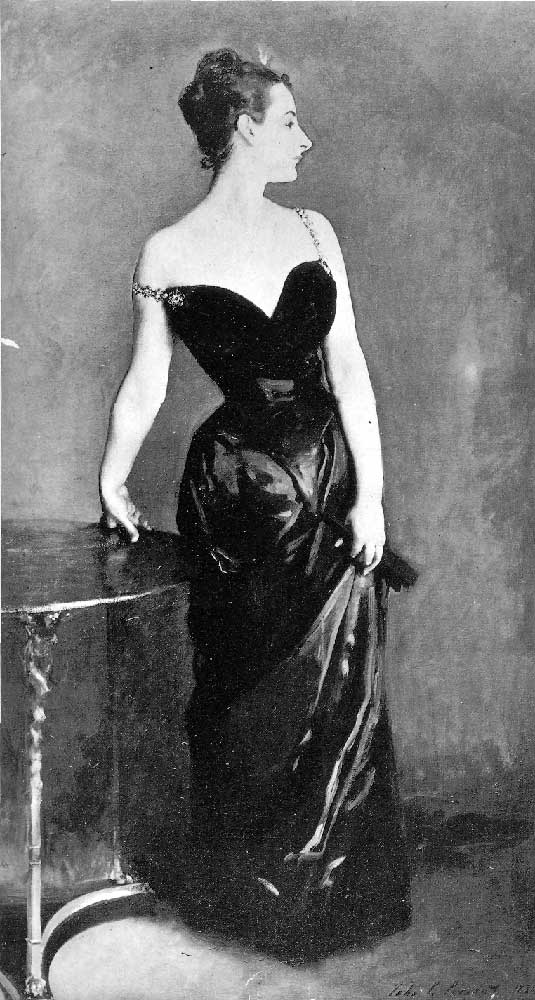
Now, like all obsessions – this story led me down a long rabbit-hole. The title, Carnation, Lily, Lily, Rose is taken from a painting by John Singer Sargent. I had to do a little research on him, and came across the famous story of Madame X.

In Paris he did a portrait of Madame Pierre Gautreau, an young American woman from New Orleans. She was a rising star in Parisian High Society and her portrait caused a huge stir when it was unveiled. A huge stir of the wrong kind.

Sargent had painted her with one strap of her gown hanging down off her shoulder. This, along with her plunging neckline and powder-white skin gave the painting a sensual excitement that wasn’t acceptable at the time.

A photograph of the original painting of Madame X.

A photograph of the original painting of Madame X.

The repainted Madame X - her gown strap is back up on her shoulder.

The repainted Madame X – her gown strap is back up on her shoulder.

He re-did the painting with the strap in a more demure position – but the damage was done. Ms. Gautreau had to slink back to Louisiana to escape the social ridicule. Sargent had to flee to England to regain his reputation.

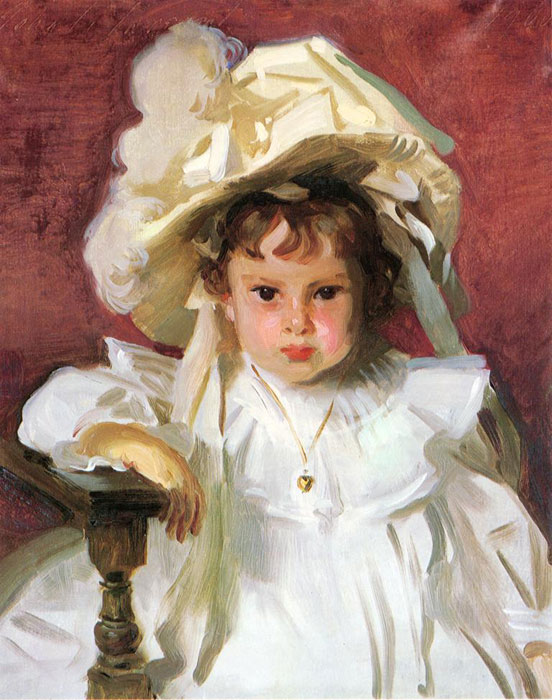
None of this has anything to do with the story – but it’s cool anyway. I’ve become a fan of Sargent because of this story, even though I’ve never been big on portraiture. I always stop and look at Dorothy whenever I visit the Dallas Museum of Art.

Dorothy, by John Singer Sargent, in the Dallas Museum of Art.

Dorothy, by John Singer Sargent, in the Dallas Museum of Art.

So, my advice is to read all of Stranger Things Happen – the other stories are just as odd, but in surprisingly different ways. Then go to the nearest good art museum and take a look at a Sargent – see what you can see in the eyes. It might be useful, help you remember things when you are stuck in limbo. We all will be there, sooner than we think.

I hope you enjoyed some of my month of short stories – it was fun and educational putting it together (though a surprising amount of work). Don’t know what I’ll do tomorrow… maybe a photograph.

Later.

I’ve been here for 3 days, and I’m trying to pretend that it’s just a vacation, like when we went to that island in that country. Santorini? Great Britain? The one with all the cliffs. The one with the hotel with the bunkbeds, and little squares of pink toilet paper, like handkerchiefs. It had seashells in the window too, didn’t it, that were transparent like bottle glass? They smelled like bleach? It was a very nice island. No trees. You said that when you died, you hoped heaven would be an island like that. And now I’m dead, and here I am.
—-Carnation, Lily, Lily, Rose, by Kelly Link

Short Story Day Thirty – Passion

30. Passion
Alice Munro
http://www.newyorker.com/archive/2004/03/22/040322fi_fiction

As we are in the ninth inning, the home stretch, of my month of short stories we come across Alice Munro. She is the master – the best of the best.

I have been voraciously reading Alice Munro for decades now… and she should be in my list of writers that I have read everything – but she writes so much (all short stories) that there is always more. Most of what she writes shows up first in the New Yorker – she is the quintessential New Yorker fictioner.

What she does is magical. Read her stories and pay attention to how she plays with time. There is usually several different time planes going on – complex, yet made clear by careful attention to detail. The story is often told by illuminating subtle changes in a character between fictional scenes that take place on different sides of a shift in the story. Often times this shift is never actually shown or described… merely inferred from what has scarred or uplifted (or both) the characters before and after. There are subtle connections across time and place – you have to look closely to figure them out – but they resonate deep in your mind as you read.

Today’s story, Passion, is pure Munro. A woman is looking back over a critical period of her life – how critical it was and in what way isn’t clear until the final sentence.

I didn’t do this on purpose – but it is very interesting to compare this story to yesterday’s – The Garden Party. Both are tales of class differences. But Passion – the Munro story – is the opposite… a mirror image, of Mansfield’s The Garden Party.

In this one, the protagonist is a poor girl that stumbles into contact with the wealthy. However, as occurs in yesterday’s tale – once in the other’s camp she is exposed to death, and is changed in complex and subtle ways. Both women (both about the same age) are smart, resourceful, and perceptive beyond their years and expectations and are relied upon to help keep things going smoothly. However, both learn that the world is a harder, more complicated, and dangerous place – with darkness, passion, and beauty all wrapped up and twined, twisted, and knotted together.

The wealthy Traverse family in today’s story is not as isolated or as heartless as the Sheridans in yesterday’s – but they are every bit as flawed and are quietly doomed.

Munro spells out this doom without embellishment or symbolism – she simply tells the story – with great skill. It’s perfect. It’s why she is the best.

She had thought that it was touch. Mouths, tongues, skin, bodies, banging bone on bone. Inflammation. Passion. But that wasn’t what she’d been working toward at all. She had seen deeper, deeper into him than she could ever have managed if they’d gone that way.

What she saw was final. As if she were at the edge of a flat dark body of water that stretched on and on. Cold, level water. Looking out at such dark, cold, level water, and knowing that it was all there was.

It wasn’t the drinking that was responsible. Drinking, needing to drink—that was just some sort of distraction, like everything else, from the thing that was waiting, no matter what, all the time.
—-Passion, by Alice Munro