
Finding a hotel in another city on the Internet is a funny thing… it’s not so much like looking for something blind as it is trying to make a decision, a choice, based on secondhand information where everyone is lying to you.
When Candy was researching a place to stay in New Orleans for our trip last week she kept coming across a place called St. Vincent’s Guest House. We’ve stayed a handful of places in the past, most notably the Prytania Park, and the Mandevilla B&B (both highly recommended BTW) but the St. Vincent was a lot (a lot!) cheaper.
I didn’t get too involved in the planning, and while we were flying to New Orleans I was really curious about what this place would be like. It was in a great location – right on Magazine Street in the Lower Garden District – close to downtown (and the quarter) and the St. Charles Streetcar.
But it was only going to cost us fifty dollars a night. What kind of Big-City hotel charges fifty dollars a night? In my mind I pictured an old run-down Motel 6, kicked out of the chain for excessive filthiness, occupied mostly by prostitutes, and a constant drug trade going on in the parking lot. Still, it’s only fifty bucks a night, we need to spend as little as possible, and all I need is a place to sleep – so I could deal with anything.
When we drove up and checked in, I quickly realized the truth could not be farther from this image. St. Vincent’s is a massive ancient brick edifice of classic New Orleans design with impossibly high ceilings, balconies with intricate cast iron railings, and one hell of a history to boot.

The imposing facade of the St. Vincent’s Guest House, facing Magazine Street in New Orleans. I had to move around a bunch of film crews and trucks to get this – they were shooting scenes for Treme. The St. Vincent must be a popular location – they did scenes for Red (the Bruce Willis film) there – now I’ll have to watch the damn thing.

The side of the St. Vincent Complex, from Race Street. We stayed on the second floor of the wing in the background, that’s the carriage house in the foreground.
From a faded clipping in the lobby:
History
St. Vincent’s was built in 1861 as an orphanage. It was founded by the Daughters of Charity order of nuns, however much of the funding was provided by Margaret Haughery. Margaret was an illiterate, Irish immigrant to New Orleans – she was a orphan herself and lost her husband and baby to yellow fever here in New Orleans. This was not unusual. Every summer up to 30.000 people here would die of mosquito born diseases such as yellow fever and malaria. Margaret’s tragic losses led her to dedicate her life to alleviating the suffering of children. She made a great fortune from her baking business and dedicated her wealth and compassion to philanthropic works. St. Vincent’s was among the greatest of these works. When Margaret died in 1882, the entire city closed down to mourn her loss and thousands followed her funeral parade, a fitting tribute to a truly great person. You will notice the clock on the roof of the carriage house at St. Vincent’s (across the courtyard) – this was willed to St. Vincent’s by Margaret as a final gift.
There is a lovely statue of Margaret between Prytania and Camp Streets, just near the 90 overpass. You may also like to visit St. Elizabeth’s orphanage, now owned by the Vampire novelist, Ann Rice. After the children turned seven, the girls were taken from ST. Vincent’s to St. Elizabeths. St. Elizabeths is in the Garden District on Napoleon Ave.
Still run by the Daughters of Charity in the 20th century St. Vincent’s became a refuge for unwed mothers. In 1901 it was discovered that mosquitoes were the cause of the summer epidemics and the city paved the streets and generally tried to eradicate the puddles of water in which mosquitoes breed. Without the annual epidemics New Orleans was in the happy situation of no longer having enough orphans for St. Vincent’s. St Vincent’s served as a refuge for unwed mothers and their children until the social revolution in the 60’s rendered such a refuge unnecessary. It remained empty for a couple of decades until brought back to life in 1994 as the Guest House you see today.

The clock on top of the carriage house, complete with cool sculpture hanging off the side.

Here’s a closeup of the sculpture on the clock on the carriage house. It’s called “New Orleans Gargoyle” by Thomas Randolph Morrison. Pretty cool, huh. You’re not going to see stuff like this hanging off the Hilton.
Now, the place was far from luxurious. It is primarily a hostel – with a constant flow of young hitchhikers and lost souls (some working at the house in one form or another for discount or free rent) and a wing of dormitories. They do have a spate of regular rooms and ours, being the cheapest, was pretty run down. The usual amenities were non-existent. The sheets had holes, the hot water sporadic, the walls were painted a bilious purple, the towels mismatched, the door key and lock of dubious quality and security, the television ancient and lacking a remote and the curtains didn’t come close to covering the entire windows. The drawers in the dresser didn’t fit, the ventilation rumbled, black sheetrock screws half-screwed into the molding provided clothes and key holders. The pool was covered in black plastic, the furniture mismatched, and empty whiskey bottles littered the common areas.
The only thing that bothered me, really, was a decidedly musty smell in the room, and it went away with a couple days of activity. To be fair, St. Vincent’s was obviously still being repaired from the damage inflicted by the last hurricane and a lot of water had gone through those old walls. We realized that, really, the whole city had that musty smell.
So it wasn’t the Hilton, it wasn’t even the La Quinta… but, my God, what history. New Orleans is a city accommodating and welcoming to spirits and everyone spoke about the ghosts of the orphans and their parents – yellow fever victims – still floating around the place. The hallways were lined with fine polished bronze sculptures. It seems a New Orleans sculptor – Thomas Randolph Morrison – displays all his bronze work in St. Vincent’s. Art – paintings or interesting old photographs – covered the walls.

The sculpture-lined hallway at St. Vincent’s.

A sculpture facing a mirror.

A view out a hallway on the third floor. Like a lot of old buildings built in tropical climates it has very high ceilings (I estimate 20 feet high), balconies, and an open plan for ventilation.
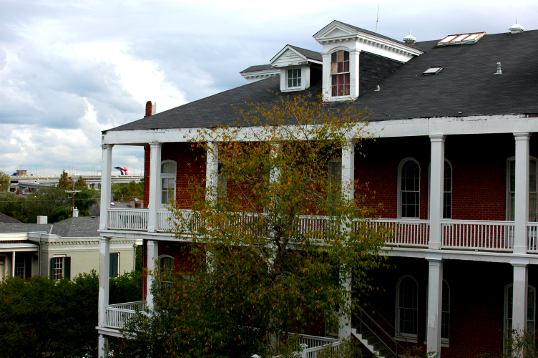
Our wing at St. Vincent’s. If you look closely on the horizon you can see the winged stack of a Carnival Cruise Ship on the Mississippi river.
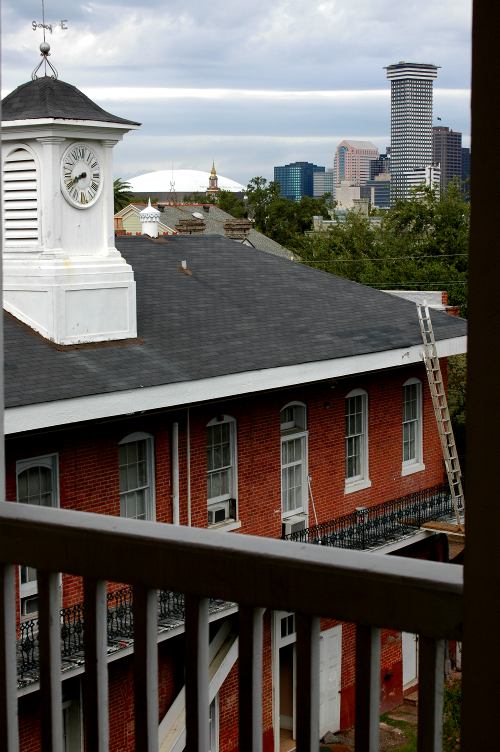
The carriage house at St. Vincent, with downtown New Orleans and the Superdome in the background.
Now, I certainly can’t recommend the place – it sure has its share of bad Internet reviews – but if you have a little imagination, a sliver of adventurous spirit and, most of all, an open mind, it’s a pretty damn cool place.
Plus, it’s in a great location and it’s only fifty dollars a night.

An old photo on the wall at St. Vincent’s Guest House, showing the original tenants, the young orphans that lost their parents to yellow fever, posed on the stairs.

The same spot, on the same stairs, today.

A tomb from Lafayette Cemetery #1
Everywhere in New Orleans you run into the ghosts of the yellow fever. This is a tomb from the Lafayette Cemetery #1 (not far from St. Vincent’s). I had to mess with the image, the top part was in deep shade. It reads:
Died of Yellow Fever
Sercy,
Born Aug. 29th 1878,
Died Aug. 30th 1878.
Mary Love,
Born Oct. 7th 1876,
Died Aug 30th 1878.
Edwin Given,
Born Dec. 3rd 1873,
Died Aug. 31st 1878.
Such is the Kingdom of Heaven.
In two days that family lost three children, age newborn, three, and five years old.







 Bill Chance