Jitterbugs in the French Quarter

New Orleans is Culture. New Orleans is Architecture. New Orleans is Food. But more than anything, New Orleans is Music… Live Music.

Jazz is the one true American art form. Jazz was born in New Orleans.

At any time of any day or night you can hear live music in New Orleans. You can see dancing.

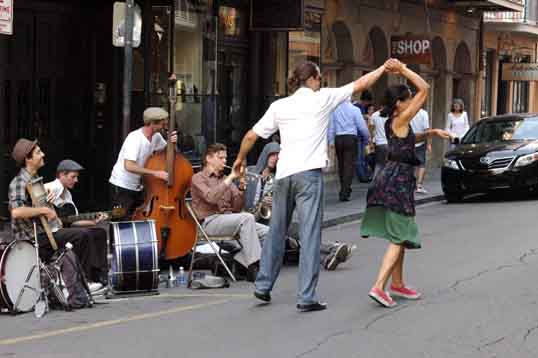
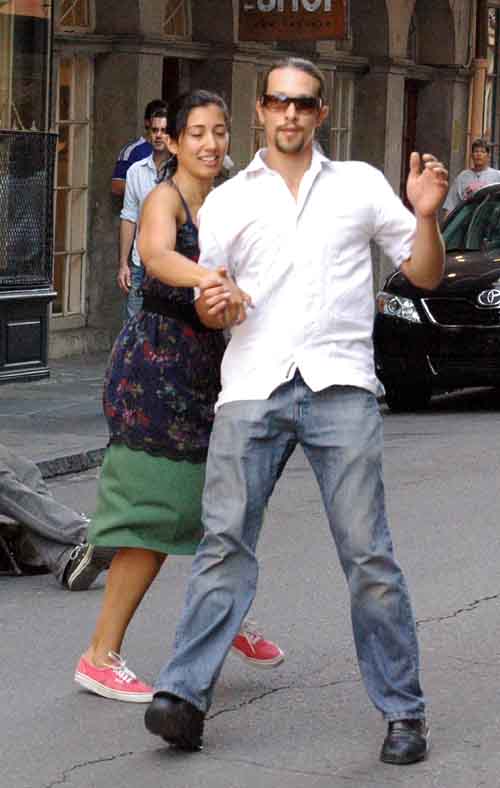
Even Jitterbugs in the French Quarter.

Nola Jitterbugs

Dancers – Chance Bushman and Giselle Anguizola

Music – Loose Marbles

New Orleans Architecture – The Garden District

The Garden District in New Orleans is one place where time has ceased to exist. The ancient, worn mansions, massive greenery, and unique architecture keeps sitting there in the humid gulf air, sticking a middle finger at floods, storms, and modernity itself. The best place for a peaceful afternoon walk. It’s no wonder so many rich and famous end up there.

The Garden District is famous for its collection of giant stately mansions. But I like some of the little details the best. Look at this beautiful little curved porch off a bedroom overlooking Magazine Street. I would like to have a morning coffee on a balcony like this at every dawn for the rest of my life.

Look at the iron railings and the colors on this building. I love the lime green on the underside of the porch overhangs. All through New Orleans you see the little round punched tin lights like you see here – they are beautiful at night.

Another cool overhang. this one is painted sky blue and you can clearly see the round lights.

The trees and the porches – they seem to be growing together.

I never get tired of looking at the intricate and beautiful details on the wooden overhang bracing.

New Orleans Architecture – Fauberg Marigny and Frenchmen Street

The French Quarter has become too touristified for my taste. Filled with grimy bars, expensive antique shops, tacky trinket emporiums, and overpriced food the Vieux Carré isn’t always what it promises to be. Immediately downriver, however, is another neighborhood that is.

New Orleans is a city of neighborhoods and one of the best is the Fauberg Marigny. At the start of the 19th century, Bernard Xavier Philippe de Marigny de Mandeville (also famous for “inventing” the dice game craps) divided his plantation into residential lots, and the Fauberg Marigny was born. In the middle part of the twentieth, the neighborhood fell into decline, with the area around Jackson Square being called “Little Angola” – after the prison due to the extreme crime. In the eighties, however, commercialization in the French Quarter drove a lot of the residents downriver into Fauberg Marigny. The Marigny became what the Quarter used to be with Frenchmen street becoming ground zero for New Orlean’s essential live music scene.

The neighborhood is a good twelve inches above sea level and escaped the worst of Katrina’s ravages. There is a wide variety of classic New Orlean’s style architecture there – early Creole cottages and townhouses, American cottages, American townhouses, shotgun houses , 19th century corner store-houses, and various modern additions.

If I could live anywhere… I think I would live in Fauberg Marigny.

The Balcony Music Club isn't actually on Frenchmen Street. It's twenty feet down Decatur Street - but it's one of my favorites.

Standing outside the Balcony Music Club last Mardi Gras (I had stepped out for a second simply to catch my breath) a large group of German Tourists came down the crowded sidewalk. The man in the lead asked me in a thick accent, where to find, “Some real jazz music.” I lead them around the corner and pointed them up Frenchmen Street, telling them to stop by each club and pick the music they liked the best. He thanked me and said in very excited broken English, “Goot… Now Ve will get to see the Real New Orleans!”

Entrance to a jazz club on Frenchmen Street.

The Spotted Cat Jazz club on Frenchmen.

A row of shotgun houses in the Faubourg Marigny.

A mermaid stained glass window.

New Orleans Architecture, French Quarter

I love the wrought iron railings throughout the French Quarter. They are beautiful even when they are not crowded with Mardi Gras crowds showering topless women with cheap plastic beads. Most of the balconies are decorated – many with tacky sports stuff – but some are particularly attractive with loads of live plants.

Something you see in tropical climates is the idea of a shaded green interior plaza or atrium with a water feature. The water and plants add a coolness, making the mid day heat almost bearable and the rest of the day delightful. These are wonderful and usually hidden living spots.

A bare balcony showing off the beauty of the elaborate wrought iron.

New Orleans is the most original of all American Cities. The French Quarter has become a tourist Mecca, but in the mornings it still feels like the natural heart of the city.

My Favorite Bit of Street

And you may find yourself living in a shotgun shack
And you may find yourself in another part of the world
And you may find yourself behind the wheel of a large automobile
And you may find yourself in a beautiful house, with a beautiful
wife
And you may ask yourself-Well…How did I get here?
—-David Byrne

It’s not a street, just a strip of a few houses. They aren’t even big houses, they are classic New Orleans Shotgun Houses – these have a second floor in the back, called Camelback Houses. It’s at Sixth and Camp in the Garden District.

(click to enlarge) Sixth and Camp in New Orleans - a beautiful row of Camelback Shotgun Houses

I love the colors. I love the front porches, so close to the street. I love the floorplan. I really love the brackets supporting the roof apron over the front porch.

I first saw this street at night when Candy and I walked through the area from the Saint Charles Streetcar on the way to eat on Magazine Street. Under the streetlights the houses looked like they were made of icing – so bright and delicate. I came back during the day to see if they looked as nice under the sunlight.

They did.

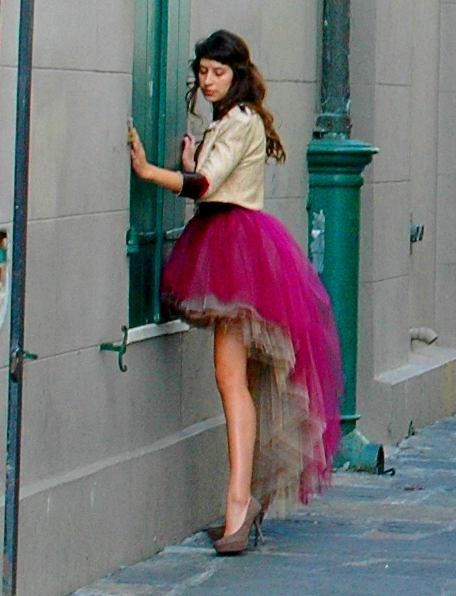
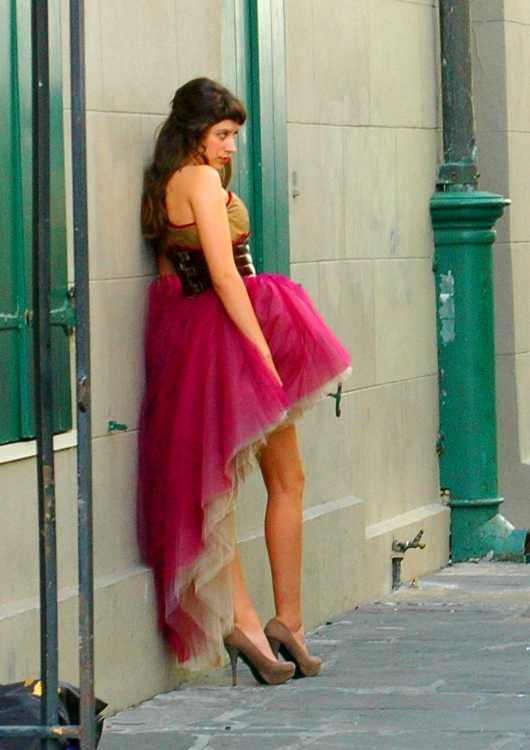
Pirate Alley Fashion Shoot

In the French Quarter, in New Orleans, there is a little alley, only one block long, between the Saint Louis Cathedral and the Old Spanish Governors Mansion, the Cabildo. It runs from Chartres Street at Jackson Square to Royal Street. The alley is intersected by Cabildo Alley and it continues past the Spanish Dungeon and then The Faulkner House, where he wrote his first novel.

It’s called Pirate Alley, or Pirate’s alley – nobody really knows how it came on that name, despite many legends.

Even though now I realize it is a famous spot – I first stumbled on it by accident trying to fight my way through the French Quarter Mardi Gras crowds. It is always a quiet little lane surprisingly isolated from the hub and the bub of the tourist crowds bursting in Jackson Square or the never ending party jostling the other French Quarter Streets. Whenever I’m in the quarter, I try to walk the Pirate Alley.

The other day I was walking and riding the streetcars around the city taking some photographs. I was walking from Canal through the quarter to Frenchman Street and cut through the alley to Jackson Square. I found a photographer and his assistant setting up lights while a few feet down a model was arranging a pile of clothes. They were doing a fashion shoot.

I didn’t stop – I had miles to go before I sleep – but a while later, I looped back through Jackson Square and took a look to see if the fashion shoot was still on.

It was.

(click to enlarge)

Without the portable lights they had, Pirate Alley was a tough place for me to shoot the people doing the shoot. Though a beautiful spot it has bad, uneven light.

I popped my head in and snapped a couple shots. I didn’t take the time it takes to make a good shot – I was more than a little self-conscious – they kept looking at me – I guess my big camera makes me look like a professional photographer (lack of skill isn’t obvious from the outside). I don’t know what the rules of courtesy are when shooting someone shooting someone. Of course, there isn’t any more pubic spot than Pirate Alley – so if you choose that as your location, you get what you get.

Mercedes Benz Superdome

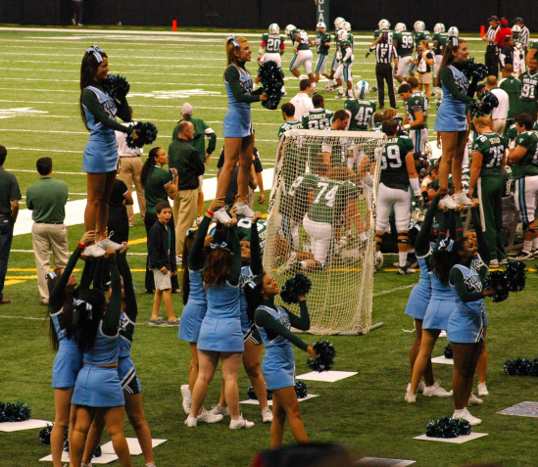
Tulane was playing Memphis in its homecoming game at the newly-named Mercedes Benz Superdome (complete with the world’s largest hood ornament hanging from the roof) in downtown New Orleans. The university provided a shuttle bus but we decided to drive downtown, find a parking spot and then walk over to the pre-game tailgate party. I used my phone to carefully plot a route from campus to the most promising lots but New Orleans traffic is unforgiving and a mistake in lane placement forced me onto a ramp that wound around until it set us on Interstate 10 going towards Baton Rouge. Before I could get to an exit we were farther away than when we started and in a completely unknown neighborhood.

I have no idea where we went but we eventually ended up downtown winding around one-way streets with no turns allowed, still confused and lost. Finally, we spotted a lot and after a couple near-misses managed to park.

I would have bet we were a mile from the stadium, but it was only a couple of blocks.

Candy, Lee, and Drew walking to the Superdome for Tulane's homecoming game.

Lee at the game.

The Superdome is an amazing building – it is so unlike anything else it appears surreal when you first set eyes on it. There is no reference point so you can’t really understand its massive size… or even figure out how far away it is. It is such a familiar sight you instantly recognize the shape and color, but somehow it always looks like it is something on television and could not really exist in the real world.

They have spruced up the exterior and redone the inside and it is very nice. It almost looks modern. One thing that I did notice, however, is that a lot of the interior ceiling panels that were blown off when Katrina struck are still missing. I don’t know it they were too hard to fix, too expensive, or if they were left as a sort of memorial harmless hard-to-see damage.

You can’t sit inside the Superdome without thinking about Katrina. You look at the football field and imagine it crowded with terrified refugees. You look up and imagine the wind whipping and tearing holes in the roof; imagine not knowing if it is going to hold or not.

A fun innocent college homecoming football game is haunted by the ghosts of Katrina. It will probably always be that way.

Completed pass

Don't drop the cheerleader.

Eventually, the game was out of hand.

The sun was setting when we left the game. The skin of the building glows gorgeous in the crepuscular light.

Ignatius J. Reilly

 When a true genius appears, you can know him by this sign: that all the dunces are in a confederacy against him.

—-Jonathan Swift

Ignatius J. Reilly

Ignatius J. Reilly

“My life is a rather grim one. One day I shall perhaps describe it to you in great detail.”

—- John Kennedy Toole, A Confederacy of Dunces

When Lee first decided to go to Tulane I became reinterested in everything New Orleans. I had always been interested… how can you not be? I had visited and worked there and in the surrounding swamps, and always thought of it as an amazingly unique city – the culture, location and architecture making it a special place – a city that will find a place in your heart if you have to courage to let it.

I have felt that way for decades, and still feel that way, stronger than ever – nothing has ever happened to change my mind.

So I started to read anything New Orleans that I could lay my hands on. There is a lot, by the way. One book I picked up right away – one that is often referred to as the quintessential New Orleans novel, is A Confederacy of Dunces, by John Kennedy Toole.

The book has a sad and amazing publishing history. The author, a graduate of Tulane, wrote A Confederacy of Dunces after a stint in the army but could never convince a publisher of its merit. Partly due to his failure as a novelist he fought depression and paranoia and killed himself at the age of 31.

He would have been long forgotten except that his mother found a smeared carbon of the manuscript and started fighting to get publishers to look at it. She kept pestering author Walker Percy (who wrote The Moviegoer, another classic novel of New Orleans – I read it right before A Confederacy of Dunces) – then an instructor at Loyola University – until he read it, mostly to get her to leave him alone. He wrote:

“…the lady was persistent, and it somehow came to pass that she stood in my office handing me the hefty manuscript. There was no getting out of it; only one hope remained—that I could read a few pages and that they would be bad enough for me, in good conscience, to read no farther. Usually I can do just that. Indeed the first paragraph often suffices. My only fear was that this one might not be bad enough, or might be just good enough, so that I would have to keep reading.

In this case I read on. And on. First with the sinking feeling that it was not bad enough to quit, then with a prickle of interest, then a growing excitement, and finally an incredulity: surely it was not possible that it was so good.”

The novel was published by LSU press eleven years after the author’s suicide and won the Pulitzer Prize in 1981.

The book is a touching picaresque comedy – memorable for its outrageous and colorful characters. Of course, the city of New Orleans is a main character – possibly the most outrageous and colorful. The protagonist is Ignatius J. Reilly, a large lumpin monstrosity that is convinced, probably accurately, that he does not belong in the twentieth century. He stumbles through his beloved city (he has only left New Orleans once – on an abortive bus trip to Baton Rouge, which he remembers with horror) like a bull through a china shop, leaving a wake of confusion and consternation – somehow coming out alive and intact – though barely.

Ignatius J. Reilly is not easy to like. He is pompous, self-important, lazy, slovenly… pretty much an all-around loser. You can’t help but love him, though. He is all of us, really. We simply don’t have the courage to admit it.

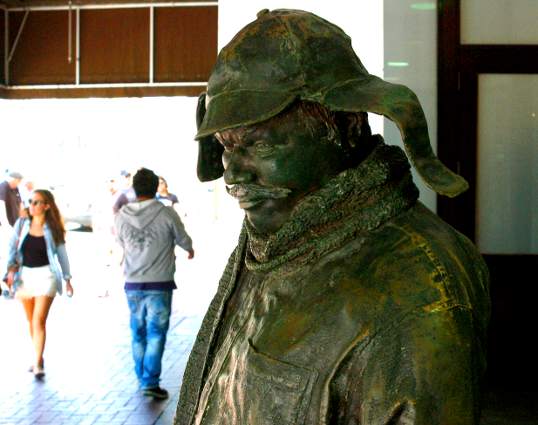
At any rate, I read that there was a statue of Ignatius J. Reilly on Canal Street in New Orleans. In the opening scene of the novel he is standing on Canal underneath the clock outside the D.H. Holmes department store holding a sack and waiting for his mother. The store is long gone, but the building is occupied by the New Orleans Chateau Bourbon Hotel. They found and replaced the clock and put up a life-sized bronze statue under it.

I had to find the statue. It wasn’t hard. The Saint Charles streetcar let me off across Canal and there he was, stupid floppy hat and all. Thousands of people walk by every day on their way to work or around the corner to the attractions of Bourbon Street… not many notice him.

So I salute you Ignatius J. Reilly, forever wearing a bad hat, and worse fashion, standing there with your shopping bag, waiting for your mother to come out of an extinct department store. She will never show, but still, you look like you know things the rest of us will never dream about.

Under the Clock

Under the Clock

“I am at this moment writing a lengthy indictment against our century. When my brain begins to reel from my literary labors, I make an occasional cheese dip.”

—- John Kennedy Toole, A Confederacy of Dunces

Cameras, Cameras, and More Cameras

A couple more photographs I took at the Nasher at the Tony Cragg exhibition.

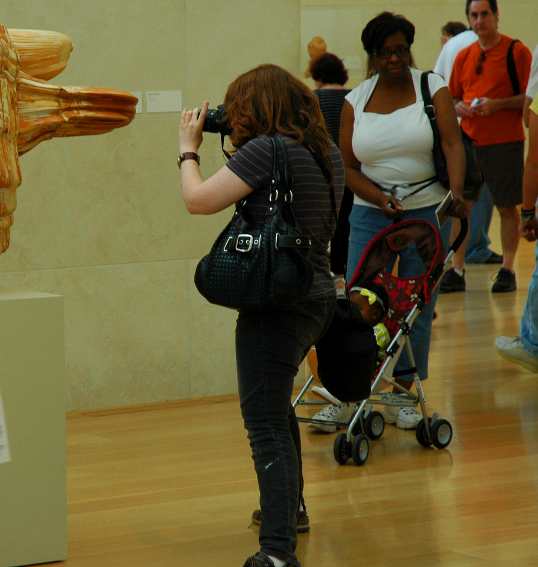
If you wonder what she is taking a picture of… it is this:

I’m Walking Here

More photographs from the Nasher.

Children and Calder (Trois Bollards)

A pair of Giacometti, in front of a window.


———————————————————————————————————

Another new Video from Lana Del Rey