Short Story Day Thirty-One – Carnation, Lily, Lily, Rose

31. Carnation, Lily, Lily, Rose
Kelly Link
http://www.fenceportal.org/?page_id=2327

This is day Thirty-One of my Month of Short Stories – the last day – a story a day for June (and one day in July).

Carnation, Lily, Lily, Rose - by John Singer Sargent

Carnation, Lily, Lily, Rose – by John Singer Sargent

Today, for the last post of my Month of Short Stories – I present to you a story I have definitely read before. It’s been a long time, though, and I wanted you to know about this story, this book, and the writer.

I remember clearly, back then… 2002? probably… I was looking for something to read. I came across an article in Salon that listed their favorite books of the year. There, nestled in with such literary giants of our time like The Corrections, Bel Canto, and Austerlitz, was an odd looking little book of stories called Stranger Things Happen by Kelly Link. The magazine raved about it.

Surfing around the web I found plenty of other folks giving it a lot of love. So I bought the thing.

And it was amazing. The stories are best described as adult fairly tales – fantastic and imaginative – passionate and very, very odd. It lived up to expectations.

So please go out and get this book. If you are cheap, it’s available for free download – as are her other works. If you download it and like it as much as I did, you will buy a copy (I think I’ve bought three over the years). She’s coming out with a hardback special limited edition later this year – but it’s a little over my price range right now.

Today’s story, Carnation, Lily, Lily, Rose is a strange piece of fantastic fiction. A recently deceased man, stuck is some sort of odd limbo, is writing letters to his still-living wife. Unfortunately, he can’t remember her name, though he does remember a girl, Looly Bellows, that beat him up in fourth grade.

As time goes on, the scene gets stranger and stranger as his mind continues to drift further away from the mortal plane. I’m not sure if it is an accurate depiction of what happens when we die, and I don’t know if I want it to be, but it’s the sort of thing that should happen if the universe has as much of a sense of perverse humor and strange surprises in the next life as it does in this one.

Now, like all obsessions – this story led me down a long rabbit-hole. The title, Carnation, Lily, Lily, Rose is taken from a painting by John Singer Sargent. I had to do a little research on him, and came across the famous story of Madame X.

In Paris he did a portrait of Madame Pierre Gautreau, an young American woman from New Orleans. She was a rising star in Parisian High Society and her portrait caused a huge stir when it was unveiled. A huge stir of the wrong kind.

Sargent had painted her with one strap of her gown hanging down off her shoulder. This, along with her plunging neckline and powder-white skin gave the painting a sensual excitement that wasn’t acceptable at the time.
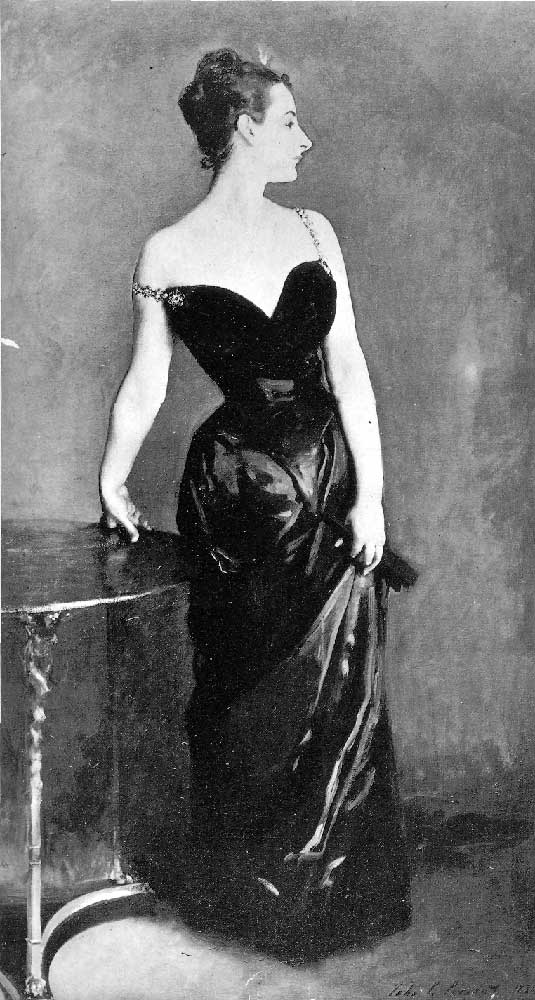
A photograph of the original painting of Madame X.

A photograph of the original painting of Madame X.

The repainted Madame X - her gown strap is back up on her shoulder.

The repainted Madame X – her gown strap is back up on her shoulder.

He re-did the painting with the strap in a more demure position – but the damage was done. Ms. Gautreau had to slink back to Louisiana to escape the social ridicule. Sargent had to flee to England to regain his reputation.

None of this has anything to do with the story – but it’s cool anyway. I’ve become a fan of Sargent because of this story, even though I’ve never been big on portraiture. I always stop and look at Dorothy whenever I visit the Dallas Museum of Art.

Dorothy, by John Singer Sargent, in the Dallas Museum of Art.

Dorothy, by John Singer Sargent, in the Dallas Museum of Art.

So, my advice is to read all of Stranger Things Happen – the other stories are just as odd, but in surprisingly different ways. Then go to the nearest good art museum and take a look at a Sargent – see what you can see in the eyes. It might be useful, help you remember things when you are stuck in limbo. We all will be there, sooner than we think.

I hope you enjoyed some of my month of short stories – it was fun and educational putting it together (though a surprising amount of work). Don’t know what I’ll do tomorrow… maybe a photograph.

Later.

I’ve been here for 3 days, and I’m trying to pretend that it’s just a vacation, like when we went to that island in that country. Santorini? Great Britain? The one with all the cliffs. The one with the hotel with the bunkbeds, and little squares of pink toilet paper, like handkerchiefs. It had seashells in the window too, didn’t it, that were transparent like bottle glass? They smelled like bleach? It was a very nice island. No trees. You said that when you died, you hoped heaven would be an island like that. And now I’m dead, and here I am.
—-Carnation, Lily, Lily, Rose, by Kelly Link

Four Women

Digital Painting done with Corel Painter and The Gimp, based on a photograph taken in the reflecting pool in front of the Winspear Opera House, Dallas, Texas

“Used to say there was four women in every man’s heart. The Maid in the
Meadow, the Demon Lover, the Stouthearted Woman, the Tall and Quiet Woman.”
― Annie Proulx, The Shipping News

Four Women, Winspear Opera House, Dallas, Texas

Four Women, Winspear Opera House, Dallas, Texas

Painting a Mural

Denton, Texas. Denton Arts and Jazz Festival.

The URL on their T-Shirts is www.Cityofdenton/watershed

mural2

mural1

Brush Strokes

“We can complain because rose bushes have thorns, or rejoice because thorn bushes have roses.”
― Abraham Lincoln

brush1

Up close, there are only brush strokes, you can’t see what you are looking at.

“What I need is perspective. The illusion of depth, created by a frame, the arrangement of shapes on a flat surface. Perspective is necessary. Otherwise there are only two dimensions. Otherwise you live with your face squashed up against a wall, everything a huge foreground, of details, close-ups, hairs, the weave of the bedsheet, the molecules of the face. Your own skin like a map, a diagram of futility, criscrossed with tiny roads that lead nowhere. Otherwise you live in the moment. Which is not where I want to be.”
― Margaret Atwood, The Handmaid’s Tale

Only with distance, in space and time, comes clarity.

Graffiti, Deep Ellum, Dallas, Texas

Graffiti, Deep Ellum, Dallas, Texas

“A portrait is not a likeness. The moment an emotion or fact is transformed into a photograph it is no longer a fact but an opinion. There is no such thing as inaccuracy in a photograph. All photographs are accurate. None of them is the truth. ”
― Richard Avedon

“The alchemist picked up a book that someone in the caravan had brought. Leafing through the pages, he found a story about Narcissus.

The alchemist knew the legend of Narcissus, a youth who knelt daily beside a lake to contemplate his own beauty. He was so fascinated by himself that, one morning, he fell into the lake and drowned. At the spot where he fell, a flower was born, which was called the narcissus.

But this was not how the author of the book ended the story.

He said that when Narcissus died, the goddesses of the forest appeared and found the lake, which had been fresh water, transformed into a lake of salty tears.

‘Why do you weep?’ the goddesses asked.

‘I weep for Narcissus,” the lake replied.

‘Ah, it is no surprise that you weep for Narcissus,’ they said, ‘for though we always pursued him in the forest, you alone could contemplate his beauty close at hand.’

‘But… was Narcissus beautiful?’ the lake asked.

‘Who better than you to know that?’ the goddesses asked in wonder. ‘After all, it was by your banks that he knelt each day to contemplate himself!’

The lake was silent for some time. Finally, it said:

‘I weep for Narcissus, but I never noticed that Narcissus was beautiful. I weep because, each time he knelt beside my banks, I could see, in the depths of his eyes, my own beauty reflected.’

‘What a lovely story,’ the alchemist thought.”
― Paulo Coelho, The Alchemist

Deep Ellum Graffiti

Deep Ellum, Dallas, Texas

de_graffiti

Well, there’s a lion… and a tree, and desert plants, and a stylized rose and a burning dove with a key on a rope and an arm and an eye and…. plenty to go around.

Yeah, right.

Yeah, right.

The Sky

The sky above Klyde Warren Park, Dallas, Texas (click for a larger version on Flickr)

The sky above Klyde Warren Park, Dallas, Texas

(click for a larger version on Flickr)

When I was a little kid, I had a paint-by-number kit… you know, one of those bilious hunks of cheap canvas board with numbered areas printed in blue ink that corresponded with little plastic tubs of oil paint. Now, I imagine they come with some sort of water-based acrylic – safer and easier for children – but this one had real slow-drying artists’ oil paint.

I might have been six years old… maybe seven. Fifty years ago.

I sat at the kitchen table, wielding the cheap brush that came with the kit, carefully cleaning it after each color and moving across the canvas matching the numbers with the proper paint. It amazed me… that I could create an actual work of art (unfortunately, my skills have advanced little since).

It didn’t seem too hard to me to make the leap beyond the preprinted canvas – surely it wouldn’t be that hard to do yourself. I was a little kid, what did I know? Nothing about composition, blending… and nothing about mixing colors.

What I especially remember is the sky above the sailboat. The scene had the boat fighting against a headwind on a dramatic tumbling, mostly overcast day – with the heavens filled with irregular patches of brown, beige, gray, and a little blue peeking through here and there. It was beautiful to me.

Now, whenever I have a sky like that… like this, my subconscious conjures up the by-the-mumbers painting of the sailboat from the distant cobwebby recesses of the past. Before I realize what I am thinking about, weather like this, fills my nose with the unmistakable odor of linseed oil and turpentine. Only then do I pause, look up, and remember the sailboat.

Free Rothko

I am very happy now that the Dallas Museum of Art has instituted free general admission to its public galleries. There is a qualitative difference when paying ten bucks to get into a museum as there is when it is gratis. It you shell out the bucks, you feel you have an obligation to get your money’s worth – to see and do and cram as much as possible into the experience. You are under pressure to enjoy yourself. With free admission you can wander in and out and have a relaxed and interested time.

When the museum first opened in downtown (moving from Fair Park) in 1983 I was working in the old (now long blown up to make room for the First Baptist Church’s Parking Garage) Cotton Exchange building, only a couple blocks from the museum. What I loved to do was to carve out an hour or so, maybe over lunch, maybe before I went home, and simply go to the museum and look at one single work of art. I’d plan it out ahead of time, choose a painting or sculpture, and then go stare at the crazy thing, and nothing else, for an hour. It was an amazing way to get to know a work – a lot different than a casual stroll through a gallery.

That’s not something you can do with a ten buck admission price.

So we were down there and I was interested in looking at the Rothko piece, Orange, Red and Red. I really enjoyed the play Red at the Wyly in February and wanted to see one of his paintings in the flesh, so to speak. During the play, the actors playing Rothko and his assistant actually splashed paint, the undercolor, covering a huge canvas. The people producing the play worked hard on getting the details right and partnered with the DMA – which made me thirst to lay my eyes on the real deal.

The problem was, I didn’t know where the Rothko was. It might have been up on the third level with the American paintings, but I didn’t see it there – it was too modern and abstract for that gallery anyway.

Later, we walked into a modern gallery off the Ross Avenue side of the museum and I thought for sure it would be in there – it fit in. But I couldn’t spot the thing so I walked up to a guard.

“Excuse me,” I asked, “Do you know where the Rothko is?”

“The Ronco?” he said.

“No, the Rothko… It’s a painting by Mark Rothko, they did a play… it’s an important… He was a painter in New York in like the fifties and sixties.”

The guard looked at me with a blank, confused look. “Maybe it’s in the American section.”

“I looked there and didn’t see it, but maybe I missed it.”

“Oh, and these paintings down here, in this gallery, they are all by female artists.”

He gave me a big, proud smile… he had found something he knew that I didn’t. I thanked him for his help and as I turned I looked over his shoulder and there, right there, behind and past him and out the entrance to the gallery, hanging on the wall of the big main spine corridor, was the Rothko. I couldn’t miss it.

So I took some time and stood there, not an hour… but at least a few minutes and looked at it. I could imagine the artist throwing down those rectangular fields of color and then staring at the work as it progressed… just like the guy in the play did.

It was pretty cool. And it was free.

Mark Rothko, Orange, Red and Red, Dallas Museum of Art

Mark Rothko, Orange, Red and Red, Dallas Museum of Art

Harmonic Vivarium and Raleigh Technium

Art by Judith Lea Perkins – Deep Ellum, Dallas, Texas

harmonic_vivarium1

harmonic_vivarium2

Judith Lea Perkins by alexandra olivia, on Flickr

A Well Muscled Aztec Warrior

I remember, once upon a time, a long time ago, in a galaxy far, far away, having a conversation with a cow-orker about art. We were in a bullpen-style office, during a break, and talking about buying artworks, where to find affordable paintings, if affordable, original art was worth the cost for poor workin’ stiffs like us or if we were better off with prints or reproductions… that sort of thing.

All of a sudden, a voice broke in. It was from another worker, one that we never thought would be interested in the subject. He was a good guy, bright enough, but not from the city. You can take the boy out of the backwoods, but you can’t take the backwoods out of the boy. His voice was slightly garbled from the giant chaw of tobacco he had stuck in his lower lip.

He said, “Oh, I just bought an original painting, myself.”

We were a little stunned at this admission. After a few seconds, I regained my composure and asked, “Oh, what did you buy?”

He said, “A painting of a well muscled Aztec warrior on black velvet.”

Not that I have anything against black velvet paintings, but at that time I didn’t really consider them art.

In the intervening decades between who I was then and who I am now… I have changed my mind.

Graffiti in Deep Ellum. This warrior is nothing if not well-muscled... plus he is carrying off his prize of war.

Graffiti in Deep Ellum. This warrior is nothing if not well-muscled… plus he is carrying off his prize of war.

Cathedonia

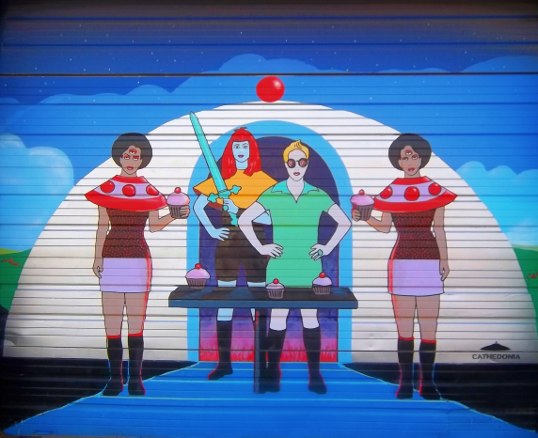
Along the walls near the Deep Ellum Green Line DART station are some odd, wonderful, and striking portraits, all marked Cathedonia.

cathedonia1


cathedonia2

cathedonia3

cathedonia4


These are the work of a local artist, Cathey Miller. She does a lot of varied work, including professional scene painting and such.

From her online bio:

Since 2001, the subject of my personal artwork has been the mythical planet of Cathedonia, a place I invented and populated with only my closest friends . My amateur studies in particle physics convinced me that I existed simultaneously in a parallel universe, flying around in a spaceship, drinking big gulps, and saving the earth from monsters.

My paintings are portrait based explorations into a symbol rich outer space environment. These images are painterly, colorful, and communicate Cathedonian ideals of truth, beauty, girl power, and heroism in the face of gigantic eagle headed flying intergalactic lobsters.