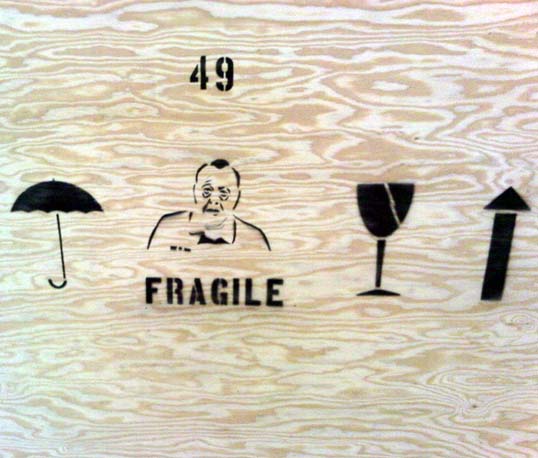
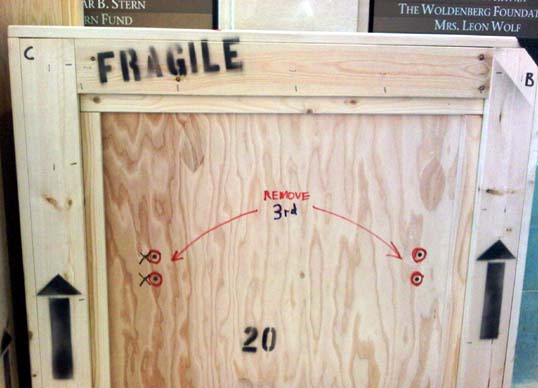
In a hallway in the New Orleans Museum of Art I saw a pile of wooden crates. Obviously a new exhibit on its way in – the plywood was stenciled with a set of transportation-related symbols.
OK, there’s the “this end up” symbol – the “do not let this get wet” symbol – a “Fragile” symbol – but what’s up with the stencil of the guy? Does it mean, “May contain Winston Churchill”? Does it mean, “Dangerous Bags Under Eyes”? “Please notify the butler”? “The old man may be constipated”?
OK, I’m not stupid, I can figure out that the stencil probably means that the crate contains art. Still, who picked that symbol? Why is it important that everybody knows it contains art? Who is that guy anyway?
The museum has some great art – but I sort of enjoyed the hieroglyphics on the packing crates as much as anything.
If I had to guess, I’d think that the crates had at least part of an exhibit called “Lifelike” in them.
More fundamentally, it is a dream that does not die with the onset of manhood: the dream is to play endlessly, past the time when you are called home for dinner, past the time of doing chores, past the time when your body betrays you past time itself.
Nothing is old… it is vintage. And if it is vintage… it is cool. It’s not rust… it’s a patina.
All bicycles weigh fifty pounds. A thirty-pound bicycle needs a twenty-pound lock. A forty-pound bicycle needs a ten-pound lock. A fifty-pound bicycle doesn’t need a lock. ~Author Unknown
Bicycle, French Quarter, New Orleans
After your first day of cycling, one dream is inevitable. A memory of motion lingers in the muscles of your legs, and round and round they seem to go. You ride through Dreamland on wonderful dream bicycles that change and grow.
—-H.G. Wells, The Wheels of Chance
Despite the fact that (in additional to the least-cool) I am the least fashionable person on the planet I am interested in the idea of bicycling style, or chic, or whatever you want to call it. Not the old spandex, carbon, and logo style, but the more relaxed, European, style of riding a bike in the urban environs.
Looking through the library I discovered a book by David Byrne, where he relates some of his experiences riding a folding bike through some of the more interesting cities of the world.
Most US cities are not very bike-friendly. They’re not very pedestrian-friendly either. They’re car-friendly – or at least they try very hard to be. In most of the cities one could say that the machines have won. Lives, city planning, budgets, and time are all focused around the automobile. It’s long-term unsustainable and short-term lousy living. How did it get this way? Maybe we can blame Le Corbusier for his “visionary” Radiant City proposals in the early part of the last century:
His utopian proposals — cities (or just towers really) enmeshed in a net of multilane roads — were perfectly in sync with what the car and oil companies wanted. Given that four of the five biggest corporations in the world still are oil and gas companies, it’s not surprising how these weird and car-friendly visions have lingered. In the postwar period general Motors was the largest company in the whole world. Its president, Charlie Wilson said, “What’s good for GM is good for the country.” Does anyone still believe that GM ever had the country’s best interests at heart?
Maybe we can also blame Robert Moses, who was so successful at slicing up New York City with elevated expressways and concrete canyons. His force of will and proselytizing had wide ranging effects. Other cities copied his example. Or maybe we can blame Hitler, who built the autobahns in order to allow German troops and supplies fast, efficient, and reliable access to all points along the fronts during World War II.
I try to explore some of these towns — Dallas, Detroit, Phoenix, Atlanta — by bike, and it’s frustrating. The various parts of town are often “connected” — if one can call it that — mainly by freeways, massive awe-inspiring concrete ribbons that usually kill the neighborhoods they pass through, and often the ones they are supposed to connect as well. The areas bordering expressways inevitably become dead zones. There may be, near the edges of town, an exit ramp leading to a KFC or a Red Lobster, but that’s not a neighborhood. What remains of the severed communities is eventually replaced by shopping malls and big-box stores isolated in vast deserts of parking. These are strung along the highways that have killed the towns that the highways were meant to connect. The roads, housing developments with no focus, and shopping centers eventually sprawl as far as the eye can see as the highways inched farther and farther out. Monotonous, tedious, exhausting… and soon to be gone, I suspect.
He’s right of course… but not completely right. There is hope. Dallas (and every big modern city) does have its notorious web of high speed freeways, concrete ribbons of death.
But they don’t cover the whole city. In between these barriers are real neighborhoods with real people living in them. The challenge is to get off the freeway and find what’s there – and a bicycle is the best way to do it.
The freeways become a barrier to pierce. The city is working on creating routes and I’m working on finding them.
He had met her through a mutual friend that thought they would be good for each other. On their first date, he had taken her to Olivier’s and it felt like they had known each other all their lives. They ate Creole Rabbit and Crawfish Étouffée.
She left him on a gray and drizzling day. He still goes to Olivier’s and watches for her, though he knows she won’t come walking in.


 Bill Chance