“I think and think and think, I‘ve thought myself out of happiness one million times, but never once into it.”
― Jonathan Safran Foer
I wonder what this guy is thinking. He’s been in that glass box a long time.

Dallas Museum of Art
Dallas, Texas
“I think and think and think, I‘ve thought myself out of happiness one million times, but never once into it.”
― Jonathan Safran Foer
I wonder what this guy is thinking. He’s been in that glass box a long time.
Dallas Museum of Art
Dallas, Texas
“I felt my lungs inflate with the onrush of scenery—air, mountains, trees, people. I thought, “This is what it is to be happy.”
― Sylvia Plath, The Bell Jar

Dallas Museum of Art, Dallas, Texas
“Masquerades disclose the reality of souls. As long as no one sees who we are, we can tell the most intimate details of our life. I sometimes muse over this sketch of a story about a man afflicted by one of those personal tragedies born of extreme shyness who one day, while wearing a mask I don’t know where, told another mask all the most personal, most secret, most unthinkable things that could be told about his tragic and serene life. And since no outward detail would give him away, he having disguised even his voice, and since he didn’t take careful note of whoever had listened to him, he could enjoy the ample sensation of knowing that somewhere in the world there was someone who knew him as not even his closest and finest friend did. When he walked down the street he would ask himself if this person, or that one, or that person over there might not be the one to whom he’d once, wearing a mask, told his most private life. Thus would be born in him a new interest in each person, since each person might be his only, unknown confidant.”
― Fernando Pessoa
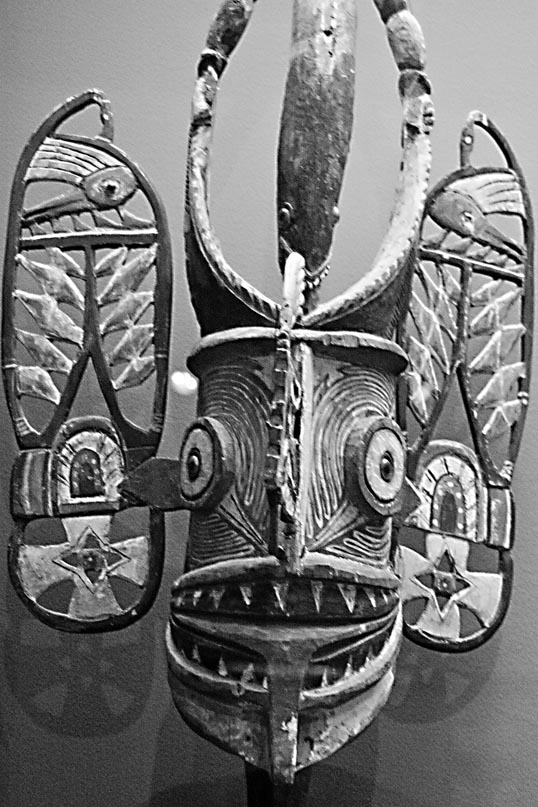
Dallas Museum of Art
Dallas, Texas
“It’s not what I’d want for at my funeral. When I die, I just want them to plant me somewhere warm. And then when the pretty women walk over my grave I would grab their ankles, like in that movie.”
― Neil Gaiman, American Gods

Funerary Figure (tau-tau)
Dallas Museum of Art
Dallas, Texas
Dallas Museum of Art
Dallas, Texas
(label text)
Funerary figure (tau-tau)
Indonesia: South Sluawesi, Sa’dan Toraja People
19th century or earlier
Wood
The Eugene and Margaret McDermott Art Fund, Inc. 1980.2 McD
The Toraja carve tau-tau, smaller than life-size funerary figures, to commemorate the deceased when a high-ranking funeral is held. Only members of the highest-ranking aristocracy are permitted to have permanent tau-tau. This unusually small funerary figure appears to be archaic in style and probably predates even the oldest effigies seen beside Toraja tombs today.
The bun or hair knot at the back of the head of this tau-tau indicates that it represents a female. Her mouth is open and may remind one of The Scream, a modern painting by Edvard Munch. The expression is not precisely understood, but it may have been meant to capture bearing of an authoritative aristocratic woman accustomed during her lifetime to public speaking and giving orders, as this tau-tau appears to be doing
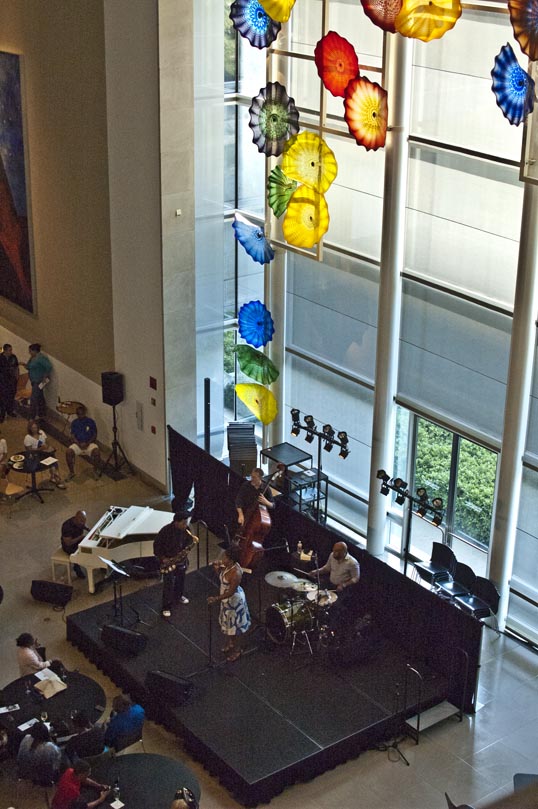
“Jazz is the music of the body. The breath comes through brass. It is the body’s breath, and the strings’ wails and moans are echoes of the body’s music. It is the body’s vibrations which ripple from the fingers. And the mystery of the withheld theme, known to jazz musicians alone, is like the mystery of our secret life. We give to others only peripheral improvisations.”
― Anaïs Nin, The Diary of Anaïs Nin, Vol. 5: 1947-1955
Dallas Museum of Art
Dallas, Texas
Barbara Hepworth
Sea Form (Atlantic)
Bronze, 1965
Dallas Museum of Art, Sculpture Garden
Dallas, Texas

Sea Form (Atlantic)
Barbara Hepworth
(click to enlarge)
“The sculptor carves because he must. He needs the concrete form of stone and wood for the expression of his idea and experience, and when the idea forms the material is found at once. […]
I have always preferred direct carving to modelling because I like the resistance of the hard material and feel happier working that way. Carving is more adapted to the expression of the accumulative idea of experience and clay to the visual attitude. An idea for carving must be clearly formed before starting and sustained during the long process of working; also, there are all the beauties of several hundreds of different stones and woods, and the idea must be in harmony with the qualities of each one carved; that harmony comes with the discovery of the most direct way of carving each material according to its nature.”
—- ‘Barbara Hepworth – “the Sculptor carves because he must”‘, The Studio, London, vol. 104, December 1932
“I have always been interested in oval or ovoid shapes. The first carvings were simple realistic oval forms of the human head or of a bird. Gradually my interest grew in more abstract values – the weight, poise, and curvature of the ovoid as a basic form. The carving and piercing of such a form seems to open up an infinite variety of continuous curves in the third dimension, changing in accordance with the contours of the original ovoid and with the degree of penetration of the material. Here is sufficient field for exploration to last a lifetime.”
“Before I can start carving the idea must be almost complete. I say ‘almost’ because the really important thing seems to be the sculptor’s ability to let his intuition guide him over the gap between conception and realization without compromising the integrity of the original idea; the point being that the material has vitality – it resists and makes demands.”“I have gained very great inspiration from Cornish land- and sea-scape, the horizontal line of the sea and the quality of light and colour which reminds me of the Mediterranean light and colour which so excites one’s sense of form; and first and last there is the human figure which in the country becomes a free and moving part of a greater whole. This relationship between figure and landscape is vitally important to me. I cannot feel it in a city.”
—-Barbara Hepworth ‘Approach to Sculpture’, The Studio, London, vol. 132, no. 643, October 1946
Vegetation growing on the wall near the entrance at the Dallas Museum of Art Sculpture Garden.
Dallas, Texas

Dallas Museum of Art, Dallas, Texas
“We are made aware that magnitude of material things is relative, and all objects shrink and expand to serve the passion of the poet. Thus, in his sonnets, the lays of birds, the scents and dyes of flowers, he finds to be the shadow of his beloved; time, which keeps her from him, is his chest; the suspicion she has awakened, is her ornament”
― Ralph Waldo Emerson, Nature
Frisco, Texas
“Quite possibly there’s nothing as fine as a big freight train starting across country in early summer, Hardesty thought. That’s when you learn that the tragedy of plants is that they have roots.”
― Mark Helprin, Winter’s Tale

(click to enlarge)
“Swerve me? ye cannot swerve me, else ye swerve yourselves! man has ye there. Swerve me? The path to my fixed purpose is laid with iron rails, whereon my soul is grooved to run. Over unsounded gorges, through the rifled hearts of mountains, under torrents’ beds, unerringly I rush! Naught’s an obstacle, naught’s an angle to the iron way!”
-Herman Melville, Moby Dick

(click to enlarge)
“The train bore me away, through the monstrous scenery of slag-heaps, chimneys, piled scrap-iron, foul canals, paths of cindery mud criss-crossed by the prints of clogs. This was March, but the weather had been horribly cold and everywhere there were mounds of blackened snow. As we moved slowly through the outskirts of the town we passed row after row of little grey slum houses running at right angles to the embankment. At the back of one of the houses a young woman was kneeling on the stones, poking a stick up the leaden waste-pipe which ran from the sink inside and which I suppose was blocked. I had time to see everything about her—her sacking apron, her clumsy clogs, her arms reddened by the cold. She looked up as the train passed, and I was almost near enough to catch her eye. She had a round pale face, the usual exhausted face of the slum girl who is twenty-five and looks forty, thanks to miscarriages and drudgery; and it wore, for the second in which I saw it, the most desolate, hopeless expression I have ever-seen. It struck me then that we are mistaken when we say that ‘It isn’t the same for them as it would be for us,’ and that people bred in the slums can imagine nothing but the slums. For what I saw in her face was not the ignorant suffering of an animal. She knew well enough what was happening to her—understood as well as I did how dreadful a destiny it was to be kneeling there in the bitter cold, on the slimy stones of a slum backyard, poking a stick up a foul drain-pipe.”
― George Orwell, The Road to Wigan Pier
There are but two things worth living for: to do what is worthy of being written; and to write what is worthy of being read.
—-Ross Perot
Taken from the Perot Museum, Dallas, Texas

Looking back towards Klyde Warren park – and the Eye of Sauron.

Entrance Plaza for the Perot Museum

Downtown Dallas
“We start off with high hopes, then we bottle it. We realise that we’re all going to die, without really finding out the big answers. We develop all those long-winded ideas which just interpret the reality of our lives in different ways, without really extending our body of worthwhile knowledge, about the big things, the real things. Basically, we live a short disappointing life; and then we die. We fill up our lives with shite, things like careers and relationships to delude ourselves that it isn’t all totally pointless.”
― Irvine Welsh, Trainspotting
My son, Nick, is home for a few days before he heads back to school. I told him I was going to do, “A stupid Dad thing.” I said I was going to drive down into South Dallas and sit around and wait until I could see an old train engine go by.
“Yes,” he said, “That sounds like a stupid Dad thing.”
When our kids were little, I used to take them down to Fair Park. It’s an underused and unappreciated piece of our city. We would stop off at the Age of Steam museum on the north side of the park. That was a little-known, overcrowded spot where they had an amazing collection of rolling stock – a true history of the American railroads.

Big Boy 4018, in Fair Park, a few years ago.

Big Boy 4018, next to a slightly lesser engine, in Fair Park, a few years ago.

Big Boy 4018, behind the wire in Fair Park
The museum was always neglected by the city and actively discouraged by Fair Park officials. It became more and more threadbare and run down. I was worried that it would fade away. But, eventually, the city of Frisco came through and decided to build a brand-new, spacious Museum of the American Railroad. It seemed to take forever, but the thing finally came together. I can’t wait to visit the place when it opens.
One challenge was to move all the rolling stock from the Fair Park sidings all the way out to Frisco. No mean feat – over the last few years they have been using slack time in the various railways across the Metroplex to move their cars and engines out to their new digs.
Only one piece of equipment remained – but that was a doozy. Union Pacific Big Boy 4018. One of twenty-five “Big Boy” coal-fired steam engines built in the early forties – arguably the largest steam locomotives in the world. 133 feet long, and weighing one and a quarter million pounds (with its tender) – that’s a big hunk of iron to move across a giant modern city.
I wanted to see this.
For months now, the move has been scheduled and canceled – due to technical and scheduling problems. Finally, this Sunday, it looked like the thing was going to go off. I followed on facebook and twitter and made sure it was going to be leaving home – then packed up my bicycle, folding chair, camera, notebook and pen, and some cold water and headed out.
The route was available online and I picked out a spot in South Dallas where the rail line ran along a deserted stretch of grass and trees – that still had a road (Railroad Avenue) right next to it. When I arrived, I realized I must have picked a good spot – there were quite a few folks there, including news reporters, official rail line photographers, railroad dispatchers on their days off, and a good gaggle of serious train fanatics.
Unfortunately, there were some serious delays and we waited for several hours while a number of other trains sped by, but no Big Boy.

While we were waiting some other trains came by. All the folks on this Amtrack were looking out the windows wondering why everyone was standing there with cameras.
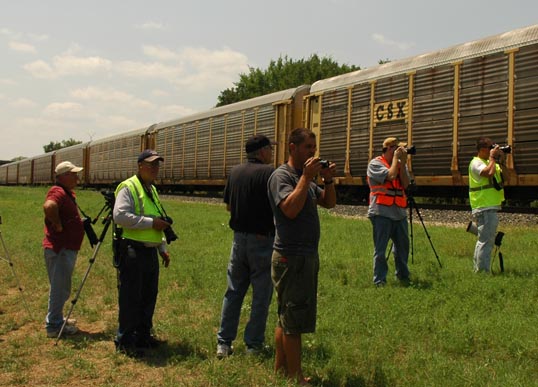
Train fans, waiting for Big Boy.
A freight train stopped on the track, blocking the route, waiting for clearance ahead and we all realized it would be several hours more – so I took off and went to a favorite place in Exposition Plaza – Pizza Lounge – for a slice, an IPA, and watch the Rangers get beat on the television over the bar. I was able to keep up on twitter – and when it looked like the train was moving again I headed out.

The crowd at Scyene Road, under the DART bridge, waiting.
This time I stopped at Scyene road, near the DART station. The train would reach that spot first, and there was a good crowd of folks still waiting. It still took about another hour, but it was pretty darn cool – worth the six-hour wait. Several serious railroad fans were saying, “Seeing an engine like this moving on the tracks is a once-in-a-lifetime experience.”
Of course, it wasn’t under its own power. There was talk once of restoring this engine to operating condition, but it would be prohibitively expensive, nobody wants coal burning trains around, and there isn’t much track left that can take this size of machine. It was pulled along by a diesel engine, and was hooked to a long line of tank cars to provide braking and stability.

Three generations. The smoking diesel pulling the steam Big Boy, while the electric DART train zooms by overhead. (click to enlarge)

Big Boy 4018 (click to enlarge)

The massive drive wheels on Big Boy 4018 (click to enlarge)

Big Boy 4018 (click to enlarge)

Big Boy 4018
I was expecting the size but not the fantastic complexity. The size, number, and beauty of all those parts spinning as the train went by was incredible. Now I understand why the train fans wanted to see it move. When you look at these things in a static museum it’s easy to forget and hard to comprehend that they were built to move, move fast, move long distances, and pull unimaginably heavy loads.
Once it went by I drove back to Railroad Avenue, and as I pulled in, the Big Boy was already passing. I managed to get a shot of it as it went over Bexar Street.

Big Boy 4018 (click to enlarge)
The Union Pacific photographer told me of a spot where I could get a picture of the train with the Dallas skyline in the background, but there was another tall container train on a siding blocking the view. The train still had a long way to go, but I was getting tired and needed some water, so I headed home.
“Choose a life. Choose a job. Choose a career. Choose a family. Choose a fucking big television. Choose washing machines, cars, compact disc players and electrical tin openers… Choose DSY and wondering who the fuck you are on a Sunday morning. Choose sitting on that couch watching mind-numbing, spirit crushing game shows, stucking junk food into your mouth. Choose rotting away in the end of it all, pishing your last in a miserable home, nothing more than an embarrassment to the selfish, fucked up brats you spawned to replace yourself, choose your future. Choose life… But why would I want to do a thing like that?”
― Irvine Welsh, Trainspotting
 Bill Chance