What I learned this week, March 08, 2013

The True-Life Horror that Inspired Moby-Dick

Kindle

Call Me Ishmael


What’s on Tap: Proposed laws good for beer – and Texas

blonde1


10 biggest fast food failures

I remember looking at a bag of potato chips and seeing the warning “May cause anal leakage.” Yeah, right.


 11 Foods You Can’t Buy Anywhere Anymore

and not alltogether a bad thing.


Could the ancient Romans have built a digital computer?


The 10 best restaurants in Dallas-Fort Worth

The 10 Best Gift Shops in Dallas
I would add La Mariposa to the list.

The 5 Best Theater Companies in Dallas


Stuff I want:

Titanium Escape Ring Packs a Shim and a Saw

Cube 3D Home Printer


A Visit From the Goon Squad

Again, it was time to decide on the next book for me to read. At one time, that meant perusing the bookshelves in my home – when we lived in Mesquite our entire hallway was lined with shelves chock-a-block with tomes (that’s been reduced to one small and two full-sized bookcases… and they are only half full – mostly non-fiction reference). Now it is a ritual of clicking through the collections in my Kindle… preferably sitting at my laptop, looking up information on each possibility. As the thread of my life is shortening my choice in reading is becoming more selective – there isn’t enough time. When I was young I would finish a book no matter how much I detested or was bored by it. Now, if it isn’t grabbing me, I hit the REMOVE FROM DEVICE selection.

I have had Jennifer Egan’s  “A Visit From the Goon Squad” for some time – having picked it out from a recommended reading list somewhere. It was something I was sure to like; a novel of tightly connected short stories that won the Pulitzer Prize and many other awards. It had to be good.

However, I had been putting it off. After thinking about it, I’ve realized that it was because I hated the title. “A Visit From the Good Squad” had very negative associations in my noggin’ – though I’m not sure what they were. My mistake was in taking the phrase “Goon Squad” literally – the book does not (in the book the “Goon” is time itself – the central metaphor for the story). I knew nothing about the details of the book (I’ve been trying to avoid plot summaries of books and films – life is a bit more exciting that way) and the title left a bad taste in my mouth.

As I was researching my choice in next-to-read I discovered that HBO is making a cable series out of the book. That was good enough for me. I clicked it into my “READING” collection and dug in.

It didn’t take long for me to realize that (a) the book is very, very good… and (b) the stories are connected in a complex web of space, time, and human connections. I was not going to be able to keep track of everything without help. So I dug out a Staples Bagaase Composition Book (one of the great inventions of all time) and three fountain pens (turquoise, gold-brown, and purple – to help keep different threads separate) and took notes as I read. I wrote down each character, their age, the year (as best as I could figure) and all the connections between them.

By the end of the book I had about twelve pages of concise notes. Not all the possibilities worked out – but I can’t imagine enjoying the stories as much as I did without this effort. It was kind of fun to sit there annotating as I read… sort of like being back in school again.

About halfway through I thought that I probably wasn’t the first person that had this need to outline “A Visit From the Goon Squad” and a quick web search revealed that I wasn’t. Two resources were particularly useful – a detailed timeline of the interlocked stories of the most important dozen characters, and a wonderful 3-D construct, an Interactive Character Map of the denizens of the novel and their relationships with each other. With these resources at my disposal my note-taking became redundant but I forged ahead – a little sloppier – and did discover a couple of connections not noted in the online references.

Having gone into this book from “How to Live Safely in a Science Fictional Universe” I was relieved to find a more conventional narrative – one with real people and settings. Still, there are a few postmodern touches – especially in the fact that one chapter is told in PowerPoint.

I cared deeply about the characters and wanted to see them happy – which is a good thing, if not always (or even very often) possible. After all, time is a goon, and we are all due our visit from the goon squad.

Harry Potter and the Too Many Pages

My kids have a history with the Harry Potter books. They were just the right age… Well, Nick was at first. He read the first three or so – I remember going to the bookstore in Mesquite at midnight and picking up the books as they were released, so he could start in the next morning. He would devour them.

Nick reading Harry Potter.

Nick reading Harry Potter. Is this the first one?

As the years went by, the books came out while we were out of town, in the middle of summer vacation. Once, we knew we would be in Santa Fe, New Mexico. So I reserved a copy at a bookstore there and Nick and I (he was old enough to stay up now – I don’t know which book it was) went down to pick it up. I remember the night – there was some serious nerdery going on in that bookstore – kids in costume, groups, organized events. I also remember one girl that had a friend in St. Louis. Since midnight there was an hour earlier, her friend was reading her the first chapter over her cell phone while she waited.

Nick sort of grew out of the books. He says he hasn’t read the last two. Lee took over… catching up and reading the rest as they came out. We learned the last book would come out while we were driving through West Texas so we reseved a copy in Amarillo. Back in the hotel, he went down to the lobby and stayed up all night (he has always been a night owl) – reading the thing. He said some strange people came into the hotel after three AM, but they left him alone. He finished the whole book about the time we left in the morning.

I had read the first book, gobbled it down quickly not long after it came out but never read any of the others. I saw… some of the films… maybe three of them. I sort of put them out of my mind as the years went by. I thought about reading them – but the massive size and the time it would require put me off.

But now that they are available as ebooks – I decided to read them on my Kindle. Somehow, the invisible digital bytes hiding inside the tiny tablet seemed less onerous than lugging around giant paper tomes and over four thousand pages of the US edition. So I charged through all seven, one after another. It took a few weeks – I have been busy, but with the Kindle I can carry it with me and grab spare minutes here and there. I liked to take it with me on my bicycle and stop to read when I wanted to take a bit of a rest.

So… what did I think about the beloved series?

First, the experience of reading this much in one gulp is overwhelming. I’ve said before that I have to be careful about what I’m reading because it has such a strong effect on my writing. I was pretty much unable to write any fiction while wallowing in the world of Harry Potter. I did squeeze out a couple mediocre tales of children or teens that didn’t fit in anywhere – lonely, confused, and abandoned… not my usual fare.

But it was an interesting experience – being immersed in J. K. Rowling’s world.

Unfortunately, reading like that does show the flaws in the books pretty starkly. Without a gap between the books the repetitive nature of the first six is obvious and tiring. It’s really the same story told six times. The last one breaks the chain… it is a fully realized grown-up novel.

Also, her overuse of creaky literary crutches – hackneyed plot devices – stuck out. The Harry Potter series is the home of the Hallowed MacGuffin. If you don’t know what a MacGuffin is… read this. Every book revolves around some object (or person), sometimes referred to in the title, that have all the characters dancing around like puppets on strings. But, in the end, that object (or person) really has nothing to do with the actual story at all. That makes it a MacGuffin. The later books have multiple MacGuffins.

There’s nothing wrong with a MacGuffin, of course. You could not have detective stories without them. Hitchcock loved them. The Maltese Falcon is the classic MacGuffin… and there’s no better story than that. But Harry Potter overused them – and when you read all the books and they keep hitting you one after another… a bit much.

She also likes to have all her characters stand around at the end of the books and speak directly about what was really going on – giving out plenty of information that was crudely, cruelly and sometimes arbitrarily withheld from the reader up until then.

And then there’s the Pensieve. Every writer struggles with backstory and point of view. In the Harry Potter books the point of view is held tightly to the hero (with the exception of a prolog or afterward here or there) and she needed a way to bring in information that wasn’t otherwise available to Harry, either by time, space, or the needs of the plot.

So, invent a Pensieve – basically a big bucket – and whenever you need to bring in information that Harry isn’t privy to, have the hero stick his head into the bucket – he falls in, and exactly what you need to have the story go forward (and nothing more) is delivered… by magic.

I shouldn’t complain – it works – but it’s a bit obvious, awkward, and lazy.

Still, though, after all the creaky prose and obvious plot devices it is one hell of a story. Especially when it’s read in one enormous gulp – like a professional eater and a mountain of hot dogs – the world of Harry Potter is irresistible and addictive. You can’t stop reading.

There is plenty there to strike a chord, plenty more to think about. It’s easy to see how it has sold so many copies and become such a touchstone for so many people of several different generations.

I’m just glad I’m done so I can get back to my own pitiful little world.

Hidden Places

Last Thursday I took a PTO day off of work, a mental health day. I decided to go to the Dallas Arboretum in the morning and hang out for a while. We have a membership there, so I don’t have to pay for parking or admission, which is nice. Especially nice because I can go at my leisure and simply relax and walk around, not feel any pressure to get my money’s worth. For that, I can always come back another time.

The Chihuly Exhibit is still up, and will be until November. It is a beautiful as always – and now, since I have a familiarity with it, I am able to see some details and subtle facets that I missed the first time or two through. More than the Chihuly stuff, gorgeous as it is, I am appreciating the beauty of the Arboretum itself – its design and vegetation.

This trip, as always, I took a lot of photographs, which I will continue to force upon my helpless readers whenever I feel like it – or I can’t think of anything else to whine on about. So far, from this trip, here, here, and here, for example… with many more to come.

But other than snapping photographs I wanted to find some spot to sit down with my Kindle and read for a bit, simply soak up the peaceful beauty.

When I first arrived at opening, there weren’t too many folks there, but the crowd quickly grew. Now, there weren’t as many folks as there are on the weekends, not by a long shot, but they tended to cluster along the main paths, surround the more spectacular Chihuly stuff, and blabber on about this and that – generally messing with my chill.

No problema, I expected this. It is a public spot – a tourist attraction – with a very popular special exhibit going on until November… I did not expect to have the whole place to myself. I had already decided to seek out a couple of hidden places, somewhere that I could sit, undisturbed, read a little, and generally chill out.

A couple of parameters had to be established:

  • Obviously, out of the main traffic areas.
  • A nice bench to sit on.
  • Shade (I am using the phrase “Chill Out” in the metaphoric sense – the heat is amazing and deadly)
  • A nice view

The first hidden spot is one I already knew about – I had spotted it the first time I came to the Arboretum. The first stage of A Woman’s Garden is a fiendishly designed series of formal gardens and water features that have a lot of Chihuly’s most spectacular glass works. It draws a big crown, oohing and ahhing and holding their iPhones up to send images back home to Aunt Emma who didn’t want to visit Dallas in the summer.

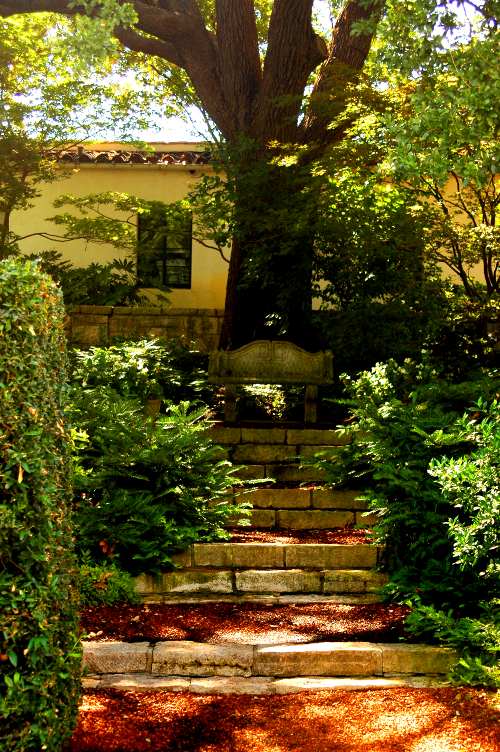
What they miss are some clever, smaller bits of garden that jut off to the side, little isolated areas that really make the place special. One of these, sandwiched between the first fountain by the entrance to A Woman’s Garden and the Degolyer Mansion is called The Sunset Garden. It is a tiny path that goes up a bit of hill to a stone bench beneath a huge tree. As the name implies, the bench faces west and would be a great place to watch the solar orb sink beneath White Rock Lake. There is a little sign that directs you to the side garden – a sign that everybody, entranced with the colorful glass beyond, seems to miss.

When you clamber up to the stone bench you look down through a gap to a fountain and then past into another small garden – The Pecan Parterre Garden, with a beautiful little sculpture – Harriet Frishmuth’s “Playdays” (more on that bronze piece in a few days, I promise). It is a truly idyllic spot.

The path up to the stone bench in the Sunset Garden from the main entrance to A Woman’s Garden.

A view of the Sunset Garden from the veranda of the DeGolyer mansion. You can see the sun-drenched entrance to A Woman’s Garden and its fountain, and the Pecan Parterre Garden, with the little statue, beyond. White Rock lake is through the trees in the background – this would be a wonderful spot to watch the sun set.

The only problem – as I discovered once I climbed up there and settled in – is that the stone bench is tilted out, ever so slightly, so it is not very comfortable. It’s like sitting in a church pew. I’m afraid that little detail makes the sunset garden a bit more useful to look at than to sit in for more than a few minutes.

Later on, though, I found another little hidden spot that didn’t have any disadvantages at all. I was strolling through the Jonsson Color Garden (the big open ovals where some large Chihuly glass rears up) and looking into the strip of woods that separates that area from the Texas Town (a children’s area with small historical displays) and noticed a wooden bench set deep within the trees. I walked around a bit and found the path back there.

It was perfect. It sits in deep shade from tall overhead trees and is screened from the main walking path by a clump of Crape Myrtles. Cool and quiet – most importantly, the wooden bench is very comfortable. A perfect spot to sit and read (I cranked through an entire novel) and contemplate the universe.

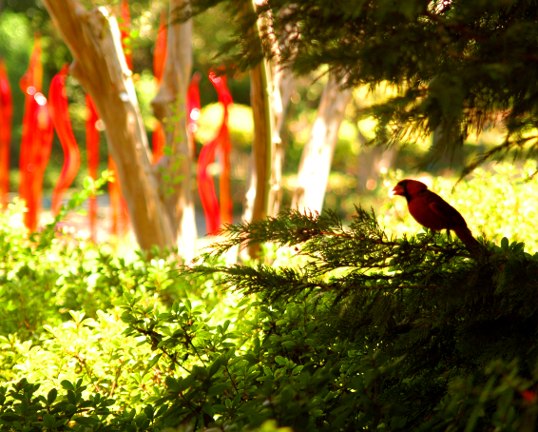
The view ahead and to the left from the little bench. These are some Chihuly red glass sculptures sitting along the edge of the Jonsson Color Garden.

To the right from the bench is a bit of a view of Chihuly’s gigantic Yellow Icicle Tower.

Here’s the bench, with my Kindle, camera case, and woefully inadequate water bottle.

I had a little visitor while I was sitting there – somebody else trying to get out of the killer afternoon heat.

It was too comfortable – I stayed too long into the stifling heat of the afternoon. The rest of the day I was dizzy and confused… even more so than normal. Still, I think I’ll go back. It’s a nice place… and there has to be some more hidden spots that I haven’t found yet. Maybe one with some burbling water nearby.

Volt

I had a little money left over on an Amazon.com gift card and began to choose some Kindle books. I picked up a couple of short story selections, Knockemstiff, by Donald Ray Pollock and Volt, by Alan Heathcock. Pretty much by a flip of the coin, I read Volt first.

Volt has eight semi-connected longish short stories. Right off the bat, the description of a farmer accidentally killing his son while tilling a field resonated with me. I’m a father and have spent a little time on a tractor seat bouncing in the heat and dust, watching a mile-distant fence line slowly, inexorably approach.  That awful scene was enough to justify the price of the book and the time to read it. I thought that first story could have ended after those two pages.

It didn’t though, as the father, destroyed by the accident and jolted by a near miss with a freight train – runs away. And runs and runs and runs – putting Forest Gump to shame. He ends up wiping his life away and building a new one, of sorts. It’s a journey worthy of Odysseus, and likewise, he finds that home is not what it used to be. Too much water under the bridge.

The stories are all small-town Gothic. They are set in the hopeless wide-spot-in-the-road of Krafton… an imaginary town. Trust me as one who knows – there are a lot of Kraftons out there. One hell of a lot. These are forgotten hamlets where everyone with any ambition or brains left town long ago – leaving the impression that the remaining conscripts – imprisoned by tradition, lack of imagination, and ennui – exist simply to work their way back down the evolutionary chain. There is even a Biblical Flood – though plenty of unworthy survive.

There is one hopeful character, Sheriff Helen Farraley, a plump middle-aged former grocery store manager pressed into service to combat evil no mortal should have to face. Her decisions seem insane, until you try to see her world through those eyes.

At the end of the finely crafted book, I felt I knew the doomed citizens of Krafton, and hoped somehow, someday they find the redemption that they deserve, even if they don’t see it or don’t chose it for themselves.

Now, on to Knockemstiff.

New York Times Review – Stories of Small-Town Strife

‘Volt’ writer Alan Heathcock’s internal duality fuels his gripping prose and creates his epic stories

‘Volt’: Stories for Mourning, After A Nameless Loss

BOOK REVIEW: Alan Heathcock

Bookslut – VOLT BY ALAN HEATHCOCK

The Best American Noir of the Century

The Kindle is like crack. Every day I get an email with the “Deal of the Day,” and every day I need to figure out how I am going to resist. It isn’t the money – these books go from ninety nine cents up to, say four bucks. It isn’t the space, either. My Kindle can hold a small library in its memory and what it won’t hold Amazon will store out in the clouds. It’s simply time. There are too many books and life is too short and time is running out too fast.

Sometimes, though, I can’t resist. I buy and I read.

One temptation given in to was a big book that came in for a one-day sale… I think it was $1.99 or so.

I love big, thick anthologies of short stories. Especially with time so short and life so mixed-up and confusing, the ability to scrape up a few spare minutes and read a whole story – complete in and of itself – no remembering galaxies of characters, confused clusters of settings, and subtle plot threads that weave and waft through the delicate tapestry of a novel… one shot, simple, fast, powerful. Give me a tome with twenty or thirty or more of these miniature jewels and I’m a happy camper.

The buck ninety-nine deal came in over the ether for purchase of the Best American Noir of the Century. Couldn’t resist – hit the “buy with one click” button and it was mine.

Reading it took a little longer. It had 39 stories, so it took a few days to plow through. The stories covered about 83 years and were in chronological order. Noir isn’t really a genre, more like an attitude, and you could feel how the stories changed over time.

The book is 800 pages… which made me glad that it was only some bits stored in the Kindle memory. That’s a lot lighter.

There is a lot of criticism of this anthology… mostly concerning the meaning of the term Noir. A lot of folks take Noir to be a hardboiled detective novel. They are disappointed because, although there are some classics in the collection, it takes a broader view of Noir and includes some stories with supernatural elements and other borderline tales.

That’s fine with me. I was surprised to find that I liked some of the more offbeat, longer, and modern riffs. I recommend the anthology highly… it’s the kind of thing you will like if you like that kind of thing.

Like any group of thirty nine tales, the offerings can be a little uneven. Some folks will like stories I didn’t… but here are a few that stood out in my mind:

Harlan Ellison: 1993: Mefisto in Onyx – Harlan Ellison, not surprisingly, comes up with a loose, weird, caterwauling tale that isn’t what it seems to be and then it turns out not to be that either. Surprising and entertaining.

Ed Gorman: 1995: Out There in the Darkness – Inspired the book and film, “The Poker Club.” The opposite of Mefisto in Onyx… a tale of four ordinary guys, folks you know and love trapped in a cycle of escalating violence.

Elmore Leonard: 2002: When The Women Come Out to Dance – Fantastic tale about a relationship between two women that turns out to be the opposite of what it seems.

Christopher Coake: 2003: All Through the House – One of the best stories I’ve read in a while. A unique structure, told in a series of short, clear scenes in reverse chronological order. Despite it descending into the past, every new section brings an unknown revelation. At the end, you are left devastated by what you know will come to destroy the innocent doomed characters.

Steve Fisher: 1938 You’ll Always Remember Me – Probably my favorite of the older works. A classic Noir.

Joyce Carol Oates: 1997: Faithless – A dark tale that, not surprisingly, reads like the best literature.

Oh, and there is a lot more, famous authors: James M. Cain, Mickey Spillane, Jim Thompson, Patricia Highsmith, James Ellroy, James Lee Burke. Each story is prefaced with a biography of the author – these can be as great a revelation as the fiction.

It makes me want to read more from some of these folks. Thats more like heroin.

Another Project – Kindle Case

Well, I installed a monitor on my exercise bicycle and then I built a case for my camera. Now, I decided on another stupid project – something I would be better off buying… but anyway.

You see, I lost my Kindle. It was my 2nd generation model – the one I received for Christmas two years ago. I felt awful. I know that a replacement isn’t that expensive anymore but I hate losing gifts – plus I try to take care of my valued possessions and I felt like an idiot. I do carry my Kindle with me literally everywhere (that’s the idea of having one) and will pull it out and read for a few seconds whenever a spare moment comes up (that’s the idea of having one) – so I suppose it was inevitable that I would misplace it eventually.

So after a week or so of terrible withdrawal symptoms, I gave up and waltzed over to the closest Everything Store and bought one of the little Kindle 4 with special offers. It was only 79 bucks and came with a discount and a gift card so it ended up costing less. I keep all my books organized, categorized, and  backed up with a program called Calibre (very highly recommended if you have an ebook reader) so it was a simple task to load all the books onto my new device.  I already have more books on the damn thing than I can probably read in the rest of my life.

The thing is tiny. It is also very light. I had to think a bit about how to carry it. I had spent a bit of money on a genuine Moleskine cover for my old Kindle. It protected the device well and came with a Moleskine Reporter Notebook attached for quick ideas while I was reading. I didn’t want an attached case for the new Kindle, however. The nice thing is its tiny size and feather weight – it makes it easy to hold. But I needed something to protect it while I was carrying it. I played around with some small sleeve-like things and a tiny plastic box that I lined with foam, but none of these fit the bill.

After thinking about it, I decided to make my own. I wanted something to protect it, maybe disguise it, and something that wasn’t much bigger than the Kindle itself.

So I decided to hollow out a book.

The first step was a stop down at the big main Half-Price Bookstore where I walked down the clearance sections with my Kindle measuring it against the books. I wanted a hardback that was only a half-inch or so bigger than the Kindle. I learned a little bit about bookbinding too. A lot of modern hardcovers are bound with the signatures glued directly to the spines. I didn’t want one like that – I wanted a book with the signatures glued to a flexible piece of cloth or paper that was separate from the spine. I wanted one that looked like this – so I could slice the pages out of the book while keeping the spine intact.

Most importantly, I didn’t want to pay more than one dollar.

I found a used copy of Dancing at the Harvest Moon, by K. C. McKinnon that met these requirements. I apologize to Mr. McKinnon and his fans. I apologize to book fanatics everywhere. It feels sacrilegious to carve up a perfectly good book (even a used one for sale for a buck) to make a portable home for an ereader. Sorry. Get over it. I promise to actually read another copy of the book when I get time. There is even a movie, with Jacqueline Bisset – and I promise I’ll watch it if I get the chance.

OK?

On with the slaughter.

Here is the book I chose, and the Kindle. And a razor knife. Oh, the humanity.

The first step is to cut the pages away from the spine and end boards with a razor knife.

Next, I used the knife to divide the pages into three groups, keeping each group glued together as best I could. I helps to cut at the borders of the signatures. The center section is the thickness of the Kindle, with the rest of the pages divided evenly into two groups.

I thinned out some carpenter's glue with water to stick all the pages together.

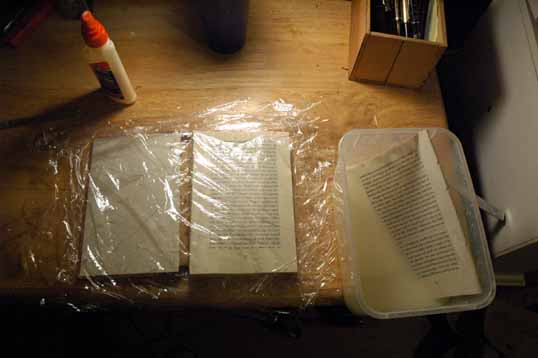
Next, I soaked each of the three groups of pages in the glue. This was pretty hard - trying to get the glue between all the pages. Then I stacked them up, with plastic between each group so they wouldn't stick together, and weighted them down to dry.

This was the part that didn’t work too well. I thinned the glue too much and it didn’t stick like I wanted it to. Also, anyone that has experience with water-based adhesives will recognize that once the pages are wrapped in plastic and weighted down they will never dry. I had to unwrap them and set them out to dry, which took a long time. I have to think of a better way to do this.

I’m thinking of epoxy resin thinned with alcohol – though that would be a real fire hazard. I’ll work on it.

When you look online, most folks only spread glue on the outside of the pages and then cut down through with a razor knife. I wanted to go a little more serious than that – I wanted to glue the pages together into something like a block of wood and then cut the center section out with a band saw.

I traced the outline of the Kindle on the center section and then cut it out on the bandsaw. One edge is open - the book spine will go there and keep the Kindle from falling out.

Again, here, I didn’t do as good a job as I should. You can see that the paper wrinkled as I was cutting. Plus I was in too much of a hurry and didn’t mark or cut the outline as neatly as I would have liked. It works great, but looks a little ragged. I’ll be more careful next time.

Then I glued the cut out center section to one of the end pieces and then glued both end pieces to the cover boards.

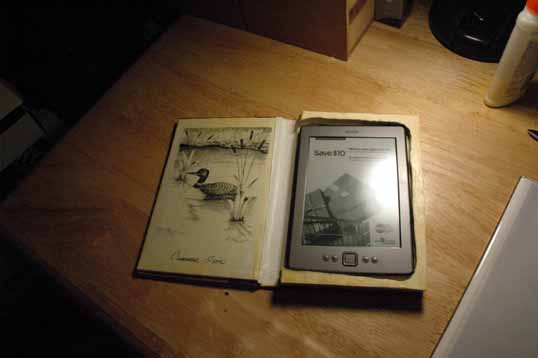
At this point, I spent some time applying extra glue to the sides of the stacks of paper and to the exposed paper. I thought about lining the opening with thin foam, but the paper itself is a pretty good cushion. After I took this picture I peeled away a couple pages until a nice picture of a duck was displayed. I also cut a piece of good quality paper and glued it over the ragged exposed spine – mostly to give it a bit of a neater look and for a bit of reinforcement.

It took a long time to dry. I couldn’t resist messing with it, but any problems could be fixed with a little bit of glue-water mix.

Finished, with the Kindle inside.

Closed, it looks like a perfectly ordinary boring book.

The only thing left is to put a closure onto it. I thought about concealing small magnets in the glued pages, but that’s a bit more complicated that I want to get this time. I need to go to a fabric store and buy some elastic so I can drill a couple holes and install an elastic closure, Moleskine style. I should have done this before I glued the pages to the cover boards, but I didn’t think of it.

I’ll use this for a while, and then, if it works well, I’ll do a second generation – applying what I learned. Hopefully, it will look a bit better and I’ll put in the magnetic closures… that would be cool. Maybe a space for a pen. Maybe a little spot to keep a USB charging cable…

The mind boggles.

Oh, by the way… while I was working on this, I got my old Kindle back. I left it somewhere and the people that found it couldn’t figure out how to get my information off of the Kindle. After about a week they thought of looking in the attached Moleskine Notebook where I had my name, address and phone number. I am very appreciative and thankful they called me and I was able to pick it up. After thinking about it for a while I decided to keep the new, smaller Kindle and let Lee take the old one back to school with him.

Library Book Sale

The Richardson Library had their annual big-ass book sale this weekend down in the crowded basement multi-purpose room. This used to be a massive deal to me. I would get a huge donated shopping bag at the entrance and fight my way along the long tables piled with paperbacks or heaped with hardcovers – the stacks screaming, protesting the weight. I would fill my brown paper bag until the kraft was tearing, pay my fee, and eagerly get my haul home.

Now, though, I have my Kindle. There are more books hiding in that slim slip of plastic than I can possibly read in the few remaining years I have allotted to me. I feel fairly certain that I will pass through this vale of tears with more than a few files left unopened.

Kindle

Call Me Ishmael

Still….

I almost skipped the book sale, but I went more out of nostalgia than any logical purpose – though I do know there are books that I’ve been looking for that are not out in digital format. Plus, it is sometimes nice to have a real, physical paper book – something you can give away or curl up with when your peepers are tired of pixels.

So I eschewed a shopping bag and simply pushed myself past all the enervated shoppers. Once more into the breach.

A good part of the large but cramped basement room was dominated by a handful of families that knew each other. They had a fleet of the massive baby carriers (barely smaller than the aircraft variety) that blocked entire aisles and provided a perch for their pre-reading hellions to reach out their snot-and-saliva encrusted paws and pull teetering piles of books onto the floor while giggling like giddy gibbons. Their slightly older siblings were grabbing stuff out and exclaiming wisdom like, “I only want books about dogs!” or “Are you SURE this is a childrens’ book?” while their mothers clucked loudly at each other with self-satisfaction at the precociousness and preciousness of their satan-spawn procreations.

Finally, after forever, this boiling mass of distraction and pain moved out the front and could be heard arguing over the price of their purchases in the hallway. The sound in the room was reduced to a certain low growl made up of the combined almost-inaudible grunting of the serious bargain hunters scooping up endless tomes that they had never known of until today but could simply not live without. This is a sober business. The air-conditioning, installed under a government lo-bid contract, struggled to cut the heat and miasma of used book mold-spores and bargain-hunting sweat.

So, did I buy anything? You betcha.

Hardbacks were only two dollars and paper seventy five cents. It would be a crime to let this opportunity go unheeded.

I bought a really nice hardback copy of Alice Munro‘s Open Secrets. Someone at work expressed a love of short stories yet had never read any Munro (yeah, I know…). I want to reread “The Albanian Virgin” carefully and outline it – it is the most amazingly structured piece of short fiction I’ve ever seen and I want to try and figure out how she does it.

On a whim I grabbed a paperback collection by John McPhee. This one is called Table of Contents and is a collection of his amazing short non-fiction. I can always read me some McPhee and come out of it knowing something I didn’t before.

After choosing these two light bits of bon-bon I thought for a minute and hauled out a big hunk of meat – the nine-hundred page posthumous magnum opus 2666 by Roberto Bolano. I have had my eye on this gigantic pile of translated text for a bit. For some reason I thought it would be fun to attack it as a fortress of paper rather than a cloud of bytes. Will I ever actually read it?

Probably. If I live long enough. Stick around and find out.

The parking lot had been full and I had to hike almost to the post office to get to my car. A thin older man scuttled by me, on his way in. He stopped and stared at the burden under my arm.

“Hey, I want all three of those books! I was worried they would be all picked over by now!”

He shot off towards the maelstrom of the book sale. If he had waited I would have sold him the three I had… at only a slight profit.

My 99 Cent Manifesto

Press

Press

I am in the home stretch of finishing up the editing and conversion of my book of short stories that I will put out as a Kindle ebook. I’ve been in the stretch run for a while. I’m struggling now with the cover… but mostly I struggle with the fear that putting something out there generates. Nothing to do but plug ahead as best as I can.

I have been thinking a lot about price points – about what I’ll charge for my book when I get it out.

First of all, isn’t it amazing that I’m even getting to decide this? Unpublished, unknown, talentless, loser writers didn’t used to have input on these decisions. The publisher decides.

But publishing, as we know it, is dead. It doesn’t know it yet – though it has a strong suspicion.

The Publishing Industry. I hate it when groups like Publishing call themselves an Industry. (Music Industry, Movie Industry, Television Industry) I’ve worked in Industry and Publishing is not an Industry (Book Printing is an Industry, but you have to go to China to find it). Industry isn’t art – it isn’t creative (not in the usual sense of creativity) Industry is a world of huge heavy smelly machines – a world of maintenance and statistics – it’s a world of hardhats, steel toed shoes, and flame resistant uniforms.

When a group like Publishers call themselves an Industry… they are dead. They have killed themselves. It is only a matter of time. The only thing left is momentum.
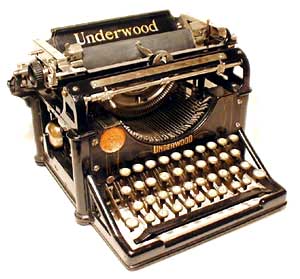
Underwood Typewriter

Underwood Typewriter

So I get to write whatever crap I feel like. And you get to read it. That’s not Industry – that’s the future. The question I have left is, “How Much Do I Charge.”

That’s a tough question. The head swims. To decide, the only way is to break it down, make a few options and choose between them. Eliminate the bottom choices, one by one. OK, that works.

The price points of ebooks don’t take long to figure out. They are:

  •  Really Expensive
  • Ten Bucks
  • Two Ninety Nine
  • Ninety Nine Cents
  • Free

The top choice, Really Expensive, is easy to eliminate. I’m nobody. I’m not selling a textbook or legal reference full of knowledge that is extremely valuable to an extremely small group. So, Really Expensive is out.

trs80

TRS80

Now, we are down to the affordable options. Why not free? This is my first ebook – all I’m really interested in is getting it out there. The idea is to get as many readers as possible, and then try and keep them. I have more books (already have enough short stories for another volume, and a novel is not inconceivable – I have a killer first sentence) in the pipeline, and a free teaser would help me spread the word.

Free is tempting, but I don’t think I’ll go that way. There is a question of value. A book is a relationship between an author and a reader. That relationship should/must have some value for it to be real and useful. Free is throwing propaganda leaflets from a bomber’s bay, free is a blog, free is a mimeographed sheet stapled to a telephone pole. These are all good things, important things, but that’s not what I want this time around.

What I want is terribly nebulous but it I feel it has to involve a transfer of value for it to truly occur.

That leaves ten, two ninety nine, and ninety nine cents.

Ten is tempting. That’s what I think an ebook should cost. That’s what I am happy paying for an established author, for something I’m pretty sure I’ll like. For the hours of enjoyment that a good book gives, ten dollars is a fantastic bargain. It even provides a nice return for the author.

But ten dollars is still a lot of money. Especially in this day of terrible tribulations and looming financial collapse a ten dollar purchase is a tough call (or at least it should be). I’m not established, I’m no sure thing, I’m not very good.

Ten dollars is too much.

Now we are down to two options. Two ninety-nine. Or ninety-nine cents.

Two ninety-nine is a great option. That’s the price (more or less) that Amazon kicks the author’s royalty up to 70 percent. My return on a book sold at that point is twice what it would be at only a few cents less. It’s not a lot of money. I feel sure that this is what I’ll charge for my second book, if I live that long.

Three bucks – a hamburger… a drink at happy hour in a bar… a bag of chips… or so. It is an odd amount of money… sort of in between.

Still, two ninety-nine… that’s not an impulse purchase. You have to think about it. It might not be much of a thought, but it is one.

And ninety-nine cents? What’s that? That’s nothing. Click on that link and it’s yours. Don’t even think about it. If it turns out to be crap – so what? You’re only out ninety-nine cents. Less than a dollar. You won’t miss a dollar. You can’t hardly buy anything with a dollar anymore.

Ninety-nine cents. The more I think about it, the more I like it. It’s something, it’s a transfer of value, but otherwise… it’s like a gift from me to you.

It’s like a cheap lottery ticket. Maybe it will be good, maybe not. But if it hits, you’ve got a lot of entertainment for not a lot of money. If it misses, so what? There is even the enjoyment of the momentary fantasy that you’ve found a bargain, something cool that nobody else has. That’s worth ninety-nine cents, right?

Kindle

Call Me Ishmael

I have always loved Kafka. His writing has been a huge influence on how I live my life (God help me). During his life, he published almost nothing. When he died, his final request was to have all his work destroyed (thank goodness, Max Brod decided to ignore his good friend’s dying wish). If Kafka was living in today’s times would he be pumping out ninety-nine cent ebooks? I like to think so. Would anyone be reading them? Probably not.

So there it is. Ninety-nine cents.

I like it.

Stay tuned.