Still More Blooms

“A garden to walk in and immensity to dream in–what more could he ask? A few flowers at his feet and above him the stars.”
― Victor Hugo, Les Misérables

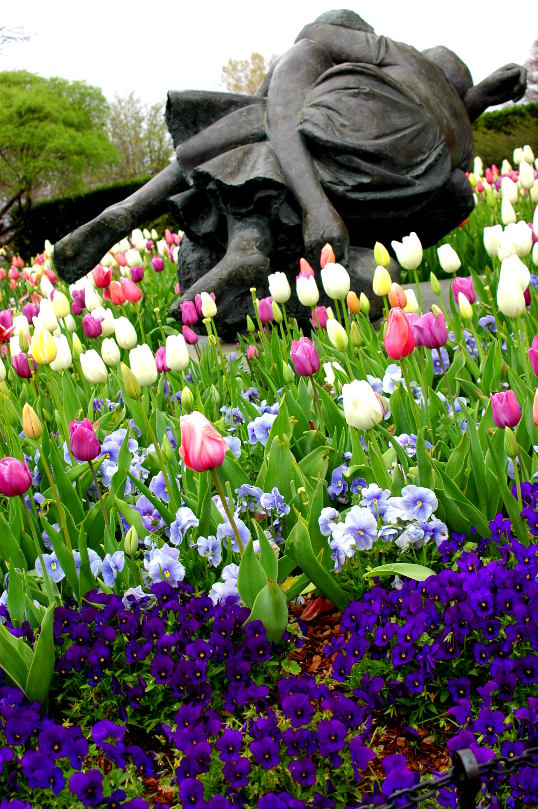
Dallas Blooms, Dallas Arboretum

“A flower blossoms for its own joy.”
― Oscar Wilde

blooms7

“There has fallen a splendid tear
From the passion-flower at the gate.
She is coming, my dove, my dear;
She is coming, my life, my fate.
The red rose cries, “She is near, she is near;”
And the white rose weeps, “She is late;”
The larkspur listens, “I hear, I hear;”
And the lily whispers, “I wait.”

She is coming, my own, my sweet;
Were it ever so airy a tread,
My heart would hear her and beat,
Were it earth in an earthy bed;
My dust would hear her and beat,
Had I lain for a century dead,
Would start and tremble under her feet,
And blossom in purple and red.”
― Alfred Tennyson

Blooms

“You’re frustrated because you keep waiting for the blooming of flowers of which you have yet to sow the seeds.”
― Steve Maraboli

Dallas Blooms, Dallas Arboretum

blooms3

It was odd walking around the Arboretum – I kept expecting to see the Chihuly Glass and it isn’t there any more. The gorgeous colors of Dallas Blooms made up for the absence of the sculptures.

My poor picture taking talents don’t do justice. Peggy does a better job than I do.

“I stopped in front of a florist’s window. Behind me, the screeching and throbbing boulevard vanished. Gone, too, were the voices of newspaper vendors selling their daily poisoned flowers. Facing me, behind the glass curtain, a fairyland. Shining, plump carnations, with the pink voluptuousness of women about to reach maturity, poised for the first step of a sprightly dance; shamelessly lascivious gladioli; virginal branches of white lilac; roses lost in pure meditation, undecided between the metaphysical white and the unreal yellow of a sky after the rain.”
― Emil Dorian, Quality of Witness: A Romanian Diary, 1937-1944

Kissing in the Tulips

blooms5

Dallas Blooms, Dallas Arboretum

blooms6

I posted an entry with pictures of this sculpture before – The Kiss.

The vegetation around it looked a lot different in July.

kiss1_1

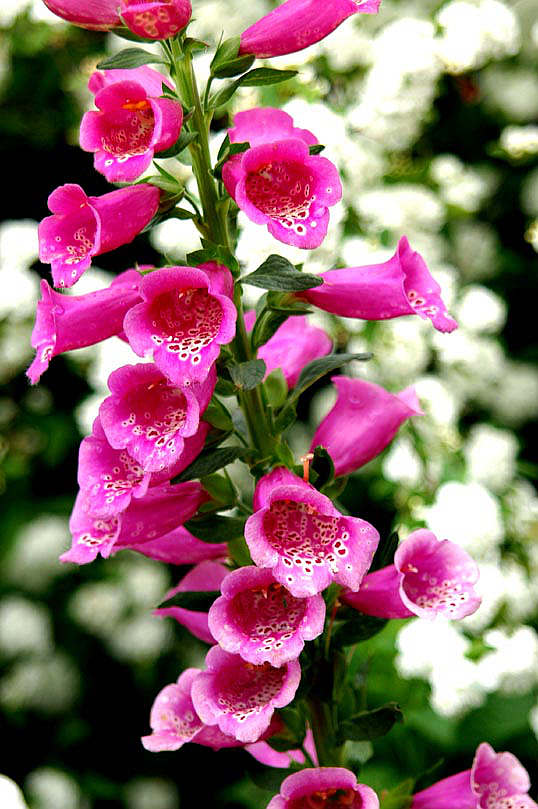
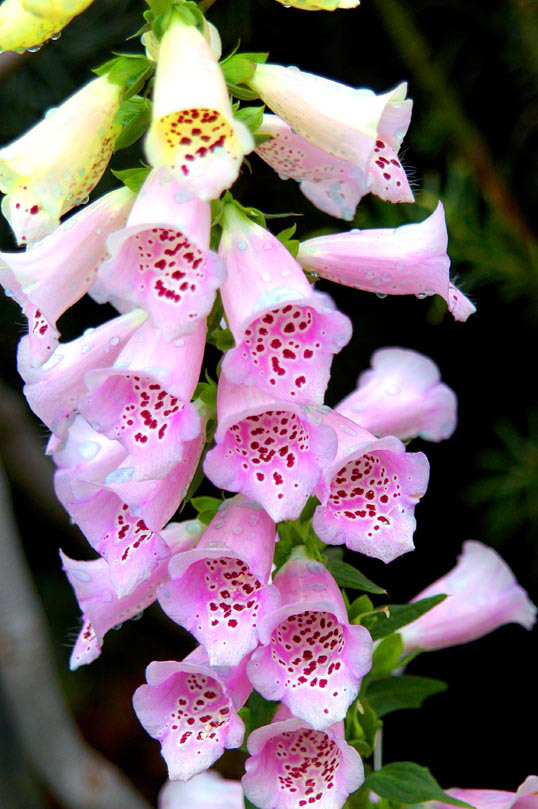
Digitalis

Dallas Blooms, Dallas Arboretum

The Foxglove now in crimson tresses rich
Depends, whose freckled bells to insect tribe
Afford a canopy of velvet bliss.

—-Wordsworth

digit3

A chemical extract from foxglove, digitalis, is both a famous deadly poison and a precious remedy for heart disease. The difference, like everything else in life, is timing and dosage.

In digitalis the gap between poison and remedy is very, very small.

digit1

How did it get its name?

According to the 19th-century book, English Botany, Or, Coloured Figures of British Plants:

Dr. Prior, whose authority is great in the origin of popular names, says “It seems probably that the name was in the first place, foxes’ glew, or music, in reference to the favourite instrument of an earlier time, a ring of bells hung on an arched support, the tintinnabulum”… we cannot quite agree with Dr. Prior for it seems quite probable that the shape of the flowers suggested the idea of a glove, and that associated with the name of the botanist Fuchs, who first gave it a botanical name, may have been easily corrupted into foxglove. It happens, moreover, the name foxglove is a very ancient one and exists in a list of plants as old as the time of Edward III. The “folks” of our ancestors were the fairies and nothing is more likely than that the pretty coloured bells of the plant would be designated “folksgloves,” afterwards, “foxglove.” In Wales it is declared to be a favourite lurking-place of the fairies, who are said to occasion a snapping sound when children, holding one end of the digitalis bell, suddenly strike the other on the hand to hear the clap of fairy thunder, with which the indignant fairy makes her escape from her injured retreat. In south of Scotland it is called “bloody fingers” more northward, “deadman’s bells” whilst in Wales it is known as “fairy-folks-fingers” or “lambs-tongue-leaves”

digit2

The Scottish doctor William Withering, while working as a physician in the 18th Century, had one of his patients come to him with a very bad heart condition and since Withering had no effective treatment for him, thought he was going to die. The patient went instead to a local gypsy, took a secret herbal remedy – and survived and improved. When the doctor found out he searched out the gypsy. The herbal remedy was made from a variety of things, but the active ingredient was the purple foxglove, digitalis purpurea.

Withering tried out various formulations of digitalis plant extracts on hundreds patients, and found that the dried, powdered leaf worked with amazing and successful results. He introduced its use officially in 1785.

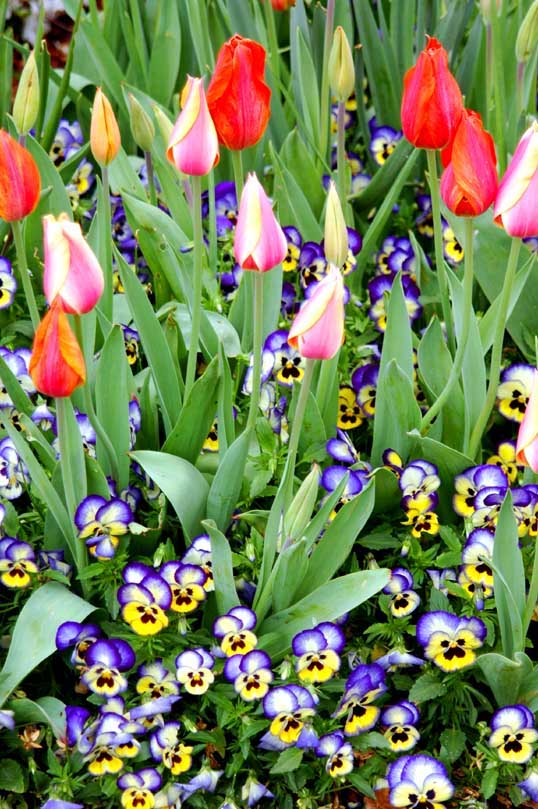
Tulips and Pansies

Dallas Blooms, Dallas Arboretum

blooms1

Spider

“There are spiders living comfortably in my house while the wind howls outside. They aren’t bothering anybody. If I were a fly, I’d have second thoughts, but I’m not, so I don’t.”
― Richard Brautigan, The Tokyo-Montana Express

Louise Bourgeois, Spider

The Sydney and Walda Besthoff Sculpture Garden, New Orleans Museum of Art

spide_w
(Click for full size version on Flickr)

“Spider venom comes in many forms. It can often take a long while to discover the full effects of the bite. Naturalists have pondered this for years: there are spiders whose bite can cause the place bitten to rot and to die, sometimes more than a year after it was bitten. As to why spiders do this, the answer is simple. It’s because spiders think this is funny, and they don’t want you ever to forget them.”
― Neil Gaiman, Anansi Boys

http://youtu.be/JMdWNwOWnng

“There was less than I’d expected in the rainy-day fund that Mom had kept in the bottom of an underwear drawer in a panty hose egg labeled ‘DEAD SPIDERS.’ As if I hadn’t always known it was there. As if I wouldn’t want to look at dead spiders.”
― Adam Rex

Moss

The Sydney and Walda Besthoff Sculpture Garden, New Orleans Museum of Art

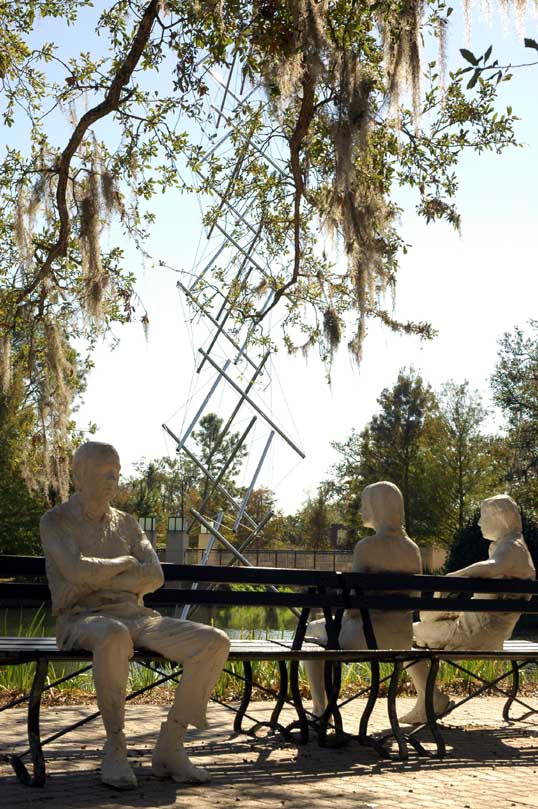
Kenneth Snelson, Verlane Tower

George Segal, Three Figures and Four Benches

.
moss
.
When I was a kid, living in places like the Northeast or the Midwest I became fascinated by Spanish Moss. I don’t remember when I first heard about it…. These were the days long, long before the internet, of course, and even television was only in black and white and hard to see (only three channels anyway) so I would have had to have read about it in a book or maybe seen some in a film.

The thought of a thin, filmy plant growing in the air, hanging from trees, seemed so exotic to me, like it was an alien organism growing on our own earth. I did as much research as I could – which at the time consisted of looking up articles in the various encyclopedias in the school library – and thought about what the stuff looked like in real life.

We were going to move from Kansas to Panama and would be flying out of South Carolina. This would take a long drive, three days – with stops in Memphis and Atlanta. Thinking about the trip, I realized that there would be Spanish Moss along the way. As we moved farther south I eagerly stared out of the window. Somewhere out of Memphis, little bits of fuzz began to appear here and there until once we were close to Atlanta, it was all over the place.

That evening, I walked around our hotel looking at the Spanish Moss. It was everywhere and it was as amazing as I thought. I couldn’t believe that people actually lived in the midst of such wonder and didn’t give it a second thought. The next day, in Charleston, South Carolina, I found even more – it hung thick in the trees like a living cloud, an aerial wave of plant life. I still remember the feeling of seeing the stuff, feeling it in my fingers, looking at it up close.

There is an amazing quality to the curiosity of youth… a passionate sense of wonder.

Now I live in the South and see the stuff all the time…. But when I do I still feel the echoes of those days.

Napping in the Sculpture Garden

I usually take a two hour nap from one to four.
—-Yogi Berra

Sydney and Walda Besthoff Sculpture Garden, outside of the New Orleans Museum of Art, New Orleans

Taking a nap in the Besthoff Sculpture Garden, New Orleans

Taking a nap in the Besthoff Sculpture Garden, New Orleans

“I do not particularly like the word ‘work.’ Human beings are the only animals who have to work, and I think that is the most ridiculous thing in the world. Other animals make their livings by living, but people work like crazy, thinking that they have to in order to stay alive. The bigger the job, the greater the challenge, the more wonderful they think it is. It would be good to give up that way of thinking and live an easy, comfortable life with plenty of free time. I think that the way animals live in the tropics, stepping outside in the morning and evening to see if there is something to eat, and taking a long nap in the afternoon, must be a wonderful life. For human beings, a life of such simplicity would be possible if one worked to produce directly his daily necessities. In such a life, work is not work as people generally think of it, but simply doing what needs to be done.”
—- Masanobu Fukuoka, The One-Straw Revolution

Source Figure

“The reason why I know the Blue Dog is important today, really, is because it relates to so many kids. If you relate something to the children, then you know you’re on something that’s sincere, that’s truth, that’s truth that’ll never die.”
—- George Rodrigue

source

Source Figure, by Robert Graham, and We Stand Together, by George Rodrigue

The Sydney and Walda Besthoff Sculpture Garden, New Orleans Museum of Art

Robert Graham’s bronze, Source Figure, (Graham was well-known as Angelica Huston’s husband until his death)

– in front of We Stand Together… one of George Rodrigue’s  Blue Dogs.

Young Faun

Now that the Chihuly Exhibit is packed up and leaving the Dallas Arboretum, I’m paying more attention to some of the other sculptures tucked in amongst the (now mostly brown) greenery.

I’ve already written about The Neighbor, the Bronze Couple, Playdays, and the fountain at Toad Corners.

There’s more.

Hidden away off a side path in the A Woman’s Garden is “Young Faun” – by Brenda Putnam.

Youn Faun, by Brenda Putnam, Dallas Arboretum, A Woman's Garden

Youn Faun, by Brenda Putnam, Dallas Arboretum, A Woman’s Garden

Brenda Putnam was born in Minneapolis, Minnesota on June 3rd 1890. Her father, Herbert Putnam, was the Liberian at the library of Congress in Washington DC. Putnam first studied sculpture at the age of 15 at the Boston Museum Art School from 1905 – 1907. She then studied sculpture under James Earl Fraser for a year and later enrolled in The Art Student’s League in New York City and at the Corcoran Art School in Washington DC.

Putnam’s first exhibit was in 1911 and in the years following the First World War she was commissioned to do several fountains, sundials and other garden accouterments. She won the Barnett Prize at the National Academe of Design in 1922 and the Wildner Gold Medal at the Pennsylvania Academe in 1923. Up until 1927 Putnam’s work was comprised mostly of children, cherubs, and garden ornaments and in 1927 she traveled to Florence, Italy to study. When Putnam returned to New York she continued sculpting and in 1935 she was awarded the Waterus Gold Medal at the National Academe of Design.

Throughout her career, Putnam was awarded many monumental commissions including: a Memorial to the women of Virginia in Lynchburg, Virginia; the Congressional Gold medal awarded to Fleet Admiral Ernest Joseph King; and the bas reliefs over the visitor’s gallery in the US House of Representatives. Her last large commission was a bust of Susan B. Anthony done for New York University in 1952.

Brenda Putnam was always an active member of the art community. She was a member of the National Academe of Design, a fellow of the National Sculpture society, and the author of a book titled The Sculptor’s Way.

 
Brenda Putnam, American sculptor, 1890-1975
 

Looking around the web, there are some cool sculptures of that she has done here and there. I need to make a list of these things so I can look for them when I travel. Her work seems to have become more serious and less playful as time went on. She did an amazing work for the 1939 World’s Fair in New York – The Crest – but I have no idea where that would be now. She has a well-known statue, Puck, in the Folger Shakespeare library in DC – it has an interesting history:

From the Wahsington Post:

The Folger’s Happy Mending

By Nicole M. Miller

Washington Post Staff Writer

Thursday, January 10, 2002

For all his mischievous doings and undoings, when it came down to it, Puck couldn’t save his own skin.

It took a bunch of mere mortals to get that job done.

Two years ago, the statue of the Shakespearean sprite that stood outside the Folger Shakespeare Library was in pretty bad shape. Acid rain had been eating away at the marble, and a skateboarder trying to give the imp a high-five had broken off the statue’s right hand.

Now, Puck is back. On Monday the statue, having undergone extensive restoration, will be formally reinstalled at the Folger — this time inside, at the entrance of its Elizabethan Theatre. Since 1932 it had been outside the building, perched above a fountain and facing the Capitol.

But his old fountain perch above the quote “What fooles these mortals be” won’t remain empty. An aluminum copy of the joker from “A Midsummer Night’s Dream” will now face the Capitol. The Folger expects the aluminum to withstand the brutal elements.

“There’s no way we could have had [the original] repaired and put him back outside. . . . That would have caused further damage,” says Frank Mowery, the Folger’s head of conservation.

Puck’s severed arm has been reattached, his broken fingertips repaired and his blackened curly locks bleached to their original snowy white. He actually returned to the Folger in October but has been sitting in a shipping crate in the exhibition hall. On Monday he will be moved to a new Ohio sandstone base in the theater’s lobby.

It was the nonprofit Save Outdoor Sculpture (SOS), a joint project of Heritage Preservation and the Smithsonian American Art Museum, that got Puck’s makeover underway with an $8,000 grant.

“They gave us the spark to say, ‘Look, guys, this is scandalous,’ ” Mowery says of the statue’s then-declined state.

SOS Director Susan Nichols is pleased about Puck’s return. Despite her organization’s focus on outdoor art, she says, “there are times and reasons that a piece needs to be moved indoors.”

Others across the country also offered financial support for Puck’s restoration. A couple in Oregon who regularly attend their local Shakespeare festival contributed. A Texan who played Puck in a high school production also sent money.

Even Peter Gazzola gave. At age 15, Gazzola posed as Puck for sculptor Brenda Putnam, a local artist and the daughter of then-Librarian of Congress Herbert Putnam. Gazzola sent $50 for Puck’s restoration in 1995 when he was 80, long before the restoration campaign began.

He was inspired to send the money after his son Ronald returned from a trip to Washington with pictures of himself beside the statue. Peter Gazzola, of Rye, N.Y., could see that Puck was already in bad shape.

“When the pictures were developed and I showed them to my father . . . he said, ‘Please fix me,’ ” Ronald says. Peter Gazzola corresponded with the Folger and pleaded that repairs be made. In 1999, he sent $25 more, as did Ronald. But Gazzola won’t see the restoration; he died in June, his son says.

Marble conservator Clifford Craine of Daedalus Inc. in Cambridge, Mass., repaired the obvious breaks, cracks, flakes and discoloration. But one thing couldn’t be fixed: the overall erosion on the sculpture’s surface.

Mowery estimates that one-sixteenth to one-eighth of an inch of Puck’s flesh is gone, exposing many small bumps of crystalline quartz — bits of harder stone that do not erode as quickly as the softer marble.

“You look at a piece like this, and maybe its aesthetics are diminished because it’s weathered. . . . I’d like to make it look new,” Mowery says. But conservationists don’t do that. “It is weathered, and you can’t change history.”

So the bumps remain.

Once the Folger decided it was best for Puck to move indoors, the library wanted to create a suitable replacement for the perch above the fountain. Marble was too expensive, so it turned to aluminum. The windows and doors of the Folger are also covered with aluminum grating.

“We decided we wanted to make the sculpture fit with the aluminum elements of the facade,” Mowery says.

Before returning to the Folger, the original, restored Puck was shipped to the Modern Art Foundry in New York, where a rubberized mold was made for the replica. The mold was exact, bumpy surface and all.

“It looked like he had chickenpox,” Mowery says. The foundry is sanding the replica’s silvery surface smooth. It will arrive at the Folger on Monday.

“He’ll tone down to this velvety gray that’s on the building . . . and look like he’s always been there,” Mowery says.

The price tag for the project is about $60,000, more than double what the Folger originally estimated. The library has has raised more than $40,000, and next Thursday it will host a benefit reception to celebrate Puck’s return.

There are two little hitches. One of marble Puck’s “Mr. Spock” ears, the right one, still has a small chip. Puck’s fingers need a bit more manicuring as well. That will all be taken care of with a final day of touch-ups, Mowery says.

”This will be the last time he’ll need this cosmetic work.”