A Month of Short Stories 2015, Day ten – Hollow

The last two years, for the month of June, I wrote about a short story that was available online each day of the month… you can see the list for 2014 and 2015 in the comments for this page. It seemed like a good idea at the time. My blog readership fell precipitously and nobody seemed to give a damn about what I was doing – which was a surprising amount of work.

Because of this result, I’m going to do it again this year.

Today’s story, for day ten – Hollow, by Breece D’J Pancake

Read it online here:

Hollow

So again today we have a story about work – about work under desperate conditions. Like yesterday‘s The Zero Meter Diving Team we have young men working in the energy industry. It is costing them their lives.

Hollow is the story of a West Virginia coal miner, Buddy. Things aren’t going very well for Buddy, he drinks too much, his lungs are shot, and his girl is looking to leave him and go back to life as a prostitute. The only thing he has going good is that the coal seam is unexpectedly thickening, promising some extra cash.

The author of the story, Breece D’J Pancake, grew up in the doom of the Appalachian coal mines. He shot himself at the age of twenty-six, at the time his first stories were being published.

At the end of Hollow – Buddy tries for a mental escape from his inescapable troubles by going on a hunt. He kills and skins his prey in an expert, methodical fashion. But there is something watching him that he is unaware of.

Something deadly… something waiting.

A Month of Short Stories 2015, Day 4 – Bullet in the Brain

The last two years, for the month of June, I wrote about a short story that was available online each day of the month… you can see the list for 2014 and 2015 in the comments for this page. It seemed like a good idea at the time. My blog readership fell precipitously and nobody seemed to give a damn about what I was doing – which was a surprising amount of work.

Because of this result, I’m going to do it again this year.

Today’s story, for day four – Bullet in the Brain , by Tobias Wolff
Read it online here:

Bullet in the Brain

I have always had a soft spot for Tobias Wolff. First of all – he’s a crackerjack writer. Probably best known for his memoir This Boy’s Life (made into a film starring Leonardo DiCaprio and Robert De Niro); I especially love his short stories. In the Garden of the North American Martyrs is among the best.

Genius.

Plus, there is this little story. He had come to Dallas to speak and read from a new novel, “Old School.” It was part of the Dallas Arts and Letters Live series at the Dallas Museum of Art. I was excited to go.

However, since I have no money, I couldn’t afford to sit in the main auditorium. There were discounted seats in the museum theater, where you could watch the lecture on a large closed-circuit screen. Almost as good as live, but a lot cheaper.

Right before the lecture, I look up, and there is Tobias Wolff standing right in front of me. He had heard about the handful of us in the remote room and come down to get us. He spoke and then led us to a row of seats he had installed in the front row of the auditorium, where we were able to sit.

Pretty damn cool.

Today’s story is Bullet in the Brain.

It is a little bit gimmicky – it reminds me a lot of the classic An Occurrence at Owl Creek Bridge. It’s interesting, especially given Wolff’s penchant for creative nonfiction, that the protagonist/victim is a particularly vile and self-centered literary critic. I’d bet that Tobias Wolff had someone (or more than one) – a particular person in mind and enjoyed writing about him coming to such an ignominious end.

But it is still the work of a genius. As a wannabe writer I was gobsmacked by this simple sentence:

“She looked at him with drowning eyes.”

That is a perfect sentence – I can’t imagine anything else being there.

Someone without the required skills, someone such as I, might write something like:

“She looked at him and he turned away.”

Or:

“She looked at him with a running nose.”

Or worse:

“She looked at him with a triangle of spinach stuck to an incisor.”

Or ever worse:

“She looked at him the way his ex-wife always did and his intestines instantly doubled in knots, causing him to keel over in agony.”

But he didn’t write anything terrible like that. He wrote the perfect sentence.

A Month of Short Stories 2014, Day 26 – In the Cemetery Where Al Jolson is Buried

A year ago, for the month of June, I wrote about an online short story each day for the month. It seemed like a good idea at the time. My blog readership fell precipitously and nobody seemed to give a damn about what I was doing – which was a surprising amount of work.

Because of this result, I’m going to do it again this year.

Today’s story, for day twenty-six – In the Cemetery Where Al Jolson is Buried, by Amy Hempel.

Read it online here:

In the Cemetery Where Al Jolson is Buried

Amy Hempel is one of only a few writers that work exclusively in short stories or other minimalist pieces. I like that. There is truth in brevity. There is efficiency in conciseness. There is power in knowing you don’t have the space to wander around.

In the Cemetery Where Al Jolson is Buried is the very first story she ever wrote. It came from Gordon Lish’s famous writing workshop – apparently in response to the prompt, write about “the ineffable, the despicable, the thing you will never live down.”

I don’t know about writing workshops (I suppose you can learn a lot – but it doesn’t take away the need to write for ten thousand hours) or about writing prompts (an icebreaker or maybe a handy crutch at best) – but this is one hell of a first story.

It’s definitely something that would be impossible to live down (although it’s something any of us would be capable of doing). How do you ask forgiveness of someone that isn’t alive any more? And who else would your really have to ask?

“Tell me things I won’t mind forgetting,” she said. “Make it useless stuff or skip it.”

I began. I told her insects fly through rain, missing every drop, never getting wet. I told her no one in America owned a tape recorder before Bing Crosby did. I told her the shape of the moon is like a banana—you see it looking full, you’re seeing it end-on.

The camera made me self-conscious and I stopped. It was trained on us from a ceiling mount—the kind of camera banks use to photograph robbers. It played us to the nurses down the hall in Intensive Care.

“Go on, girl,” she said. “You get used to it.”

I had my audience. I went on. Did she know that Tammy Wynette had changed her tune? Really. That now she sings “Stand by Your Friends”? That Paul Anka did it too, I said. Does “You’re Having Our Baby.” That he got sick of all that feminist bitching.

“What else?” she said. “Have you got something else?”

Oh, yes.

For her I would always have something else.

A Month of Short Stories 2014, Day 22 – The Nightingale and the Rose

A year ago, for the month of June, I wrote about an online short story each day for the month. It seemed like a good idea at the time. My blog readership fell precipitously and nobody seemed to give a damn about what I was doing – which was a surprising amount of work.

Because of this result, I’m going to do it again this year.

Today’s story, for day Twenty Two – The Nightingale and the Rose, by Oscar Wilde

Read it online here:

The Nightingale and the Rose

There is no wittier writer in the history of the world than Oscar Wilde. I remember reading The Portrait of Dorian Gray as a kid and staring in wonder across the pages at the pithy quotes and aphorisms sprinkled throughout the text. These nuggets of wisdom and bile were a second story concealed within the main book – I had a feeling that Wilde was pouring his real beliefs and feelings into these witticisms as much as into the events of the main text.

The novel feels like it was written by compiling a long, long list of witty barbs – and only then constructing a story as a framework or trellis to display them on.

  • there is only one thing in the world worse than being talked about, and that is not being talked about
  • But beauty, real beauty, ends where an intellectual expression begins.
  • You seem to forget that I am married, and the one charm of marriage is that it makes a life of deception absolutely necessary for both parties.
  • Being natural is simply a pose, and the most irritating pose I know.
  • As for believing things, I can believe anything, provided that it is quite incredible.
  • Every portrait that is painted with feeling is a portrait of the artist, not of the sitter.
  • I can’t help detesting my relations. I suppose it comes from the fact that none of us can stand other people having the same faults as ourselves.
  • genius lasts longer than beauty.
  • The only way to get rid of a temptation is to yield to it.
  • The bravest man amongst us is afraid of himself.
  • It has been said that the great events of the world take place in the brain. It is in the brain, and the brain only, that the great sins of the world take place also.
  • I always like to know everything about my new friends, and nothing about my old ones.
  • Nowadays most people die of a sort of creeping common sense, and discover when it is too late that the only things one never regrets are one’s mistakes.
  • He was always late on principle, his principle being that punctuality is the thief of time.
  • I never talk during music–at least, during good music. If one hears bad music, it is one’s duty to drown it in conversation.
  • Nowadays people know the price of everything and the value of nothing.
  • Men marry because they are tired; women, because they are curious: both are disappointed.
  • She was free in her prison of passion.
  • Children begin by loving their parents; as they grow older they judge them; sometimes they forgive them.
  • To be in love is to surpass one’s self.
  • Women … inspire us with the desire to do masterpieces, and always prevent us from carrying them out.
  • There are only two kinds of people who are really fascinating — people who know absolutely everything, and people who know absolutely nothing.
  • There is always something ridiculous about the emotions of people whom one has ceased to love.
  • We live in an age when unnecessary things are our only necessities.
  • One can always be kind to people about whom one cares nothing.
  • It often seems to me that art conceals the artist far more completely than it ever reveals him.
  • Is insincerity such a terrible thing? I think not. It is merely a method by which we can multiply our personalities.
  • Each of us has heaven and hell in him.
  • I love scandals about other people, but scandals about myself don’t interest me. They have not got the charm of novelty.
  • Sin is a thing that writes itself across a man’s face. It cannot be concealed. People talk sometimes of secret vices. There are no such things. If a wretched man has a vice, it shows itself in the lines of his mouth, the droop of his eyelids, the moulding of his hands even.
  • Each of us has heaven and hell in him.
  • Nobody ever commits a crime without doing something stupid.
  • The husbands of very beautiful women belong to the criminal classes.
  • It is perfectly monstrous the way people go about nowadays saying things against one behind one’s back that are absolutely and entirely true.
  • Women love us for our defects. If we have enough of them, they will forgive us everything, even our intellects.
  • A man can be happy with any woman, as long as he does not love her.
  • I like men who have a future and woman who have a past.
  • Moderation is a fatal thing. Enough is as bad as a meal. More than enough is as good as a feast.
  • I admit that I think that it is better to be beautiful than to be good. But on the other hand, no one is more ready than I am to acknowledge that it is better to be good than to be ugly.
  • Scepticism is the beginning of faith.
  • The only horrible thing in the world is ennui,
  • To get back my youth I would do anything in the world, except take exercise, get up early, or be respectable.
  • The tragedy of old age is not that one is old, but that one is young.

Over the years I have become a big fan of quotations. Oscar Wilde is the never ending fount of the pithy quote. For that, if nothing else, I am grateful.

Today’s story is very short and simple tale – not enough room for any extraneous worlds of wisdom. Alas.

But it starts out as a romantic fairy tale and appears to be so until you reach the final, dying words. Never fear, though – Wilde’s bitter cynicism will not be denied.

“No red rose in all my garden!” he cried, and his beautiful eyes filled with tears. “Ah, on what little things does happiness depend! I have read all that the wise men have written, and all the secrets of philosophy are mine, yet for want of a red rose is my life made wretched.”

A Month of Short Stories 2014, Day 7 – This Sandwich Has No Mayonnaise

A year ago, for the month of June, I wrote about an online short story each day for the month. It seemed like a good idea at the time. My blog readership fell precipitously and nobody seemed to give a damn about what I was doing – which was a surprising amount of work.

Because of this result, I’m going to do it again this year.

Today’s story, for day Seven – This Sandwich Has No Mayonnaise, by J.D. Salinger

Read it online here:
This Sandwich Has No Mayonnaise

So you’ve read Catcher in the Rye, I know you have. Everyone has. Everyone has to – it is a requirement.

And it doesn’t matter if you liked it, or respected it, or hated it… you know Holden Caulfield. If you let your mind go fuzzy for a second Holden ceases to be a literary character and becomes someone you knew, or thought you knew, or was yourself… when you were that age.

Even though everybody reads Catcher in the Rye, most folks don’t read the rest of J. D. Salinger’s writing. Oh, some drudge through Franny and Zooey, or pick up Nine Stories – but most don’t. Beyond that there are the published but “uncollected” stories. These are not readily available in print form – but there is the web – the ultimate source of all wisdom.

So I’ll bet that you, probably, don’t know what happened to Holden Caulfield.

Read the story first, It’s not very long. It’s protagonist is Vincent Caufield, Holden’s brother, as he attempts to solve a problem, a dilemma, involving a truckload of soldiers in a terrrific rainstorm in Georgia one evening. A sticky situation, but Vincent is only half thinking about it… he is mostly thinking about his brother.

So read it, now, and then come back so I can talk about it. Beware, spoilers ahead. Go on, read it.

….

….

….

….

So, Holden Caulfield is dead, (don’t let missing in action fool you, he never appears anywhere again). He’s dead at nineteen, only two years after Catcher in the Rye. Not only that, but This Sandwich Has no Mayonnaise was published six years before Catcher in the Rye – so J. D. Salinger already knew Holden was dead when he wrote the famous book.

How could he do that? How could he be so mean?

Easy, it’s easy. It’s because there is no such thing as Holden Caulfield. He’s completely imaginary. You can kill him, torture him, drive him crazy, leave him old and infirm in an Idaho rest home – anything you want. It doesn’t matter because it never really happens.

As for the reader… do you want to think that Holden survived? Do you want to believe that he eventually appeared somewhere, a little shell-shocked but otherwise as confused and loveable as ever? Well, go ahead and believe it – it’s at true as anything else – this is fiction of the highest order, which is all simply a pack of carefully crafted and well-told lies.

Just be glad you are not in the story, though. Because his brother is stuck there, and for him, Holden is gone, and it’s killing him.

“Gotta wait for the lieutenant,” I tell him. I feel my elbow getting wet and bring it in out of the downpour. Who swiped my raincoat? With all my letters in the left-hand pocket. My letters from Red, from Phoebe, from Holden. From Holden. Aw, listen, I don’t care about the raincoat being swiped, but how about leaving my letters alone? He’s only nineteen years old, my brother is, and the dope can’t reduce a thing to a humor, kill it off with a sarcasm, can’t do anything but listen hectically to the maladjusted little apparatus he wears for a heart. My missing-in-action brother. Why don’t they leave people’s raincoats alone?

The 22 Lost Salinger Stories

Inside the Mind of a Young J.D. Salinger

Holden Caulfield’s Goddam War

A Conversation

Damian Priour, Austin Temple (detail) 2000 fossil limestone, glass, steel In Memory of Buddy Langston 1947-2004 Frisco, Texas

Damian Priour, Austin
Temple (detail)
2000 fossil limestone, glass, steel
In Memory of Buddy Langston 1947-2004
Frisco, Texas

Life consists of making the decision of what you are going to do in the next split second. Nothing else exists other than the process of making that decision and executing it. Everything else is an illusion.

What if I make the wrong choice? What if I choose something that limits my future choices? What if I paint myself into a corner?

I didn’t say it was easy. I didn’t say it was a good thing. All I said is that that is all there is.

I thought that life was pain! I thought that life was suffering!

It is. Pain is choice. It is. Choice is suffering.

But if choice is all there is… and I can choose whatever I want – then I am totally free.

Choice is freedom. Total choice is total freedom. Freedom is all there is.

So I am totally free.

Yes – but if life is pain and suffering and choice is also freedom – then life is freedom.
But freedom is pain and suffering.

Freedom is suffering?

Yes.

I get it.

Yes, you do.

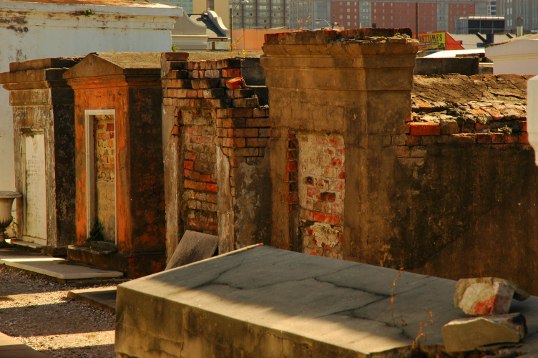
Cities of the Dead

tour1

New Orleans Cemetery – Saint Louis #1

On our last trip to the Big Easy, we signed up for a New Orleans Cemetery tour from Tulane University.

The Cemeteries of New Orleans are famous – when you visit you notice them right away on your drive away from the airport. Because of the high water table, burial in the city is above ground in crypts. If you tried to stick a coffin underground it would come bobbing up in the first hurricane and go hurtling down the street.

The dense clusters of stone crypts packed into rows give the cemeteries of New Orleans the nickname, “cities of the dead.”

All the parents piled in to the bus on the Tulane campus for the trip to St. Louis Cemetery #1. The woman sitting next to us spent her time making desperate phone calls. She was from Rockaway in New York and her house had been destroyed by Hurricane Sandy. She had decided to go ahead and make the planned trip to visit her daughter at school so she could use the Internet to register for assistance while her husband remained behind trying to salvage what he could. There was a lot of irony in a parent from New York coming to see her daughter in New Orleans as a refugee from a devastating hurricane.

The tour was very interesting – mostly because of our tour guide. A spry elderly New Orleans native of French extraction – thick with that amazing melodious Cajun accent – she spoke a lot of the unique way of looking at life (and death) necessary for survival in a place as inhospitable to polite civilization as New Orleans. She spoke of the constant friction between the attitude of the New Orleans natives and the Americans… spoken as if they were aliens from another planet.

She said she didn’t understand the Americans, even though she was glad she was married to one, because, “Darling, somebody has to do the work.” She said, not long after she was married, her husband had to go in to the office on a Saturday,

“Honey, where’re you goin’,” she asked.

“I’m going to work.”

“What do you mean? It’s Saturday. Nobody works on a Saturday!”

The concept was completely incomprehensible to her.

Then she went on to describe the details of a New Orleans internment. She said, “Ah never though this was unusual. I thought everybody did it like this. When I went to another city I was stunned. Ah said ‘You did a hole? And drop a body down there? And cover it up?’ Ah couldn’t believe it.”

You see, I always knew about the above ground crypts in New Orleans, but I never understood the process. You see, these are family crypts – or in some cases, organizational crypts. They are built in two parts, an upper chamber and a lower one. A small opening at the back of the crypt connects the two.

When you die, there is no embalming… and no fancy metal or lined casket – just a pine box. They open the crypt and you go in the top chamber. There you wait, for at least a year and a day, until the next person expires. Then they open up the tomb, secure in the knowledge that the tropical heat and humidity have done their work, and there isn’t much left of you. Any surviving pieces of casket are removed and everything else is pushed back through the opening where it falls into the lower chamber, leaving room for the next occupant.

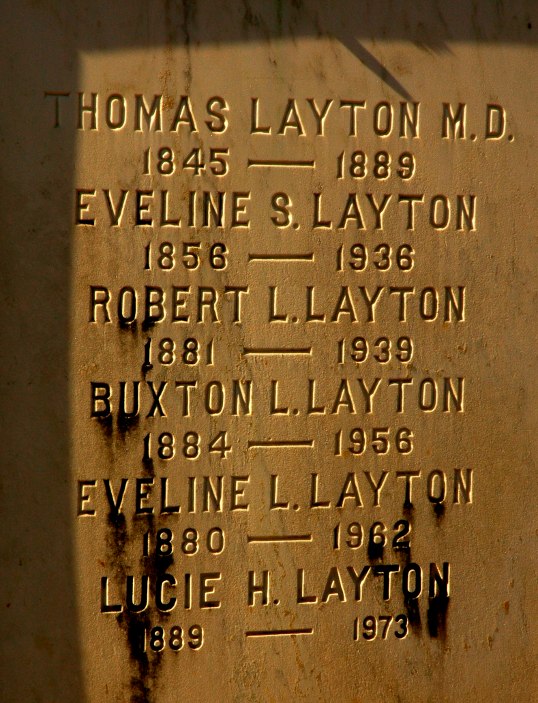
This is repeated as long as necessary. Some of the tombs had dozens of names on them, spanning well over a century.

Some of the details are fascinating. The walls of the cemetery are lined with small “wall tombs.” These are for when, as our guide said, “Somebody dies too soon, before the year and a day. They get stuck in the wall tomb until they can get moved back into the family crypt.”

Our tour guide in front of a typical New Orleans burial crypt.

Our tour guide in front of a typical New Orleans burial crypt.

A street in the City of the Dead. Family crypts on the left, wall crypts on the right.

A street in the City of the Dead. Family crypts on the left, wall crypts on the right.

Older crypts, getting run down.

Older crypts, getting run down.

Wall crypts. Space is at a premium. Look at the tiny spaces at ground level.

Wall crypts. Space is at a premium. Look at the tiny spaces at ground level.

Layton family crypt.

Layton family crypt. Over a century of family members.

Our guide said she was waiting for tomb space to open up and had saved money to buy in. “Space is limited, and in death like in life, it’s location, location location. I don’t want to go to my rest outside the city, I want a tomb in New Orleans.”

When a family dies out, nobody is left to take care of their crypt and it can collapse. Our guide said she had her eye on this spot in case it came up for sale.

When a family dies out, nobody is left to take care of their crypt and it can collapse. Our guide said she had her eye on this spot in case it came up for sale.

What I learned this week, November 23, 2012

My dream is to some day write something that shows up on this list:

The 40 most gruesome deaths in literature

Blood Meridian is my “favorite” – if that’s the right word.

The fates of The Kid and Judge Holden are irrevocably intertwined. Although Holden slaughters The Kid (by now The Man) in an outhouse, we’re spared the repugnant details. We’re not spared the reactions of those that spy the hideous scene. The Man’s death was not a quick, nor was it a pretty affair.


This man is my hero.

When I watch that video, it’s amazing how many of the things that make Dallas livable are a direct product of this guy’s work.

One thing I thought interesting is that, as an example of what Dallas has that is bad – he showed a photo of the High Five interchange. What he didn’t know/mention is that underneath that giant monstrosity is a really nice bicycle trail. When they built the High Five, they thought seriously about providing alternative transport and added a way to cross both 635 and 75 – two of the frustrating barriers to alternative transport in our area.

It’s also a pretty darn impressive route to ride – along a little urban creek with almost a billion dollars worth of five layers of roadway stretching upwards hundreds of feet overhead.

The problem was that the cities on either side didn’t provide the support to build access to the High Five trail for years after it was built. Now it’s connected, but not as well as it should be.


20 Small Things In Life That Are Absolutely Delightful


IT’S TIME TO REFLECT WELL ON DALLAS:

A CALL TO ACTION

Over the past 14 months, as this issue became known and stories about the damage Museum Tower is doing to its neighbors have appeared locally and nationally, many of you have asked us what you can do to encourage a positive resolution. If you live in the city of Dallas, I would ask you to make your Dallas city council representative aware of your opinion, whether by letter, email, or telephone. If you live outside of the city and care about Dallas’ cultural institutions voicing your support and opinion to our elected officials is also welcome. The leadership of Museum Tower needs to recognize their responsibility to our community, and your council representatives can play an important role in resolving this matter.

I’d like to reaffirm that we at the Nasher are advocates for the development of the Arts District and support the goal of Museum Tower to add residencies to this neighborhood. Ray Nasher has given our community an incredible gift by building an unparalleled museum in the heart of the Dallas Arts District and making his extraordinary collection accessible to all. The Nasher is an invaluable educational, cultural and economic resource for the people of Dallas and visitors from around the world and we need your support and your voices to ensure its future contributions to the region.

With thanks, as ever, for your interest and support,|
Sincerely,
Jeremy Strick
Director
Nasher Sculpture Center

If you would like to share your thoughts please contact support@nashersculpturecenter.org

The deadly solar rays burning down from the Museum Tower onto the Klyde Warren Park. The tower builders say this is not a problem, but take my word for it, it was nasty.

This bright shadow on the wall of the Nasher sculpture garden is not cast by the sun, but by the reflection off the Museum Tower.


Why are fountain pen sales rising?

Why? Because they are cool, that’s why.

You might expect that email and the ballpoint pen had killed the fountain pen. But sales are rising, so is the fountain pen a curious example of an old-fashioned object surviving the winds of change?

For many people, fountain pens bring back memories of school days full of inky fingers, smudged exercise books and piles of pink blotting paper.

But for others, a fat Montblanc or a silver-plated Parker is a treasured item. Prominently displayed, they are associated with long, sinuous lines of cursive script.

…..

Sharon Hughes, a buyer for John Lewis, says people relish returning to solid, traditional objects to make sense of a difficult and complex world.

“They are an old-fashioned thing but people like the personal touch. It is nice for things to be handwritten and not having everything via email,” she says.

According to Eva Pauli, from German manufacturer Lamy, the digitisation of everyday life has led to a change in writing by hand.

“Writing is becoming more and more exclusive and personal. This will probably be the reason that some people speak of a comeback of the fountain pen,” she says.

Sheaffer Pens

Sheaffer Pens


Portland’s cargo bike love and expertise spreads to Texas


Why I Love to Slaughter my Characters

Man is born crying. When he cries enough, he dies.
—Ran
——————————————————————–

As I’ve said before, I can outline too many of my short stories with three cards-

1. Introduce Compelling Character – interesting and fully rounded human that, despite some quirky faults and failings, the reader likes and can identify with.

2. Something bad happens – the protagonist is presented with something that does not go as planned and puts them in some distress – a problem to solve.

3. Protagonist dies. Nothing works, doom descends and the main character dies an ignominious, painful death.

They aren’t all like this, but this is what I like to shoot for. It’s just that sometimes my characters refuse to do what I tell them to and, despite my best efforts, they get lucky, scrape by with the skin of their teeth, and survive.

Everyone tells me I’m a terrible person because I take so much joy in butchering my heroes and heroines, especially since they are sometimes such nice people. Some ask me why I do that. I do it because I like it. I do it because I can. I do it because it doesn’t hurt anybody.

These are fictional characters. They are not real. Everything is a lie. Writing this stuff is a lot of hard work, time that I should be spending in useful money-making activities – so I want a payoff. Since I can do anything, doesn’t it make sense to do what I can’t ever do in real life? Death! Off with their heads!

The idea is to kick it up a notch, isn’t it? What possible reason is there not to kick it up as far as it will go. Turn those amplifier knobs to eleven.

Yell

Yell

It’s the same thing if you are reading. It takes time to turn those pages; time you should be using to interact with real human beings. So if you are choosing to hang out with an imaginary shade instead of a flesh-and-blood person you are going to want to make the best of the situation. So what is the one advantage of befriending fiction, a pack of ghostly lies, over some warm living example of God’s creatures?

You can kill them and nobody gives a shit. Plenty more where they came from. Close those book covers or shut off that e-reader and the pain and mourning is all gone. You can wipe a tear and go make a sandwich-nobody knows any better.

So let’s raise a glass to fictional death. Give a big hearty laugh at the disaster yarn. Let the blood spill and the darkness descend, as long as it is behind the protective screen of those twenty-six letters with the added armor of a few punctuation marks.

There’s too much out here, so lets keep it in there. As much as we can.