Fountainhead , Nasher XChange, Entry Three of Ten

Previously in the Nasher XChange series:

  1. Flock in Space, Nasher XChange, Entry One of Ten
  2. X , Nasher XChange, Entry Two of Ten

Charles Long
Fountainhead
Northpark Center, Dallas, Texas

In keeping with my project of going to all ten of the Nasher XChange sites without using a car, after work I rode my commuter bike over to the nearest DART station, locked it up in a Bike Lid, and took the train down to Park Lane station.

I walked across Central Expressway to get to the shopping center. That felt really strange – Northpark is the cold dark center of the Dallas upper crust car culture. Swarms of honking, smoking metal carapaces jammed themselves along the frontage roads while a thick stream clogged the freeway lanes below.

There were other people on the sidewalks, working their way to or from the mall. A thin trickle of what were obviously employees – from retail, cleaning crew, restaurant workers – dishwashers to waiters, all wearing weary uniforms, trudging home or dragging their way to work, shift after shift.

I waited a long, long time for a walk signal, then crossed the penultimate road. I reached the other side and was moving on down the sidewalk when I heard the distinctive squeal of brakes and skidding rubber on concrete. Then came that awful sound of expensive sheet steel rending – a pop and crunch. A thin rancid cloud of burnt tire treat floated by.

I turned and looked into the mass of automobiles to see the horde slowly sorting itself out with the green light. One young man in an old sedan sporting a very fresh dent in the front grille came slowly sorting himself out of the fray, winding from lane to lane until he escaped the traffic. He made a right turn and I expected him to pull over and wait for his victim, but he suddenly accelerated and then, he was gone… like a fart in the wind.

A hit and run.

It was all too fast for me to think. No chance to make a note of a license, I’m not even sure of the color, let alone the model of the car.

While I walked away I saw a shiny Lexus SUV pull over with its back end smashed. A couple of other cars pulled up beside, and a clot of women piled out, all standing on the sidewalk and gesticulating.

I turned and began to cross the vast parking lot into the cavernous mall on foot.

Fountainhead Charles Long Northpark Center Dallas, Texas

Fountainhead
Charles Long
Northpark Center
Dallas, Texas

Virtual money flowing across the surface of the sculpture. Fountainhead Charles Long Northpark Center Dallas, Texas

Virtual money flowing across the surface of the sculpture.
Fountainhead
Charles Long
Northpark Center
Dallas, Texas

From the Nasher Website:

Charles Long, a Long Branch, NJ native, currently resides in Mt. Baldy, CA. His sculptures have explored the abstract autonomous art object as a psychological investigation into the nature of self and others and have been made from diverse media such as coffee grounds, rubber and hair from Abraham Lincoln.

For his Nasher XChange commission, Long plans to create an interactive, waterless fountain entitled Fountainhead that extends his ongoing investigation into the viewer/artwork relationship through the use of new technologies. The installation performs every function of a traditional fountain, only virtually.

Projected images of sheets of dollar bills move serenely down the surface of a sculpted monument, flowing like water, instantly adapting to every nook and curve, accompanied by a serene soundtrack scored especially for it. Three kiosks topped with interactive screens face the monolith and offer an opportunity for visitors to donate money to one of the three designated charities, much like the coins tossed into the Trevi Fountain are donated to charity. After payment is tendered, visitors are encouraged to flick a virtual coin off of the screen toward the sculpture resulting in an exuberant splash of dollars going in every direction. The three designated charities were selected by the artist and Nasher Sculpture Center director, trustees and staff.

“In creating this new work for Nasher XChange I was conscious of the social role that sacrifice has played throughout history. In Fountainhead, I sought to encourage the passerby to give up something of value before an anticipating audience. It’s a bit of harmless fun, yet it echoes ancient public sacrificial ceremonies and it seems pertinent to be doing this kind of sacrifice today in this very popular shopping center where visitors have been seeing public art for decades,” said artist Charles Long. “One of my interests as a sculptor has been to play with the image of value and art, and in this work I wanted to see what a massive fountain of money issuing endlessly forth might feel like as a public spectacle. There is decadence, but then there is this social act of giving. I chose charities proximally close to the lives of the participants so that their giving had a more tangible meaning.”

Nasher XChange will extend the museum’s core mission beyond its walls and into Dallas’ diverse neighborhoods, alongside key community partners, to present advances in the rapidly expanding field of sculpture, raise the level of discourse on the subject within the city, and contribute to broader national and international conversations on public sculpture. As the only institution in the world exclusively dedicated to collecting, exhibiting, and researching modern and contemporary sculpture, the Nasher Sculpture Center is uniquely positioned to investigate this growing practice of sculpture in the public realm.

Nasher XChange also references the history of the Nasher Collection itself: from the time of its early formation, major works from it were displayed at NorthPark Center, the indoor shopping mall created in 1965 by Raymond Nasher, and that tradition of making museum-quality art available for everyday enjoyment continues today. Millions of people every year have the opportunity to experience this fascinating and significant art located throughout NorthPark Center.

Long has been interested in the intersection between art, sound, and viewer participation since he collaborated with the band Stereolab in the mid-90’s to create sculptures with sound components that could be accessed through headphones. In his latest public art piece, Pet Sounds, Long evolved his ideas as new technological possibilities were developed with a special focus on activating sound through touch.

Long is an internationally exhibited artist with more than thirty solo shows at such venues as Site Santa Fe; St. Louis Art Museum; Orange County Museum of Art, Newport Beach; Sperone Gallery, Rome; London Projects, UK; and Tanya Bonakdar Gallery, NYC. Long has taught at California Institute of the Arts, Art Center College of Art and Design, Otis College of Art and Design, Harvard University and currently is faculty and chair of the UC Riverside Department of Art.

Fountainhead Charles Long Northpark Center Dallas, Texas

Fountainhead
Charles Long
Northpark Center
Dallas, Texas

I donated five dollars to the North Texas Food Bank. You swipe your credit card, push the button. There's an artificial splash and the  cash projected on the fountain swirls around in a virtual splash

I donated five dollars to the North Texas Food Bank. You swipe your credit card, push the button. The cash projected on the fountain swirls around in a virtual splash
X , Nasher XChange, Entry Two of Ten

Previously in the Nasher XChange series:
Flock in Space, Nasher XChange, Entry One of Ten

Out of the wide variety of the Nasher XChange art exhibition the sculpture/work that is closest to where I live is X, a sculpture done by Liz Larner on the University of Texas at Dallas (UTD) campus. It’s ten easy bicycle miles, with a trail the whole way. On cold and wet Sunday morning, I bundled up and rode up there – forgetting my map, so I had to wander the campus a bit until I found the sculpture.

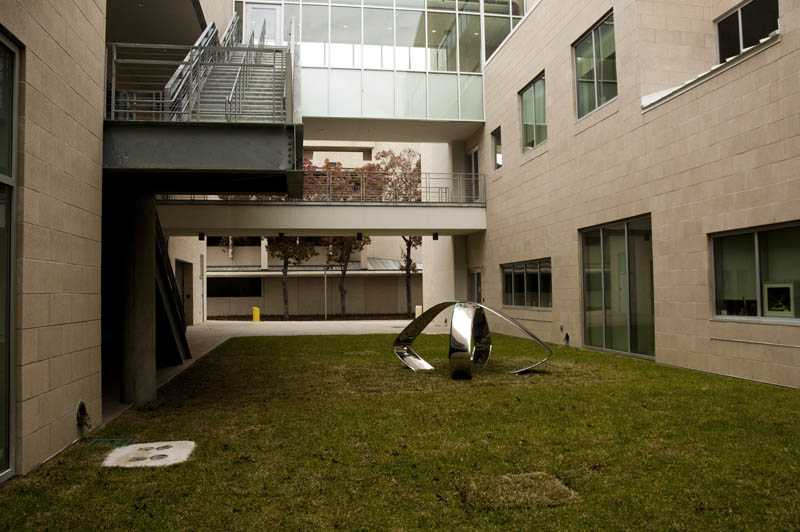
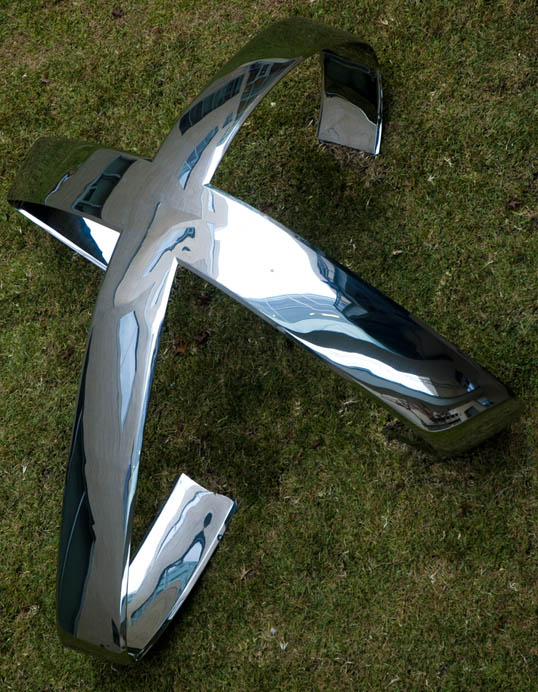
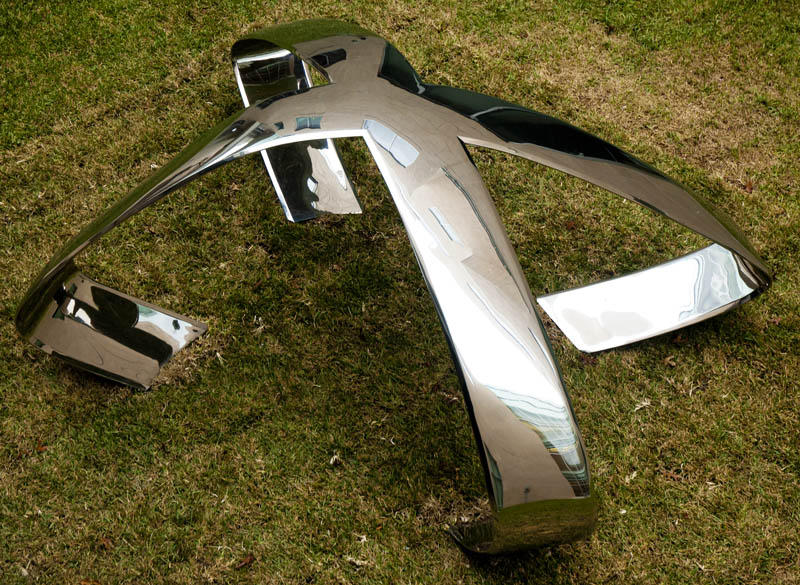
There are actually two versions. A preliminary wooden version sits inside a lobby of the new arts and science building while a polished metal version sits in a deep, narrow grass-covered atrium outside. It’s a surprisingly isolated location – I can’t imagine too many people visiting it there, unless you count the students walking by overhead along some exterior corridors.

In some ways I like the wooden, temporary version better. It seems warmer and more organic – a nice contrast to the abstract mathematical variable qualities of the X.

Liz Larner X,  UTD, Richardson, Texas

Liz Larner
X,
UTD, Richardson, Texas

Liz Larner X,  UTD, Richardson, Texas (click to enlarge)

Liz Larner
X,
UTD, Richardson, Texas
(click to enlarge)

From the Nasher Website:

Liz Larner
Los Angeles, California
X
800 W. Campbell Rd.
University of Texas at Dallas
Edith O’Donnell Arts and Technology Building

Two sculptures elegantly symbolize the intersection of art and technology.

Liz Larner is a Los Angeles-based artist whose work has been characterized by a sustained examination into the nature of sculpture. For Nasher XChange, Larner has created two sculptures for the new Edith O’Donnell Arts and Technology Building as a symbol for the exchange of ideas between these disciplines. Arts and Technology is a new interdisciplinary curriculum at UT Dallas that fosters collaboration at the intersection of the arts and humanities with science and engineering, and is a partnership between the Erik Jonsson School of Engineering and Computer Science and the School of Arts and Humanities.

The innovative X-shape of the sculptures, described by the artist as continuing her “investigation into the open form and the use of line to create volume,” has been developed over several years and could not have been realized without the use of digital modeling technology.

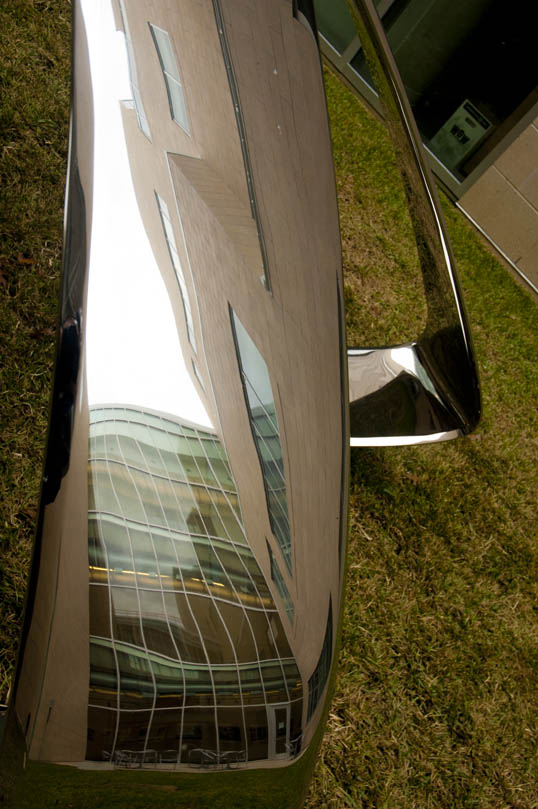
Larner’s experience working both with and without technology intrigued faculty at UT Dallas, and made this pairing a natural fit as the program progresses through its first year. A wood version of the sculpture, on view inside the building, embodies the intersection of traditional sculpture media and new technology. The stainless steel version, being made for the outdoor courtyard, evokes the futuristic and technological, providing a fleeting succession of colors and flashes of light and shadow reflecting the activities and experiences of the building’s occupants and visitors.

Liz Larner X,  UTD, Richardson, Texas (click to enlarge)

Liz Larner
X,
UTD, Richardson, Texas
(click to enlarge)

Liz Larner X,  UTD, Richardson, Texas (click to enlarge)

Liz Larner
X,
UTD, Richardson, Texas
(click to enlarge)

Liz Larner X,  UTD, Richardson, Texas

Liz Larner
X,
UTD, Richardson, Texas

From the Label Text:
Liz Larner
X, 2013
Stainless steel
Courtesy of the artist and Regen Projects, Los Angeles

Los Angeles-based artist Liz Larner engages some of the most intrinsic issues of sculpture, such as the relation of line and mass, or of volume and density, yet she does so in unexpected ways, in a range of materials and techniques. For Nasher XChange, Larner has created two sculptures for the new Edith O’Donnell Arts and Technology Building that can be seen as figures enacting the exchange of ideas between these disciplines. The X-shape of the sculptures, described by the artist as continuing “my investigation into the open form and the use of line to create volume,” has developed over several years and could not have been realized without Larner’s use of digital modeling technology. A wood version of the sculpture, on view inside the building, embodies the intersection of traditional sculpture media and new technology. A stainless steel version, seen here, evokes the futuristic and technological, providing a fleeting succession of colors and flashes of light and shadow reflecting the activities and experiences of the building’s occupants and visitors.

Liz Larner X,  UTD, Richardson, Texas Indoor, Wooden Version (click to enlarge)

Liz Larner
X,
UTD, Richardson, Texas
Indoor, Wooden Version
(click to enlarge)

My Raleigh Technium road bike reflected in the window outside X,  UTD, Richardson, Texas

My Raleigh Technium road bike reflected in the window outside
X,
UTD, Richardson, Texas

Flock in Space, Nasher XChange, Entry One of Ten

In October, I went to a lecture at the Nasher Sculpture Center about the Nasher XChange – a fascinating exhibition of ten varied artistic works spread out across Dallas. Listening to the speakers – one subject they kept coming back to again and again is how big the city is, how spread out the sites of the XChange are, and how much driving they have had to do on this project. They kept talking about Dallas as a “car oriented city” and the way the city seems to consist completely of massive freeways and parking lots.

The lecture was entertaining and interesting and I agree, mostly, with the speakers. However, this is not how it has to be. If you never get out of your car then the city does seem to consist of freeways and parking lots.

It is huge and spread out – but I have learned that if you have a DART train pass and a bicycle, you can get anywhere. I made the decision, right then and there, to visit all ten Nasher Xchange sites without using a car. I immediately took a look at the map and began plotting my routes.

The weather has been nasty this winter which has really cut into my bike riding – plus I’ve been sick a lot (Cedar Fever, actually) so I didn’t get out as fast as I wanted to. As of this weekend, I had been to (or seen) six. There were still three sites in South Dallas that were still on my list.

I worked out a route – take the Red DART line from Richardson to Downtown Dallas, then the Green Line to the Buckner Station. Then I could ride to the sculpture Flock in Space at the Trinity River Audubon Center, then a trail through the Great Trinity Forest on to Black & Blue Cultural Oasis in the Hills at Paul Quinn College. At that point I would turn north and ride through the neighborhoods to the third Nasher exhibit – Buried House. Then catch the DART Blue Line at the Kiest Station – transfer to the Red Line downtows and back home. The biking distance was 12.5 miles – not too far.

But this was a part of the city that I was not familiar with at all. I wasn’t too comfortable with my route; sometimes it’s hard to decide how bad traffic is based on Google Maps – but you have to do the best you can do.

The weather today was not too good, cold with a little spitting rain, but there’s a cold front blowing in and it’s not going to get better soon. The Nasher XChange Exhibition ends soon. So it was now or never.

The only problem I had getting from the train station to the first exhibit – at the Trinity River Audubon Center was the fact that the neighborhood had a lot of folks with pit bulls running loose. I can usually outrun a dog on my bike, but it’s not a lot of fun.

I’m going to have to go back to the Audubon Center again – with nicer weather and more time. The bike trails are really nice. The sculpture was very cool. But I had somewhere to get to so I snapped a few pictures and set out again.

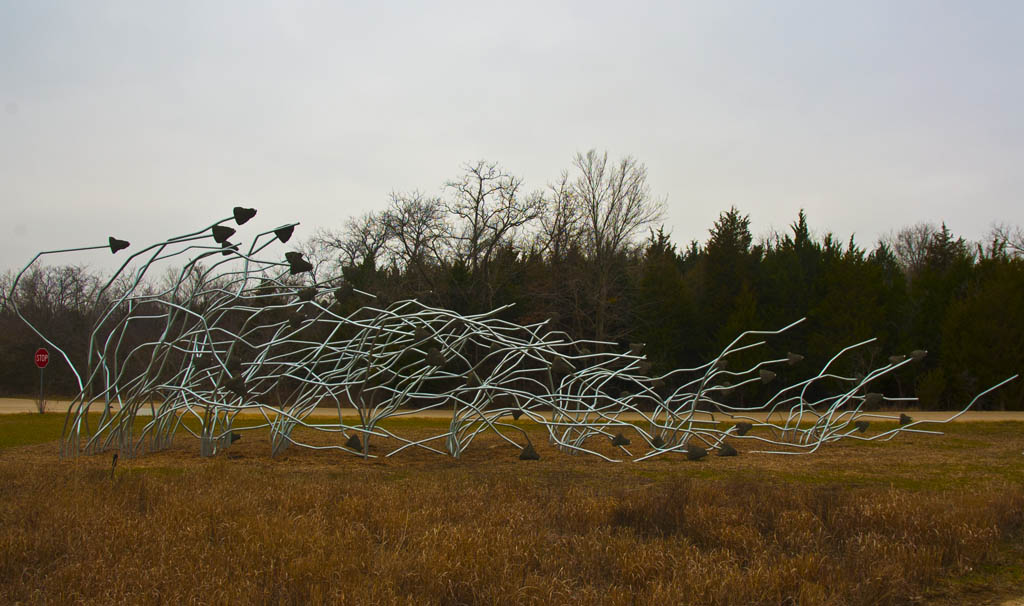
Flock in Space, Ruben Ochoa Trinity River Audubon Center, Dallas, Texas (click to enlarge)

Flock in Space, Ruben Ochoa
Trinity River Audubon Center, Dallas, Texas
(click to enlarge)

Flock in Space, Ruben Ochoa Trinity River Audubon Center, Dallas, Texas (click to enlarge)

Flock in Space, Ruben Ochoa
Trinity River Audubon Center, Dallas, Texas
(click to enlarge)

From the Label Text:

Ruben Ochoa
Flock in Space, 2013
Concrete and steel

Ruben Ochoa is a Los Angeles-based artist who has created a unique body of work that transforms common materials into breathtaking sculptures. For his Nasher Xchange commission. Ochoa has responded to the origins of the rinity River Audubon Center – now a beautiful nature preserve at the edge of the largest urban hardwood forest in the United States – as an illegal dump site in Southeast Dallas. Ochoa has installed a group of concrete and steel sculptures derived from post footings in chain link fences. In conversation with Brancusi’s iconic sculpture Bird in Space, Ochoa envisions his installation as man-made forms morphing into organic movement, reminiscent of a flock of birds. By evoking the site’s change from urban dumping ground to place of scenic beauty, Ochoa’s work reflects the malleability and resiliency of nature.

My commuter bike in front of Flock in Space, Ruben Ochoa Trinity River Audubon Center, Dallas, Texas (click to enlarge)

My commuter bike in front of Flock in Space, Ruben Ochoa
Trinity River Audubon Center, Dallas, Texas
(click to enlarge)

Flock in Space, Ruben Ochoa Trinity River Audubon Center, Dallas, Texas (click to enlarge)

Flock in Space, Ruben Ochoa
Trinity River Audubon Center, Dallas, Texas
(click to enlarge)

The Weird and Wicked World of the Singing Cowboy

One of the surprisingly few times that I regret being poor is when I think about how I can’t afford to support artists or collect works of art as much as I would like… – especially local work.

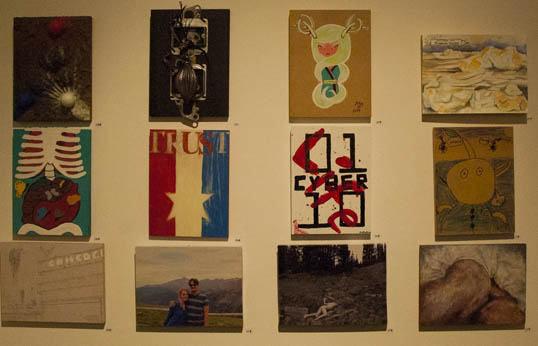
Because of that, whenever an opportunity presents itself for me to pick up something affordable – well, it’s a good thing. For a long time, I have been a fan of Kettle Art in Deep Ellum and the artists they support. So I read about an annual event they put on For the Love of Kettle – I jumped all over it. It’s a fundraiser for the gallery. Participating artists donate a small work which are sold off for 50 dollars each – with the funds going to support the gallery. It is billed as a “competitive shopping event.”

I can come up with fifty bucks. I can pack a sack lunch for a couple of weeks.

On Facebook, over three hundred people has said they were going, but there were only going to be a hundred and fifty works of art. Looking through the selections on the website, I realized that there was going to be a feeding frenzy on this stuff when the doors opened, so I went down there an hour and a quarter early and stood in line. There were only a half dozen folks there when I arrived, but the line stretched out down the block, getting longer by the minute.

Most of the people in the front part of the line were participating artists – it was fun talking to them. Also, a lot of people said that this sale was popular not only for the price, but for the small size of the art. So many said they had art they couldn’t put out because they were out of wall space.

These were my kind of people.

Looking into the windows of the Kettle Gallery, waiting for the show to start.

Looking into the windows of the Kettle Gallery, waiting for the show to start.

Everybody peered through the windows at the art on the walls. The rules of the sale were distributed on little slips of paprer. You had to get the number (printed on the wall beside the painting) of the piece you wanted and then register with the volunteers. You wouldn’t necessarily know if someone had already bought the one you chose until you get to the desk. Later, your name would be called at the cashier station and you would pay. Then, you take your receipt to another desk to get your purchase. These careful rules were necessary to handle the surge of people desperate to buy something.

One woman said she fought somebody for a painting a couple years ago. Wouldn’t that be cool? I’d love to have a painting hanging in my hall that I could boast I punched someone for… maybe a splotch of dried blood on the back for proof.

We all talked about the art we could see from the sidewalk and the works that were in the back room. The cry went out, “One Minute!” and everyone tensed. I began to get nervous – this was going to be a lot of pressure to find and purchase the exact right painting under these competitive conditions. I had a three by five card in my had and a pen at the ready.

The door swung open and we rushed in. I went to a spot I had chosen from outside and started to look at the art up close. Knowing I didn’t have much time, I wrote numbers down on the card – paintings I liked in order… 26, 28, 30, 7, 136. Surely one of those five would be available. The line at the volunteer table was quickly growing so I jumped in. Within three more minutes the line reached the length of the gallery behind me.

A man was standing in line right in front of me. An out-of-breath woman came up and lifted up her phone. They had gone in with a plan. He had grabbed a spot in line while she ran up and down the walls taking shots of the paintings (with their associated numbers) with her phone. Now, the two of them were going over the artworks and deciding which one(s) they wanted to buy.

After a few minutes (I was the twentieth in line) it was my turn. Number 26, my first choice, was available. It was a work I had noticed on the website… and it had looked even better in person.

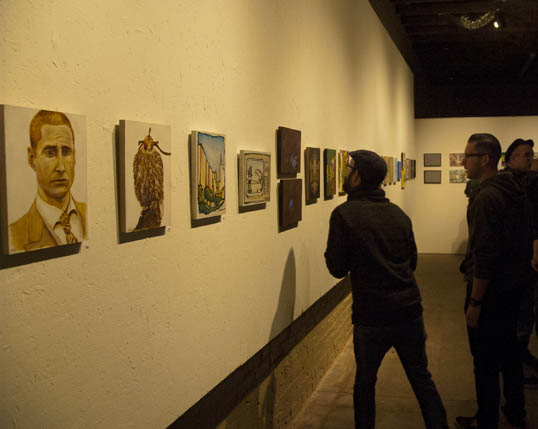
For the Love of Kettle Looking at the art

For the Love of Kettle
Looking at the art

For the Love of Kettle

For the Love of Kettle

For the Love of Kettle

For the Love of Kettle

Now, finally, I had time to leisurely push through the crowd and take a careful look at all of the hundred fifty works. They were all good. I thought that they could have sold them at random and I would have been happy – there were no more than two or three that I actually didn’t like. Still, I was pleased with what I chose.

The crowd was thick and happy. A lot of artists were there and some folks were taking pictures with the artists posing next to the artwork they had bought. That’s pretty cool.

A lot of people crowded into the gallery.

A lot of people crowded into the gallery.

They called my name and I went to pay. Since I was one of the first I had a discount and only paid forty two dollars. I milled around talking to people about what they had chosen, until the paintings were starting to disappear and I turned in my receipt and picked up my artwork.

A row of paintings. I chose the one in the middle.

A row of paintings. I chose the one in the middle.

Clay Stinnett painting on the wall at Kettle Gallery.

Clay Stinnett painting on the wall at Kettle Gallery.

On my way to the door, someone looked at my artwork and said, “Oh, you’ve got the Clay Stinnett,” then he read the text off the front – “Tumbling Tumbleweeds.”

The Weird and Wicked World of the Singing Cowboy by Clay Stinnett

The Weird and Wicked World of the Singing Cowboy
by Clay Stinnett

The title, written on the back, is The Weird and Wicked World of the Singing Cowboy. I really like it.

Clay Stinnett Tumblr
Clay Stinnett’s Honky Tonk Mind
Clay Stinnett Is Painting A Collection of Big Tex On Fire Pictures
Art We Like: Clay Stinnett at Smoke and Mirrors

I’m definitely going back next year… and I’ll be there early and near the front of the line.

Decorated Dumpsters

Why is the dumpster decorated? Who is that in the photo?

Design District Dallas, Texas

Design District
Dallas, Texas
(click to enlarge)

Art is where you find it.

You will never see stuff like this from a car (is that a good thing? maybe) – you are moving too fast and, hopefully, looking where you are going. On a bicycle you move slow (but, unlike walking, you can cover quite a bit of area) enough to see around, to notice things, and to stop and smell the dumpsters whenever you feel like it.

If you look on google maps street view, the dumpsters are there, but they aren’t decorated.

It’s right around the corner from the Faded Sign from the other day.

BTW, that Faded Sign – it wasn’t hard to figure out – it actually says, “Grandale Galleries”

Design District, Dallas, Texas (click to enlarge)

Grandale
(click to enlarge)

Galleries

Galleries

Grandale Galleries Warehouse is a recently defunct discount furniture store… as best as I can figure out.

Ad Astra

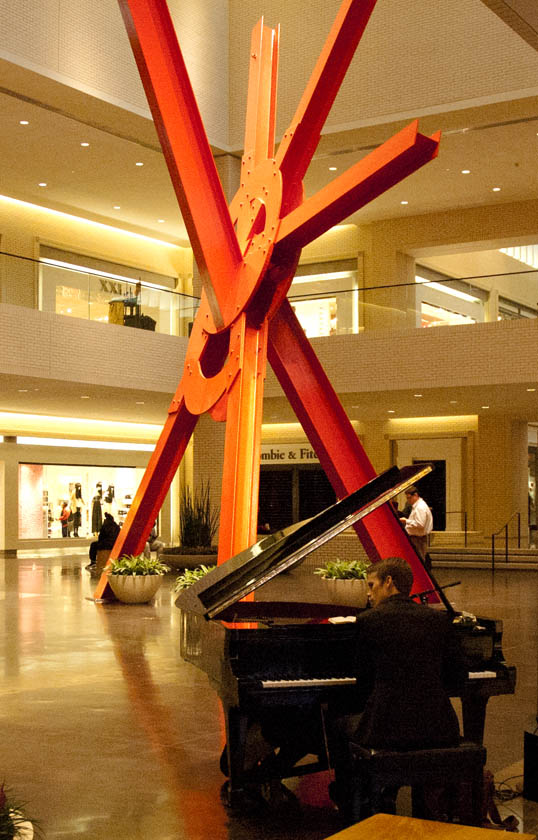
Northpark Center, Dallas, Texas (click to enlarge)

Northpark Center, Dallas, Texas
(click to enlarge)

Mark di Suvero
Ad Astra, 2005
Painted Steel
48 x 25 feet

Other works by di Suvero in the Dallas area – Proverb and Ave

Pamela Nelson and Robert A. Wilson
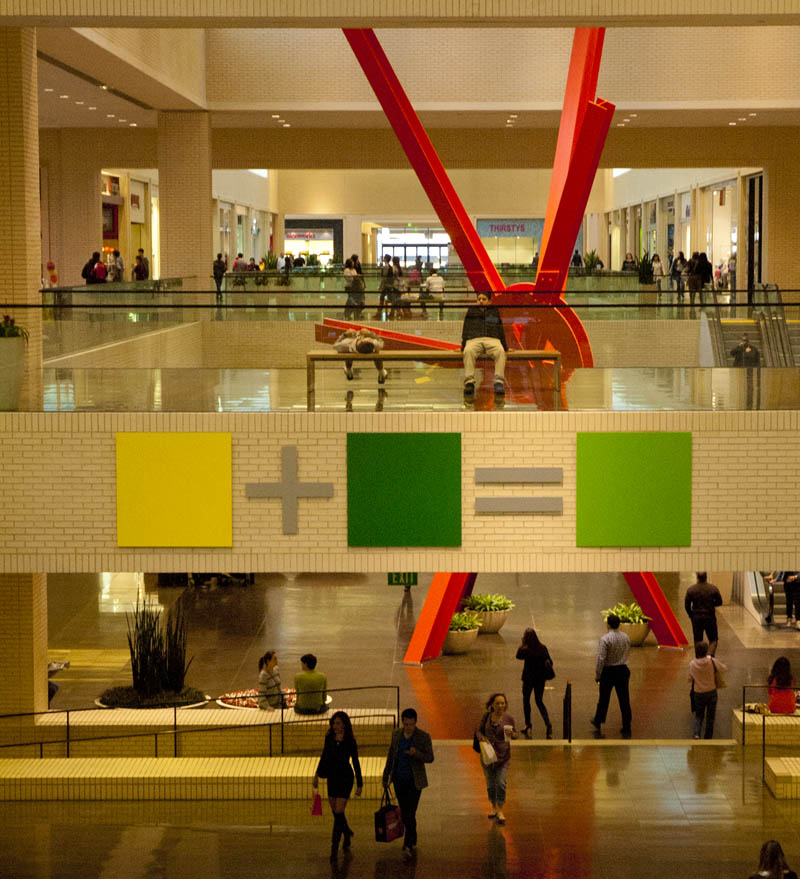
Color Equations, 2007
4′ x4′ Placards (aluminum with glossy vinyl Surface

I took the train to the Park Lane station and walked across Central Expressway to Northpark Center to look at one of the Nasher Xchange sculptures there. To walk to Northpark is a subversive act in itself. It is the epitome of car culture, of consumer culture, of upper crust shopping culture.

I felt like I was an alien, a barbarian spy infiltrating a pecunious fortress.

Of course Northpark is more than a mere shopping experience. It is the heart of Raymond Nasher’s real estate empire and the main source of the funds he used to build his incredible collection of sculpture and his museums, including Dallas’s Nasher Sculpture Center. There are some incredible artworks installed in the mall.

So I had to walk around and look at them. It is a very odd and unique setting for some amazing art. To be there looking at sculpture and not toting little bags with designer names or logos on them…. it was surreal.

Ad Astra, Mark di Suvero Northpark Center Dallas, Texas

Ad Astra, Mark di Suvero
Northpark Center
Dallas, Texas

Ad Astra, Mark di Suvero Northpark Center Dallas, Texas (click to enlarge)

Ad Astra, Mark di Suvero
Northpark Center
Dallas, Texas
(click to enlarge)

Arcady

“In the beginning, God created the earth, and he looked upon it in his cosmic loneliness.

And God said, “Let Us make living creatures out of mud, so the mud can see what We have done.” And God created every living creature that now moveth, and one was man. Mud as man alone could speak. God leaned close to mud as man sat, looked around, and spoke. “What is the purpose of all this?” he asked politely.

“Everything must have a purpose?” asked God.

“Certainly,” said man.

“Then I leave it to you to think of one for all this,” said God.

And He went away.”
― Kurt Vonnegut, Cat’s Cradle

4320 Arcady, Highland Park, Texas - a few months ago

4320 Arcady, Highland Park, Texas – a few months ago

Candy and I sometimes like to go to estate sales. Midweek we receive emails with lists of various sales throughout the city and, if I have time, I’ll go through the list, looking for interesting sales.

I don’t go to the sales so much to buy anything other than the occasional art object (I have enough useless crap already) – I go for the stories. You see, an estate sale – especially one where the owner has passed away after a long and interesting life – is a mirror into the past. It’s a museum displaying a person’s… a complete stranger’s entire collection of heart-ache and the thousand natural shocks that flesh is heir to. These timeless treasures are arranged and papertagged with a string and a price so the slouching horde can shuffle through, pawing at the lot.

It’s an afternoon’s entertainment.

A few months ago, I was clicking through the emails, looking at the collections of photos, trying to find something a little more curious and compelling than the ordinary run-of-the-mill when a certain address caught my eye.

4320 Arcady

I knew where Arcady street was. That’s the heart of the most expensive neighborhood in the most expensive town in the Metroplex – Highland Park. That’s where the rich and famous cavort in their multi-million dollar mansions. Plus, it is mostly old money – the rarefied world of the bloated upscale opulent set – a world I will never see, a life I will never lead. Maybe a glimpse.

I printed a map.

When we arrived, the place was not quite what I expected. The house was beautiful, an old Mediterranean Style two story with a red tile roof. And it was old. For Dallas, it was very old. It was like stepping back into a time machine.

There wasn’t much for sale and that was ancient and worn out. Still, I loved the old house, loved the high ceilings, loved the original windows – opened by metal hand-cranks with cracked ropes leading to sash weights inside the walls, loved the tiny white hexagonal tile in the bathrooms and kitchen (sometimes called “Dallas Tile”) loved the formal staircase, loved the deep wood of the floors… I even loved the thick old dust that coated everything like a blanket of compressed time. I wanted to find out more, so I headed to the huge bookcase that lined one wall of the living room.

There were University of Texas Yearbooks from 1942 and 1943. There were a couple of scrapbooks filled with old cartoons clipped from magazines in the 1950’s along with jokes written in a careful, elegant script (the kind everyone used to write in). Now, I wish I had bought the scrapbooks, but I put them back. Nothing else gave a clue.

I went out to the garage to talk to the person putting on the sale. He said, “The house has already been sold, I heard it was for three million. After this sale, it’s going to be torn down. The buyer is going to put up a new house on the lot.”

That made me sad. I looked down the street at the rows of fake Gothic mansions – all intended to look like English Manor homes shrunk down a little and plopped down right next to each other in the blistering heat of Texas. They all looked the same.

Now, I understand a little. The Arcady house had a tiny kitchen, and only a couple of miniscule bathrooms. That would never do. But it could be saved… a cleverly designed addition… a modern attached kitchen….

No, it would never work. People that live on Arcady street in Highland Park don’t understand uniqueness or preservation. It is an exclusive club they desperately want to join and to fit in you have to live in the proper house.

At home I did some searching. I found that the property had been bought by a builder and he had a replacement already designed by an architect named Wilson Fuqua. Ok.

I also found out who had lived in the house. It was a woman named Catherine Duls. Her father was a well-known Harvard educated attorney named William H Duls. I believe he built the house and moved his family there when his daughter was three. She lived there her entire life until she passed away at the age of 89.

Catherine played tennis at the University of Texas and worked at the SMU law library. Her friends called her Kitty. In her obituary, someone wrote, “ I loved her beautiful voice and Southern drawl, her gorgeous hair and complexion, and her fabulous sense of humor. She was complicated, intelligent, and wise. I appreciated her so very much. She will truly be missed.”

The other day, I had some work not too far away and because the traffic was lighter than I thought, arrived early enough to take a short detour down Arcady.

The house is now a vacant lot.

4320 Arcady, now

4320 Arcady, now

Faded Sign

I an old man,
A dull head among windy spaces.

Signs are taken for wonders. “We would see a sign”:
The word within a word, unable to speak a word,
Swaddled with darkness.

—-from Gerontion, by T.S. Eliot

Design District, Dallas, Texas (click to enlarge)

Design District,
Dallas, Texas
(click to enlarge)

There was a sign here once, on this very wall. I’m sure I must have seen it long ago when I passed this way before, when it was here, when it was whole, when it was relevant… to something. But what was it? What did it mean? Why is it gone now?

What terrible disaster befell the owners of the sign? It might have been a sudden death, an unexpected and unprepared tragedy. Most likely though, it was a slow dissolution over time, a deliberate failing covering decades, sluggish yet inexorable. Like the frog in cool water I imagine the involved never really felt the change, the lazily rising boil, an unseen poach of doom. Or maybe they felt a shadow of cataclysm, a hidden fear, dismissed as paranoia or lack of confidence, or deliberately ignored out of a fearful inability to face the inevitable.

Was it a proud name? A bit of art? Bright colors? A splash of neon phosphorescence? Clever typography?

It doesn’t matter, really. What is gone is gone. Dust is dust.

What you see now is all there is: cracked plaster, empty mounting holes circled with spall, streaks of rust stain on dusty stucco. The cold wind howls by.

Some might look at the bright side – maybe the missing sign is simply an indication that success was so sudden and bountiful the denizens were able to depart for greener shores.

I doubt it, though. This looks like a place that you visit on the way down, not heavenward.

The remains hint at letters, but are indecipherable. The past does not fit well with literacy. Entropy is not lucid.

Then I am on my way again. Maybe some day another sign will grace the wall.

Or at least a fresh coat of paint.