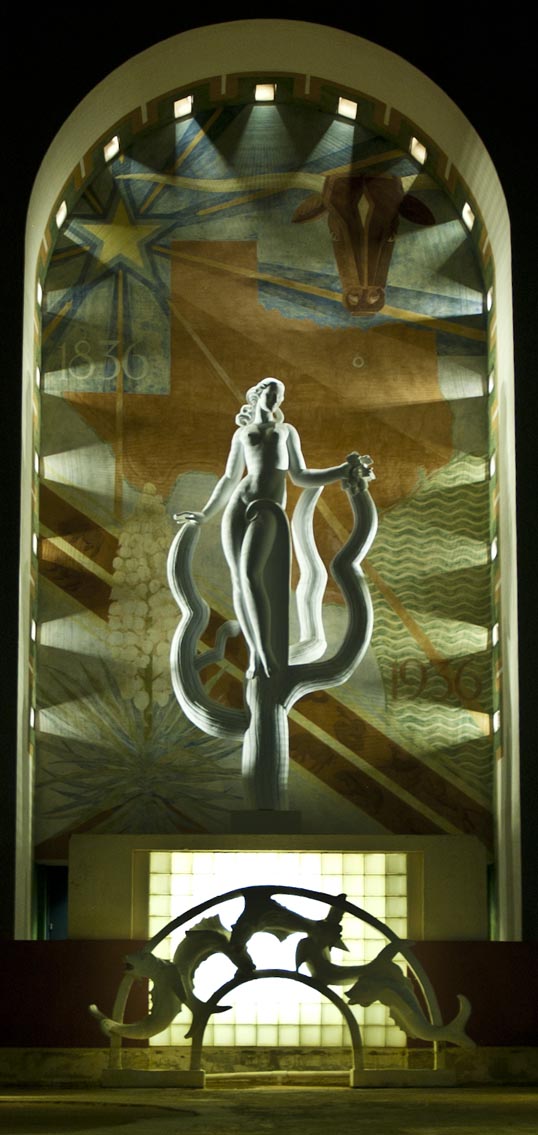
I love the art deco murals and sculptures in Fair Park. My favorite may be the Spirit of the Centennial sculpture in front of the Woman’s Building.
I have seen it in the daylight many times and took some photos of it. But I had never had a good look at it at night. It glows with a preternatural beauty – worth a gander, for sure.
Spirit of the Centennial, Woman’s Building, Fair Park, Dallas, Texas
Spirit of the Centennial, Woman’s Building, Fair Park, Dallas, Texas
The City of Dallas is slowly working on developing the long-neglected river bottoms along the Trinity River. In conjunction with the opening of the Continental Avenue Bridge Park a limited system of hike and bike trails were opened up in the river bottom called the Dallas Skyline Trail.
Map of the Dallas Skyline Trail (click to enlarge)
These trails will eventually be extended to the south to connect up with the Santa Fe Trestle trail once the work on the I45/I30 “Horseshoe” project is finished (if we all live long enough).
For the time being, the 4plus miles in place will have to do. I took the DART train down there to explore. The biggest problem right now is lack of access on the downtown (north) side of the river. I had to ride across the Continental bridge where there is a steep ramp down the levee into the floodplain and the trails. The limited (2) trail heads open now, with one more to open in a few months, is fine if the trail system is used for recreational riding, but if it is to help with car-free transportation, they need more access points.
I rode the whole system and wanted to check out another possible point – on Commerce street, behind the city jail complex. The trail climbs the levee and it may be another spot to get to the system – though it’s hard to find and there isn’t any parking very close.
At any rate, the view from there is nice – in all directions.
Part of the Dallas Skyline Trail. The Commerce Street Bridge, Old Railroad Trestle, Margaret Hunt Hill Bridge. (click to enlarge)
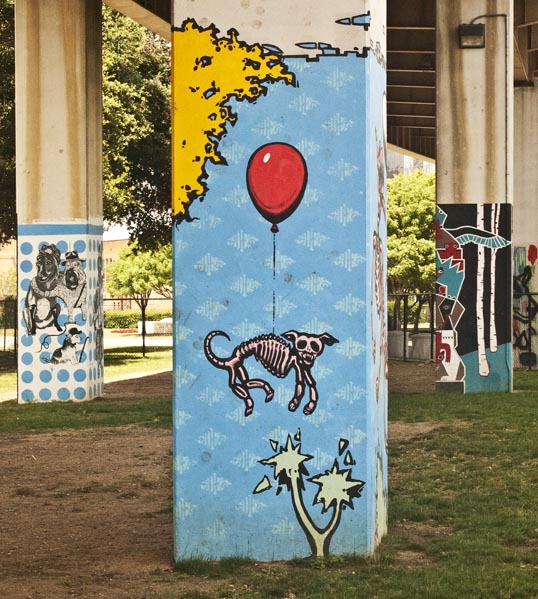
The paved trail climbs the levee. That’s the Commerce Street bridge in the foreground, with graffiti on the pillars, a bit of the old railroad trestle, and the Margaret Hunt Hill Bridge in the distance.
Top of the levee, with the Dallas Jail in the background.
The top of the levee is paved the short distance to Commerce Street behind the sad monoliths of the Dallas Jail and its parking garage.
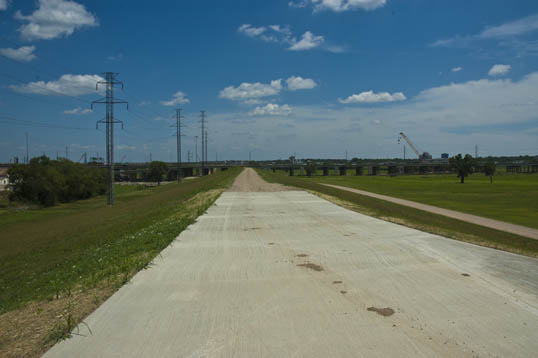
Dallas Skyline Trail on top of the levee.
In the other direction the trail is paved for a short way along the tip of the levee. Beyond is a gravel road which is rideable with a mountain bike.
Trinity River Floodplain
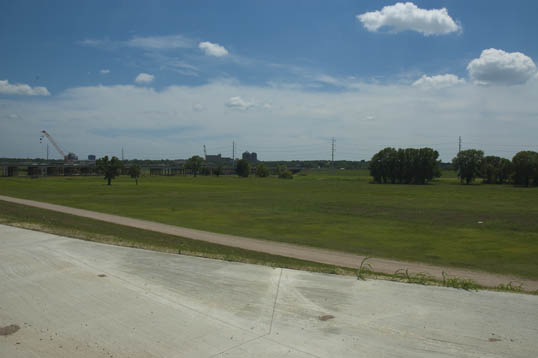
The open floodplain of the river bottoms, across to Oak Cliff. The construction of the Horseshoe can be seen in the distance.
Nice levee top view of Downtown from the Dallas Skyline Trail. (click to enlarge)
To the North, there is a great view of the downtown skyline from the top of the levee.
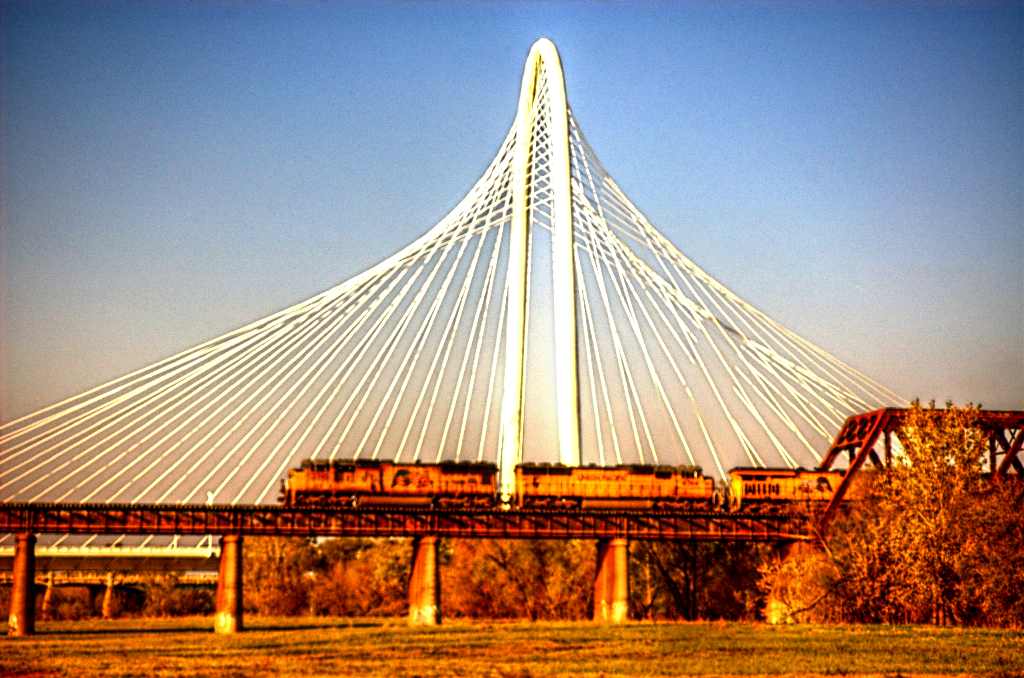
Almost three years ago, while the Margaret Hunt Hill Bridge was still under construction, I took a photo of a train going by on an old railroad trestle next to the new bridge. Now, the city has opened up the beginning of a network of trails in the river bottoms, and I was able to pass underneath that old trestle.
Dallas Museum of Art, Sculpture Garden
Dallas, Texas
Sea Form (Atlantic) Barbara Hepworth (click to enlarge)
“The sculptor carves because he must. He needs the concrete form of stone and wood for the expression of his idea and experience, and when the idea forms the material is found at once. […]
I have always preferred direct carving to modelling because I like the resistance of the hard material and feel happier working that way. Carving is more adapted to the expression of the accumulative idea of experience and clay to the visual attitude. An idea for carving must be clearly formed before starting and sustained during the long process of working; also, there are all the beauties of several hundreds of different stones and woods, and the idea must be in harmony with the qualities of each one carved; that harmony comes with the discovery of the most direct way of carving each material according to its nature.”
—- ‘Barbara Hepworth – “the Sculptor carves because he must”‘, The Studio, London, vol. 104, December 1932
“I have always been interested in oval or ovoid shapes. The first carvings were simple realistic oval forms of the human head or of a bird. Gradually my interest grew in more abstract values – the weight, poise, and curvature of the ovoid as a basic form. The carving and piercing of such a form seems to open up an infinite variety of continuous curves in the third dimension, changing in accordance with the contours of the original ovoid and with the degree of penetration of the material. Here is sufficient field for exploration to last a lifetime.”
“Before I can start carving the idea must be almost complete. I say ‘almost’ because the really important thing seems to be the sculptor’s ability to let his intuition guide him over the gap between conception and realization without compromising the integrity of the original idea; the point being that the material has vitality – it resists and makes demands.”
“I have gained very great inspiration from Cornish land- and sea-scape, the horizontal line of the sea and the quality of light and colour which reminds me of the Mediterranean light and colour which so excites one’s sense of form; and first and last there is the human figure which in the country becomes a free and moving part of a greater whole. This relationship between figure and landscape is vitally important to me. I cannot feel it in a city.”
—-Barbara Hepworth ‘Approach to Sculpture’, The Studio, London, vol. 132, no. 643, October 1946
In college, we managed to score a keg of beer that had been left behind from a Fraternity Party in a cafeteria cooler. It has sat there for well over a year. We threw a big party, tapped the keg, and realized it had gone bad.
“What are we going to do?” my friend asked, “The beer is bad and all these people are coming over.”
“I know,” I said, “Let’s tell everybody it’s Lone Star.”
People would complain about the beer and I’d tell them it was Lone Star – they would nod knowingly and keep drinking.
Even though it was over thirty years ago, I remember the first time I walked into Tango like it was yesterday. I had been living in Dallas for a couple years – living just off Lower Greenville in the Turtle Dove apartments behind the Granada Theater. Farther down the street, in Lowest Greenville, Shannon Wynne built a new nightclub.
It was a huge converted bank building – and it was something else. There was the big main room with a balcony all around – a great place for live music. There was a terrible restaurant in an unbelievably loud room off the balcony. The walls were lined with televisions, all screaming nasty early 80’s rock videos. Then, down a back stairway, was my favorite spot – the Aquarium Bar. This was an elevated dance floor – sort of like a big, rectangular boxing ring, that filled all but a narrow strip around the edge of the room. All night extremely loud dance music would boom from speakers only a couple feet over your head – while the lights spun and flashed. Behind some sort of glass wall costumed dancers would sometimes perform in fish suits… I think.
You had to be there.
I think the wildest night I was there was one concert – Brave Combo opened up for Joe “KING” Carrasco and the Crowns, with Johnny Reno and the Sax Maniacs playing backup. Believe it or not – the last set was filmed (badly) and is still available on blurry Youtube.
(If you have time to watch this video – check out the interviews – a young Mike Rhyner at 5:55 and a very, very young Lisa Loeb at 11:10)
The place was fantastic, but it lost money hand over fist and closed after little more than a year. The bank building was torn down and a Taco Cabana Mexican Fast Food restaurant went up in that spot.
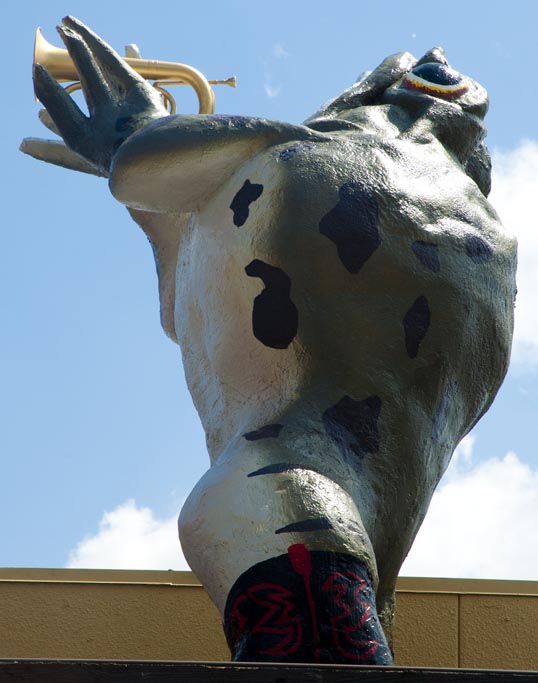
But what most people remember Tango for was the frogs on the roof. While the bank building was being renovated Bob Daddy-O Wade was commissioned to make a half-dozen giant frogs to be placed on the roof. Dallas (at that time, especially) had no sense of humor and the city decided, in its infinite bureaucratic wisdom, that the frogs (two dancing, one each playing the guitar, saxophone, trumpet and maracas) were in violation of the city sign ordinance and had to come down.
and after much hullabaloo they were exonerated and allowed to stay. Not long after that, the place went belly-up and the frogs were sold off.
Three went to the roof of a mega-gas-station south of Dallas. I used to see them down there whenever I drove to Austin and meant to stop and get some pictures (for old times’ sake) but never pulled it off. The other three (guitar, sax, and maracas) went to Chuy’s Mexican restaurant in Austin – then on to the Chuy’s in Nashville, where they still are.
I had to see this. I rode my bike down to the DART station – took the train to the underground CityPlace station and rode the extreme escalators up to the surface. It was a short bike ride on to Lower Greenville where, as clear as could be, were the three frogs up on the roof.
They had hired a talented local mural painter, Stylle Read, to repaint the frogs and bring them back to their state of glory, then mounted them up on the roof.
A lot of people were stopping and taking pictures of the frogs. Talking to them, I was the only person old enough to have actually been in Tango when it was open (most had never seen or heard of the frogs, a few had seen them at the gas station).
It’s sort of a silly thing, but I feel good that they have come home.
Vegetation growing on the wall near the entrance at the Dallas Museum of Art Sculpture Garden.
Dallas, Texas
Dallas Museum of Art, Dallas, Texas
“We are made aware that magnitude of material things is relative, and all objects shrink and expand to serve the passion of the poet. Thus, in his sonnets, the lays of birds, the scents and dyes of flowers, he finds to be the shadow of his beloved; time, which keeps her from him, is his chest; the suspicion she has awakened, is her ornament”
― Ralph Waldo Emerson, Nature












 Bill Chance