The Ways Of Beauty Are As A Honeycomb

“Our house was made of stone, stucco, and clapboard; the newer wings, designed by a big-city architect, had a good deal of glass, and looked out into the Valley, where on good days we could see for many miles while on humid hazy days we could see barely beyond the fence that marked the edge of our property. Father, however, preferred the roof: In his white, light-woolen three-piece suit, white fedora cocked back on his head, for luck, he spent many of his waking hours on the highest peak of the highest roof of the house, observing, through binoculars, the amazing progress of construction in the Valley – for overnight, it seemed, there appeared roads, expressways, sewers, drainage pipes, “planned” communities with such names as Whispering Glades, Murmuring Oaks, Pheasant Run, Deer Willow, all of them walled to keep out intruders, and, yet more astonishing, towerlike buildings of aluminum and glass and steel and brick, buildings whose windows shone and winked like mirrors, splendid in sunshine like pillars of flame; such beauty where once there had been mere earth and sky, it caught at your throat like a great bird’s talons, taking your breath away. ‘The ways of beauty are as a honeycomb,’ Father told us, and none of us could determine, staring at his slow moving lips, whether the truth he spoke was a happy truth or not, whether even it was truth. (“Family”)”
Joyce Carol Oates, American Fantastic Tales: Terror and the Uncanny from the 1940’s Until Now

Construction, Downtown Dallas

We Have To Be Greater Than What We Suffer

“No matter how buried it gets, or lost you feel, you must promise me, that you will hold on to hope and keep it alive. We have to be greater than what we suffer. My wish for you is to become hope. People need that.”
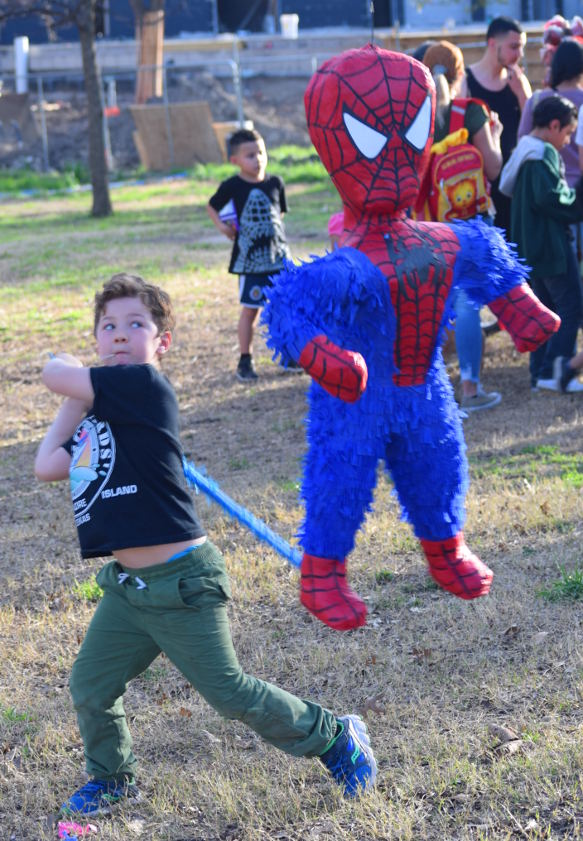
Gwen Stacy, Spiderman

Spiderman Piñata, Kidd Springs Park, Oak Cliff, Dallas, Texas


Spiderman Piñata, Kidd Springs Park, Oak Cliff, Dallas, Texas

Until the Neck Vertebra Begin To Crack

“While serving one of his countless sentences of imprisonment, he was given ex-wrestler Paul as cell companion. Paul was at that time a dock worker; he was in jail for having, during a strike riot, remembered his professional past and applied the grip known as a double Nelson to a policeman. This grip consisted in passing one’s arms through the opponent’s arm­pits from behind, locking one’s hands behind his neck, and pressing his head down until the neck vertebra began to crack. In the ring this had always brought him considerable applause, but he had learned to his regret that in the class struggle the double Nelson was not done.”
Arthur Koestler, Darkness at Noon

Luchadores, Oak Cliff, Dallas, Texas

Pointed Blasphemously At Heaven

“This tower, patched unevenly with black ivy, arose like a mutilated finger from among the fists of knuckled masonry and pointed blasphemously at heaven. At night the owls made of it an echoing throat; by day it stood voiceless and cast its long shadow.”
Mervyn Peake, Titus Groan

Downtown Dallas, Texas

I Don’t Understand How It Subtracts

“I have a friend who’s an artist and has sometimes taken a view which I don’t agree with very well. He’ll hold up a flower and say “look how beautiful it is,” and I’ll agree. Then he says “I as an artist can see how beautiful this is but you as a scientist take this all apart and it becomes a dull thing,” and I think that he’s kind of nutty. First of all, the beauty that he sees is available to other people and to me too, I believe. Although I may not be quite as refined aesthetically as he is … I can appreciate the beauty of a flower. At the same time, I see much more about the flower than he sees. I could imagine the cells in there, the complicated actions inside, which also have a beauty. I mean it’s not just beauty at this dimension, at one centimeter; there’s also beauty at smaller dimensions, the inner structure, also the processes. The fact that the colors in the flower evolved in order to attract insects to pollinate it is interesting; it means that insects can see the color. It adds a question: does this aesthetic sense also exist in the lower forms? Why is it aesthetic? All kinds of interesting questions which the science knowledge only adds to the excitement, the mystery and the awe of a flower. It only adds. I don’t understand how it subtracts.”
Richard P. Feynman

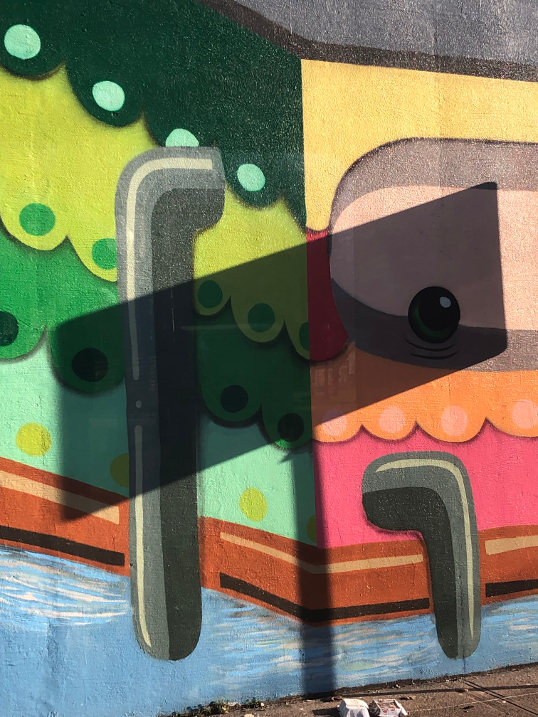
Mural by Sour Grapes Crew (detail) Oak Cliff, Dallas, Texas (taken from Dallas Streetcar window)

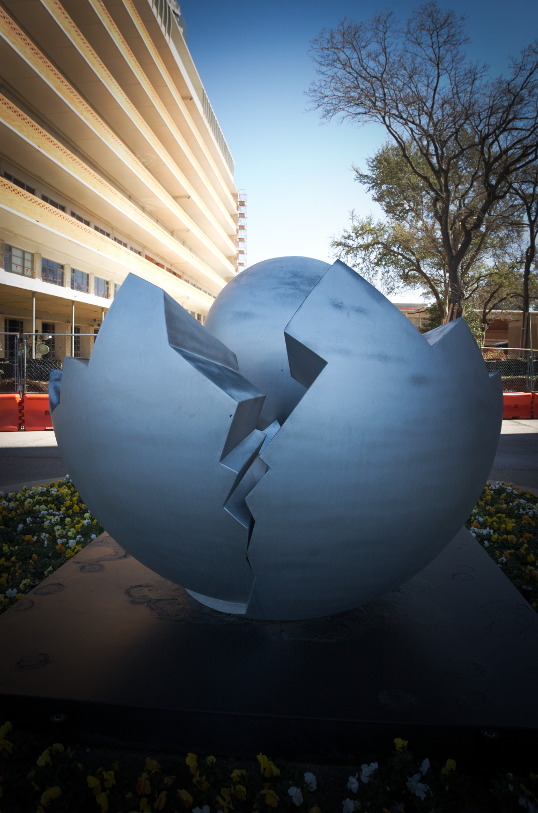
Birth II

“The greatest artist does not have any concept
Which a single piece of marble does not itself contain
Within its excess, though only
A hand that obeys the intellect can discover it.”
Michelangelo Buonarroti, I Sonetti Di Michelangelo: The 78 Sonnets of Michelangelo with Verse Translation

Birth II, by Arthur Williams, Dallas, Texas

Twice over the last decades (2013, and 2019) I have stopped at the Lover’s Lane Red Line DART station to photograph the sculpture there. It’s really cool looking, and hard to find – I imagine it was once more obvious, but the construction of the DART station and the expansion of Central Expressway cut it off. Unfortunately, I couldn’t find a plaque or other sign and had no idea who the sculpture was done by or what its name was. It seems to have been neglected over the years, it is getting a bit ragged looking.

Finally, I dug out a book I bought used a long time ago and have found very useful: A Comprehensive Guide to Outdoor Sculpture In Texas by Carol Morris Little. The sculptures are listed by the name of their sculptors (which I did not know) so it took a bit of page-turning, but I found it.

From the book:

Arthur Williams
American, born 1942

Birth II 1983

Abstract, 7′ x 15′ x7′ 8″ ; welded and pressed steel

Location: 6688 North Central Expressway
Funding: Sullivan Corporation

Comments: Sculpture by Arthur Williams appears in public and private collections throughout the United States. In addition to large steel and cast-bronze sculptures, Williams carves alabaster, marble, and wood. This work and his monumental installation in Galveston are from his Birth series.

It’s cool to finally know something about this sculpture – will have to look for its twin the next time I’m in Galveston.

Birth II, Arthur Williams, Dallas, Texas

The Heart Apparently Doesn’t Stop

“The heart apparently doesn’t stop that easily.”
Haruki Murakami, Colorless Tsukuru Tazaki and His Years of Pilgrimage

Renovation Yard, Dallas, Texas

A Gift You Can Make To Posterity

“The planting of a tree, especially one of the long-living hardwood trees, is a gift which you can make to posterity at almost no cost and with almost no trouble, and if the tree takes root it will far outlive the visible effect of any of your other actions, good or evil.”
George Orwell

Crape Myrtles (or Crepe Myrtles) are one of the few blessings during the toxic summer North Texas Heat. Those beautiful blossoms of a plethora of bright colors are the only thing that looks like it is alive during those months. Those trees (or shrubs) are everywhere in Dallas and everybody loves them. In addition to the blooms, they have these beautiful branches – sinuous and almost animal – like. I have photographed and blogged about them before.

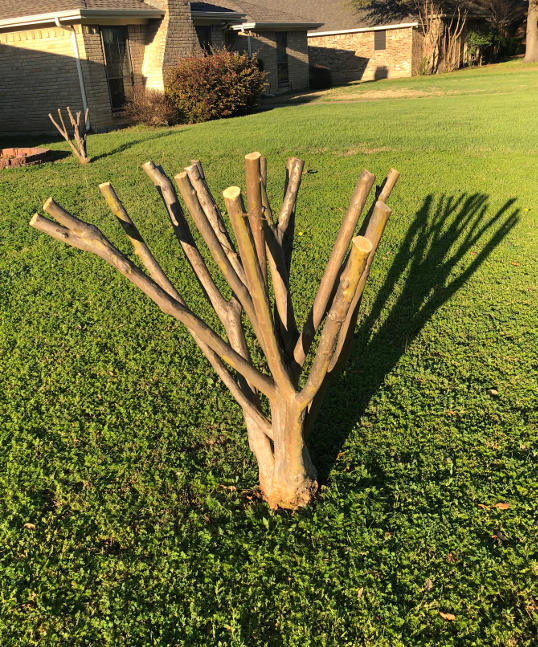
So why the hell do people do this?:

Topped Crape Myrtle, Dallas, Texas

You see this all over the city in the winter months. People chop the tops off their Crape Myrtles. It ruins them. They grow back with a cloud of ugly little branches sprouting out from the cut ends.

Someone that knows much better than I, Neil Sperry, the guru of North Texas plants writes:


Please! Stop Topping Crape Myrtles

I love crape myrtles. No flowering shrub that we grow rewards us so completely, yet requires so little care and attention. Then why must this barbaric chopping persist?

THIS IS JUST NOT ACCEPTABLE!

I have spent an entire career in Texas horticulture trying to get people to STOP TOPPING CRAPE MYTLES! I’ve seen progress in DFW, where many of us have been preaching this gospel. But in the rest of Texas and across the South, and still even in the Metroplex where I live, people are doing it.

I’m going to ramp up my rant. My previous 45 years of trying to be polite haven’t gotten the job done. THIS IS INSANE. There is simply no call for what many of you now call “crape murder.”

I have listened to seemingly every excuse in the world for this barbarism, from “My plant is too tall for the space that I have for it” to “It makes my plant flower better.” It’s all just so much hooey, and I hope you’ll forgive me if my eyes glaze over and my smile seems frozen. I’m thinking about something else. I am no longer tuned in to you.

Whacking the plants back like this does not change their genetics. They’re still going to try to grow just as tall. Topping won’t stop that. All topping will do is leave the plants looking gnarled and ugly. If you have a crape myrtle that’s too big for its spot, either move it – or remove it entirely. Don’t put it and yourself through the misery of topping your crape myrtle each year.


I wonder why people do this and why it bothers me so much. I think the root cause behind both is the concept of Control. What more gratifying Control Of Nature act could there be than beheading your bushes? It must give some people a big rush to be able to cut back and restrict the growth of something so beautiful, innocent, and alive. And I have come, over my decades, to detest Control… especially blind, hurtful, and damaging Control.

So there it is, I drive home from work or ride my bicycle through the suburban streets and am presented with these decapitated shrubbery, these beheaded bushes, these topped trees. It isn’t fun. The winter is bad… maybe the worst… or maybe it isn’t – the spring is horrible as the maimed, damaged, and deformed remains send out their shoots, trying to get back to normal – though they never will. The scars of their maiming are there forever in their distorted forms.

So, you ask me, then how do I trim my Crape Myrtles? Just remove any excess or damaged branches as a whole. That enables them to keep their attractive shape…. Like this:

Properly Trimmed Crape Myrtle, Dallas, Texas

There Was Only This One Lamp-post

“There was only this one lamp-post. Behind was the great scoop of darkness, as if all the night were there.”

D.H. Lawrence, Sons and Lovers


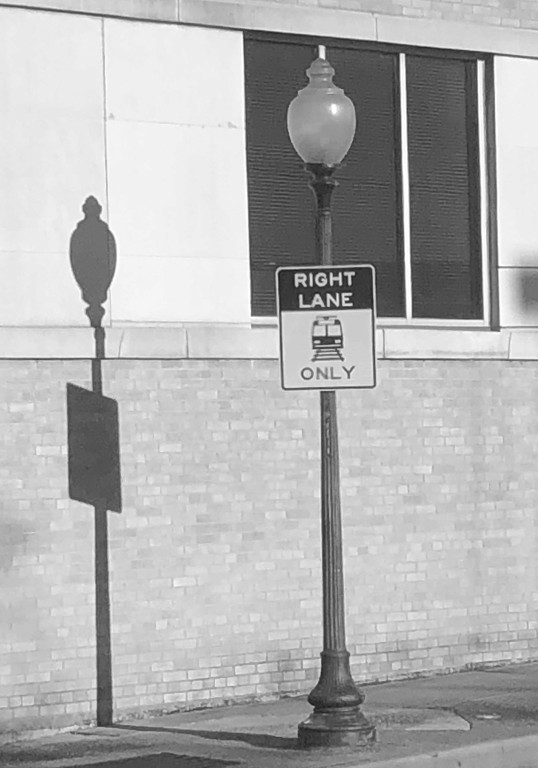
Downtown Dallas, along the streetcar line

Vultures Are the Most Righteous Of Birds

“Vultures are the most righteous of birds: they do not attack even the smallest living creature.”

Plutarch

Dallas Zoo