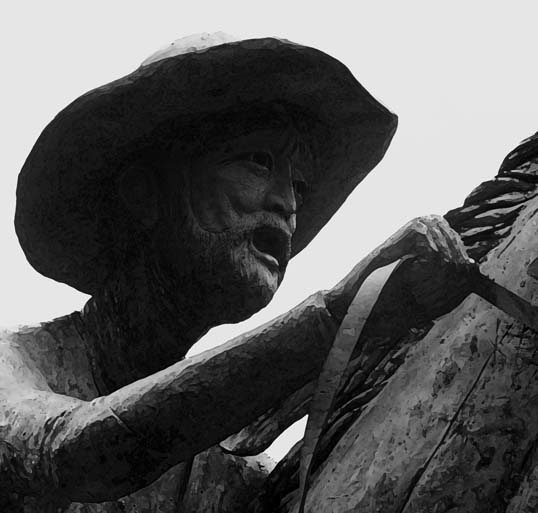
T Paul Hernandez, Austin
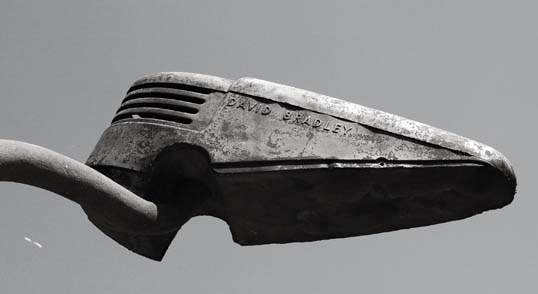
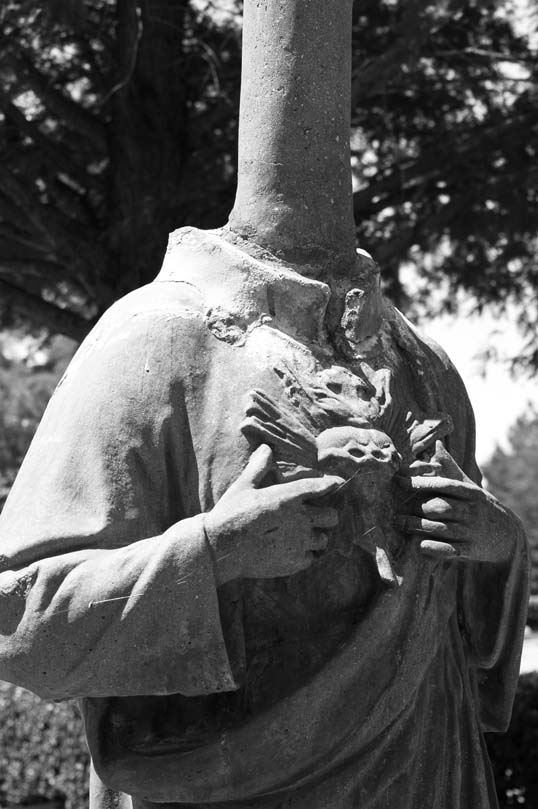
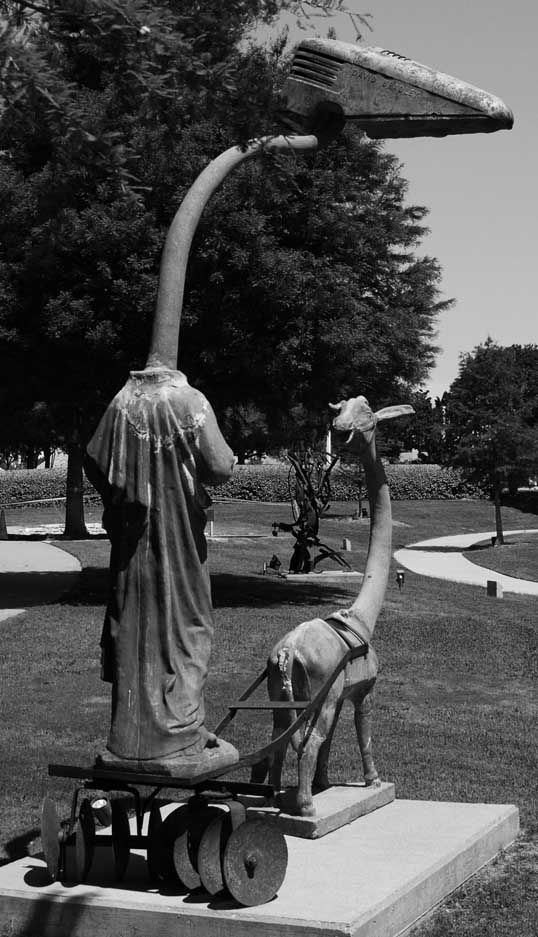
Reincarnation of Farmer Bradley
1999 Concrete, Steel, Paint
Frisco, Texas
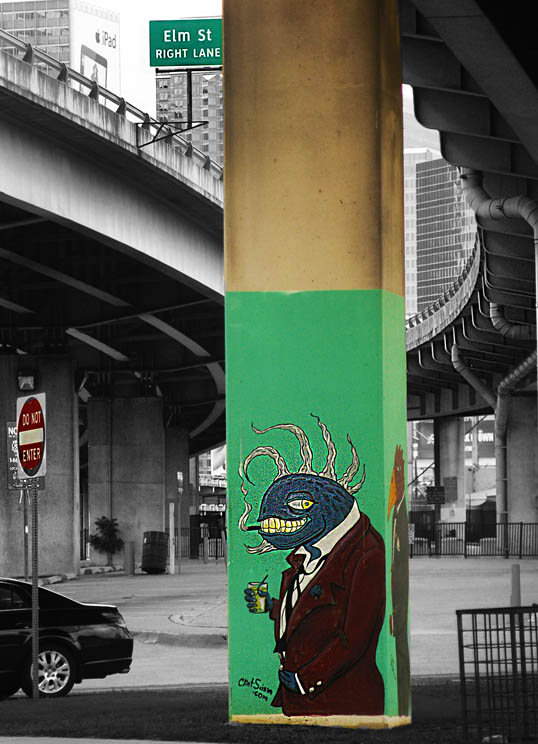
Graffiti
Clint Schism
Art Park
Deep Ellum, Dallas, Texas
Brent’s Arch
Harry Gordon, 1992
Frisco, Texas
Background – Mountain Landscape with an Approaching Storm, Claude-Joseph Vernet, Dallas Museum of Art
“Proverb” by Mark di Suvero, Arts District, Dallas, Texas
It’s behind the Meyerson, visible from Klyde Warren Park. If you’re curious, it’s here.
“A bird in the hand was worth two in the bush, he told her, to which she retorted that a proverb was the last refuge of the mentally destitute.”
― W. Somerset Maugham, The Painted Veil
“People who count their chickens before they are hatched act very wisely because chickens run about so absurdly that it’s impossible to count them accurately.”
― Oscar Wilde
“Three things are too wonderful for me; four I do not understand:
the way of an eagle in the sky,
the way of a serpent on a rock,
the way of a ship on the high seas,
and the way of a man with a maiden.”
― Anonymous, Holy Bible: King James Version
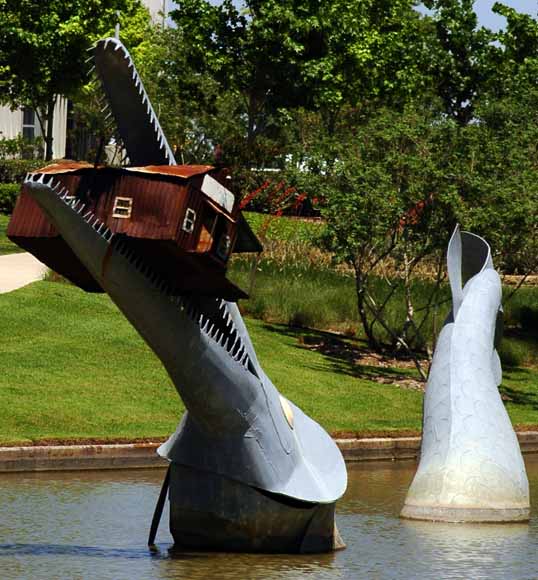
Joe Barrington, American (Texas), The Headlines Screamed, Baithouse Disappears, 2000
Frisco, Texas
If you are curious, it’s Right Here.
Here is Another one by Joe Barrington
“How do men act on a sinking ship? Do they hold each other? Do they pass around the whisky? Do they cry?”
― Sebastian Junger, The Perfect Storm: A True Story of Men Against the Sea
“He remembered the time he had hooked one of a pair of marlin. The male fish always let the female fish feed first and the hooked fish, the female, made a wild, panic-stricken, despairing fight that soon exhausted her, and all the time the male had stayed with her, crossing the line and circling with her on the surface. He had stayed so close that the old man was afraid he would cut the line with his tail which was sharp as a scythe and almost of that size and shape. When the old man had gaffed her and clubbed her, holding the rapier bill with its sandpaper edge and clubbing her across the top of her head until her colour turned to a colour almost like the backing of mirrors, and then, with the boy’s aid, hoisted her aboard, the male fish had stayed by the side of the boat. Then, while the old man was clearing the lines and preparing the harpoon, the male fish jumped high into the air beside the boat to see where the female was and then went down deep, his lavender wings, that were his pectoral fins, spread wide and all his wide lavender stripes showing. He was beautiful, the old man remembered, and he had stayed.”
― Ernest Hemingway, The Old Man and the Sea
“…as the wind howled on, and the sea leaped, and the ship groaned and dived, and yet steadfastedly shot her red hell further and further into the blackness of the sea and the night, and scornfully champed the white bone in her mouth, and viciously spat round her on all sides; then the rushing Pequod, freighted with savages, and laden with fire, and burning a corpse, and plunging into that blackness of darkness seemed the material counterpart of her monomaniac commander’s soul.”
― Herman Melville, Moby-Dick
“You see? I know where every single book used to be in the library.’ She pointed to the shelf opposite. ‘Over there was Catch-22, which was a hugely popular fishing book and one of a series, I believe.”
― Jasper Fforde, Shades of Grey
“I must be in love with this woman, Sumire realized with a start. No
mistake about it. Ice is cold; roses are red; I’m in love. And this
love is about to carry me off somewhere. This current’s too
overpowering; I don’t have any choice. It may very well be a special
place, some place I’ve never seen before. Danger may be lurking
there, something that may end up wounding me deeply, fatally. I might
end up losing everything. But there’s no turning back. I can only go
with the flow. Even if it means I’ll be burned up, gone forever.”
― Haruki Murakami, Sputnik Sweetheart
“There’s nothing in the sea this fish would fear. Other fish run from bigger things. That’s their instinct. But this fish doesn’t run from anything. He doesn’t fear.”
― Peter Benchley, Jaws
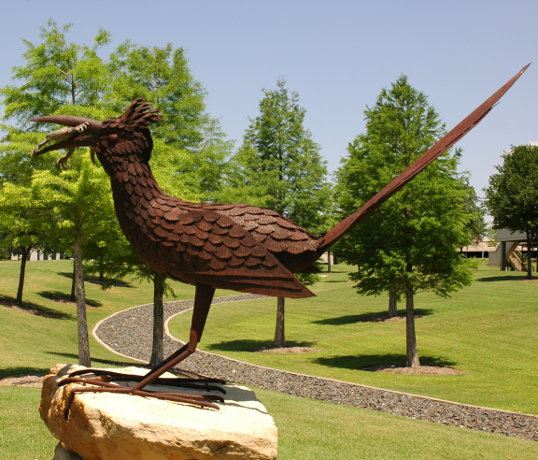
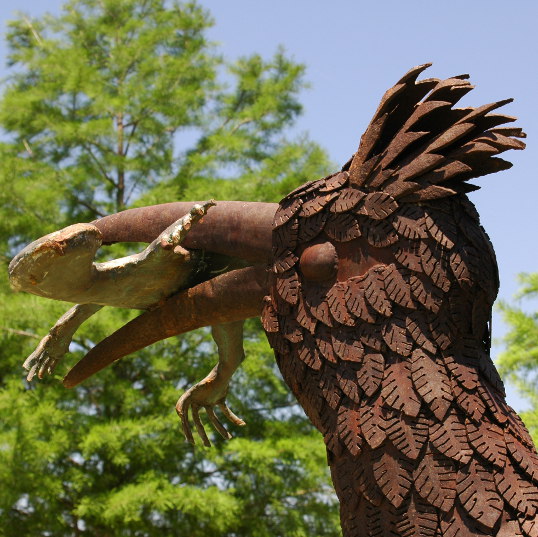
Joe Barrington, Texas, 2000, Roadrunner with Lizard. Frisco, Texas
Dear Warner Brothers,
I am old enough to know what the Beep-Beep is covering up when the Roadrunner gets away from the Coyote.
“I am somewhat exhausted; I wonder how a battery feels when it pours electricity into a non-conductor?”
― Arthur Conan Doyle, The Adventure Of The Dying Detective
Sculpture by Mac Whitney, Cisco
Emergency Generator by Generac
Frisco, Texas
“One of the saddest lessons of history is this: If we’ve been bamboozled long enough, we tend to reject any evidence of the bamboozle. We’re no longer interested in finding out the truth. The bamboozle has captured us. It’s simply too painful to acknowledge, even to ourselves, that we’ve been taken. Once you give a charlatan power over you, you almost never get it back.”
― Carl Sagan, The Demon-Haunted World: Science as a Candle in the Dark
“Invention is the most important product of man’s creative brain. The ultimate purpose is the complete mastery of mind over the material world, the harnessing of human nature to human needs.”
― Nikola Tesla, My Inventions
“Is it a fact – or have I dreamt it – that, by means of electricity, the world of matter has become a great nerve, vibrating thousands of miles in a breathless point of time?”
― Nathaniel Hawthorne
There are few things in life as much fun as falling down a rabbit hole.
Ever since Candy and I went to see Turandot at the Death Star I have been fascinated by the world of Opera and have been learning about it – if only a little bit at a time.
The only problem is that Opera is an expensive rabbit hole and I am broker than broke right now. But there are ways, there are always ways – to be cheap and to find stuff for free. One way to reduce the cost of Opera is to not see it live, but to find simulcast productions. The Met has a series of HD broadcasts and, right now, they are replaying old ones. I was able to score free tickets to a broadcast of Carmen a couple weeks ago, and really enjoyed it.
Before Carmen, they showed previews of upcoming broadcasts and I made note of the wild finale of Rossini’s Armida. Wednesday, after work, even though I was exhausted, I drove up into Plano to watch the repeat broadcast of the opera on a big HD screen at a movie theater there.
The Met’s production, with Renée Fleming and Lawrence Brownlee didn’t get very good reviews (from a Blog, from the New York Times) but it was more than entertaining for my uneducated ears. I especially enjoyed the ballet in the second movement (even with the odd tutu-wearing demons)… maybe that’s another rabbit hole. I enjoyed the singing more than I expected. I even enjoyed the hokey representation of the characters of Love (a young girl) and Vengeance (who looked like he might have been in Metallica) – battling over Armida’s soul.
I did some research into Rossini and Armida, learning that it is a late example of Bel Canto – a term I had heard but never understood before. The florid singing, the coloratura, is what most people, the unwashed masses, make fun of when they think of Opera – but in context it is beautiful and expressive.
I studied the story of Armida and Rinaldo. It’s a classic tale and the basis of many operas and paintings. The bare story of the opera is simple and melodramatic, but there are a few dimensions that I found fascinating. Armida is the classic story of a powerful woman brought down by love, and then jilted. But unlike, say Dido, she is not ultimately defeated. She does not kill herself. Struggling at the end between Love and Vengeance – she chooses the latter.
Slowly I build my knowledge and my repertoire. Oh, and I did buy tickets to the Dallas Opera’s live version of Carmen at the Winspear Opera House in October (the matinee performance on the 27th). The tickets are nosebleed –but I’m excited about actually going to see it live. There will be another broadcast performance on the 25th – in Klyde Warren Park, and I plan on going to see that too.
Doing the research on the styles and history of opera brought back one memory from the spiderwebby recesses in my mind. Prior to, say, 1800, the most prized voices were of the Castrado. In seventh grade (or so) I took a fairly serious (for seventh grade) class in music theory. I still remember studying Jazz and the Blues and having the teacher playing instruments behind our backs and having us figure out what they were (the sound difference between a trumpet and a cornet is hard, but can be done).
We did study a little bit about Opera and its history. The teacher mentioned the Castrado. But she said, and I still remember her exact words, “They had a special operation on their… uhh… throat when they were children that caused them to have high voices. They don’t do that anymore.”
Yeah, right. On their throats. I guess she didn’t have much choice other than to lie to us – those were more innocent times. It didn’t sound right to me, though. Something was wrong, and that’s why, I suppose, I remember her saying that to this day. I knew enough to suspect what the word Castrato meant.
But I couldn’t believe it. She had said “Throat” and that made some sense. Surely, I thought at the time, nobody would cut their kids’ balls off simply to make them sing higher for the rest of their life.
That was too horrible to comprehend.
I didn’t know.
Pray always for all the learned, the oblique, the delicate. Let them not be quite forgotten at the throne of God when the simple come into their kingdom.
—-Evelyn Waugh
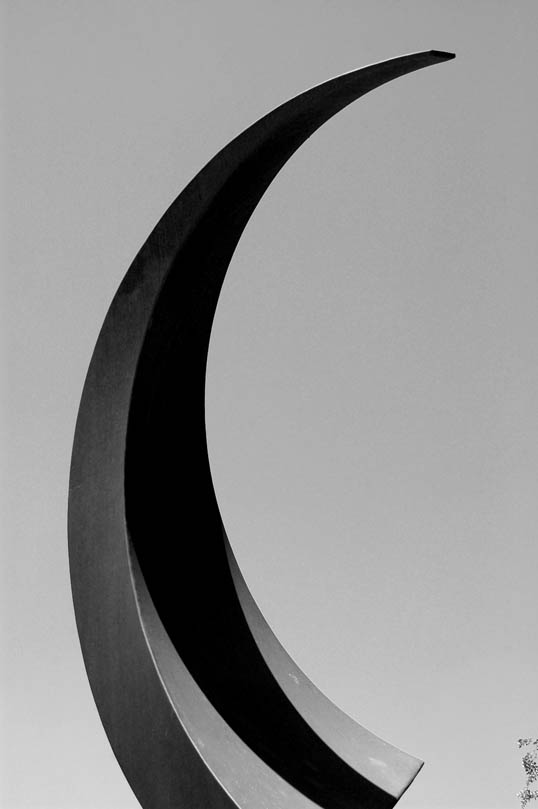
John Brough Miller, Oblique Sweep, Frisco, Texas
“What he loved in horses was what he loved in men, the blood and the heat of the blood that ran them.”
—-Cormac McCarthy, All the Pretty Horses
Shawnee Trail Sculpture, Central Park, Frisco Texas, bronze by Anita Pauwels
“But there were two things they agreed upon wholly and that were never spoken and that was that God had put horses on earth to work cattle and that other than cattle there was no wealth proper to a man.”
—-Cormac McCarthy, All the Pretty Horses
“He found he was breathing in rhythm with the horse as if some part of the horse were within him breathing and then he descended into some deeper collusion for which he had not even a name.”
“…and in his sleep he dreamt of horses and the horses in his dream moved gravely among the tilted stones like horses come upon an antique site where some ordering of the world had failed and if anything had been written on the stones the weathers had taken it away again and the horses were wary and moved with great circumspection carrying in their blood as they did the recollection of this and other places where horses once had been and would be again. Finally what he saw in his dream was that the order in the horse’s heart was more durable for it was written in a place where no rain could erase it.”
“He thought the world’s heart beat at some terrible cost and that the world’s pain and its beauty moved in a relationship of diverging equity and that in this headlong deficit the blood of multitudes might ultimately be exacted for the vision of a single flower.”
—-Cormac McCarthy, All the Pretty Horses