I’m Dancing As Fast As I Can

“Practicing an art, no matter how well or badly, is a way to make your soul grow, for heaven’s sakes. Now, I mean, I’m talking about singing in the shower, I’m talking about dancing to the radio, I’m talking about writing a poem to a friend–a lousy poem.”
― Kurt Vonnegut

“The sacred sense of beyond, of timelessness, of a world which had an eternal value and the substance of which was divine had been given back to me today by this friend of mine who taught me dancing.”
― Hermann Hesse

“The funny thing about writing is that whether you’re doing well or doing it poorly, it looks the exact same. That’s actually one of the main ways that writing is different from ballet dancing.”
― John Green

dance1a

“Life is the dancer and you are the floor.”
― Armando Vitalis, No Reason to Get Out of Bed – A Murderous Mystery

“We danced in the handkerchief-big space between the speak-easy tables, in which stood the plates of half-eaten spaghetti or chicken bones and the bottles of Dago red. For about five minutes the dancing had some value in itself, then it became very much like acting out some complicated and portentous business in a dream which seems to have a meaning but whose meaning you can’t figure out. Then the music was over, and stopping dancing was like waking up from the dream, being glad to wake up and escape and yet distressed because now you won’t ever know what it had been all about.”
― Robert Penn Warren, All the King’s Men

“there is no new experience in life. something may happen to you that you think has never happened before, that you think is brand new, but you are mistaken. you have only to see or smell or hear or feel a certain something and you will discover that this experience you thought was new has happened before.”
― Horace McCoy, They Shoot Horses, Don’t They?

Cadillac Ranch

Well there she sits buddy just a-gleaming in the sun
There to greet a working man when his day is done
I’m gonna pack my pa and I’m gonna pack my aunt
I’m gonna take them down to the Cadillac Ranch
Eldorado fins, whitewalls and skirts
Rides just like a little bit of heaven here on earth
Well buddy when I die throw my body in the back
And drive me to the junkyard in my Cadillac
—Bruce Springsteen, Cadillac Ranch

Cadillac Ranch, is west of Amarillo, Texas. I’ve stopped there a few times, mostly on the way back home from Santa Fe. It is an odd place – a modern American Icon of the New West.

Dallas Art Park, Deep Ellum, Dallas, Texas

Dallas Art Park, Deep Ellum, Dallas, Texas

Cadillac Ranch, West of Amarillo, Texas

Cadillac Ranch, West of Amarillo, Texas

Googlemap View

Cadillac Ranch

A crude little sketch I did in watercolor pencil on a postcard at the Cadillac Ranch west of Amarillo.

Cadillac Ranch - Old Guys Rule

Old Guys Rule

Cadillac Ranch

Cadillac Ranch

Invisible Cities

Cities & Desire 5

From there, after six days and seven nights, you arrive at Zobeide, the white city, well exposed to the moon, with streets wound about themselves as in a skein. They tell this tale of its foundation: men of various nations had an identical dream. They saw a woman running at night through an unknown city; she was seen from behind, with long hair, and she was naked. They dreamed of pursuing her. As they twisted and turned, each of them lost her. After the dream, they set out in search of that city; they never found it, but they found one another; they decided to build a city like the one in the dream. In laying out the streets, each followed the course of his pursuit; at the spot where they had lost the fugitive’s trail, they arranged spaces and walls differently from the dream, so she would be unable to escape again.

This was the city of Zobeide, where they settled, waiting for that scene to be repeated one night. None of them, asleep or awake, ever saw the woman again. The city’s streets were streets where they went to work every day, with no link any more to the dreamed chase. Which, for that matter, had long been forgotten.

New men arrived from other lands, having had a dream like theirs, and in the city of Zobeide, they recognized something from the streets of the dream, and they changed the positions of arcades and stairways to resemble more closely the path of the pursued woman and so, at the spot where she had vanished, there would remain no avenue of escape.

The first to arrive could not understand what drew these people to Zobeide, this ugly city, this trap.

—-Invisible Cities, Italo Calvino
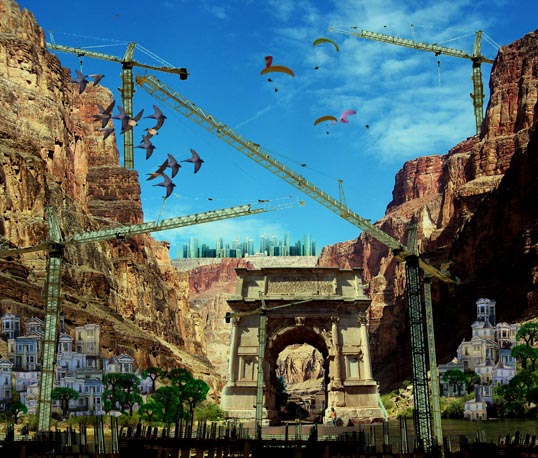
Invisible City - Gateway to Arcturus

Invisible City – Gateway to Arcturus

Thin Cities 5

If you choose to believe me, good. Now I will tell how Octavia, the spider-web city, is made. There is a precipice between two steep mountains: the city is over the void, bound to the two crests with ropes and chains and catwalks. You walk on the little wooden ties, careful not to set your foot in the open spaces, or you cling to the hempen strands. Below there is nothing for hundreds and hundreds of feet: a few clouds glide past; farther down you can glimpse the chasm’s bed.

This is the foundation of the city: a net which serves as passage and as support. All the rest, instead of rising up, is hung below: rope ladders, hammocks, houses made like sacks, clothes hangers, terraces like gondolas, skins of water, gas jets, spits, baskets on strings, dumb-waiters, showers, trapezes and rings for children’s games, cable cars, chandeliers, pots with trailing plants.

Suspended over the abyss, the life of Octavia’s inhabitants is less uncertain than in other cities. They know the net will last only so long.

—-Invisible Cities, Italo Calvino

For a month, starting on June 1, I read a short story every day and wrote a journal entry about them. For me at least, (I don’t know about how it was for you) it was a fun, interesting, and educational experience and exercise. One thing I learned is how wide the world of short fiction is – how varied and variable, diverse and divisive the styles, techniques, and artistry.

So I vowed to continue reading widely… and that brought me to a book by Italo Calvino – Invisible Cities (PDF). Technically, it’s a novel – a short novel. However, it is made up of a long series of very short sketches, each one describing a different, fantastic city – fifty-five in total. These are framed by an outer story, where Marco Polo is talking to Kublai Khan and telling the tales, thereby describing the cities he has visited.

Kublai Khan does not necessarily believe everything Marco Polo says when he describes the cities visited on his expeditions, but the emperor of the Tartars does continue listening to the young Venetian with greater attention and curiosity than he shows any other messenger or explorer of his. In the lives of emperors there is a moment which follows pride in the boundless extension of the territories we have conquered, and the melancholy and relief of knowing we shall soon give up any thought of knowing and understanding them.
—-Invisible Cities, Italo Calvino

The descriptions can be read individually, in relation to each other, and to the deep philosophical questions raised by the framing story.

It is short and easy to read, yet complex – with hidden aspects and dimensions that have to be teased out. It is so full of unique and interesting ideas that it slowed my reading down… I’d devour a half page and then have to rest to let the concepts and thoughts born by the text stop vibrating and resonating inside my head, let it all calm down, before I could read some more.

The book shows a lot of influence of Jorge Luis Borges… and is one book that is referred to as Borgesian. It is full of self-referential conundrums, mysterious contradictions, and postmodern enigmas.

I have to be careful about what I am reading when I write, because my reading is such an influence on what I write. I put up an entry containing something I wrote, Free Breakfast, while reading Invisible Cities a few days ago.

I would love to write like Italo Calvino… though nobody would read it. His fiction is a lot of fun, but it isn’t, for example, something that will ever be as popular as, say Harry Potter.

Now that I think about it… wouldn’t that be cool? A postmodern, Borgesian Harry Potter.

It could explore the duality of Harry Potter’s life. He lives in a cupboard, ignored, miserable, and hopeless for part of the year, then spends the rest in a world of Magic… where he is the chosen one. Which life is the real one… which is the real Harry Potter? Could the dire tragic life of poor Orphan Harry be so demoralizing that it drives him crazy? – Is the whole magical world of Hogwarts born from Harry’s desperation – an imaginary world where he gains unthinkable power and importance – where he becomes the chosen warrior in a war against the ultimate evil?

And what about Voldemort? He shatters his soul into a handful of pieces and stores each one in a Horcrux. He achieves immortality, at the price of a broken soul. Do these items then become Voldemort? How can a soul exist without consciousness? The potential for paradox and existential exploration are endless.

Even something as simple as the paintings…. Dead people make an appearance in the moving, talking paintings of Hogwarts. Is this a form of limited immortality? Do the paintings know they are dead? Are they sad? Are there moving and talking paintings with subjects that were never alive? Why not? If so… what are their memories? Do the dead paintings sleep? Do they dream of the living?

That would be a book worth reading… if someone had the skill to pull it off.

Hidden Cities 1

In Olinda, if you go out with a magnifying glass and hunt carefully, you may find somewhere a point no bigger than the head of a pin which, if you look at it slightly enlarged, reveals within itself the roofs, the antennas, the skylights, the gardens, the pools, the streamers across the streets, the kiosks in the squares, the horse-racing track. That point does not remain there: a year later you will find it the size of half a lemon, then as large as a mushroom, then a soup plate. And then it becomes a full-size city, enclosed within the earlier city: a new city that forces its way ahead in the earlier city and presses its way toward the outside.

Olinda is certainly not the only city that grows in concentric circles, like tree trunks which each year add one more ring. But in other cities there remains, in the center, the old narrow girlde of the walls from which the withered spires rise, the towers, the tiled roofs, the domes, while the new quarters sprawl around them like a loosened belt. Not Olinda: the old walls expand bearing the old quarters with them, enlarged but maintaining their proportions an a broader horizon at the edges of the city; they surround the slightly newer quarters, which also grew up on the margins and became thinner to make room for still more recent ones pressing from inside; and so, on and on, to the heart of the city, a totally new Olinda which, in its reduced dimensions retains the features and the flow of lymph of the first Olinda and of all the Olindas that have blossomed one from the other; and within this innermost circle there are always blossoming–though it is hard to discern them–the next Olinda and those that will grow after it.

—-Invisible Cities, Italo Calvino

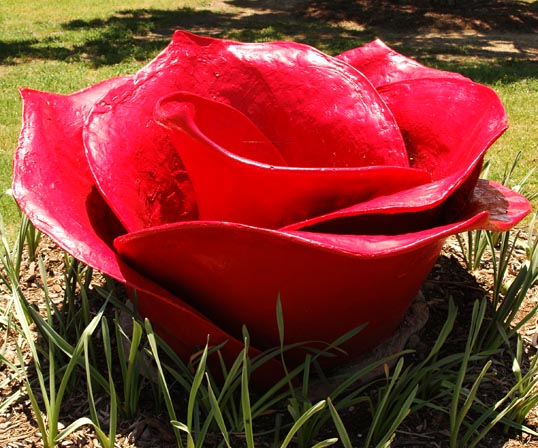
Tar Roses

Make things that carry with them the residue of where they have been.
—-Dennis Oppenheim

Dennis Oppenheim 1938-2011
American (New York)
Tar Roses
1996

Frisco, Texas

Tar Roses, Dennis Oppenheim, Frisco, Texas

Tar Roses, Dennis Oppenheim, Frisco, Texas

Tar Roses, Dennis Oppenheim, Frisco, Texas

Tar Roses, Dennis Oppenheim, Frisco, Texas

Tar Roses, Dennis Oppenheim, Frisco, Texas

Tar Roses, Dennis Oppenheim, Frisco, Texas

Tar Roses, Dennis Oppenheim, Frisco, Texas

Tar Roses, Dennis Oppenheim, Frisco, Texas

Decades of Art

With cities, it is as with dreams: everything imaginable can be dreamed, but even the most unexpected dream is a rebus that conceals a desire or, its reverse, a fear. Cities, like dreams, are made of desires and fears, even if the thread of their discourse is secret, their rules are absurd, their perspectives deceitful, and everything conceals something else.

“I have neither desires nor fears,” the Khan declared, “and my dreams are composed either by my mind or by chance.”

“Cities also believe they are the work of the mind or of chance, but neither the one nor the other suffices to hold up their walls. You take delight not in a city’s seven or seventy wonders, but in the answer it gives to a question of yours.”

― Italo Calvino, Invisible Cities

decades1

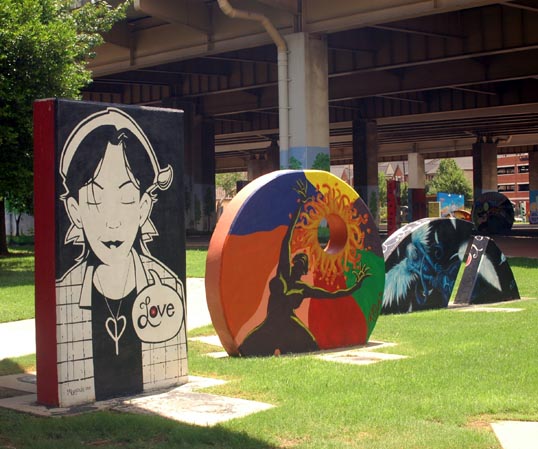
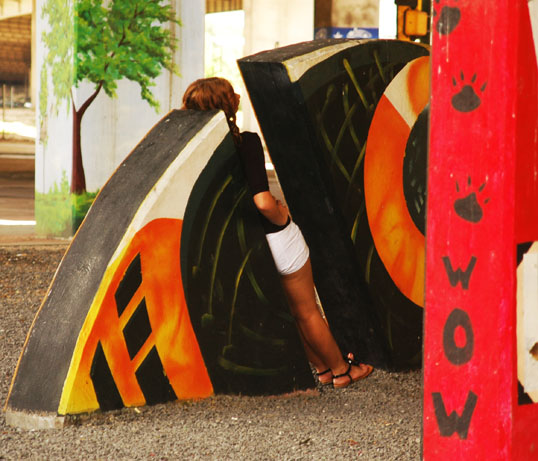
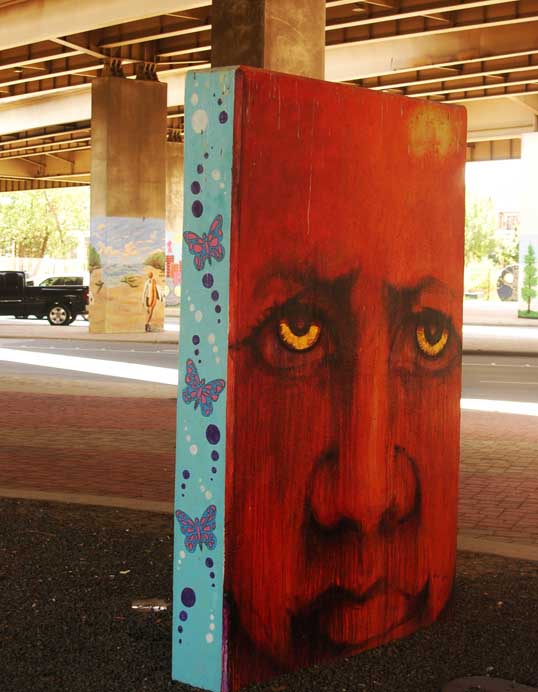
I have been putting up photographs I took a few weekends back at the Deep Ellum Art Park near Downtown Dallas. I have a lot more that I can use as I postprocess them to fill in journal entries on days that nothing much happens (or nothing that I want to write about here). The Deep Ellum Art Park is an area of concrete pillars of the overhead freeway connecting I30 and H75 (Central Expressway) plus a series of monoliths of various shapes that have been arranged in the gravelly areas between roadways for the purpose of serving as a canvas.

It’s a fun and interesting use of otherwise wasted space – a recovered area of urban blight.

It’s been growing over a period of decades and now has expanded to include decorative artworks in and around an urban garden and a dog park. It’s sort of officially authorized graffiti. I enjoy visiting the area, walking around looking at the graffiti/ paintings, and (obviously) taking photos of the scene.

decades2

One of the things I particularly enjoy is that I’ve been going down there for about twenty years now and it brings back memories. I remember sometime… maybe the early 90’s or so, that I did essentially what I’m doing now – I rode my bicycle (it would have been my Yokota Mountain bike – newly purchased – now converted into a commuter) down there and took some photographs.

That wasn’t really that long ago (in geologic time, for example), but times have changed so much. I would have been using my Pentax 35mm SLR so I would have been a lot more judicious about the number of shots – don’t want to waste film. Do you remember when you would say things like, “If the pictures come out” – “come out” was a common term back when you couldn’t look at the back of your camera and see what you had just shot?

….Or was it only ten years ago and I was using a primitive crude digital camera?
I don’t know which is true – I guess it doesn’t matter – thought it is pitiful and sad when your life stretches out into one featureless plain and one decade is indistinguishable from another.
Yet, a lot has changed.

But most of what has changed is me.

It was going down there and finding a few monoliths newly constructed and being painted for the first time. No more than a slim handful of them. Now there are over thirty, plus the hundred or so column sides. Each had an artist attached to it. Through lucky timing I had arrived during the inaugural event and the artists were at work.

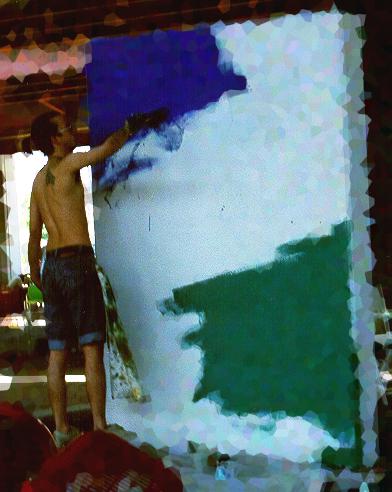
I sat down on a bench to watch the painters paint (that’s another change – the benches are all gone – taken away because they attracted too many sleeping homeless people). There was an older man on a tall upright obelisk, a young man on a rectangular panel, and a young woman next to him on a semicircle jutting out of the earth.

I had so little confidence then – it was so very difficult to take pictures of people. Now, I would walk right up and ask them to pose with their work… they are painting a public monument after all – they would crave the publicity.

Watching the woman paint her bit of whitewashed concrete canvas I was filled with a hollow sense of longing and beauty. I don’t know why the scene of a woman and two men painting had this effect on me. The woman wasn’t especially attractive – and her painting, honestly, wasn’t particularly good. As a matter of fact, only the old man had a great amount of talent and skill – though I don’t remember what any of them actually painted. Their work is long gone now – painted over several times.

I dug around in my files and photographs and the only things I could find are these two small, blurry, edited shots I was using in some silly project.

11

2

The only thing that remains, the only thing left, is my memory of sadness that I felt at the time. That is still vivid and clear… even as all the other details have faded into obscurity.

decades3

He was thinking of all these things when he desired a city. Isidora, therefore, is the city of his dreams: with one difference. The dreamed-of city contained him as a young man; he arrives at Isidora in his old age. In the square there is the wall where the old men sit and watch the young go by; he is seated in a row with them. Desires are already memories.
― Italo Calvino, Invisible Cities

Welcome to the Deep Ellum Art Park

Dallas, Texas

Wink

Wink

Have a drink.

Have a drink.

It's Texas... you never know who's packin'

It’s Texas… you never know who’s packin’

welcome1

Wow

Art Park
Deep Ellum, Dallas, Texas

People understand me so little that they do not even understand when I complain of being misunderstood.
—Søren Kierkegaard

Someone else was taking photos at the same time I was.

Someone else was taking photos at the same time I was.

Coming out of the Circle

Sherry Owens, Dallas
Coming out of the Circle 1999 Steel
Frisco, Texas

Everything the Power of the World does is done in a circle. The sky is round, and I have heard that the earth is round like a ball, and so are all the stars. The wind, in its greatest power whirls. Birds make their nest in circles, for theirs is the same religion as ours. The sun comes forth and goes down again in a circle. The moon does the same and both are round. Even the seasons form a great circle in their changing, and always come back again to where they were. The life of a man is a circle from childhood to childhood, and so it is in everything where power moves. Our tepees were round like the nests of birds, and these were always set in a circle, the nation’s hoop.

—-Black Elk Speaks

circle1

Then I was standing on the highest mountain of them all , and round about beneath me was the whole hoop of the world. And while I stood there I saw more than I can tell and I understood more than I saw; for I was seeing in a sacred manner the shapes of all things in the spirit, and the shape of all shapes as they must live together like one being. And I saw that the sacred hoop of my people was one of many hoops that made one circle, wide as daylight and as starlight, and in the center grew one mighty flowering tree to shelter all the children of one mother and one father. And I saw that it was holy.

—-Black Elk Speaks

circle2

I did not know then how much was ended. When I look back now from this high hill of my old age, I can still see the butchered women and children lying heaped and scattered all along the crooked gulch as plain as when I saw them with eyes still young. And I can see that something else died there in the bloody mud, and was buried in the blizzard. A people’s dream died there. It was a beautiful dream.

And I, to whom so great a vision was given in my youth, — you see me now a pitiful old man who has done nothing, for the nation’s hoop is broken and scattered. There is no center any longer, and the sacred tree is dead.

—- Black Elk Speaks

circle3

To the center of the world you have taken me and showed the goodness and the beauty and the strangeness of the greening earth, the only mother — and there the spirit shapes of things, as they should be, you have shown to me and I have seen. At the center of this sacred hoop, you have said that I should make the tree to bloom.

With tears running, O Great Spirit , Great Spirit, my Grandfather — with running tears I must say now that the tree has never bloomed. A pitiful old man, you see me here, and I have fallen away and have done nothing. Here at the center of the world, where you took me when I was young and taught me; here, old, I stand, and the tree is withered, Grandfather, my Grandfather!

Again, and maybe the last time on this earth, I recall the great vision you sent me. It may be that some little root of the sacred tree still lives. Nourish it then, that it may leaf and bloom and fill with singing birds. Hear me, not for myself, but for my people; I am old. Hear me that they may once more go back into the sacred hoop and find the good red road, the shielding tree!

—-Black Elk Speaks

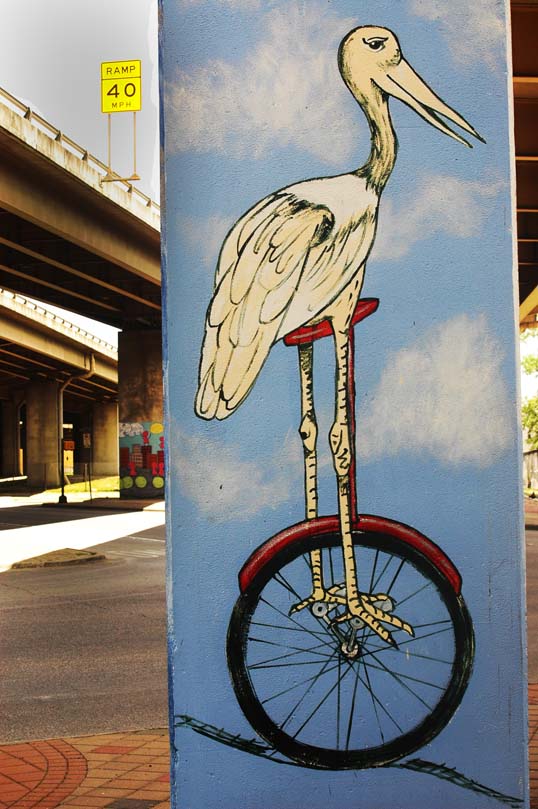
Ramp 40

Graffiti

Art Park
Deep Ellum, Dallas, Texas

Ramp 40 - Deep Ellum Art Park, Dallas, Texas

Ramp 40 – Deep Ellum Art Park, Dallas, Texas

No more speed, I’m almost there
Gotta keep cool now, gotta take care
Last car to pass, here I go
And the line of cars goes down real slow

And the radio played that forgotten song
Brenda Lee’s “Coming On Strong”
And the newsman sang his same song
Oh, one more radar lover gone

—-Radar Love, Golden Earring

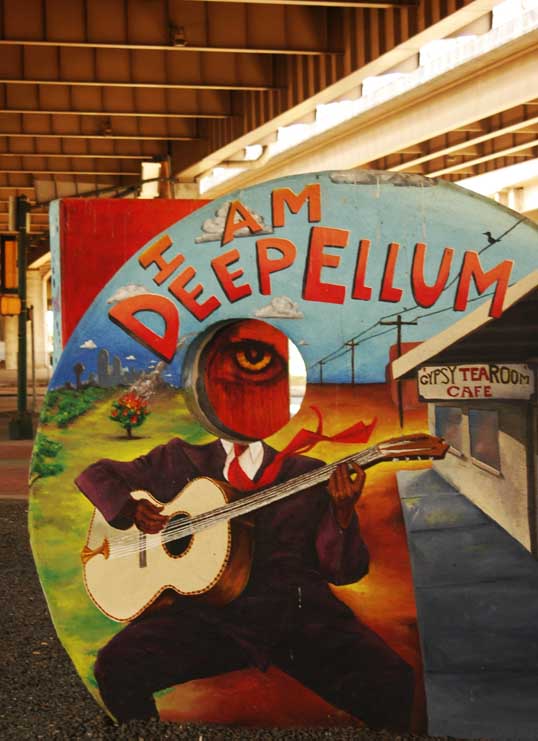
I Am Deep Ellum

Graffiti

Art Park
Deep Ellum, Dallas, Texas

iam1

iam2

If you go down to Deep Elem
Just to have a little fun,
You’d better have your fifteen dollars
When the policeman come.

Oh, sweet mama, daddy’s got the Deep Elem Blues.

If you go down to Deep Elem,
Keep your money in your shoes;
The women in Deep Elem
Got those Deep Elem blues.

If you go down to Deep Elem,
Take your money in your pants;
The women in Deep Elem
Never give the men a chance.

Now I once knew a preacher,
Preached the Bible through and through,
He went down into Deep Elem,
Now his preaching days are through.

Now I once had a sweet gal,
Lord, she meant the world to me;
She went down into Deep Elem;
She ain’t what she used to be.

Her papa’s a policeman
And her mama walks the street;
Her papa met her mama
When they both were on the beat.

—-Deep Elem (Ellum) Blues – Trad.