Seven Points of View

“I assert that the art of sculpture, among all the arts connected with design, is at least seven times greater than any other, for the following reason: why, sir, a statue of true sculpture ought to have seven points of view, which ought all to boast equal excellence.”
― Benvenuto Cellini, The Autobiography Of Benvenuto Cellini

Gymnast, by Enrique Alferez, bronze, Poydras Street, New Orleans
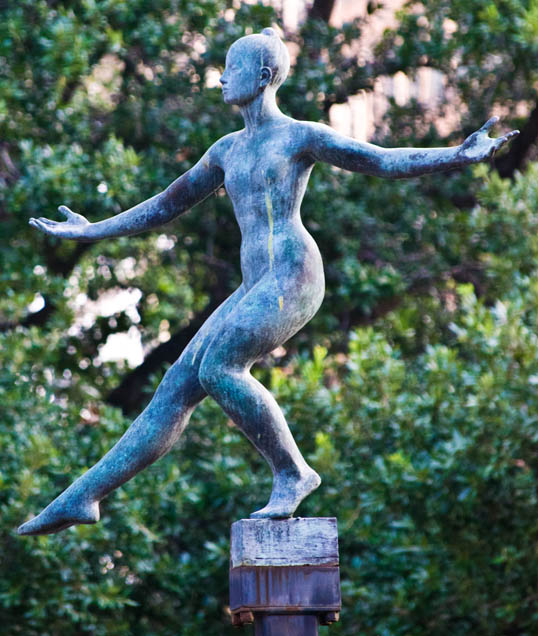
In the City of New Orleans there is a fantastic arrangement of sculpture along Poydras Street. Walking down and back from my son’s apartment to the Running of the Bulls I took photos of a few of them that I’ll share with you.

The first one that I noticed was a beautiful bronze woman in an athletic, dancelike pose, rising above the median only a few feet toward the river from where my son lives. Looking it up, I wasn’t too surprised to find out it was another work by Enrique Alferez like the nearby Lute Player and David – which I wrote about the last two days.

Alferez has work all over the city.I must make a list and try to get to some more the next time I visit.
Beautiful And True

“Why do beautiful songs make you sad?’ ‘Because they aren’t true.’ ‘Never?’ ‘Nothing is beautiful and true.”
― Jonathan Safran Foer, Extremely Loud and Incredibly Close

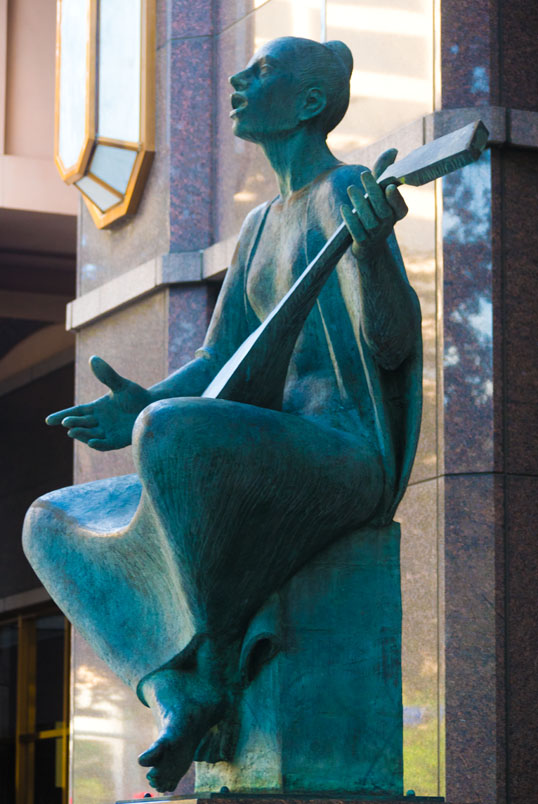
The Lute Player, Enrique Alferez, New Orleans

On the right side of the entrance to the First Bank & Trust Tower on Poydras street, downtown New Orleans – is the huge statue of David, which I wrote about yesterday. On the other side, also done by Enrique Alferez is “The Lute Player” a softer sculpture, adding a little contrapoint.

A Few Squeaks

“I wanted to play saxophone, but all I could get were a few squeaks.”
— Stevie Ray Vaughan

Dots Hop House, Deep Ellum, Dallas, Texas

Superiority To the Sleeping World

“The last refuge of the insomniac is a sense of superiority to the sleeping world.”
― Leonard Cohen

Above the bar, Three Links, Deep Ellum, Dallas, Texas
Ancient Mystic Order of Samaritans
AMOS, Xerxes

It’s out there, it’s all around. You do have to look close.

The Life of a Ghost

“I woke up as the sun was reddening; and that was the one distinct time in my life, the strangest moment of all, when I didn’t know who I was – I was far away from home, haunted and tired with travel, in a cheap hotel room I’d never seen, hearing the hiss of steam outside, and the creak of the old wood of the hotel, and footsteps upstairs, and all the sad sounds, and I looked at the cracked high ceiling and really didn’t know who I was for about fifteen strange seconds. I wasn’t scared; I was just somebody else, some stranger, and my whole life was a haunted life, the life of a ghost.”
― Jack Kerouac, On the Road

Nasher Sculpture Center, Dallas, Texas

Are there ghosts around us… ghosts that are simply moving too fast for us to see? There are definitely live people moving too fast for anyone to see. Maybe a blur. All you feel is a buzz of wasted excitement and maybe a bit of a hot breeze.

And they are gone.

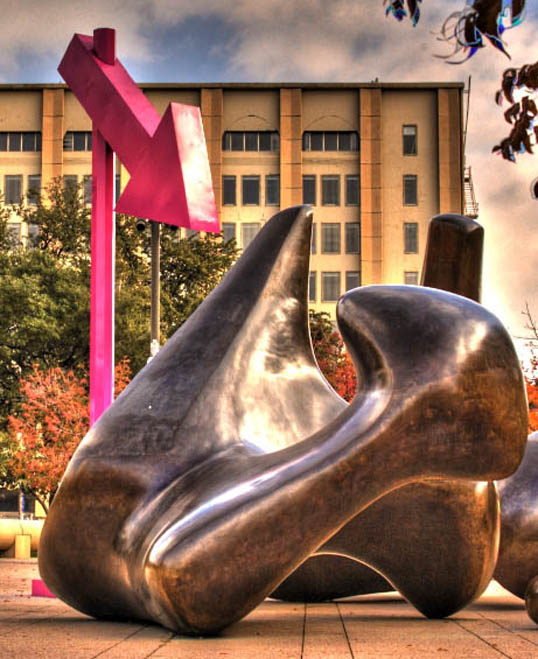
The sculpture in the photograph above is a Henry Moore bronze – Three-Piece No. 3: Vertebrae (Working Model). It is a prequel for Moore’s larger Three Piece Sculpture: Vertebrae, also known as the Dallas Piece, which sits in a forlorn spot in front of I. M. Pei’s Dallas City Hall.

I’ve always loved that sculpture and have visited it for decades. One especially cool time was when Rachel Harrison added a temporary pink arrow in a sculpture known as Moore to the Point as part of the Nasher Xchange project.

Moore to the Point
(click to enlarge)

Rachel Harrison
Moore to the point
City Hall Plaza
(click to enlarge)

Desire Not To Desire

“ Give up all hope, all illusion, all desire..I’ve tried. I’ve tried and still I desire, I still desire not to desire and hope to be without hope and have the illusion I can be without illusions..Give up, I say. Give up everything, including the desire to be saved.”
― Luke Rhinehart, The Dice Man

Decatur, Texas

The Things You Don’t Do

“The voice says, maybe you don’t go to hell for the things you do. Maybe you go to hell for the things you don’t do. The things you don’t finish.”
― Chuck Palahniuk, Lullaby

Oblique Strategy: Always first steps

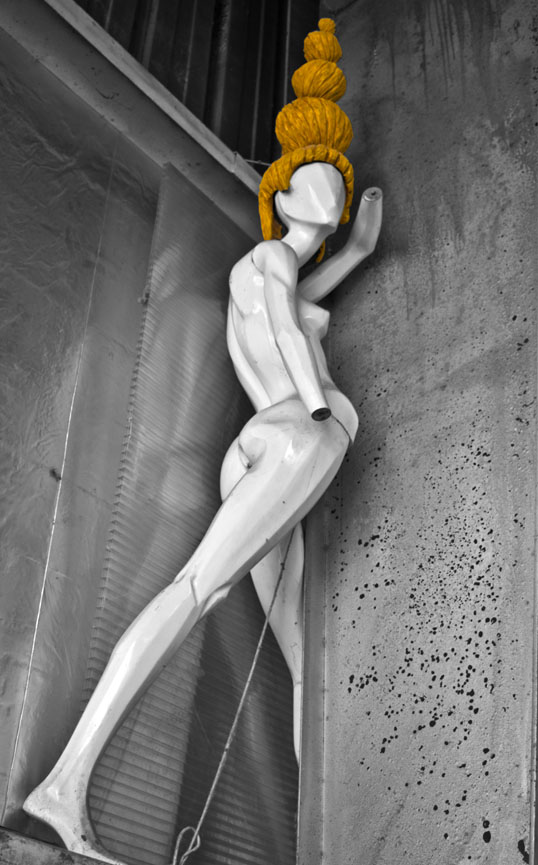
It’s tough being a carhop. You have to remember what car has what order. You have to be able to skate balancing a tray groaning with food and milkshakes. You have to be able to hook in onto the window… just right. You have to endure and handle the nuts and assholes.

The hours are long and the tips are small.

Poor Ethel. The only good thing about being a carhop is that at the end of the day you get to go home. But she doesn’t. She has to stand there, looking as beautiful as ever.

Is beauty its own reward? You exist mainly in the foggy yet electric haloed memories of teenagers long grown old and gray. Is it worth the effort to represent an age long gone by – an era of rollerskates and rootbeer in this age of smartphones and Spice?

Is there an app for that?

All Nature Has Is a Potential

“That’s all the motorcycle is, a system of concepts worked out in steel. There’s no part in it, no shape in it, that is not out of someone’s mind […] I’ve noticed that people who have never worked with steel have trouble seeing this—that the motorcycle is primarily a mental phenomenon. They associate metal with given shapes—pipes, rods, girders, tools, parts—all of them fixed and inviolable., and think of it as primarily physical. But a person who does machining or foundry work or forger work or welding sees “steel” as having no shape at all. Steel can be any shape you want if you are skilled enough, and any shape but the one you want if you are not. Shapes, like this tappet, are what you arrive at, what you give to the steel. Steel has no more shape than this old pile of dirt on the engine here. These shapes are all of someone’s mind. That’s important to see. The steel? Hell, even the steel is out of someone’s mind. There’s no steel in nature. Anyone from the Bronze Age could have told you that. All nature has is a potential for steel. There’s nothing else there.”
― Robert M. Pirsig, Zen and the Art of Motorcycle Maintenance: An Inquiry Into Values

Future Sculpture, Clarence Street Art Collective, The Cedars, Dallas, Texas

Oblique Strategy: Is the intonation correct?

After a really rough day I needed a little victory so I made a sweet potato casserole to take to a potluck tomorrow. Is a well-cooked casserole a work of art? Probably not. Especially when its destiny is a long table already groaning under other casseroles also full of sweet potatoes (at least mine does not feature marshmallows – it has goat cheese and walnuts) or green beans mixed with oversalty industrial mushroom soup and canned fried onions. I’m sure mine will be ignored, no matter how delicious. Such is the ultimate destiny of all art.

P.S. After having written the above, I went to the kitchen to put my cassarole, which had been cooling on a rack, into the fridge to take to the potluck tomorrow. While transferring it, I dropped it, flipping it onto the kitchen floor.

The day continues.

The Marriage of Reason and Nightmare

“The marriage of reason and nightmare that dominated the 20th century has given birth to an ever more ambiguous world. Across the communications landscape move the spectres of sinister technologies and the dreams that money can buy. Thermo-nuclear weapons systems and soft-drink commercials coexist in an overlit realm ruled by advertising and pseudo-events, science and pornography. Over our lives preside the great twin leitmotifs of the 20th century – sex and paranoia…In a sense, pornography is the most political form of fiction, dealing with how we use and exploit each other, in the most urgent and ruthless way.”
― J.G. Ballard

Tony Collins Art, Dallas, Texas

Oblique Strategy: Make a sudden, destructive unpredictable action; incorporate

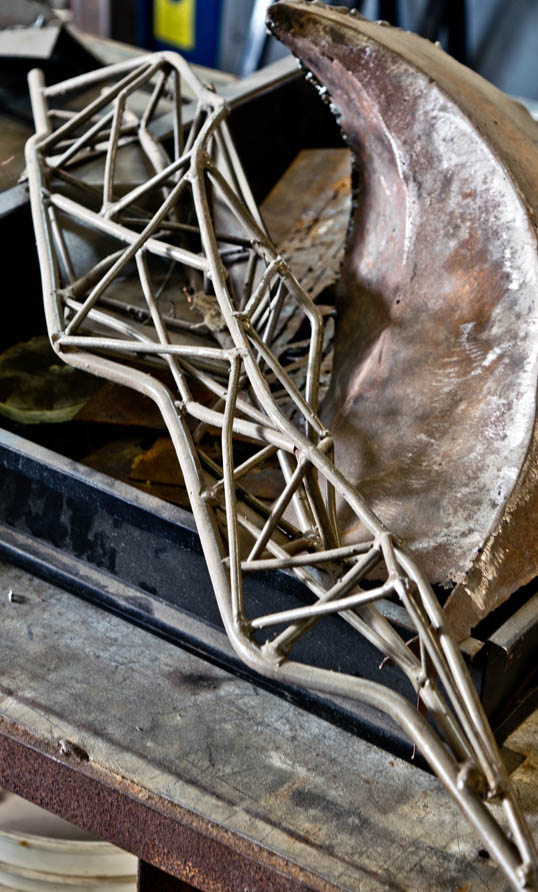
Is it a bomb?
Or simply a disposable fuel tank.

Does it matter? Now, anyway, it’s just a sculptural form.
A piece of shaped steel, sexy somehow. It pulls the eye to it.
You wonder about its story. Where did it come from?
Why is it hanging there?

Does it matter?

Disoriented At the End

By the end of a poem, the reader should be in a different place from where he started. I would like him to be slightly disoriented at the end, like I drove him outside of town at night and dropped him off in a cornfield.
—– Billy Collins

Clarence Street Art Collective, The Cedars, Dallas, Texas

Oblique Strategy: The inconsistency principle

Found Poetry

A taste for pure pork fat, long restricted to a furtive devouring of the white nubbin in the can of baked beans, can now be worn as a badge of honor.
(Julia Moskin, New York Times, 5/7/03, article on pork fat in high-class restaurants)

Under 6 years: 1 pastille as required. Maximum 5 pastilles in 24 hours
(Meggezones 24x)

…on a long bus ride, you should always choose to sit next to Mrs. Robinson, for example, rather than Benjamin.
(Roger Ebert, from a review for Death to Smoochy)

Daisy, the this pretty sea, and the wind.
(Bablefish translation of the first line of a Ruben Dario poem I have stuck in my head… the Spanish is: Margarita, esta linda la mar, y el viento.)

Dolly, Good, Hernia, Bad
(big block letters on the side of a Budget rental truck in my neighborhood)

When I cruise, I’m an adventurer, eager to try new experiences. So on the second day of my first Carnival vacation, I found myself lying on a massage table wrapped in a crisp, clean sheet.
(From Currents, a magazine for people taking Carnival cruises)

Often Imitated, Never Duplicated-Great for Men and Women-As Seen on TV-It’s not magnetic, not copper…it’s the Q-Ray Ionized Bracelet designed to help balance your body’s Yin-Yang. Worn by professional athletes striving for energy, strength, flexibility and endurance, it’s also worn by people looking for natural pain relief. According to the oriental theory of Yin-Yang, we remain in good health when our negative (Yin) and positive (Yang) ions are in balance.
(from an ad for the Q-Ray bracelet, $49.95, in Dr. Leonard’s America’s Leading Discount Healthcare Catalog)