Sunday Snippet – Free Breakfast

I have to be careful what I read while I’m writing. The style and feeling of what I’m reading tends to seep into, drown, and dominate what I put on paper.

Last week I plowed through Invisible Cities, by Italo Calvino. I’ll write about that book… maybe the day after tomorrow. But in the meantime… this is what happened.

Richardson2

Richardson2

Free Breakfast

Thelma bent and reached under the seat in front of her, pulled out her briefcase, and opened it on the meal-table which folded down from the seat back. Arranged in neat, alphabetical folders was information on a hundred cities that she had visited, either for work or for pleasure alone.

Anchorage, Birmingham, Cairo, Dallas… on and on. She was assiduous about collecting what would be useful on a return trip: lists of restaurants, business cards of important contacts, tourist magazines taken from hotel rooms – and would file these upon her return home. Thelma was especially fond of the compact maps that the rental car agencies would give out – she found these to be carefully designed for maximum help. They were the exact size and scale to get a renter around a city without any superfluous information or ornamentation.

She thumbed through the folders, one by one, allowing the memories of the previous visits to flood over her, hoping to jar loose a recollection of her present destination. She remembered getting a phone call in the middle of the night ordering her to go to the airport before dawn and getting on a flight, but she couldn’t remember where. All she remembered is thinking at the time that not only was that a city she had never been to, she had never even heard of it before that moment. It was odd that there was a city unknown to her (human geography had always been a passion)… but there it was. She couldn’t even remember getting on the plane, but assumed the ticket had been pre-purchased by her company… the way they always were.

Her memory was so bad because she was so tired. She had not had a good night’s sleep in weeks. Her nightmares had become so severe that her doctor said she was suffering the symptoms of Post Traumatic Stress Disorder – caused by the terrible subconscious memories of the nightmares – yet she could actually remember nothing from the dreams except vague impressions of deep, cold water, things moving in darkness, and breaking pipes. Awakened by the nightmares in her bed, she would lie in terror – confused about exactly where she was and even who she was. It was mid-summer but she would shiver with bone-deep cold, rising up from within.

The folders did not succeed in giving her a clue to her destination, so she closed the case and placed it back by her feet. She looked at the man sitting in the seat next to her – perhaps she could ask him their common destination. He was a large man, dressed formally, with an oddly-shaped beard, reading a book. Looking at the pages, all she could make out were squiggly lines in some unfamiliar alphabet. He probably didn’t even speak English – and how could she possibly ask a total stranger a question as stupid as, “Excuse me, do you know where this plane is going?”

Frustrated, she let out a sigh and tried to relax. Quicker that she imagined was possible, she slumped sideways against the reading man and fell asleep. For the first time in weeks she did not have a nightmare. She dreamed she was in a large green meadow, surrounded by steep, granite, rugged mountains capped with bits of snow. The meltwater coursed across the meadow in a hundred swift streams and as she walked up to a watercourse and began to step into it her foot began to rise up and she stepped again and again, higher and higher, as if on a rising stairway of air.

Soon, in her dream, Thelma was floating and then flying, rising and moving. She could see the patterns of the little streams in the meadow far below which, instead of joining into a larger river, meandered in a random pattern, sometimes joining together, sometimes splitting apart, so that the same configuration filled the entire area and it was impossible to determine where the water entered and where it left.

She rose higher and moved closer to the ragged vertical walls of rock until she could clearly see the small remaining nubs of snow and ice which were melting in the summer sun. Still higher, she began to look closer to see what was on the other side of the mountains… some sort of shape was emerging from the haze of distance.

But at this point she woke up. She felt refreshed from her first undisturbed sleep, but had to wipe a bit of spittle that had formed on her lips and she saw that it had stained the sleeve of the man sitting next to her. She turned to apologize but saw that he was still immersed in his reading and was paying no attention to her. She became aware of a noise and realized that the flight crew was making an announcement.

“We are now pulling up to the gate and will turn off the seatbelt sign as soon as the doors open. Will all passengers continuing on to Chicago, Paris, and Tokyo please remain seated while everyone debarking disembarks. We will only be on the ground for a short time. Thank you for your attention.”
Thelma frowned. She had missed the announcement of their location… but she was sure her stop was the first one on the flight, so at the ding of the bell, she collected her briefcase, rose, and retrieved her carryon bag from the overhead bin. She was the only person that left the plane.

The airport was crowded. Thelma could only see a few feet sideways through the surging sea of passengers. They did not seem to be the usual airport denizens – businessmen, families on holiday, students with backpacks – the mob wore tattered, wrinkled, out-of-style clothing – and had a thin, desperate, hungry look about them. Although there were men, women, and children of all ages and races, they did not seem to be in any family groupings – they all seemed to be struggling to get to their various destinations alone. The few that were carrying luggage had crude bags or parcels wrapped in dirty cloth.

Looking up above the crowd, Thelma realized that the airport looked exactly like every other airport – beams of steel or wood arched overhead, supporting a corrugated roof of light blue or cream metal. Large windows let in an orange light of either sunset or sunrise. Signs hung down with directions printed in several languages, none of which Thelma understood, and also included simple iconic drawings of mysterious objects. Finally, she spotted one sign that seemed to sport a sort of crude suitcase and an arrow beneath the puzzling lines of text – so she pushed her way in that location to get her checked luggage. She thought she remembered checking bags.

In complete contrast to the main concourse, the baggage claim area was deserted. A thin layer of dust covered the floor and Thelma could see her footprints as she walked across. A half-dozen huge metal belts emerged from openings in the wall that were covered with finger-shaped strips of rubberized cloth. These were all motionless and festooned with cobwebs. In some corners a hint of rust was beginning to appear on the machinery.

However, in the center of the room, there sat two bags, one large and one a bit smaller. They looked familiar to Thelma and she realized they were the same style and almost the same color as the carryon she held. She tried to check to make sure but the paper ID tags had been torn off.

Still, she collected the bags, attaching her carryon to the top of the smaller, and extending the handles, she lumbered out toward the twilit line of windows and glass doors. The automatic portal hissed open at her approach and she pulled her bags out to the curb. The thick humid air and oppressive heat struck her like a blow as she emerged from the cool air-conditioned terminal.

The orange light from earlier must have been sunset because it was now getting to be quite dark. She was happy to see, right in front of her, a large van parked along the curb. Large red symbols of some unknown language blazed across its side, but beneath, in smaller black block letters, were the welcome words “AIRPORT SHUTTLE”.

A man in a dark blue uniform and a jaunty cap stood beside the door and smiled at her. She stared at him – he looked familiar.

When Thelma was twelve, her parents had taken her on a driving trip across the continent, ending in New York. They had crossed the Mississippi on a huge bridge made up of silver steel beams and then had stopped in a tall Holiday Inn right on the Memphis riverbank. As they were checking in, she kept staring at the family in line in front of her. Outside she had seen the family which had already pulled up in a station wagon that was facing in the opposite direction. The father was untying a large valise from the rack on the roof. Thelma imagined that they were going on the same trip, coast to coast, but the other way, from East to West. There was a young boy about her age and something about him had drawn her to gawk. In her own way, she had fallen instantly in love with this boy.

Her family only stayed there for a day before they continued their journey, but everywhere Thelma went, to eat in the hotel restaurant, to swim in the pool, down the hall to fetch some ice from the machine, she would see the boy, sometimes close… sometimes at a distance, and her heart would ache. She never spoke to him and the boy never seemed to even notice her, but the day and the boy were etched deep into her head and heart forever.

Thelma realized that this man waiting at the Rental Car Van looked exactly like she imagined that boy would now. This could be him grown up. But what could she say? It would be silly to ask if he had been in a Holiday Inn with his parents decades earlier. And what if it was him? They had never spoken to each other.

“May I have your bags please,” he said with a sparkling smile.

She stood mute while he climbed into the van, carefully placing her bags on a tubular rack.

“And your purse, Ma’am?”

Thelma didn’t even think about how odd this request was as she handed him her handbag. Another flash of smile and he turned and climbed into the driver’s seat. She let out a soft sigh and began to follow but as she stepped forward the folding glass door of the van snapped shut an inch in front of her nose.

Shocked, Thelma staggered back a few steps as the van screeched its tires, sped away from the curb, and went careening down the street, disappearing around a concrete wall. Thelma felt panic welling up, she was now stranded in a strange city – she didn’t even know its name – without clothes, without ID, without money, without a credit card. She turned and retreated to the doors that she had emerged from, but found them locked.

At that moment, all the lights in the terminal went out. Thelma realized how late it was and how dark it had become. Still, who ever heard of an airport closing like that? What about the crowds trapped inside? She stood there for a long time, waiting for someone to come along or for something to happen, but no one did, and nothing occurred. The only thing she could do is start walking. In the distance, beyond the wall where the van had sped away, she could see the blue glow of streetlights.

She walked along the sidewalk as the road curved away from the airport. The way was well lighted by the ring-shaped streetlamps suspended high above on metal poles. She felt herself sweating through her clothes but made good time walking along the sidewalk. After a bit the sidewalk split away from the road and became a separate, paved trail. Thelma wasn’t sure about following it, but the road crossed a dark, swampy-looking patch on a bridge that had no walkway, so she had no choice.

The path entered a thick wooded area and curved first to the left, then to the right, and the streetlights were far enough distant so that the only thing visible was the bright concrete between the trees. The path became rougher and then the paving gave out until all that was left was a narrow, sandy lane. Thelma struggled along as best she could in the dark. The branches tore at her clothes and snipped at her face, thorny weeds underfoot sliced at her ankles.

Thelma decided she couldn’t go any farther and turned around to retreat. The path improved slightly but then began to go wild again and she realized she had made a wrong turn. Fighting back panic, she could think of nothing except to sit down in the soft sand along the widest patch of trail she could find.

She sat curled up, hugging her ankles and sobbed. The crying wore her out and she slowly gave up, stretched out in the warm sand, and fell asleep. She found herself in the same dream as she had on the plane, walking through the mountain meadow. As she approached a stream she began floating upward again, and looked ahead eagerly toward the rim of the surrounding mountains, hoping to get farther this time… and she was able to.

As she soared over the snowfields of the mountains she felt herself drifting lower on the other side, moving gently through waves of warm rising air. As she moved downward through the mist a shape began to form on the ground below. She saw long straight stretches of pale pavement, all emerging from a large building made of a complex series of giant halls. As the mist fell away she realized it was an airport and, though she had never seen it, it was the airport she had just left. As she drifted closer she saw the spot where the van had left her and the curving road away.

As Thelma’s dreamself passed high over the airport she saw a huge sign at the spot the largest road came up to the terminal. Though it was in an alphabet strange to her as she looked the symbols began to feel familiar and in her dream she realized the sign spelled out “Nepenthium International Airport.” That was the name of the city, Nepenthium.

The scene dissolved and she woke feeling the hot morning sun on her cheek. Aching, she gathered and pulled herself erect. Thelma was ravenous and thirsty, her clothes were torn and patches of sand stuck to her skin. Still, the peaceful sleep and pleasant dream had done her a world of good and she felt new hope welling up.

Looking around in the light of the rising sun she saw there was a barbed wire fence only a few feet into the woods on one side of the sandy path. There seemed to be light and space on the other side. She pushed her way through the tree branches and began to struggle over the wire. A barb jabbed her thigh. Fabric caught on the wire and she felt her clothing tear, but she pulled her way over. With a final rip as a hefty piece of cloth was left behind she fell clear and found herself on a strip of cool grass. She stood up and realized she had lost a shoe in the exertion to get over the wire. She kicked off the other and started moving barefoot. A trickle of blood ran down one leg.

The grass lined a road and on the other side was a large building. She waited for a gap in the passing cars and crossed the road. The building was undoubtedly a hotel and, although again the symbols on the sign were strange, she recognized a familiar logo of an international chain. Under the sign was a lettering board with black plastic letters lined up on a white glowing background.

The top line was a grouping of symbols, but underneath that was an English translation. It said, “Free Breakfast.”

Beyond the sign was a concrete apron in front of what must be the registration desk. Parked on the apron was the van from the airport. Thelma limped towards it, despite her torn clothing and desperate appearance.

Next to the van was the driver, standing there with the same bright smile. He had her luggage in a neat pile next to him. As she approached his grin expanded even wider and he reached his hand out and handed over her purse.

Tuesday Snippet – The Fatted Calf

Prodigal Son, Thomas Hart Benton, Dallas Museum of Art

Prodigal Son, Thomas Hart Benton, Dallas Museum of Art

The Fatted Calf
(First Scene of a Short Story)

It had been a decade since Sam had rented a car. He always had his assistant arrange for a limousine. Those days were gone – long gone.

At the rental counter the first three credit cards were rejected but the fourth went through and after a short, polite argument he was allowed a subcompact car. Red-faced he took the vehicle out onto the old highway – the one he remembered from his childhood – now gone over to cracked asphalt and weeds creeping over the edges. He blared the radio and tore down the rough road with the windows down – looking across the bright green bristles of spring wheat at the lines of huge trucks on the newer Interstate – parallel – a mile distant.

He remembered his mother driving him to the airport twenty years earlier – his small bag packed. His mother teared and resigned – her wet eyes locked on the road ahead. His father was plowing the east forty. Sam could see the cloud of brown dust raised by the steel blades slicing and turning the dry soil. He watched the distant tractor stop – the dust cloud blowing past and leaving the huge machine alone and tiny in the distance. Sam had to imagine his father watching the pickup flying by on the road clear past the end of the field carrying his son away.

The hamlet was closer to the city than Sam had remembered and he drove down the main street before heading out to the family farm. Everything was so familiar – nothing had changed in the two decades – except it all seemed smaller somehow. Smaller and quieter – the streets deserted and more than a few windows boarded up or taped over with paper.

It was like driving through a miniature model of his childhood memories – perfect in detail, yet missing something essential – a soulless reproduction.
This strange living mutation of what he remembered frightened him. He accelerated, squealing his tires in the dust that leaked in thin waves onto the streets, and turned off the paved highway at the edge of town. He drove down the familiar washboarding sanded country lane – the hedgerows on each mile section taller than he remembered or often taken out altogether, leaving a gap like a missing tooth.

As he approached the farm he felt his heart beating like a fluttering bird – his breath coming with some difficulty.

At first he didn’t recognize the place. The weeds had grown high across the yard – once kept cropped short by a small herd of sheep – now gone riot. The familiar barn to the left of the drive was gone. Sam looked closer and saw the expanse of scorched earth where the wood and stored hay must have burned. The encroaching weeds were greener and taller here – fertilized by the ash.

The house – always a clean white wash – was speckled with a gray peeling – revealing the weathered old wood underneath. The windows, which Sam remembered as bright rectangles showing his mother’s colorful handmade curtains were now bare shadow pits adorned only with crystal scythes – shards of shattered windowglass.

Although it was obvious that the place was uninhabitable, for some reason Sam took his suitcase – no larger than the one he had left with two decades ago – out of the trunk after he climbed out of the tiny car.

For a long time, he stood in the remaining bit of sandy road, trying not to touch the invading weeds, with his hand on his jaw, trying to comprehend. Off to the side, behind a few strands of rusted barbed wire, was the skeleton of a cow, now bleached by the sun to a bright white. He wondered if this was the calf he had left behind –the one he had been getting up before dawn to feed. It wasn’t of course – those onerous chores were twenty years in the past – that calf was hamburger long, long ago.

The skeleton seemed to pull Sam out of his reverie and, looking past the house, he saw a structure still intact. It was the old windmill. Green vines climbed the four metal struts that supported the structure, but the zinc-coated blades were still creaking, spinning in the breeze.

Sam pushed his way through the weeds and found the path that ran from the kitchen to the windmill. The well below was too shallow – the water too contaminated and salty for humans to drink, but the cows and sheep seemed to like it fine. A series of troughs, now twisted and junked, ran from the pump attached to the mill to a half dozen watering stations that the farm animals could use.

It had another use, though. The farm was too far out for city utilities, and potable water was precious. Halfway up the tower was a tank that could be filled by the windmill, and underneath that a compartment, about the size and shape of a phone booth, was constructed of galvanized steel. A big old-fashioned shower head hung below the tank like a drooping sunflower.
Sam had hated going out to the windmill and taking his shower before school – especially in the winter. It was humiliating even when it wasn’t brutally uncomfortable.

Staring at the mechanism now, Sam was oddly drawn to it. He reached out and yanked a few stray vines out of the way and then pulled the familiar lever. Sam jumped back when the pump arm let out a huge metallic groan, but it started to move again and he heard rumbling and the telltale splash of water starting to fill the tank. As if on cue, the breeze picked up and the blades began turning faster.

Sam looked around at the vast expanse of nothing, nobody. It was silent except for the clicks and hissing of insects moving through the weeds. The sun was directly overhead and the day had turned hot – Sam felt the streams of sweat trickling across his face.

As the tank filled, Sam pulled off his suit and hung his clothes on the old hooks that ran up the windmill strut. As he waited for the tank to top off he stood naked, leaning back in the sun. As a child, he was always shy and would dash from the house with a towel held firmly, but now he didn’t care. There was nobody within miles anyway.

He reached out and pulled on the rusty handle that opened the valve to the shower head. At first there was only a hiss, then some lumps of old mud-dauber wasp nest tumbled out, followed by little more than a thin rusty trickle. It did not take long for the pipes to clean themselves and the stream gained in strength and clarity. Soon the water was pure and strong, and Sam stepped into the shower, ducking his head into the cold liquid, sparkling in the sunlight.

Sunday Snippet – New Orleans Writing Marathon

On the morning after Halloween Candy went down to the restaurant in the St. Vincent’s Guest House for breakfast and when I joined her she introduced me to someone she had met at the counter. It was Brant Osborn, an English Teacher from Slidell.

He was at St. Vincent’s for a Writing Marathon organized and sponsored by the Southeastern Louisiana Writing Project. The idea was that a group of about twenty writers would break into groups, either stay at the guest house or walk around the Lower Garden District for the day, stopping and writing as the mood struck them. Periodically, folks would read what they had written – hopefully providing ideas, inspiration and motivation for each other.

He asked me if I wanted to go.

I ran up to my room and grabbed my Moleskine and Varsity Disposable Fountain Pen.

The entire group (mostly English teachers and a few intruders like myself) started in the common room at the guest house, wrote a little and then we took off. There were five of us in my group, myself, Richard Louth (the organizer of the writing marathons), George, and Roman.

We walked down Magazine street, hitting a coffee shop, then po-boys for lunch, a side trip to a park, and then a beer at a table outside a neighborhood bar. We’d write and read at each stop. At the end we met back at St. Vincent’s for a celebration and reading, until darkness fell completely.

Most folks wrote little essays or short works inspired by St. Vincent’s, the history of New Orleans, or the other folks in the writing group. I, as is my wont, struggled to squeeze out some fiction. I didn’t have any of my writing prompt or idea collections with me. The only things I had was the inspiration of the St. Vincent’s hostel, some bits of story the other guys would tell, and a quote from a singer on Frenchman Street the night before, “Folks from small towns get arrested in the big city, folks from the big city get arrested in small towns.”

So I spent a whole day walking around Magazine Street in New Orleans with a group of like-minded folks, writing and reading. It was, for me, a perfect day. I want to publicly thank Richard Louth for putting together this program and for Brant Osborn for inviting me.

It was so much fun that now I want to do a writing marathon in Dallas. I’ve been thinking about it and am putting together a page on my blog to organize my thoughts. Go over to that page and take a look, feel free to leave comments or suggestions. The more the merrier.

So what did I write? Here it is, copied pretty much verbatim from my Moleskine. It’s about a third of a short story… and I’m working on where to take it from here.

Parasol

Chapter 1 Svetlana (I)

Svetlana dragged her backpack up the rickety wooden stairs through a heavy wrought iron gate. A fat man with an eyepatch sat behind a tall desk with paint peeling off the front.

She worried about her English – she had studied for over a decade and always dreamed of this – but now was the first time she actually spoke a complete sentence. She could feel her accent rolling in her mouth like a hot walnut.

The man with the eyepatch didn’t even look up. He flipped a set of keys in front of Svetlana and handed her a half-sheet of paper – cut unevenly with a set of numbered rules. It was handtyped and xeroxed, with a tattoo of hand-written corrections. The top line said, “Rules are non-negotiable – you will be thrown out of the hostel.

The one-eyed man finally spoke, still without looking up. “Down that hall – men on the left, you are on the right.”

Svetlana dragged her pack down the hall. The thin, worn carpet and painted walls were stained with water leaking from somewhere above. Strangely, the passage was lined with fine bronze sculptures of nude men and women – out of place in the worn and tattered building.

She reached the women’s dormitory and pushed the door open.

A quick feeling of panic rose in her throat as she looked down the center of a double row of bunk beds constructed of two by four beams nailed in a grid. In the Ukraine, she had her own wing with a personal servant. She had never slept in a room shared with strangers.

Chapter 2, Russell (I)

Russell never thought, never in a million years, that he could be thrown in jail for pissing on the side of a building. At home, you can pee wherever you want – it is a God-given right. He was no more than a block down the street from the bar when he realized he had forgotten to use the bathroom before he left. There was an unlit alley and he ducked in. He was admiring the patterns of oblique shadow the streetlights made on the rough brick when he noticed the blue and red flashing lights mixed in with the yellowish streetlight.

Just when he broke out into a grin at the interplay of colors and shapes he felt a rough hand on his shoulder.

Russell jumped a bit at the voice yelling in his ear, “Well, now, look who’s going to jail tonight.”

His arms were pulled back and he felt the cold steel click around his wrists.

“Shit, son, you ain’t even zipped up,” the unseen voice said. “Now, don’t you piss on me or I’ll crack your damn head.”

He felt his hands released and as soon as he brought them forward and fixed his pants he was shoved forward. His hand came up to catch himself from falling, his palms against the uneven wall. Boots pushed his feet apart.

Strong hands moved down his sides and between his legs, and finally slid his wallet out of his back pocket.

Chapter 3 Svetlana (II)

She looked down the room and saw a woman with spiked hair and a piercing through the side of her nose rummaging through a pile of plastic grocery sacks. She looked up. Svetlana thought she saw a tiny colorful flickering on the woman’s face.

“Which bed should I take?” Svetlana asked. The woman looked at her for what seemed like a long time then gestured at a lower bunk three beds down from where she was crouched.

“This one honey, it’s right under mine. Throw your pack on the bunk, but don’t leave it there when you’re gone. They got too many thieves ’round here.”

The woman glanced down at the bags at her feet and Svetlana saw a guilty look flash over her face. It didn’t stay there long. Svetlana threw her pack onto the lower bunk the woman had gestured at and then stood at the foot of the bed, stiffly, waiting to see what would happen next.

For most of her life Svetlana had dreamed of this moment – she had escaped. She was halfway around the world, but this was no dream. She realized, for the first time, that she had not actually thought past this very second, and was at a complete loss of what to do now. The panic rose and settled like a hard knot in her chest. She felt paralyzed – her mind blank. She stared at the woman, afraid the two of them would be standing like that forever.

The woman broke the impasse by moving quickly toward her – almost at a run – turning at the last instant in front of the flinching Svetlana and jumping up onto the top bunk. The woman was so close to Svetlana that she could see that her nose piercing was a tiny skull. Inside, a small LED was blinking – making the skull’s eyes flash bright red.

“You’re not from around here, are ya,” the woman said.

“No, the Ukraine. Is my accent that bad?”

“Nah, everybody’s got an accent here.”

“Your nose piercing?”

“Oh yeah, cool, huh. I make these and sell ’em on the corner. People love ’em. Changing the battery’s a bitch though. You want one? I’ll give you a discount.”

“I’m afraid I don’t have a piercing there.”

“Oh, no problema,” the woman said, fingering a large safety pin laced into a leather bracelet on her wrist. “Don’t have to go through your nose anyway. I’ve got a double skull – red and blue – can put that one through a nipple.”

Svetlana started to shake a little, and the knot under her breastbone grew and hardened.

“Not now, I’m sorry. Just off the plane and I’m still,… what do you say? Still on Ukraine time?”

‘Jetlagged.”

“Jet – Lagged,” Svetlana repeated slowly.

“Shit Ukraine,” the woman said, “I’m Joanna.”

“Svetlana.”

“OK Ukraine, whatever. You look like you need a beer. Grab your bag, let’s go.”

Chapter 4 Russell (II)

The concrete pallet had no mattress and the jailhouse orange coveralls were thin so Russell wasn’t really asleep when the noise outside the cell snapped his eyes open. Two huge deputies were dragging a man down the corridor towards the cell. He was wearing a once-whitish suite, covered in thin blue lines – now stained with blood and at least one other substance. The man looked exhausted and one eye was swollen almost shut but he still heaved and wiggled against the thick arms that restrained him.

The two deputies tossed him against a wall where he gathered himself erect and began the useless task of trying to smooth the countless deep wrinkles out of his suit. One deputy turned and began to work the lock on the cell door while the other kept facing the man in the suit.

“Gentlemen, “ the man in the suit began to talk in a surprisingly clear, steady, and controlled voice. “I do not stand to be treated like this. You should know that, not only am I an attorney, I am a member of the New York bar.”

The guard facing the man did not say a thing but gave a sharp shrug of his shoulder and a heavy telescoping rod shot down from his hand about the length of his forearm. At the end of the rod was a small but mean looking black sphere.

The man in the suit said, “Ahhhh,” but before a complete word could form the guard raised the extended truncheon and began wailing away at the man in the suit. His arm moved like a piston while the rod whistled through the air landing on the man with a sickening wet thud. Russell noticed the man had the presence of mind to cover his good eye with both hands and to turn and curl to present the smallest target. Russell had the feeling that this wasn’t the first time he had been beaten.

Russell guessed than swinging a heavy club like that was hard work and within a minute the guard stopped, bent over with his hands on his knees and breathing hard. He caught his breath and asked his partner, “Do you want a go at him, Hubert?”

“Naw, I got my licks in when we picked him up. I got a bottle in my locker, lets drop him here and grab a quick snort.”

They grabbed the man and attempted to throw him into the cell but somehow, he resisted enough to stand and walk through the cell door on his own volition. It shut with a metal clang and the two guards left without a backwards glance.

“They didn’t put you in a jail jumpsuit,” Russell said.

“No they did not,” the man said with a bit of pride in his voice, “That, my friend, is the source of the disagreement I had with those two apes back there. As you see, I’m still wearing my seersucker, and that I won that argument.”

Russell thought that was a definition of the word, “won,” that he had not ever heard before.

“How did you get here from New York?”

“Oh, I’m not really from New York. I was born and raised less than three miles from this very hoosegow. I only said I was from New York to impress those dimwitted thugs back there.”

“Now,” Russell said, “I’m just a country kid, but if I sat up all night thinking of saying something that would guarantee I got a bad beating in here, I don’t think I could do any better than telling them I was a New York lawyer.”

The man went on as if Russell hadn’t said a thing. “Now friend, I am an attorney… or at least I was. The state bar did not take too kindly… and over-reacted to – a trivial incident involving a real estate loan and the District Attorney’s niece. My present plans, however, do include, when they come to fruition, the reinstatement of my lawyerly license.”

“I don’t see how getting beat up in jail is going to help you get your license back,” Russell said. “Oh, and I’m Russell and I guess I’m pleased to meet you.”

The man seemed to think for a minute before giving up his name. “Jameson P. Samuel, at your service, but you can call me Jim.”

Chapter 5 Svetlana (III)

Joana ordered, “Two beers, whatever IPA you’ve got on tap please, and a coffee.”

“”What coffee you want?” the Bartender/Barista asked.

“I like my coffee like I like my women, dark, bitter, and Nicaraguan.” Joana turned to Svetlana, “No offense intended, Ukraine.”

Svetlana had no idea how to react to this but luckily one of her English lessons had covered what to say when someone said, “No offense.”

“None taken,” she replied.

The two women grabbed their drinks and settled into a booth at the end of the bar. Svetlana noticed everyone staring at someone in the booth across from them. She followed their gaze and saw a man in a stained white suit that looked like it had been slept in for a week. Half his face was swollen terribly. He was sipping a Bloody Mary with the paper umbrella stills ticking out of it and was talking loudly to a young man with ruffled hair – nursing a coffee in a foam cup.

Sunday Snippet – Benjamin

I’m doing more editing now than writing. The worst part of editing is trying to decide if something you wrote some time ago is worth rescuing… or finishing… or should be plopped in the digital dumper.

Here’s a piece of text that I was enthusiastic about when I wrote it… but now, not so much.

I don’t know, there might be something here or there might not.

Benjamin

With a resigned expression and a clumsy attempt at a dramatic flourish, Beauregard Evans slapped a crisp new bill down on the linoleum table. The small motley group that had gathered around leaned over for a good look. There was a collective sigh followed by a sucking in of breath as the implications began to sink in. Sam pushed between Sally Pumpernickel and Joshua Jones to get a better view of the fat aging hairy hippy, Beauregard, leaning over the table so far his belly pushed out under his dirty tie died T-shirt onto the table, almost touching the bill itself.

“Benjamin,” Sam mumbled to himself.

“A brand spankin’ new one hundred dolla bill,” Beauregard began his spiel, “Raught ‘dere. It goes to the first one to try the thing out. I needs ah test pilot. I need someone with the balls to ride da wild horse. Come on ya pussies! Who’s gonna give ‘er a shot.”

“Man, a hundred dollars won’t buy enough beer to wipe the horror of ridin’ that thing out ‘yer brain, that’s for sure,” said Jimbo. He stood off to the side, smelling of grease and ozone, still wearing his thick leather gloves, his welding helmet tipped up on top of his head, like some sort of degenerate knight, resting after a joust that had gone terrible bad.

Sally Pumpernickel said, “Well a hundred dollars will buy something more powerful than a sinkful of that cheap horse piss you call beer… that’s for sure too.” She blurted out a dizzy giggle at the thought of whatever she could plunk the c-note down on. She wriggled a bit as she imagined it hitting her bloodstream.

Sam broke away from the others as they were beginning to get restless, churning and murmuring, and crossed the room to the open porch, feeling the rough floorboards give with an aching creak as he walked. He looked out over the porch to the slopes beyond. Bits of the morning mist was still tumbling down the mountain, giving the park a surreal, blurred look. But the mist couldn’t hide it – there it was, blue as blue could be… right in front of his nose. The bright artificial blue of fresh paint, still giving off the soybean and solvent smell of drying enamel – the brushes tilted up from drying pools of leftover paint at the bottom of the abandoned open cans.

It was basically a huge iron tube, running down the side of the mountain. A sluice gate had been installed at the top, diverting a strong stream of the ice-cold water from the high spring-fed pool they called “The Dragon’s Cave” into the top of the steep metal pipe.

Sam tried to think it through. Really it was only an enclosed water ride, nothing much more. They had a half dozen just like it already. Jimbo and his crew had taught themselves how to weld the surplus plate steel, boiler iron, and ancient drill pipe they had scrapped and salvaged together into twisting and turning water-courses. The drunk, high, and poverty-stricken customers that on hot summer weekends enjoyed the cut-rate aqueous entertainment the park offered would throw themselves with abandon into the dark sewers – the longer, faster, twistier, scarier… the better.

The most popular enclosed slide was a real piece of work called, “The Devil’s Backbone.” It ended right behind the crude cabin that served as a workshop. The crew liked to hang out on the porch, drink, pass the bong and watch the customers tumble into the pool at the end of the ride. A particularly violent and unexpected isosceles twist right at the end tended to yank suit bottoms down and dislodge all but the most tightly secured bikini tops. It was great. Everybody, even the customers… especially the customers… loved it.

It had taken Jimbo a year to get the proper hang of the welding, and a lot of customers had been sent down the mountain to the emergency room while he was learning. He had been showing signs of mellowing… but now, this.

They had not named the new ride, the one that Sam was staring at, the one they were offering all the cash for the first one stupid and desperate enough to leap into. It was so simple. A simple tube running straight down the mountain at a very steep angle for about three hundred feet. It needed the run, it needed the speed, for at the bottom was a simple, elegant, round loop in the tube, shooting up about thirty feet in the air before looping back down and discharging into a generous pool at the bottom.

“Are you thinking about taking that thing?” asked Joshua Jones. He and Sally had followed Sam out on to the porch and leaned on the railing beside him.

“Yup.”

“You know what happened to the test dummies that the ran down there?”

“Yup.”

Jimbo had gone into Trinidad for a salvage sale at the “Platform Fashion Boutique” bankruptcy and bought their entire stock of realistic mannequins to use in testing out new rides. The water would wash them out of the bottom of the looping tube with their arms and legs detached, their necks bent at unnatural angles.

“Not a good test,” Beauregard Evans had said. “Those dummies don’t have no brains, no muscles, no reflexes. A human bean can wiggle through no problema. We’ll grease ’em up with Crisco to get em over the hump and make sure they keep their arms crossed over their chests.”

Now Sam, Joshua, and Sally leaned on the rail, looked at the tube, and thought of the crisp currency on the table and on the pieces of old mannequin stacked up behind some bushes.

“You still thinkin’?” Joshua asked Sam again.

“Yup.”

“You’ll never ride that thing,” Sally Pumpernickel said. “You don’t have the guts.”

Sam let out a sigh. No use thinking any more; now he had no choice. There was no way he could live the rest of his years… no matter how short, with Sally Pumpernickel thinking and saying he was a chicken. He pushed away from the railing, turned and walked briskly into the maintenance shed. He had to push the crowd aside – but he didn’t have to say anything – just reach out onto the table and snatch up the hundred dollar bill.

Sunday Snippet – The Revenge of the “Blank Claveringi”

Yesterday, I wrote about my quest to find a short story that I remembered from my childhood about a scientist eaten by a giant snail. It turned out to be a story called The Quest for the “Blank Claveringi” by Patricia Highsmith. I found two versions of the story, one, in a 1967 edition of The Saturday Evening Post and another in a plethora of horror short story anthologies.

I could not get the tale out of my noggin’ so I realized that I had no choice for my Sunday Snippet entry other than to write a sequel. So, I give you the first rough draft of the first scene in my homage to Patricia Highsmith and her tale of ravenous snails the size of Volkswagens.

Since I read two versions of the story, I tried to craft my sequel so that it would fit either one – though I had the Saturday Evening Post version in my head. I put in enough backstory that you can read mine without knowing the Highsmith version – though of course, mine will contain many spoilers if you read it first. Sorry. If you want, go to your library and read the Highsmith story first. It’s worth it. You can find it anthologized in a number of books.

I left the story so I can continue on with more if I get the druthers. My idea for the next scene would take place a few years later on the I10 bridge over the Atchafalaya Swamp in Louisiana.

I’ll leave the action there to your imagination.


The Revenge of the “Blank Claveringi”

Doctor William Stead braced himself as he thrust his hands into the thick rubber gauntlets of the glove box. He did not have any dexterity to spare as he used forceps to pull the yielding bodies of six Zebra Snails out of their shells and snip off samples with a tiny pair of scissors. He was seventy five years old, felt even older, and the gloves made his work that much more difficult. Still, his license to work with invasive species carefully stipulated that he work under strict procedures to keep any of his subjects from escaping into the wild.

After collecting enough sample material he transferred the bits of brownish gray tissue into a small mortar, added a few drops of solvent from a pipette and began to grind the sample into a paste. Almost immediately his hands began to cramp and he set his work down and pulled out of the glove box to massage his fingers. He wished he had an assistant to help but he didn’t trust anyone with some of the work he was doing.

Stead was the most celebrated expert in malacology, with his expertise in snails. He had spent a third of his life looking for the giant snails of Kuva Island in the isolated Matusas group west of Hawaii. The natives there told of legends of enormous man-eating mollusks that once lived on Kuva until brave warriors had fought to exterminate them. Decades of futility had made him the laughing stock of the small community of scientists that shared his field of expertise.

Then, suddenly, and unexpectedly, Stead had been vindicated with the discovery of the species Carnivorous Steadi, the giant snail of Kuva. He was filled with pride when the snails were named after him. Two full-grown specimens had been discovered, one alive and one dead, along with a large group of smaller, immature specimens. The snails were monsters, with shells fifteen feet across and bodies twice as long.

The snails were omnivorous. At that size, the natives’ claims that they were man-eaters certainly could be right, although they could not move more than twenty feet in a minute. Doctor Stead was starting to put the plans that he had dreamed of for a quarter century into motion, building a massive, stout crate to bring the giant specimen back to the mainland for study, when the military stepped in and halted his work.

The public story was that the Matusas had been contaminated by a secret, early atomic bomb experiment and that had caused the strange mutations in the snail population. The natives were forcibly relocated and the entire area quarantined.

Stead, of course, knew this to be poppycock, and was quiet only under severe threats from some very powerful people. His research was taken from him and he was dragged back to the mainland. To further insure his silence, he was reimbursed to a generous degree, enough to establish his present laboratory in his original hometown of Kittanning, perched directly on the Allegheny river. He was even given a sizable grant to continue his research into mutations in the snail population. The government was sure he would be quiet and cooperative, laboring away in obscurity during the last few years of his life.

What the military and the government did not know is that Stead had managed in the short time that he was able to study the Carnivorous Steadi, the giant man-eating snails of Kuva, to learn the secrets of the mollusks’ complex and unique reproductive cycle. In addition, he had managed to secret a small vial containing several dozen fertilized eggs, each no bigger than a grain of rice, onto his person and brought them to this very laboratory on the banks of the Allegheny.

Stead had hatched these eggs and was studying the small larval form of the giant snails. These were voracious shell-less tiny forms of the species, able to thrive on land and in fresh water, eat both plant matter and animal flesh, and seemed to be able to reproduce on their own. Stead had always wondered why he had never been able to find any of the giant snails on the small almost featureless Kuva island for decades – then, after he had given up looking for two years, the massive mollusks suddenly made an appearance. There seemed to be a trigger that would cause these small leech-like larvae to suddenly metamorphose into the giant form, growing quickly to a gigantic size in a surprisingly short time.

He wasn’t sure exactly what circumstances would cause this dramatic change, but he was beginning to suspect it was a combination of brackish water and warm temperatures. It was this ability to hide as a tiny form for long periods of time, even decades, and then reappear as the monstrous form that had made survival of the species possible. The natives of the islands had many legends about heroic expeditions to exterminate the snails. That was also how they had managed to elude him for so long.

The doctor turned back to his work, using the thick gloves to apply small patches of the material he had prepared to long strips of electrophoresis gel and then clamp electrodes to the end of each strip. He had begun to suspect that the Carnivorous Steadi were able to interbreed with other local species of snails. Would these hybrids be able to grow under the proper conditions? If so, to what size? Stead knew it was vitally important to find out.

As this stage of his work neared completion, he heard the insistent buzzer at the door. “Just a minute,” he said as he withdrew from the glove box, assuming it was another routine delivery of equipment. He was surprised when he opened the door to see a strong-looking young woman enter the laboratory with long, firm strides.

“Doctor William Stead?” she asked with the attitude of someone that already knew the answer.

“Yes,” said Stead. He was sure he had never met her although something about the structure of her face looked familiar.

“Doctor, my name is Wanda Clavering. I believe you were the last person to see my father, Avery, alive.”

Stead stood in front of the woman stunned, until with a great effort he regained his composure and said simply, “I am so sorry for your loss.”

“You know that he left me and my mother waiting in Hawaii while he went off to visit you and to look for those horrible giant snails don’t you. We were stranded there for months before we were able to find out what had happened. My mother has never recovered from the shock and it has fallen on my shoulders to find out the truth about what happened out there.”

“Well, again I am so sorry. Your father came to see me in the Matusas Islands and I warned him of the expedition to Kuva. I did my best to discourage him from making the trip. He was an inexperienced sailor and must have fallen overboard as his boat was found drifting and abandoned. It was the height of irony when I traveled to Kuva to insure he wasn’t there that I finally discovered the creatures that I had so long sought after.”

“He was looking for them too.”

“Yes, but he was only a neophyte. Again, I feel terrible for your loss, but he was new to the quest, while I had been working for decades.”

The young woman turned away, opened her purse, and seemed to clutch a tiny object in her palm. Her jaw was set and she seemed to be trembling slightly, with rage or sadness… Stead couldn’t tell.

“Doctor Stead, do you know a Lieutenant Barnes?”

Now it was Stead’s turn to seethe. “Yes, I know him. He’s that upstart that the military sent out into the Pacific to take over my studies. He is an usurper.”

“I was able to meet with him and he was able to impart some information to me about my father,” Wanda Clavering said.

“He must have been infatuated with you to give up any information,” Stead replied. “I found him to be very stingy with the facts.”

“I assure you his only motivation was to set the record straight, no matter what you may think.”

“The record?”

“Yes, your story, Doctor Stead, is well known, but Lieutenant Barnes had educated me to the existence of some serious inconsistencies in that tale,” said Wanda.

“That’s ridiculous.”

“First of all, I’m sure you are aware that one of the two giant snails on Kuva was already dead when you and the natives arrived in the catamaran canoe. The natives have testified that it had been done in with a crude wooden spear.”

“What does that have to do with me?”

“It means that my father was alive on Kuva when you reached it and you fed him to the snail to take the glory of discovery for yourself. You have said that you had been searching for decades while he was only a mere neophyte. That must have driven you mad.”

“A mollusk with a stick in it does not convict me of that crime, my dear.”

Wanda continued on as if Stead had not spoken. “You know that after a terrible accident that cost the life of three soldiers, eaten in their sleep, that the second snail was put to death.”

“No, I did not know that. It doesn’t surprise me, though, those military buffoons would be ones to be surprised by something as slothful as a snail.”

“After the specimen was dispatched,” Wanda said, “A complete autopsy was done. Inside the snail’s digestive tract… this was found.”

Wanda Clavering extended her palm and exposed the item she had picked out of her purse. It was a simple gold band.

“My father’s wedding ring.”

Doctor William Stead exploded. “Your father was an imbecile. He did not even understand that the snails would eat through the mooring ropes of his sailboat. The minute I saw the boat adrift and examined the ends of the anchor lines I knew they had been chewed through by mollusk teeth – enormous ones. He told me he thought of the snails as Blank Claveringi with his name as the species and an unknown genus. Snail food was too good an end for him, believe me. It was an undeserved honor to be devoured by the glorious  Carnivorous Steadi.”

Wanda Clavering let out a horrendous scream and moved forward as if to strike the frail old man. Stead knew he could not stand up to her youth and fury and turned to flee out the door of the laboratory. As he moved through the opening, he turned and saw Wanda looking about for a weapon. Her eyes fell on a heavy glass cylinder containing a mass of green plant matter with a thick lid clamped shut. Stead recognized this as a container with maybe twenty of the precious immature giant snail larvae within.

He paused in his flight right outside the door, standing on the little strip of concrete that ran along the bank of the river.

“No! Not that!” he shouted to no avail as Wanda Clavering threw the container with all her might and it struck Stead on the head with a sickening thunk. Dazed, he turned and fell to the ground amongst the shattered glass shards of the container, which had fallen and broke open on the concrete after cracking his skull.

Stead could not move, paralyzed by the head wound, but could see the steady stream of blood pouring out onto the ground. Greedily lapping at the blood were the larvae, freed of their glass prison and eager to eat something other than the sprigs and leaves that Stead would drop into the jar.

He realized that his left arm was still moving under his control. In the periphery of his vision he saw that Wanda Clavering had found a heavy shovel leaning against the wall of the laboratory and was quickly walking over with the obvious intent of avenging her father. Stead used his last ounce of strength to sweep as many of the larvae as he could off the grass. Some bit his arm and held on but he saw a few slide down the bank and squirm, flipping into the quickly moving stream of the Allegheny river.

“Swim, swim, my children, swim fast and far, swim to the sea,” Doctor William Stead mumbled as Wanda Clavering brought the blade of the shovel down on the back of his neck.

Sunday Snippet – Punch Card (How I Met Your Grandmother)

I had a writing teacher once that said that ideas were swimming through the air all around us and if you didn’t catch one as it went by, someone else would.

This morning, I caught an idea for a short story and wrote down an outline before I went out for a bicycle ride. There are four scenes, spread out over, say, forty years. The working title for the story is Punch Card (How I Met Your Grandmother).

Here’s the second scene, which takes place in the past (maybe 1975 or so). I’ll write the other three scenes over the next few days – hopefully to take to my writing group. If you want a copy of the first draft when I finish it, send me an email at bill*chance99@gmail.com – except put a period where the asterisk is and the number 57 where the 99 is (take that spammers).

I hated the punch card machine more than anything I had ever hated before. I was a junior, majoring in comparative literature and since I wasn’t in the computer science department I could only use the computer lab after ten in the evening. The giant computer itself took up half of the bottom floor of the building – but nobody was ever allowed to go or even see in there. The other half was filled with a filthy snack bar, lined with rusty autobots that spat out moldy candy bars and bags of stale off-brand potato chips – and a series of dingy rooms filled with hundreds of punch card machines.

I had taken an elective class in Fortran programming because I thought that computers were the future and I was worried about paying rent after graduation. Writing the assigned programs was easy – find the sides and angles of a right triangle, the day of a date, or draw a series of boxes. I could write the code, but I couldn’t punch the cards.

My homework problems had to be punched onto these beige cards – rectangular with one corner cut off. I had to buy a case of the damn things at the beginning of the semester. I couldn’t imagine using all those cards. I didn’t know. Three months later, I had to buy another half-box from some kid in my dorm. I was always a terrible typist and would get nervous, freeze up and hit the wrong letter.

This was worse than a typewriter. You would load a stack of cards into the machine and then it would warm up and start to hum. The heat would rise and the ozone would burn your nose. The keys were big and yellow and had to be shoved hard before the machine would roar and then… “Blam!” it would whack a little tiny rectangle out of the card. A paper flake would fly through the air to join the thick layer of cardstock confetti coating the floor and, magic, a corresponding hole would appear in the card itself.

With the punchcard machine a mistake was a disaster. I never could see that I’d missed a key. Sure, the code printed out along the top of the card but they never put new ribbons in the machines and it was always too faint for me to read. When I had my stack of cards all finished I’d take them into the computer room, wrap them with a rubber band, and shove them through this little wooden door in the wall where they would fall down a chute. You never could even see what was on the other side.

Then it was time to wait. Wait for hours. I’d spend all night there, waiting for my program to run. Then, my output would drop down another, bigger, chute into a pile. Every time an output would drop, all the kids waiting would run in and see if it was theirs. It was horrible.

You see, if your program ran correctly you’d get a few sheets of paper with the code and the answer printed on it but I never did. I’d find my cards still rubberbanded together and clipped to a huge stack of pinfeed folded green and white striped paper. On the top would be a handwritten note that would say something like, “Core Dump, you loser!”

Whenever you made a mistake, even a tiny one, the core would dump and the computer would print out hundreds of pages of gibberish. You were supposed to carefully peruse the printouts and find your error in there somewhere but nobody had time for that. You’d throw the printout in this huge wooden bin, scratch your head, and start looking for your mistake. I have no idea why they wasted all that paper.

Sometimes it would be a mistake in my work, but usually it was a typo in my card punching. I figured out that the little holes corresponded to letters, numbers, or symbols and I punched out a card with everything on it, in order, and I would have to slide the thing slowly over every card I had punched to try and find the mistake.

It was horrible. I would be so tired, my eyes swimming, sitting at that huge punch machine, trying to type. I’d make a mistake and throw the card onto the overflowing trash bins and start again. Even when I made it through a card, I’d be terrified I had made an unknown error and would generate another core dump. It was killing me… but I had nowhere else to go.

Our instructor was always harping on us to put in comment cards. These were punch cards marked in a certain way that they didn’t make the computer do anything, but simply left comments. You were supposed to leave comments about what your code was supposed to be doing or what your variable represented or why you decided to do something the way you did. It was a pain in the ass and I never did it until the teacher started marking my grade down because I had insufficient comments in my code.

So I started putting the comments in, though I never commented on the code. I figured he didn’t really look through everybody’s work for these things and only took the computer’s count of how many comments were in here. Sometimes I’d just gripe… like, “Fortran really sucks,” or “This is too hard,” or “It’s way too late at night to be doing this.”

This got to be pretty boring pretty fast so I switched to some of my favorite Shakespeare Quotes, “As flies to wanton boys, are we to the gods; they kill us for their sport” or “There’s not a note of mine that’s worth the noting,” or “I am not bound to please thee with my answer.” I might make some mistakes punching the comments… but who cared? They would still go through as comments and you could still read them.

Like it was yesterday, I remember the day when I picked up my output and, sure enough, there was the big thick stack of folded paper, another core dump, but instead of a handwritten note, there was a punched card on top of my stack. It was different in that it had been done on a machine that had a fresh ribbon in it and across the top, in crisp, clear, printing, it said, “Funny Comments Ronald. You’re getting close. Ck crd 7 error in do loop – Christine.”

And sure enough, in my seventh card I had hit a capital letter “Z” instead of a number “2.” I never would have seen that.

So I redoubled my efforts at witty, humorous, and obscure quotations for my comment cards. I was reading this huge crazy new book called Gravity’s Rainbow and one day I quoted from it. Stuff like, “You may never get to touch the Master, but you can tickle his creatures.” or “If they can get you asking the wrong questions, they don’t have to worry about the answers,” or “Danger’s over, Banana Breakfast is saved.”

My program ran that time and the card on top said, “A screaming comes across the sky – Christine,” which made me so happy I didn’t stop smiling for a day.

The next program, I added a comment card that said, “Christine, I can’t see you – Ronald.”

And it came back with, “I know, but I can see you. I think you’re cute – Christine.”

So I thought about it and worked up my courage. At the end of a program that I larded with my best quotes from the composition book I carried with me and scribbled in all the time… my commonplace book, I finished with a card that said “Christine, I want to meet you – Ronald.”

All that night I was the first to fight their way in to grab any program that slid down the chute, only to be disappointed again and again as other student’s projects ran before mine. Finally, as the sky was beginning to turn a light pink in the west, my program dropped. On top was a card. I ran back to my dorm room to read it, not daring to look at it anywhere in public.

It said, “Love to Ronald. Snarky’s at six, on Thursday. Don’t be late – Christine.”

Snarky’s was a little chain restaurant off campus not far from the computer building. My heart almost beat out of my chest. Thursday was going to take a long time to get there.

Sunday Snippet – Character Sketches

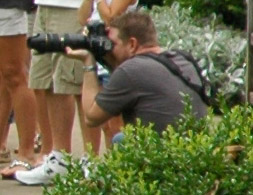
When my writing group was wandering around the Dallas Arboretum doing our photography thing, I took a step to the side while we were in the Women’s Garden and looked down some steps into a large, rectangular formal garden setting. There, in the center of the garden, sitting on a wooden crate, was an attractive young couple, messing around with something that was wrapped in a complex packaging.

It was obviously a staged engagement. The couple was surrounded by smiling people, friends and relatives, all pointing cameras in their direction. I took a couple shots of the scene and moved on.

Now I have a picture of all these people I don’t know at all. That’s a good way to practice doing character sketches. I take a look at each one and try to make up their story.

I know that’s a nasty thing to do… make up a bunch of stupid lies about a group of complete strangers and then put the thing out on the web. But there is something about expectation of privacy at work here… and if you are going to get yourself engaged in the middle of a formal garden in the Dallas Arboretum on a Saturday Morning… well you can kiss any expectation of privacy goodbye.

So, here, without any further ado… I give you:

The Happy Couple

Roberta Bustamante
Franklin Sellars

They met when stuck next to each other for two hours on the Texas Twister ride at the second-rate amusement park Frontier Daze. The ride was upside down for the entire time with the riders hanging from their safety harnesses and Roberta liked that Franklin had smuggled in a sizable flask in his pant leg. Franklin had chugged a good part of the flask to empty it so Roberta would have a place to pee. She thought that was a chivalrous thing to do; he was impressed by the gymnastics.

The park had been rented out by Franklin’s boss, Tyrone Woodchipper and his company Acrasia Investments as a cheap morale booster. Franklin hated the place but felt he had to attend.

Franklin has never been given a straight answer as to why Roberta was there.

They dated for some time and then moved in with each other a year ago. Roberta had a much larger and more luxurious apartment but she insisted on moving into Franklin’s. He has always wondered how she could have afforded such a nice place and was disappointed they couldn’t move there. Franklin loved the window treatments.

Their long-range plans pretty much peter out at the end of their European honeymoon.

The Parents and entourage

Front to back:

Svetlana Bustamante (Roberta’s young half-sister)
Smithsonian (Smitty) Bustamante (Father)
Georgia Bustamante (Stepmother)
Metal Hurlant (Mrs. Sellars’ personal secretary – barely visible)
Claudia Sellars (Mother)
Freemont Sellars (Father)

Smitty is a widower – his first wife, Roberta’s mother, was killed in a mall parking lot – run down by a shoplifting suspect speeding in a pickup truck, fleeing mall security. Georgia was a mail order bride from the Ukraine. Smitty had never lived on his own and didn’t want to mess around with the dating scene. The little girl, Svetlana, is Georgia’s daughter. She left her behind with relatives and didn’t tell Smitty about her until they had been married a year – he immediately sent for her and loves her like his own.

In the back are Franklin’s parents Freemont and Claudia. He made a fortune off of the chain of furniture rental shops he inherited from his father. He always expected Franklin to follow in his footsteps but was secretly relieved when he went off on his own. Even though he undoubtedly loves his son – the kid always made him uneasy when he was around him too much.

The two, Freemont and Claudia, were high school sweethearts. They watch a lot of television. He collects antique watches, she likes to crochet.

Next to Claudia, barely visible in the photograph, is Claudia’s personal secretary who was originally hired from France as an au pair to help raise their daughter, Penelope. Her name is Metal Hurlant – and is from Marseilles – although Claudia tells everybody she is from Paris. Metal organized and set up the whole engagement extravaganza.

Jimmy Bustamante

Roberta’s little brother. He was an infant when his mother was killed and doesn’t remember her at all.

He has been in a very good mood lately after finding a motherlode of illegal drugs hidden in what used to be Roberta’s underwear drawer. He made the discovery when he finally moved into her bedroom after she became engaged and made it clear she would not be moving home.

The drugs were stashed there in a panic by Joaquin Smirnov – a handsome yet terribly addled fling of Roberta’s. Joaquin panicked and threw the bundle of baggies into the drawer when he heard Franklin, Roberta’s fiancé, coming up the stairs. Joaquin hid under the bed, naked, while Franklin paced around, waiting for Roberta, upset (he suspected something) for over an hour and a half. Roberta, unknown to anyone, had gone downstairs for a glass of ice water and bailed out the back door when Franklin drove up and was hiding, also naked, in a large clump of ornamental grass waiting for him to leave.

Joaquin forgot about the stash due to the strain of hiding under the bed for ninety minutes. The drugs stayed there for Jimmy to find because Roberta never looked in the drawer – she hasn’t worn underwear for a year and a half.

Jimmy is now the most popular kid in General George S. Patton Junior High School. He is taking photos with the new hi-tech Nikon compact camera he bought with sale proceeds.

Wendal Fruitbat

He is Metal Hurlant’s boyfriend, though nobody in the family knows this. She is madly in love with him. Their only discussion of the future has been her telling him that if they ever marry, she will not take his last name. He understands perfectly that she does not want to go by the name Metal Fruitbat.

She hired him for the engagement when he told her he had been his high school yearbook photographer. Metal rented him his equipment. Unfortunately, though Wendal is a good person generally, he is a helpless inveterate liar. He knows nothing about photography and is currently using a terrifically expensive camera without a data card.

Reginald Von Sample.

He is Franklin’s oldest and closest friend. They met by random their freshman year at university when they were put in a room together due to an experimental and controversial software program that analyzed students’ admission essays and placed freshmen that the algorithms deemed compatible. They lived the entire six years of both their undergraduate studies together in the same dormitory room.

Reginald left after graduation for a stint in the Merchant Marine. He said he wanted to see the world. He returned two years early and said there didn’t seem to be much out there worth seeing. He moved back in with Franklin until there was a nasty drunken argument late one night. Reginald suffered a serious cut under one arm that seemed to be inflicted by a Cuisinart Chef’s knife. He declined to press charges but moved out.

There was a distance between Reginald and Franklin after this, but the engagement seems to have brought them close together again.

Deasel Widdershins

Deasel is a private investigator hired by an unknown person (even to herself). She receives her instructions by anonymous email and payment through a mysterious Paypal account. She has been instructed to get to know the family and report on anything untoward.

Her cover story is that she is a scout for an obscure cable channel that is considering a newlywed reality show.

It was made clear that she was selected due to a reputation of absolute trustworthiness. Her honesty is not accompanied by competency, however, and she has not found out anything interesting yet.

Penelope Sellars

Franklin’s little sister. She is at that confusing age… made even more confusing by the sudden appearance of deep feelings for her brother’s fiancé. She has made the decision to simply go with it and see what happens. She doesn’t really have any choice.

Tyrone Woodchipper

He has been the Sugardaddy to the soon-to-be blushing bride for the last three years. He made his fortune through his company, Acrasia Investments, which advertises itself as offering speculation in arbitrage futures, but is in reality a front used by Mexican drug cartels to launder their United States profits.

He met Roberta through his son, Luther, who saw her briefly but passionately after their meeting at a speed-dating event. Roberta had an acrimonious breakup with Luther a month after she started sleeping with his father.

Tyrone has very mixed feelings about his mistress’ upcoming nuptials. He is glad that her husband works for him, which will enable him to keep her around easily, but he feels his manhood threatened in general. He is not getting any younger.

Luther Woodchipper (hiding in bushes)

Luther has never recovered from his breakup with Roberta and desperately manages to keep tabs despite the various court issued restraining orders. He doesn’t know what he will do but knows that whatever it is, it has to be soon.

Sunday Snippet – Night Guitar (opening scene)

This week’s snippet is the first scene from the worst short story I’ve written in the last few years. It’s so bad I should simply delete the files and get on with my life, such as it is, but I haven’t done that yet. The mere existence of that pile of silly randomness bugs me like a hangnail and I can’t help but pick at it. I’ve taken it apart and am editing some of the parts that might work sometime and trying to create a creaking framework to hang everything on.

And because I am just too damn tired to come up with anything worthwhile this evening I give you what I’ve written for a opening scene so I can humiliate myself and you can wallow in some shallow schadenfreude before you click away.

Night Guitar

Copernicus Mayhem was the lead singer and guitar player of the band Sweetmeat Valentine. He made damn sure nobody called him anything else. The name his parents had chosen for him was Doug Chandler. But nobody called him that. Not any more.

“Oh, come on Copernicus, please, pretty please, let’s go. I wanna go,” said Serena Twist. She was his West Coast girlfriend, and that was where they were, so she was his girlfriend.

“Oh, babe, I’m beat. This is the first three days off I’ve had in a month. Let’s stay here, the suite’s big and nice, hit some weed, soak in the tub.”

“Hit some weed and soak in the tub? That’s all you wanna do. I’m bored. I’m bored. Let’s go.” Serena had switched her voice into her high sniveling mode – like fingernails on chalkboard. Copernicus knew that he would be giving in, but he wanted to hold out for a minute or two. Have to keep up appearances. He had a sliver of pride left – or he hoped he did.

“What kind of stupid concert is this anyway?” Copernicus asked without any intention of listening to the answer.

“It’s classy. It’s classical. This composer, Tyrone Page, has done a new symphony. It’s never been performed before. You’ve been invited and I want to go. It’s a humongous honor.”

Copernicus had heard of Tyrone Page though he had never actually heard his work. Page was a mystery, an enigma, nobody knew who or where he was.

The scores of Page’s works arrived on the desks of famous conductors at random intervals. Copernicus wondered why he had never heard anything written by the infamous mystery composer… then he remembered. Page never allowed his stuff to be recorded. It had to be heard live. And though the composer was hidden, his lawyers weren’t. Nobody dared put the sound down on tape, or disk, or anything else.

Copernicus was interested. Now, he actually wanted to go; intrigued. It had been a long time since he had felt intrigued.

“Ok, ok, If you want this thing so much, I’ll go,” Copernicus said. “But I want you to call Skinner and make the transportation arrangements. I want a stretch this time, no van. And I want some weed in the car and a bottle of Maker’s Mark. And plenty of ice.”

“Sure honey, I’ll set it up. Thank you, Thank you.” Serena seemed truly grateful.

“Yeah, you do that. And Serena? I’m gonna be hungry when we get back. I want some good room service this time. Not that usual stale crap. Oh, and please change. If this is a big deal like you say, I want you to wear something… something shiny.”

Sunday Snippets

A very busy day today, out and about… I did manage to sit in the Espumoso Caffe in the Bishop Arts District in Oak Cliff and sketch out a short story in my notebook. I meant to type it up when I was home in the evening and let you see it here, but I’ve been hammering away and it’s nowhere near done. I have to drive to Oklahoma City tomorrow to pick up Nick, so I better get some sleep.

All I have for this week, therefore, are three little snips of text, signifying very little. I try to keep on file, well, several hundred little scenes or sketches… mostly culled from the wreckage of failed stories – in the hope that I might be able to use them someday. I pull them out in times of low ambition and massage them, water and fertilize them… see if something roots and grows from the barren cuttings of words.

For example….


The little boy came up out of the water like a sprite from a fountain. He shook the droplets off and watched the tiny rainbows as they flew from his body. He looked down at the dark footprints his wet soles left on the hot concrete – at the space between the toes and curved pads and as he gained speed there was only the toes and the ball, then finally nothing as his skin dried.

A sudden scream of air – a whistle – blown – designed to startle – stopped the boy in his tracks right at the foot of the ladder.

“No Running!” came the simple loud command from high.

The boy shook as he looked up at the voice from the chair – but the speaker was obscured by the bright haloing sun.

He walked carefully the rest of the day, little steps, glancing up at the chair.

That night he ate his dinner and cleaned his plate. Then he copied his lessons from the book onto his blue-lined three-holed paper using his number two lead pencil. He took his evening bath, and – remembering the instructions from his health textbook – combed his hair one hundred times. Finally, he crawled into bed, pulled his blanket up to his neck and quietly, almost silently, sobbed himself to sleep.


He sat on a thin high chair at a narrow bar of blond wood facing the broad windows sipping his drink and watching people drive up outside. Two scruffy guys wearing leather jackets sat smoking and talking – making wide, violent gestures and laughing – at a little table on the sidewalk. He was looking out over their heads. One guy had long stringy dirty hair, balding a little in front. The other had given up and shaved this pate.

Across the busy intersection was a bank building of white marble alternating in vertical strips with blue reflective glass. It extended up past the top of the windows – he wasn’t sure how tall it eventually was. He glanced up and caught the reflection of an aircraft, an orange and red Southwest passenger jet, crossing the face of the building. It must have been on landing approach over his head; lined up with the bank building’s mirrored windows. The image would jump from one strip to the next, sometimes curved and distorted, sometimes magnified, sometimes shrunk to a pinpoint, depending on the flaw in that particular glass panel. The plane would dance, bend, and jump, flitting distorted and plastic.

He noticed the two guys staring at the dancing plane too. As the reflection disappeared off the left side of the bank they laughed and waved their arms bent in the air in imitation of the flexible jet. They turned and shared a silent smile with him through the window – for a split second.

Until he thought better of it and turned back down to his book.


(click to enlarge)

Paul woke up naked and crusted with what must have been vomit. His brain felt like it had swelled to twice its usual size but was still stuck in the same little head. He thought the pressure might separate his skull along some jagged line, exploding his brain in sweet relief. Every nerve in his body was firing quickly and randomly and the light pouring in from the end of the bridge felt toxic. Paul tried to protect himself by digging deeper under the pile of filthy blankets that was left to him. They weren’t thick enough and Paul was forced to try and figure out what to do. His elbows and knees were scraped bloody and his tongue felt torn on the underside, like it had been half pulled out.

He scrabbled around for his clothes, keys, and wallet and found nothing except a filthy pair of green shorts and a denim jacket that said Big Bambu on the back and a fresh bloodstain coursing across the front. He put those on, wrapped himself in the least-filthy rag he could find for warmth, slid down the concrete slope, and padded barefoot along the trail under the high Interstate overpass back to his car.

He wasn’t really surprised when he found the Chrysler missing. He dug around the camp trying to find anything of value but it had been stripped. The dirty shreds of rags, old shopping carts, and trash were still there as was a dark spot where the night’s campfire had burned itself out cold. But no food, drink, shoes, or anything else of any value remained.

Paul sat and cried for over an hour, until the sun rose and heated the mass of concrete overhead and it felt like a rumbling broiler. He could not figure out how to get home. He considered hitchhiking but couldn’t imagine anyone stopping for a horrible apparition like himself. He couldn’t find any change – not enough for a pay phone, and the thought of trying to panhandle… he couldn’t bear the thought of someone seeing him like that.

Then Paul realized that the creek at the bottom of the interchange was the same drainage system that coursed through his apartment complex. He thought he could follow the way, make the correct turns. He limped down into the stale slow-flowing water, the mud feeling good on his feet, but the filthy liquid stinging his wounded knees and elbows. He noted the direction the water was flowing, turned into it and began trudging upstream.

Sunday Snippet – Historical Fiction

Today’s bit is from a confused collection of text that I have been working on for a long time. It was intended to be a piece of historical fiction – a form I love to read but have never really had luck writing.

I think I’m going to give up the historical aspects of this story and move it into the present day. That means I can remove everything from the past and tell it as a complete lie. Trying to do proper research and insure historically accurate details and language was more time than I wanted to waste and more energy than I wanted to expend.

The following is the end of what I used to mess with and it will have to go. But I thought I’d let you take a read before I send it up to that great delete key in the sky.


“Up, Up!” For the second time in the last day, someone was shaking me and shouting into my face. “We must go now!” It was my father. He was in such an agitated state I almost didn’t recognize him.

It took me a minute to get my bearings, to remember and start to understand why I was in bed yet still dressed. The clock showed it to be late afternoon. My face ached terribly and I gingerly touched my mouth and cheek, feeling the dried blood, which stained my shirt with an irregular dark streak. Father ignored my awful appearance, threw an old overcoat around my shoulders and dragged me out the front door.

The Beauregards and the Carrolltons were waiting there, on horseback. Carson held the reins of two more steeds, one for me, one for my father. Before we could mount, my father grabbed me roughly by the shoulders and shoved his face inches from mine. His usually deep and reserved eyes were swollen and bulged out, his cheeks red as beets, his hair, once carefully groomed, now dirty and wild. With a disturbed cracking and rising voice that I wouldn’t have believed could have come from that cultivated and meticulous man he screamed into my face.

“Listen! Listen to me. No matter what happens, no matter what they say or what questions they ask… remember, nothing could have been done! It was God’s will… an act of God alone!” “Do you understand.”

He said the last three words not like a question but as a statement of fact. With that I was grabbed roughly and pulled onto a horse and immediately the group rode off along the road. The rain had let up; only a light misting remained of the violent storm. Everyone was silent as we moved along behind the row of cottages. I couldn’t look out at the lake, it was screened from view by the buildings and landscaping, plus I had to pay attention as the horse worked his way through the deeply rutted road, maneuvering around the many small ponds of standing water. Before long we emerged before the bridge over the spillway but instead of crossing it to the dam the others were turning onto the rough path that led away into the woods. I followed.

They all halted and turned, staring out over the lake. I halted my horse and turned also. I’ll never forget the chill that struck all the way to my very core — the horrible sight that my eyes saw from that road.

The lake was gone. The view was so shocking and unexpected it took several seconds for my mind to comprehend what I was looking at.

Above the old waterline, everything was as it always was; the cottages lined up, the big lodge house, smoke still curling up against the light rain from its cluster of chimneys. The boardwalks still ran along the edge, extending out to the fishing and boat docks, which still stood in place. The hills still ran up and away, covered with the green growth of spring, the blue mountain mists still licked down the hollows to the old waterline.

Below this line, however, everything was horribly, horribly wrong. The lake was replaced with an enormous black wound in the earth. To look down, down into the gaping maw of mud, to see small rivulets of filthy water still running down the impossibly steep sides was to stare into the very depths of hell. I couldn’t stand it. I turned my head away and looked over at the dam itself and saw that it too, had simply ceased to exist. The huge earthen wall was represented now by two small, steep hillocks at each end of an immense chasm. The dam had been neatly sliced away entire by the unimaginable force of the water confined behind it.

Instinctively, I looked back at our own cottage. The dock still stood, except now it was perched high in the air, on stilted legs above an obscene slick, barren hillside. My sailboat hung from its mooring line at the bow, dangling in mid air, swinging in the breeze. Something else moved down there, and I had to look closely to make out the Italian workmen, wading down into the mud. They were grabbing the stranded fish, the bass flopping around helpless, and stuffing them into canvas bags.

For one second I felt sorry for myself. Our wonderful cottage, my beautiful boat, the summers all ruined. That instant of self-pity was drowned by a clear voice that welled up from somewhere deep within me, a voice of awful clarity in the confusion. That voice simply asked, “Where did the water go?”

The lake had been several miles long and up to seventy feet deep. Millions and millions of tons of water had rushed out in what must have been little more than minutes, carrying with it the untold tons more of earth and rock that made up the dam itself. I shuddered when I thought of the power of that giant wave, of how it would grow in deadly fury as it rushed down the mountainside, picking up trees, rocks, roadway… any thing that stood in its inexorable path.

I thought of the narrow canyon that carried the stream down off the mountain, the very valley that I had fought my way up the day before. There was nothing along that way to halt or even slow down the wave; it would actually focus the power, help it to build up upon itself.

Finally, I thought of the city of Johnstown far below. It was already flooded, waterlogged, completely at the mercy of the disaster that fell from the mountains above. The remains of the lake would descend upon the town like a falling mountain, a moving mountain of water and debris, a flying, boiling unstoppable wave of violent death.

Finally, I thought of Maggie in her little shack, perched right there on the bank by the water. Right where the Conemaugh River opened up into the doomed helpless hopeless city.

I let out a cry, a shriek like that of a pitiful useless animal and began to shake uncontrollably. An icy coldness held me in a merciless grip. I couldn’t move. My father saw my state and, still muttering “Act of God, nobody’s fault, Act of God” grabbed the reins of my horse and led us all away into the woods along the rough path.