A Month of Short Stories 2017, Day 6 – And of Clay Are We Created, by Isabel Allende, translated by Margaret Sayers Peden

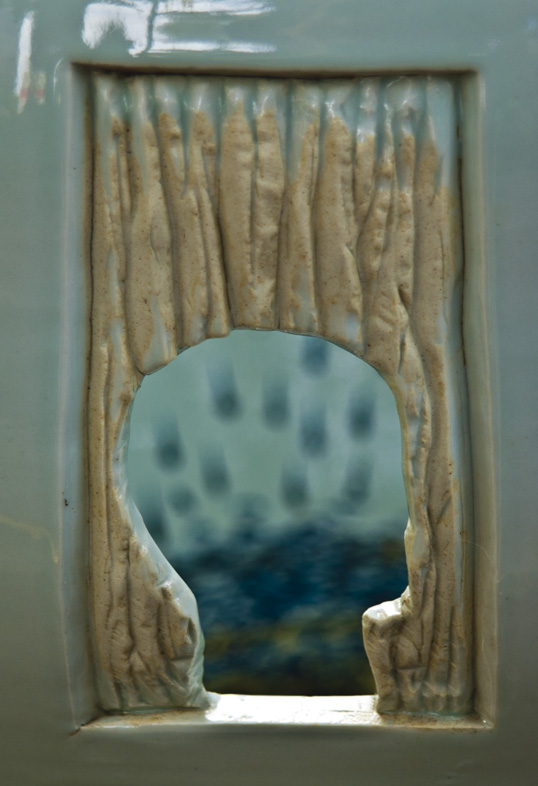
Statue on top of a crypt, Saint Louis Cemetery Number One, New Orleans

Over several years, for the month of June, I wrote about a short story that was available online each day of the month…. It seemed like a good idea at the time. My blog readership fell precipitously and nobody seemed to give a damn about what I was doing – which was a surprising amount of work.

Because of this result, I’m going to do it again this year – In September this time… because it is September.

Today’s story, for day 6 – And of Clay Are We Created, by by Isabel Allende, translated by Margaret Sayers Peden

Read it online here:

And of Clay Are We Created by Isabel Allende, translated by Margaret Sayers Peden

First a subterranean sob rocked the cotton fields, curling them like waves of foam. Geologists had set up their seismographs weeks before and knew that the mountain had awakened again. For some time they had predicted that the heat of the eruption could detach the eternal ice from the slopes of the volcano, but no one heeded their warnings; they sounded like the tales of frightened old women. The towns in the valley went about their daily life, deaf to the moaning of the earth, until that fateful Wednesday night in November when a prolonged roar announced the end of the world, and walls of snow broke loose, rolling in an avalanche of clay, stones, and water that descended on the villages and buried them beneath unfathomable meters of telluric vomit.

—-Isabel Allende, And of Clay Are We Created

There isn’t much I can add to today’s story. Any comment would seem trivial and trite. This one is the real deal. Just read it.

Interview with Isabel Allende:

Q. Can you elaborate on the idea of writing fiction—of telling a truth, of telling lies, of uncovering some kind of reality? Can you also talk about how these ideas might work together or against one another?

A. The first lie of fiction is that the author gives some order to the chaos of life: chronological order, or whatever order the author chooses. As a writer, you select some part of a whole. You decide that those things are important and the rest is not. And you write about those things from your perspective. Life is not that way. Everything happens simultaneously, in a chaotic way, and you don’t make choices. You are not the boss; life is the boss. So when you accept as a writer that fiction is lying, then you become free. You can do anything. Then you start walking in circles. The larger the circle, the more truth you can get. The wider the horizon—the more you walk, the more you linger over everything—the better chance you have of finding particles of truth.

Q. Where do you get your inspiration?

A. I am a good listener and a story hunter. Everybody has a story and all stories are interesting if they are told in the right tone. I read newspapers, and small stories buried deep within the paper can inspire a novel.

Q. How does inspiration work?

A. I spend ten, twelve hours a day alone in a room writing. I don’t talk to anybody. I don’t answer the telephone. I’m just a medium or an instrument of something that is happening beyond me, voices that talk through me. I’m creating a world that is fiction but that doesn’t belong to me. I’m not God; I’m just an instrument. And in that long, very patient daily exercise of writing I have discovered a lot about myself and about life. I have learned. I’m not conscious of what I’m writing. It’s a strange process—as if by this lying-in-fiction you discover little things that are true about yourself, about life, about people, about how the world works.

—-Isabel Allende, from her website

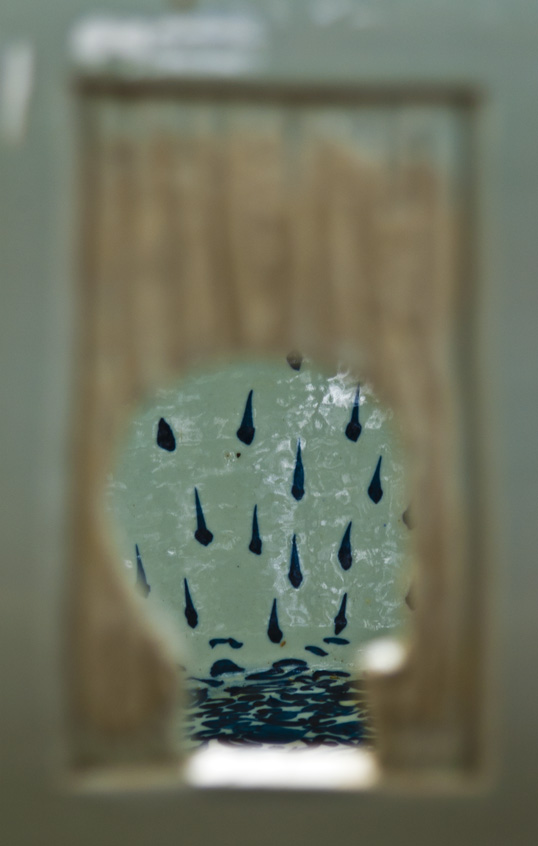
The land of lakes, volcanoes, and sun. A painting I bought on my last trip to Nicaragua.

A Month of Short Stories 2017, Day 5 – Pending Vegan, by Jonathan Lethem

The Wyly Theater in the Dallas Arts District

Over several years, for the month of June, I wrote about a short story that was available online each day of the month…. It seemed like a good idea at the time. My blog readership fell precipitously and nobody seemed to give a damn about what I was doing – which was a surprising amount of work.

Because of this result, I’m going to do it again this year – In September this time… because it is September.

Today’s story, for day 4 – Pending Vegan, by Jonathan Lethem
Read it online here:

Pending Vegan, by Jonathan Lethem

And, after the insipid triumphalist overture of music and video and prancing androgynous spandex, when the orcas finally entered the arena and began their leaping, SeaWorld was overwritten by their absolute and devastating presence. By their act of stitching two realms together, sky and water, merely for the delight of a stadium full of children—children who, in response, leaped, too, and vibrated in their seats, and gurgled incoherently, practically speaking in tongues. Other kids, older and more intrepid than his own, raced down to the plastic barrier to be splashed, to stand with their arms flapping. The killer whales, with their Emmett Kelly eyes, were God’s glorious lethal clowns. Their plush muscular bodies were the most unashamed things Pending Vegan had ever seen. Like panda bears redesigned by Albert Speer.

—-Jonathan Lethem, Pending Vegan

A few years ago, my son Lee and I went down to the Dallas Theater Center’s Wyly Theater to see a new musical, The Fortress of Solitude, adapted from Jonathan Lethem’s eponymous novel. It was Pay What You Can Night (pretty much the only way I can see quality live theater on an ongoing basis) – which is cool, though what we saw was essentially a dress rehearsal open to the public. Because of this, there was a bit of confusion and we discovered that our assigned seats weren’t there (the Wyly is infinitely reconfigurable and they had configured our seats out of existence). No problem, the box office had alternate seats which were better anyway (not that the Wyly has any bad seats) – we were placed in a line of vacant seats right up front. Two men sat next to us at the last minute.

The play was excellent, very enjoyable. I never read the novel, so I don’t know if it followed or did justice, but as a night of live musical entertainment, it fit the playbill. As the play ended, the man sitting next to Lee started asking him a series of questions, “Did you like the musical?” “What songs did you like?” – the inquiry seemed more pointed than curious. I looked at the man and at the Playbill folder in my hand and realized this was the author (of the play, not Jonathan Lethem, alas). The idea was to premiere the musical in the hinterlands (Dallas), iron out the rough spots, them move to Off Broadway (Public Theater) then, eventually, to the Great White Way.

It looks like the momentum has stalled and it probably never will make it to Broadway… but at least I saw it.

Today’s story, also by Jonathan Lethem, is a chronicle of a family’s trip to Sea World in San Diego. The protagonist is struggling with a sudden attack of giving a damn about animals and, possibly more importantly, just now coming off his prescription to anti-depressants. His doctor warns him he might, “see bums and pickpockets.” Worried that he might hallucinate, the doctor assures him that he won’t imagine them, he may simply notice them.

I, of course, have been to Sea World (the San Antonio version) with unruly children a couple of times. I dealt with it a little bit differently than the father in the story – I didn’t think about it. It was a day for the kids and all I was responsible for was trying my best they didn’t get eaten by sharks or destroy an expensive exhibit. All other thoughts were put on hold.

For about a quarter century.

—–

In the interview below, Lethem says, “I’d also have trouble imagining a fiction writer who, after visiting the place, wouldn’t start fooling around with story ideas.” When I first read this I disagreed – I couldn’t think of any story ideas from SeaWorld.

Then I remembered seeing the Shamu show one year. The Orca wasn’t in a good mood and basically stayed at the bottom of his tank and refused to do any tricks. He was the male in the pod and the two females were in the lake outside of the arena. They kept surfacing and making these loud sounds. There is no doubt they were laughing at him.

The neoprene-wet-suited show people tried to get on with the act. They even brought a volunteer from the audience out to try and coax him into getting to work. I thought, “Man, if I had a humiliated, cranky, and uncooperative killer whale at the bottom of a tank, the last thing I’d want to do is lean out and wiggle a fish over him.”

Hmmm. I guess that is an idea for a story.

Interview with Jonathan Lethem about this story:

This week’s story, “Pending Vegan,” follows one family, a husband and wife and their four-year-old twin daughters, on a trip to San Diego’s SeaWorld. When did you start thinking about using SeaWorld as the setting for a story? Did you ever consider inventing the theme park and fictionalizing everything, or was it important that the story be set in a real place?

This story really began with a class I taught, called Animals in Literature. I assigned Jack London, William Faulkner, Franz Kafka, Olaf Stapledon, Lydia Millet, J. R. Ackerley, and a bunch of other stuff, including some essays and theory. (Animals are actually pretty “hot” in theory now.) In the spirit of due diligence, I also read a bunch of animal-rights and vegan manifestos, which is how I blundered into the realm of “Fear of the Animal Planet” and so forth—books I purchased, and which sit staring at me from the shelf, even if I failed to assign them or, in many cases, even to read them. I suppose some of this bad faith leaked into the characters: What would it be to think you’ve gone about halfway, or not even halfway, down some irreversible ethical path, then got stuck there?

Of course all this remained inchoate until suddenly I visited SeaWorld. I can’t imagine anyone setting a story there who hadn’t visited. (I’d also have trouble imagining a fiction writer who, after visiting the place, wouldn’t start fooling around with story ideas.) Long ago, I’d have been certain to disguise it as “Fathomverse,” or “Poseidon’s Playhouse,” or “Orcasm,” or something. But that wouldn’t really be likely to fool anyone, would it? A lot of fiction—most?—derives some of its effects, and energy, from its hybrid nature: half documentary, or half confession or argument or whatever, and full of references outside itself, whether obvious to the reader or not. I’ve made my peace with this. Besides, I’d have had to give up “Sea World, Eat World.”

The story’s protagonist, Paul Espeseth, is going through a crisis of sorts, which he has hidden from both his family and his shrink. He’s renamed himself Pending Vegan as a way of acknowledging his increasing uneasiness with the relationship between man and beast, yet he’s acutely aware of his daughters’ ability to reconcile “their native animal-love and the pleasures of eating.” What’s it like to imagine a child’s version of the animal world versus an adult’s?

Forget “animal world” —what about just “world”? Where’s the script for breaking the news, to a kid, of reality’s roaring wackness? Its moral bankruptcy? Imagine a scene from the breakfast table with a six-year-old listening to an NPR report on the firing of nine air-force commanders over cheating on the tests to qualify as officers for oversight of nuclear missiles.
Six-year-old: “What did they cheat on?”
Father (already in trouble): “Well, see, they were in, like, ‘soldier school’…”
Six-year-old: “Don’t they know it was wrong?”
Father: “———”
Six-year-old: “What are nuclear missiles?”
Father: “———”
Six-year-old: “Why would they cheat? Don’t they want to be good at fighting?”
Father (suddenly impassioned, intense): “Well, actually, the reason this matters so much is that nuclear missiles are these weapons we don’t want anyone ever to use…” (He stops at brink of disaster.)
Six-year old: “—?!?—”
Father: “Uh, eat your pineapple.”
Six-year old: “My teacher told me that pineapple was bad for your skin.”
Father (with relief): “She’s definitely wrong.”

A dog bounds into the story in its final page. It’s not the first time dogs have shown up in your work (“Ava’s Apartment,” for example, an excerpt we published from your novel “Chronic City,” features a memorable three-legged dog). Do dogs hold a particular place in your imagination? Can you imagine a cat exercising as much power?

Cat person or dog person? Funny about that. I grew up with cats; I’m more familiar with them, more fond of them, and I identify with them more. My parents bred Siamese cats for a while, and in a lot of baby pictures I’m seen swimming in a mass of kittens. Dogs were in stories, first: “Nobody’s Boy,” “The Incredible Journey,” Jack London’s and—especially—Albert Payson Terhune’s work. I was probably the last boy in the history of boys to drink deep at the well of “Lad: A Dog” and “His Dog.” Meanwhile, real dogs terrified me. This lasted a while. Even after we got a dog, other people’s dogs terrified me. I was 33clear to me. As in the case of my character, dogs are a problem I can’t solve; they throw me back into the question of self and other. For a writer, that’s good. Writing a story about a cat would be like writing a story about my arm or my ear.

—- Interview with Jonathan Lethem in The New Yorker
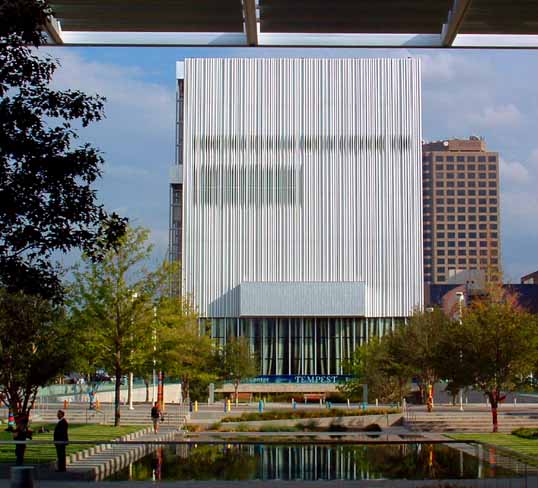
The Wyly Theater.

A Month of Short Stories 2017, Day 4 – Attitude Adjustment, by Tim Gautreaux

Big Boy 4018

Over several years, for the month of June, I wrote about a short story that was available online each day of the month…. It seemed like a good idea at the time. My blog readership fell precipitously and nobody seemed to give a damn about what I was doing – which was a surprising amount of work.

Because of this result, I’m going to do it again this year – In September this time… because it is September.

Today’s story, for day 4 – Attitude Adjustment, by Tim Gautreaux

Read it online here:
Attitude Adjustment, by Tim Gautreaux

Sometimes he would close his eyes tight and try to remember what had happened—how, in the heavy forest south of Passion Gap, a train had been trumpeting a monstrous chord of warning through the snow, but Father Jim, driving toward his church, creating a new homily in his head, had failed to hear it. He was proud of his sermons and wanted to get this latest one just right. The road twisted through a railway crossing, but with no crossing arms or blinking signals, Father Jim never saw the locomotive of a 100-car coal train explode into his vehicle, shoving it a quarter mile in a veil of flames and coppery sparks. The impact thrust the priest through a million diamonds of windshield and he landed in the middle of Highway 16, his skull fractured like a dropped melon, his hands tracked with cuts, both legs broken and bleeding. He lay in the snowy road for an hour while an ambulance crew came up the mountain through the developing blizzard, the engineer and brakeman crouching over his body, trying to stop the bleeding with shop rags.

—-Tim Gautreaux, Attitude Adjustment

A long time ago, I worked for the EPA as a consultant on a technical assistance team. My job was to provide my expertise on various technical subjects (emergency response, chemical cleanups, analytical chemistry, safety plans… that sort of thing) to oil spills, chemical accidents, and Superfund Emergency Removals. In 1982 I was sent to Livingston, Louisiana to help after the derailment of a train carrying a large amount of chemicals in the center of town. I spent about a month there working on various parts of the response and cleanup.

If you really want to know, I’m visible in the video at the 8:57 point, wearing blue coveralls and a blue cap leaning on the door of the van.

Years later, at a Writing Marathon in New Orleans, I told the story of the derailment and cleanup. Someone said that a local well-known writer Tim Gautreaux had written a fictional short story based on the Livingston train derailment called Waiting for the Evening News. I had read Gautreaux before and enjoyed his short stories. I dug around and found the collection with Waiting for the Evening News in it and eagerly read the story. Though his point of view on the accident was very different than mine – it was pretty cool.

I think I sent the author an email… maybe not. At any rate, I never met or talked to him, but still felt some sort of a connection.

Today’s story, Attitude Adjustment is a simple tale of a Catholic Priest that survives a horrific car accident – a collision with a coal train. He comes out the other side severely damaged, both physically and mentally. It becomes almost impossible for him to deliver a proper sermon or confession. He resorts to a lot of little tricks simply to help his mind get through a normal day.

This leads to a misunderstanding with the Federal Government, specifically the Bureau of Alcohol, Tobacco, and Firearms… and things don’t go very well for him.

Or maybe they do. He is a good man after all, and a tough man, and it looks like he might make it through after all.

Tim Gautreaux Interviews:

I’m not interested in labels; I’m interested in storytelling. And nobody even knows what a Cajun is. I put a redneck character in one of my stories in Welding with Children, and a lot of people have called him a Cajun, and he’s from Alexandria, which is the most un-Cajun place on the face of the earth. And he’s not Catholic, and he doesn’t have an Acadian surname. Anybody from the region understands who that fellow is, but people out of the region will read other things into it. I just can’t worry about that.
—-An Interview with Tim Gautreaux: “Cartographer of Louisiana Back Roads”, from Southern Spaces

I think most little towns in America present a mixture of all sorts of cultures, and this makes me suspicious of stereotypes based on the assumption that a certain region is peopled by one type of person. Back in the 1950s I thought Texas was all cowboys and oil men listening to Hank Williams or Bob Wills, yet traveling by train through Texas with my transistor radio I picked up Mexican polka music played on German accordions. This marriage of musical cultures introduced me to the idea that no region is one thing only. A writer has to keep this in mind when he deals with setting. Don’t oversimplify, and pay attention to what’s around you culturally. Awareness of class and culture is money in the bank for a fiction writer.
—-A Conversation with Tim Gautreaux, from Image

Three generations. The smoking diesel pulling the steam Big Boy, while the electric DART train zooms by overhead.

A Month of Short Stories 2017, Day 3 – The Ambush, by Donna Tartt

M41 Walker Bulldog
Liberty Park
Plano, Texas

Over several years, for the month of June, I wrote about a short story that was available online each day of the month…. It seemed like a good idea at the time. My blog readership fell precipitously and nobody seemed to give a damn about what I was doing – which was a surprising amount of work.

Because of this result, I’m going to do it again this year – In September this time… because it is September.

Today’s story, for day 3 – The Ambush, by Donna Tartt

Read it online here:

The Ambush, by Donna Tartt

“Oh my God!” he said. “Stay with me, Hank! You can’t die, you son of a bitch!”

I grimaced and tossed my head from side to side in agony as Tim – in a desperate effort to revive me – pounded on my chest. I was impressed by his profanity, but even more impressed that he had taken the Lord’s name in vain on my behalf.

Far away, from the back porch, Tim’s grandmother called out to us in a thin, irritating voice: “Do you all want lemonade?”

—-Donna Tartt, The Ambush

A while back I read Donna Tartt’s The Secret History and liked it more than I anticipated. The Goldfinch is on my list of books to read – a long list that is, unfortunately, growing rather than shrinking.

Maybe before I die.

Today’s story, The Ambush, is a spectacularly well written tale of childhood and war. The descriptions are all too precise and knowing for a child of eight (the narrator) and you know it is being told from a point far in the future. That the memories are so strong and accurate shows how important the events are to the character, the author, and the reader.

It is a story of the time, a time gone, but of a time I remember. It’s a story of the death of a friend’s father and of the death of a certain kind of life we used to live.

This is something that the novel does better than any other art form: reproducing the inner life and the inner experience of another person, particularly extreme forms of consciousness like grief, dreams, drunkenness, spiritual revelations, even insanity. Unlike movies, where we’re always onlookers, in novels we have the experience of being someone else: knowing another person’s soul from the inside. No other art form does that. And I like dealing with particularly intense inner experiences because I think that in many ways, this is what the novel does best.
—-Donna Tartt

A Month of Short Stories 2017, Day 2 – The Itch, by Don DeLillo

Crow Collection of Asian Art
Sculpture Garden
Dallas, Texas

Over several years, for the month of June, I wrote about a short story that was available online each day of the month…. It seemed like a good idea at the time. My blog readership fell precipitously and nobody seemed to give a damn about what I was doing – which was a surprising amount of work.

Because of this result, I’m going to do it again this year – In September this time… because it is September.

Today’s story, for day 2 – The Itch, by Don DeLillo.

Read it online here:
The Itch, by Don DeLillo

But nobody showed up, so he sat awhile looking at the wall. It was one of those Saturdays that feel like Sunday. He didn’t know how to explain this. It happened intermittently, more often in the warmer months, and it was probably normal, although he’d never discussed it with anyone.
—-Don DeLillo, The Itch, opening lines

I have read some of Don Dellilo’s work… not what I would say a lot of it… not by any means all of it. The most notable absence is the massive novel Underworld which I have been meaning to read for a couple decades. Tomes of that weight and size require a commitment that I have been unable to grant for some time. Maybe soon.

Maybe before I die.

At any rate, I loved his novel White Noise enough that the other things he has written pale in my mind. That novel rotates around a bucolic modern scene that is interrupted by an Airborne Toxic Event of some kind… something that I am sort of familiar with in real life. It is an entertaining and haunting work of fiction.

In modernist fiction, there is an interesting difference between novels and short stories. In a novel, the strange detachment of modern life has to be dealt with and resolved… at least partially. In a short story, the author is free to wallow in the surrealism of daily life in this best of all possible worlds.

In today’s story that surrealism takes the form of an itch. The protagonist bounces from doctor to doctor… getting no help, and towards a possible love interest. But always present, if sometimes latent, is the itch, possessing a strange and fearful symmetry, and a perverse unpredictability. It doesn’t make life unbearable, but it probably makes it less fun. Which seems pretty unbearable.

Interviews:

I’m thinking of two dimensions of a screen or a page on which people read. We hope, writers hope, that in fact their characters are living in a three-dimensional world, first in the writer’s mind, then in the minds of readers.

When I’m conceiving a scene, do I see it in three dimensions? It’s not so easy to answer what appears to be a simple question. I see it — I see characters, I see people, I see streets, cars — and they seem to exist in this special level of mental reality. I could not distinguish the features of a character’s face when I have an idea concerning this character, when I see him or her in a room, and in most cases the room itself is fairly generic — except when I’m actually describing a room — this does happen somewhere in “Zero K” — and then I see a room much more clearly.
—-from an LA Times Interview

INTERVIEWER
Do you have any idea what made you a writer?
DON DeLILLO
I have an idea but I’m not sure I believe it. Maybe I wanted to learn how to think. Writing is a concentrated form of thinking. I don’t know what I think about certain subjects, even today, until I sit down and try to write about them. Maybe I wanted to find more rigorous ways of thinking. We’re talking now about the earliest writing I did and about the power of language to counteract the wallow of late adolescence, to define things, define muddled experience in economical ways. Let’s not forget that writing is convenient. It requires the simplest tools. A young writer sees that with words and sentences on a piece of paper that costs less than a penny he can place himself more clearly in the world. Words on a page, that’s all it takes to help him separate himself from the forces around him, streets and people and pressures and feelings. He learns to think about these things, to ride his own sentences into new perceptions. How much of this did I feel at the time? Maybe just an inkling, an instinct. Writing was mainly an unnameable urge, an urge partly propelled by the writers I was reading at the time.
—-From The Paris Review

Crow Collection of Asian Art
Sculpture Garden
Dallas, Texas

A Month of Short Stories 2017, Day 1 – Love (“Amor”) by Clarice Lispector

(click to enlarge)

Over several years, for the month of June, I wrote about a short story that was available online each day of the month…. It seemed like a good idea at the time. My blog readership fell precipitously and nobody seemed to give a damn about what I was doing – which was a surprising amount of work.

Because of this result, I’m going to do it again this year – In September this time… because it is September.

Today’s story, for day 1 – Love (“Amor”), by Clarice Lispector.

Read it online here:

Love (“Amor”) From The Complete Stories; Translated by Katrina Dodson By CLARICE LISPECTOR

Ana’s children were good, something true and succulent. They were growing up, taking their baths, demanding for themselves, misbehaved, ever more complete moments. The kitchen was after all spacious, the faulty stove gave off small explosions.
—-from Love, by Clarice Lispector

I don’t know where I first heard of Clarice Lispector and her short stories… it was surprisingly recent. She is considered one of the masters of the form from Brazil. I checked out a book of her stories, translated into English, of course, from the library and am working through them.

Her work has that surreal quality that translated stories usually have – especially the ones from Latin America. The emotional knowledge is so subtle, acute, and accurate, it is almost painfully real and exciting fantasy at the same time. It makes me wish I could write like that.

Today’s story, Love, shows that there is nothing more delicate and unbalanced than an ordinary modern family life. Anything can tip the cart over – even something as simple as a blind man chewing gum.

Daily Ritual

New Orleans Writing Marathon

Day Five, Friday, July 14, 2017

“America has only three cities: New York, San Francisco, and New Orleans.
Everywhere else is Cleveland.”
—-Tennessee Williams

Fish on the sidewalk,
Governor Nichols Street
New Orleans, Louisiana

Every day I have to select what I will be handwriting for the day. I carry a burlap zippered bag that used to hold five pounds of Basmati Rice that I bought from the local Indian market (a great bag, by the way) and into this bag I put one, two or three journals. I also select a couple of fountain pens, usually of contrasting ink colors, which I put into an Otterbox armored cigar case (two cigars) for protection.

Pens – I usually have about 5 in rotation – I may put a new one into or take one out (clean it of old ink, place it back in storage) rotation.

Things to think about:

  • Value – Don’t want to carry an expensive pen someplace risky.
  • Age – The older pens are fragile and won’t carry one if I’m going somewhere active (like on a bike)
  • Line Width – If I am going to write a lot I’ll want a pen with a narrow line – wider lines are fun for short writing
  • Ink Color – I like to vary this – for the heck of it
  • Reliability – how long will I be gone? If more than a short time, I need a reliable pen.
  • Amount of ink held – again, how much writing?

Journals:

  • Bullet Journal – go to, usually carry
  • Idea Journal
  • Goals Journal
  • Straightening Journal
  • Fiction snippets journal
  • … several others

This has to be done every morning before I leave the house. The rice bag will fit in my work backpack if I’m going to work.
I don’t know how to carry extra ink (bottle, cartridges, syringe?) – need to work on that.

Walking Along Governor Nichols Street

New Orleans Writing Marathon

Day Four, Thursday, July 13, 2017

Ancient tree growing through the sidewalk, Governor NIchols Street, New Orleans, Louisiana

Walking in the morning is too hard. My feet ache from all the walking the day before, my leg muscles are stiff and weak from sleeping all night. The morning humidity is difficult to breathe as if the moisture is displacing all the oxygen.

Time oppresses this morning. I can feel the burden of centuries in the teetering live oaks growing out of the sidewalks – their ancient roots beginning to slip and rise, pushing the bricks and slabs of concrete up and aside like they are packing peanuts.

I have seen these trees lying on their sides after a violent storm. Enormous root ball exposed to the air – an obscene display of the oak’s private parts.

How many storms, named and ancient anonymous, have these giant trees endured.

Some of them… I don’t think they will make it through the next one.

I have been through too many storms – some quiet, some loud, and they have left be bent. How many more do I have left?

Not too many, maybe not enough.

In the Cathedral

New Orleans Writing Marathon

Day Three, Wednesday, July 12, 2017

Walking around the French Quarter we decided to stop off at the iconic (and beautiful) St. Louis Cathedral as a peaceful respite from the heat and a nice place to write for a bit. This is some of what I wrote there.

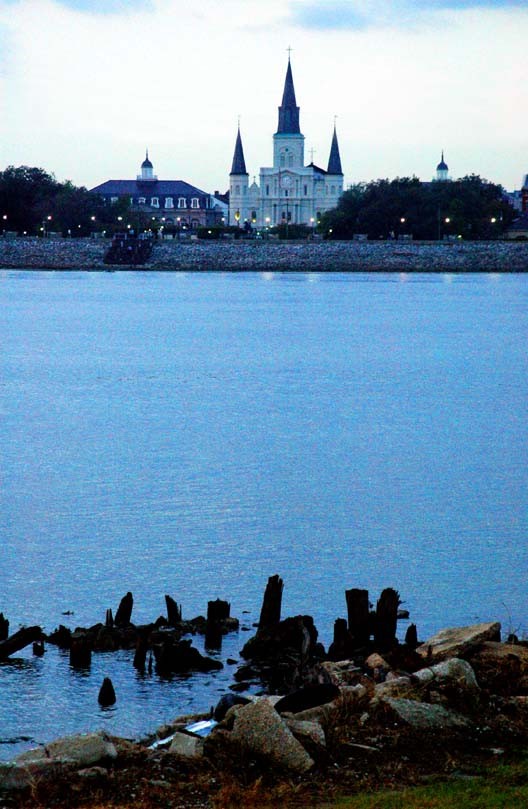
Saint Louis Cathedral from across the Mississippi River

The Devotion Machine

The Cathedral was designed – as all were – to draw the eyes upward, the attention and ultimately, the soul, toward heaven.

At first the peasants felt their rough clothes, callused hands, and freshly scrubbed skin acutely – feeling out of place, uneasy, and embarrassed at their poverty and the effects of a difficult and dangerous life. But the calm and quiet reverence would wear away their feelings of unease and they would accept the fact the opulent gilt statuary, soaring columns, and ceiling frescoes of Saints and the Christ peering down, magnanimous, as if through gaps in the clouds, were all intended for them. Each individual worker feeling as if this vast impressive building – this Machine for Devotion – was designed, constructed, and decorated for him and him alone. A personal miracle that helped him forget the world and dream of a higher place.

At least for a few precious seconds.

Children in the Cathedral

Down the center aisle two children – a small boy and his younger sister, almost a toddler – hopped along, playing a game of leaping contrasting floor tiles in a complicated very personal and mysterious children’s pattern. Their feet clomped and echoed through the vast silent space. All the supplicants stared in vexation.

“They think they own the place,” everyone thought to themselves – some daring to mumble out loud.

And that’s the horror of growing up, isn’t it. At that young age everyone owns the world. Over the next years those kids will come the slow horrifying realization that they own nothing.

The First Time

New Orleans Writing Marathon

Day Two, Tuesday, July 11, 2017

One snippet of what I wrote that day.

The first time Jambalaya Joe cooked for us he made – of course – jambalaya. A great black cast iron kettle, suspended over a ring of roaring blue gas jets fed by a rusty steel bottle mounted on his trailer, bubbled furiously and steamed like a witch’s cauldron into the humid Louisiana air.

Rice, mysterious lumps of meat, and bags of vegetables went in – to roil and cook.

Then Jambalaya Joe looked around as if to make sure nobody was watching (though we all were – ravenous after a long, hard working day) extracted a large tin box from a stained canvas bag, lifted it over the boiling pot, and opened the lid with the creak of old hinges.

A cloud of red spice tumbled out to disappear into the boil below. It changed the color of the stew from a flat brown to a fiery red.

“That’s his famous secret spice mix,” said some random stranger next to me, complete with a wink and a subtle elbow to the ribs.

Jambalaya Joe cooked the evening meal for us every night, hired by The Company to feed the work crew until the job was finished.

He made something different each night. Jambalaya became gumbo, then red beans and rice, Irish stew, chili, then spaghetti and meatballs… on and on – visiting every cuisine of the world. I never imagined a cast-iron kettle could be so versatile.

But every meal he dumped the exact same tin box filled with the same secret spice mix into the pot.