Deep Ellum, Dallas, Texas

Deep Ellum, Dallas, Texas
You can’t take a photograph of a city at night. The eyes see things the lens never dreams about.
Those who dream by day are cognizant of many things that escape those who dream only at night.
—-Edgar Allan Poe, Eleonora

(click for a larger version on Flickr)
“I love the silent hour of night, for blissful dreams may then arise, revealing to my charmed sight what may not bless my waking eyes.”
― Anne Brontë, Best Poems of the Brontë Sisters
I woke last night to the sound of thunder
How far off I sat and wondered
Started humming a song from 1962
Ain’t it funny how the night moves
When you just don’t seem to have as much to lose
Strange how the night moves
With autumn closing in
—-Bob Seger, Night Moves

The sky above Klyde Warren Park, Dallas, Texas
(click for a larger version on Flickr)
When I was a little kid, I had a paint-by-number kit… you know, one of those bilious hunks of cheap canvas board with numbered areas printed in blue ink that corresponded with little plastic tubs of oil paint. Now, I imagine they come with some sort of water-based acrylic – safer and easier for children – but this one had real slow-drying artists’ oil paint.
I might have been six years old… maybe seven. Fifty years ago.
I sat at the kitchen table, wielding the cheap brush that came with the kit, carefully cleaning it after each color and moving across the canvas matching the numbers with the proper paint. It amazed me… that I could create an actual work of art (unfortunately, my skills have advanced little since).
It didn’t seem too hard to me to make the leap beyond the preprinted canvas – surely it wouldn’t be that hard to do yourself. I was a little kid, what did I know? Nothing about composition, blending… and nothing about mixing colors.
What I especially remember is the sky above the sailboat. The scene had the boat fighting against a headwind on a dramatic tumbling, mostly overcast day – with the heavens filled with irregular patches of brown, beige, gray, and a little blue peeking through here and there. It was beautiful to me.
Now, whenever I have a sky like that… like this, my subconscious conjures up the by-the-mumbers painting of the sailboat from the distant cobwebby recesses of the past. Before I realize what I am thinking about, weather like this, fills my nose with the unmistakable odor of linseed oil and turpentine. Only then do I pause, look up, and remember the sailboat.
“A garden to walk in and immensity to dream in–what more could he ask? A few flowers at his feet and above him the stars.”
― Victor Hugo, Les Misérables
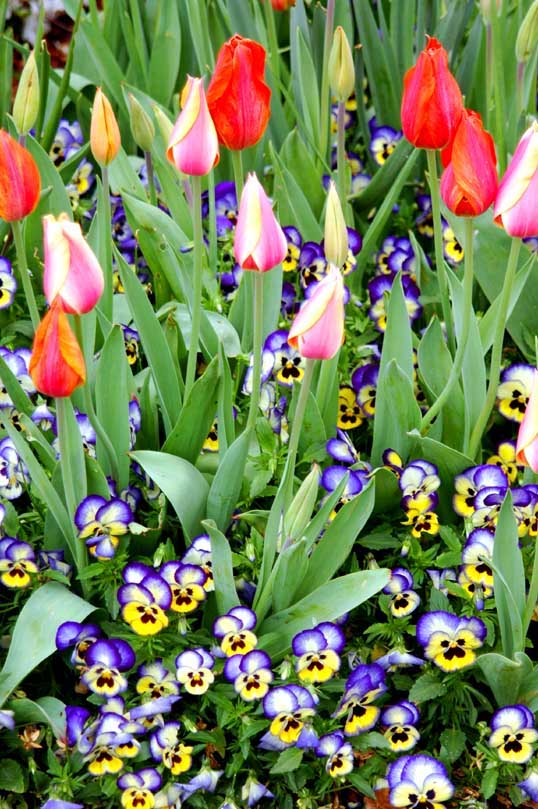
Dallas Blooms, Dallas Arboretum
“A flower blossoms for its own joy.”
― Oscar Wilde

“There has fallen a splendid tear
From the passion-flower at the gate.
She is coming, my dove, my dear;
She is coming, my life, my fate.
The red rose cries, “She is near, she is near;”
And the white rose weeps, “She is late;”
The larkspur listens, “I hear, I hear;”
And the lily whispers, “I wait.”She is coming, my own, my sweet;
Were it ever so airy a tread,
My heart would hear her and beat,
Were it earth in an earthy bed;
My dust would hear her and beat,
Had I lain for a century dead,
Would start and tremble under her feet,
And blossom in purple and red.”
― Alfred Tennyson
“You’re frustrated because you keep waiting for the blooming of flowers of which you have yet to sow the seeds.”
― Steve Maraboli
Dallas Blooms, Dallas Arboretum

It was odd walking around the Arboretum – I kept expecting to see the Chihuly Glass and it isn’t there any more. The gorgeous colors of Dallas Blooms made up for the absence of the sculptures.
My poor picture taking talents don’t do justice. Peggy does a better job than I do.
“I stopped in front of a florist’s window. Behind me, the screeching and throbbing boulevard vanished. Gone, too, were the voices of newspaper vendors selling their daily poisoned flowers. Facing me, behind the glass curtain, a fairyland. Shining, plump carnations, with the pink voluptuousness of women about to reach maturity, poised for the first step of a sprightly dance; shamelessly lascivious gladioli; virginal branches of white lilac; roses lost in pure meditation, undecided between the metaphysical white and the unreal yellow of a sky after the rain.”
― Emil Dorian, Quality of Witness: A Romanian Diary, 1937-1944
White Rock Lake, Dallas, Texas
“hark, now hear the sailors cry,
smell the sea, and feel the sky
let your soul & spirit fly, into the mystic…”
― Van Morrison

“Where lies the final harbor, whence we unmoor no more? In what rapt ether sails the world, of which the weariest will never weary? Where is the foundling’s father hidden? Our souls are like those orphans whose unwedded mothers die in bearing them: the secret of our paternity lies in their grave, and we must there to learn it.”
― Herman Melville, Moby Dick
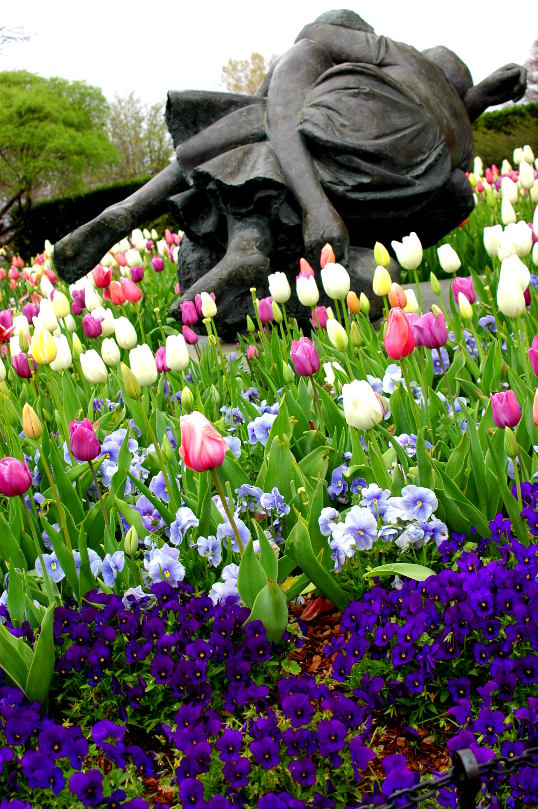
Dallas Blooms, Dallas Arboretum

I posted an entry with pictures of this sculpture before – The Kiss.
The vegetation around it looked a lot different in July.

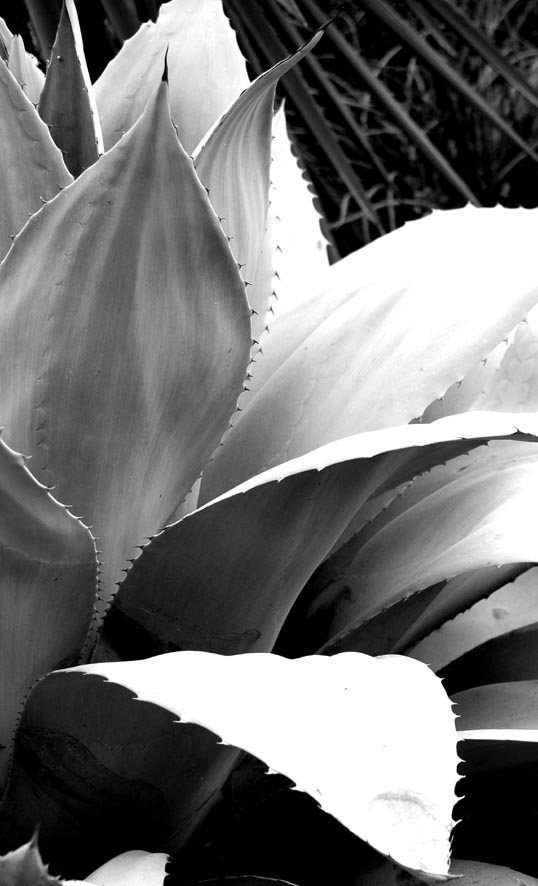
Dallas Blooms, Dallas Arboretum
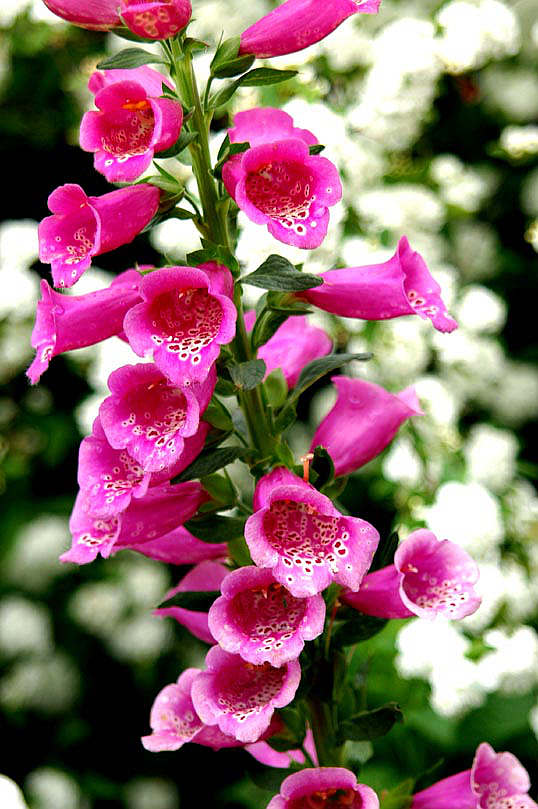
The Foxglove now in crimson tresses rich
Depends, whose freckled bells to insect tribe
Afford a canopy of velvet bliss.
—-Wordsworth

A chemical extract from foxglove, digitalis, is both a famous deadly poison and a precious remedy for heart disease. The difference, like everything else in life, is timing and dosage.
In digitalis the gap between poison and remedy is very, very small.
How did it get its name?
According to the 19th-century book, English Botany, Or, Coloured Figures of British Plants:
Dr. Prior, whose authority is great in the origin of popular names, says “It seems probably that the name was in the first place, foxes’ glew, or music, in reference to the favourite instrument of an earlier time, a ring of bells hung on an arched support, the tintinnabulum”… we cannot quite agree with Dr. Prior for it seems quite probable that the shape of the flowers suggested the idea of a glove, and that associated with the name of the botanist Fuchs, who first gave it a botanical name, may have been easily corrupted into foxglove. It happens, moreover, the name foxglove is a very ancient one and exists in a list of plants as old as the time of Edward III. The “folks” of our ancestors were the fairies and nothing is more likely than that the pretty coloured bells of the plant would be designated “folksgloves,” afterwards, “foxglove.” In Wales it is declared to be a favourite lurking-place of the fairies, who are said to occasion a snapping sound when children, holding one end of the digitalis bell, suddenly strike the other on the hand to hear the clap of fairy thunder, with which the indignant fairy makes her escape from her injured retreat. In south of Scotland it is called “bloody fingers” more northward, “deadman’s bells” whilst in Wales it is known as “fairy-folks-fingers” or “lambs-tongue-leaves”
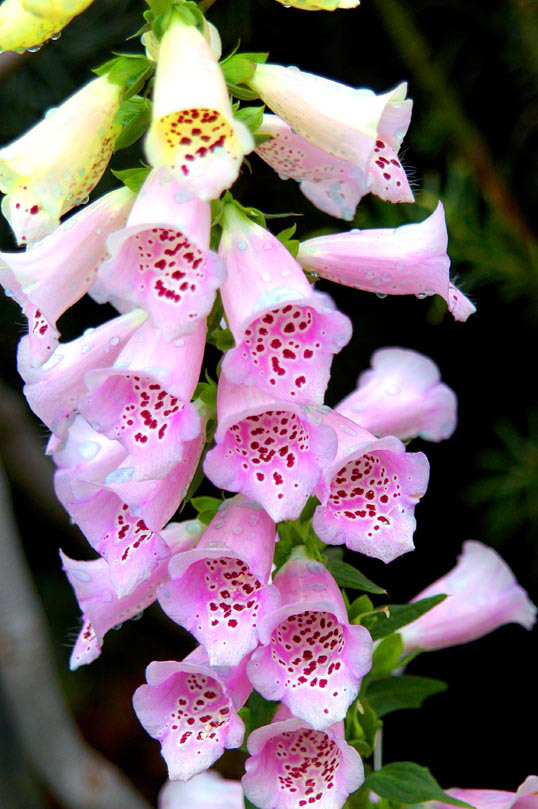
The Scottish doctor William Withering, while working as a physician in the 18th Century, had one of his patients come to him with a very bad heart condition and since Withering had no effective treatment for him, thought he was going to die. The patient went instead to a local gypsy, took a secret herbal remedy – and survived and improved. When the doctor found out he searched out the gypsy. The herbal remedy was made from a variety of things, but the active ingredient was the purple foxglove, digitalis purpurea.
Withering tried out various formulations of digitalis plant extracts on hundreds patients, and found that the dried, powdered leaf worked with amazing and successful results. He introduced its use officially in 1785.
Dallas Blooms, Dallas Arboretum
 Bill Chance