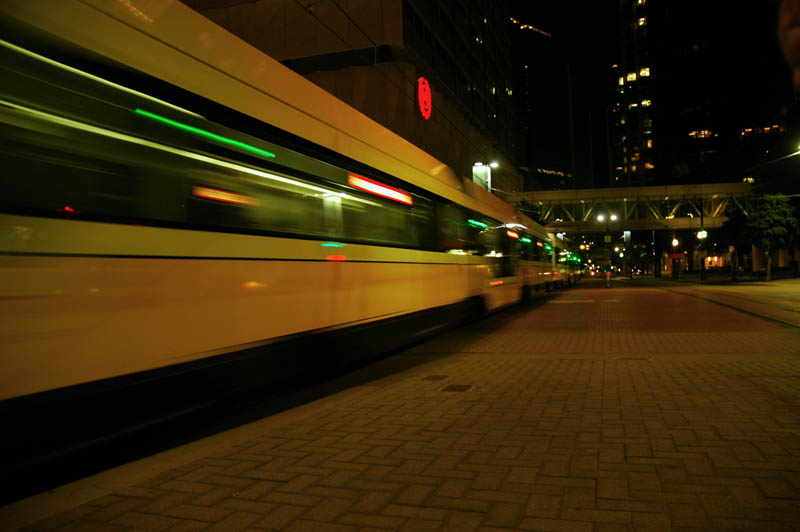
Arrow to Nasher

“Sure, everything is ending,” Jules said, “but not yet.”
― Jennifer Egan, A Visit from the Goon Squad

Time Exposure, Night, Downtown Dallas, Ross and Olive

Time Exposure, Night, Downtown Dallas, Ross and Olive

“No matter how much time passes, no matter what takes place in the interim, there are some things we can never assign to oblivion, memories we can never rub away.”
Haruki Murakami, Kafka on the Shore

A familiar bit of street, smeared out in time, like a fuzzy memory. All the remembrances of that place are layered upon each other. Some are stronger than others – surprisingly, the strongest are often the oldest.

Because the oldest are the first. When everything is new and fresh.

I remember the first time I walked along – crossed at a light – Ross avenue. The big city was fresh in my young mind. I remember when I first turned off Ross to get to the Nasher Sculpture Center – it was many years later and I wasn’t that young any more (though I was a lot younger than I am now – but I didn’t know that then) but the Nasher was fresh and new. I’ve been back.
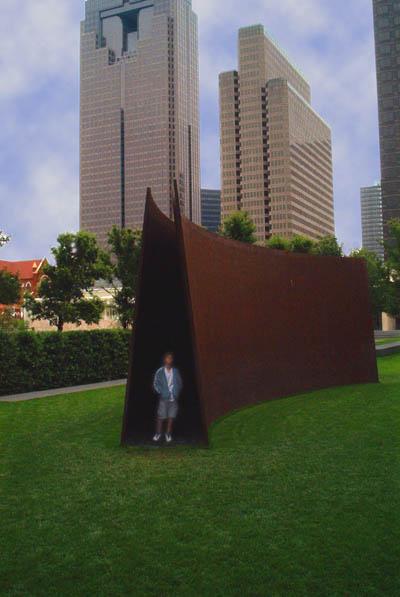
My Curves are Not Mad - Richard Serra, 2004

Lee inside My Curves are Not Mad – Richard Serra, 2004

Richard Serra - My Curves are Not Mad

Lee inside the same sculpture by Richard Serra – My Curves are Not Mad in 2011. Lee is not the only thing that has grown – look how much larger the trees are.

“Time it was
And what a time it was, it was
A time of innocence
A time of confidences

Long ago it must be
I have a photograph
Preserve your memories
They’re all that’s left you”
― Paul Simon

Lee sitting by Night, 2004

Lee sitting by Night, 2004

Night (La Nuit)

Night (La Nuit) – 2011 (they had moved the sculpture)

“He walked out in the gray light and stood and he saw for a brief moment the absolute truth of the world. The cold relentless circling of the intestate earth. Darkness implacable. The blind dogs of the sun in their running. The crushing black vacuum of the universe. And somewhere two hunted animals trembling like ground-foxes in their cover. Borrowed time and borrowed world and borrowed eyes with which to sorrow it.”
― Cormac McCarthy, The Road

Eve, by Rodin, 2004

Eve, by Rodin, 2004

Eve, by Rodin

Eve, by Rodin

“Belief, like fear or love, is a force to be understood as we understand the theory of relativity and principals of uncertainty. Phenomena that determine the course of our lives. Yesterday, my life was headed in one direction. Today, it is headed in another. Yesterday, I believe I would never have done what I did today. These forces that often remake time and space, that can shape and alter who we
imagine ourselves to be, begin long before we are born and continue after we perish. Our lives and our choices, like quantum trajectories, are understood moment to moment. That each point of intersection, each encounter, suggest a new potential direction. Proposition, I have fallen in love with Luisa Rey. Is this possible? I just met her and yet, I feel like something important has happened to me.”
― David Mitchell, Cloud Atlas
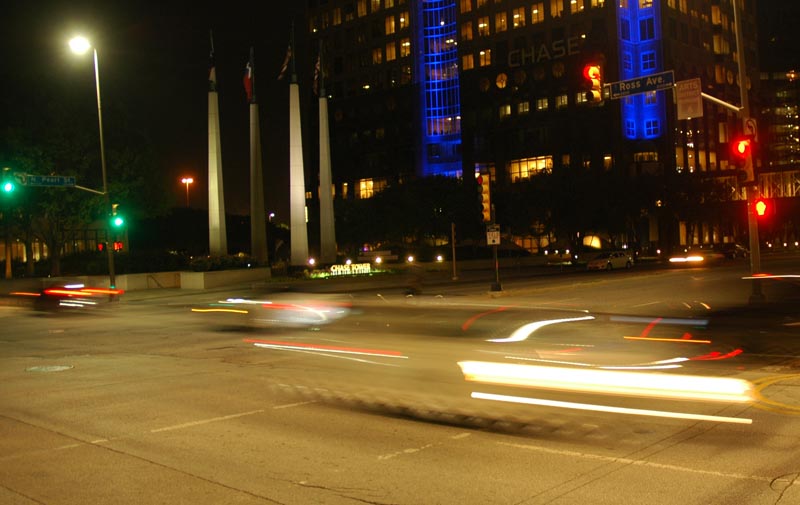
Blur in the Intersection

“The long triangular grooves on the car had been formed within the death of an unknown creature, its vanished identity abstracted in terms of the geometry of this vehicle. How much more mysterious would be our own deaths, and those of the famous and powerful?”
― J.G. Ballard, Crash

Time Exposure, Night, Downtown Dallas, Ross and Pearl

Time Exposure, Night, Downtown Dallas, Ross and Pearl
(Click to Enlarge)

Sometimes the world is hidden in the nooks and crannies of the cable television spectrum – especially in the middle of the night.

There are these shows when some bunch of celebrity grease monkeys steal some poor victim’s car and then rebuild it – adding subwoofers that can shatter glass eardrums, lights visible from other planets, and an aquarium in the rear deck— things like that. Hopefully, they also shove in an engine that starts and brakes that stop.

At the climax – the reveal – the dupe is shown his new pimped-out chariot and he cries. He says, always, “Thank you. My life is changed.” The show ends with the impression that everything will be all right now.

I like that part. I am a sucker for redemption. I like to bask in the feeling that it is even possible that everything will be all right (although I know that it is not true).

Think about it. They are talking about a car. A hunk of metal and rubber – a capsule of steel and glass – a rolling coffin propelled by the burning ghosts of ancient jungles.

But maybe they are right. A car is freedom. A car is the ability to change your location at will. A car is sex… and a nice car is good sex.

When I was young, I went to a lake with a friend of mine and we were swimming in the green water, constantly being slightly bitten by tiny fish, and listening to some women talking to each other while they sunned on a worn wooden dock. One asked another if it was OK if she went out and had her hair cut the same way as the other. Then one asked another about her boyfriend.

“I don’t know,” she answered, “I don’t really like the guy, he doesn’t treat me that well, but he has that really nice sports car.”

“After being bombarded endlessly by road-safety propaganda it was almost a relief to find myself in an actual accident.”
― J.G. Ballard, Crash

Street Sign

Time Exposure, Night, Downtown Dallas, Ross and Olive

Time Exposure, Night, Downtown Dallas, Ross and Olive

Phoenix pushed back on his chair and leaned up against the rough brick wall. He grinned and watched the woman work her way through the bar, staring at every customer, one by one. She was obviously looking for someone. He was the only person in the place by himself – and he wanted to see what happened when she reached his spot. She glanced his way a few times, and it didn’t take long for her to clear the nearest table and look down at him. He willed his face into its most relaxed, nonchalant expression – something he took pride in and had worked on for years.

“Excuse me, but I’ve arranged a meeting here with someone I’ve never seen in person… are you Brett?”

“Why, yes… yes I am. Glad to meet you.” Phoenix had not even had time to think about the lie… it simply came out. And now… nothing to do except go with it. He put on his biggest, broadest smile and reached out his hand toward the woman.

Instead of taking it, she scooted back about half a step and reached into that cavernous bag she carried.

Phoenix had enough time to think, “Oh, that’s why she has such a large purse,” but not much more as the woman’s hand flashed out with a gigantic chrome plated revolver. She raised it and Phoenix’s brain noticed how it gleamed in the uneven light of the bar. He couldn’t do anything else, though. Propped in the chair like that, he was trapped, it would take at least two or three seconds to tip forward and leap one way or the other… but he had less than one.

The gun roared as the woman kept pulling the trigger and slug after slug pumped out and into Phoenix’s chest at point-blank range.

—- from The Smeebage Affair, by Armando Vitalis

Music Video

Filming a Mexican Music Video in Klyde Warren Park.

Filming a Mexican Music Video in Klyde Warren Park.

One of the nice things about living in the big evil city is that – if you keep your eyes open – you can see a lot of interesting things.

While I was walking around downtown I crossed from the crowded west section of Klyde Warren Park over into the less-used eastern part. A small group was filming a Mexican Music Video.

It was not a big operation – a guy playing an acoustic guitar wearing sunglasses and a huge blue fake mohawk. There was a photographer with a tiny handheld camera. An assistant with a boombox on a little cart – this was cranking out a tinny version of the tune so the signer could lip-sync along. There was also a video babe in a tight spandex dress and a bright red wig.

She wasn’t in the shot when I passed by – I imagine she does some wiggling at some point.

Mass Transit

J.G. Ballard wrote a short story named “The Concentration City” (you can read the PDF HERE) about a city that has grown to encompass the entire universe… theoretically and practically – whether it is actually is another question.

The protagonist tries to find the edge of the city, to find “free space” – to find an area where he can build and use a flying machine, by hopping a supersonic express sleeper train and riding it west for weeks.

Unfortunately, he discovers that no matter where you go, there you are.

Here in Dallas – which is shaped sort of like a bulls-eye, with concentric rings of highways and radial connectors – all the trains run out of the center and stop. There is no endless loop. They make you get off the train at the end, before it switches track and heads back in.

Otherwise it would be tempting to get on and never exit. Ride the endless electric rails – watch the city go by, circuit after infinite circuit, the commuters come and go. Everything would slide past forever.

Maybe it’s best that you can’t do that.

transit1

transit2

(click to enlarge)

[…]
“The surgeon hesitated before opening the door. “Look,” he began to explain sympathetically, “you can’t get out of time, can you? Subjectively it’s a plastic dimension, but whatever you do to yourself you’ll never be able to stop that clock”- he pointed to the one on the desk-“or make it run backward. In exactly the same way you can’t get out of the City.”
“The analogy doesn’t hold,” M. said. He gestured at the walls around them and the lights in the streets outside. “All this was built by us. The question nobody can answer is: what was here before we built it?”
“It’s always been here,” the surgeon said. “Not these particular bricks and girders, but others before them. You accept that time has no beginning and no end. The City is as old as time and continuous with it.”
“The first bricks were laid by someone,” M. insisted. “There was the Foundation.”
“A myth. Only the scientists believe in that, and even they don’t try to make too much of it. Most of them privately admit that the Foundation Stone is nothing more than a superstition. We pay it lip service out of convenience, and because it gives us a sense of tradition. Obviously there can’t have been a first brick. If there was, how can you explain who laid it, and even more difficult, where they came from?”
“There must be free space somewhere,” M. said doggedly. “The City must have bounds.”
“Why?” the surgeon asked. “It can’t be floating in the middle of nowhere. Or is that what you’re trying to believe?”
M. sank back limply. “No”
The surgeon watched M silently for a few minutes and paced back to the desk. “This peculiar fixation of yours puzzles me. You’re caught between what the psychiatrists call paradoxical faces. I suppose you haven’t misinterpreted something you’ve heard about the Wall?”
M. looked up. “Which wall?”
The surgeon nodded to himself. “Some advanced opinion maintains that there’s a wall around the City, through which it’s impossible to penetrate. I don’t pretend to understand the theory myself. It’s far too abstract and sophisticated. Anyway I suspect they’ve confused this Wall with the bricked-up black areas you passed through on the Sleeper. I prefer the accepted view that the City stretches out in all direction without limits.””
[…]
—-The Concentration City (1957). James Graham Ballard. The Complete Short Stories

The Bus

I sat around in the bus station for a while but the people depressed me so I took my suitcase and went out in the rain and began walking.
—-Charles Bukowski, Factotum

Downtown Dallas at Night, (Click to Enlarge)

Downtown Dallas at Night, (Click to Enlarge)

Ride a city bus at night. Late at night. Look around. Really look around. Don’t read your book, don’t check your phone, don’t turn away.

Look at the people. Open your pores and let the pure atmosphere of despair and regret inside where it will knead your soul. Feel the exhaustion of going home from the night shift. Touch the grease spot on the window where people that can’t even find the energy to keep their heads upright fall. Breath in the ghosts of ancient alcohol and unwashed perspiration. Listen to the giggling and proud talk of the night denizens on their blowzy way home from a night of exhausted carousing. Feel their desperate intoxicated love.

Let yourself enter the mysterious world.

Later, maybe a week later, or a month, or years later, late at night – when you are at home on your prescription mattress and breathing that conditioned – carefully purified and modified – air wafting from ductwork overhead. When you have set your book down on the nightstand after a particularly satisfying chapter. When the glowing red digits indicate you have a good, restful, eight hours before you start mashing the snooze button. When the large, high definition, flat-screen television that you carefully positioned so that you can see it from your bed is showing the double-plays, strikeouts, and home runs from all over the country. When you begin to nod off and feel the dreams welling up….

the people on the late night buses are still there. You are home and so are they. They are still there. They are always there.

Blood Red Streaks

’twas in another lifetime, one of toil and blood
When blackness was a virtue and the road was full of mud
I came in from the wilderness, a creature void of form.
Come in, she said,
I’ll give you shelter from the storm.
—–Bob Dylan, Shelter From the Storm

Time Exposure, Night, Downtown Dallas, Ross and Olive

Time Exposure, Night, Downtown Dallas, Ross and Olive (click to enlarge)

Crankcase oil drippings leave grease spots on the tarmac. The Texas summer profligate heat splits the pavement like an overripe tomato. But it’s night now and the humidity hums and settles over the earth. The browning grass still has a little green to give up.

Time smears the taillights into blood read streaks – claret smears – ephemeral neon tubes projected onto the light detector. Effects you can’t see with your eyes appear in the little screen.

And in the other lane, headlights leave a blazing aurora. Brilliant luminous lines.

These are always there – but you don’t ever notice them – hidden by time, too busy keeping things from running into each other.

“Space and time are the framework within which the mind is constrained to construct its experience of reality.”
― Immanuel Kant

The Cut

“Your red dress,’ she said, and laughed.

But I looked at the dress on the floor and it was as if the fire had spread across the room. It was beautiful and it reminded me of something I must do. I will remember I thought. I will remember quite soon now.”
― Jean Rhys, Wide Sargasso Sea

Dallas Skyline at dusk

Dallas Skyline at dusk (click to enlarge)

The time, the light right around sunrise and sunset is called the Golden Hour or the Magic Hour. In the central downtown of a big city, surrounded by the crystal canyons of mirrored glass with the actual sky only visible in an irregular sliver overhead (though reflected between the ranks of colossal ziggurat prisms) the light takes on a surreal artificial quality. For an instant at dawn and dusk the dirt of the evil city disappears, the armies of worker drones melt into the cool pavement, the honking traffic mutes.

I walk along a familiar street, the echoes of decades spent working and commuting ringing back – yet everything is suddenly fresh. The city engineering and architectonics takes the place of geology, but changes faster – compared to eternal living stone, the steel, concrete, and glass is quicksilver. I can feel the silent movement.

And there, reproduced in some mysterious modern process, is a woman in a red dress, twenty stories high, a runway model in a hat. She is an illusion in a tablet – an illusion inside a delusion wrapped in a deception – blown up into a cyclopean beauty.

She is selling something.

But I’m sorry – I’m not buying.

Under the Sculpture

“Those who dream by day are cognizant of many things which escape those who dream only by night.”
― Edgar Allan Poe, Eleonora

In front of the Dallas Museum of Art, night, long exposure

In front of the Dallas Museum of Art, night, long exposure (click to enlarge)

The sculpture is Ave, by Mark di Suvero – the same sculptor that did the Proverb piece not too far away.

“The sky grew darker, painted blue on blue, one stroke at a time, into deeper and deeper shades of night.”
― Haruki Murakami, Dance Dance Dance

They say you are not to touch the works of art. But I always used to see kids using the sloping steel structure – the one painted bright red in the middle of the preternatural green grass sward in front of the museum – as a slide. I don’t see that any more – security must be better.

But still I think of a slide when I see it – I think of the time we used a wax paper cup to lubricate an old, rusty piece of playground equipment down at the end of the block when I was ten years old. It became so smooth and frictionless…

The feeling of rocketing down that perilous slippery slope was intoxicating and frightening. The exhilaration was accelerated by the knowledge that we had figured it out and done it ourselves. We felt we were the only children in the world to understand the secret effects of rubbing wax paper cups on smooth steel.

A father came to fetch his kids and we boasted of how fast it was. Fathers were competitive then and he said it couldn’t be that fast because were were only little kids and we didn’t know what we were talking about.

It told him to try it. With a wry, dismissive grin he hauled his creaking, awkward bulk up the ladder much too small for him (I remember him as being oh so old, though now, of course, he would have been maybe thirty years younger than I am now) and sat bumbling down, unsure suddenly of the whole endeavor, giant feet reaching down the smooth steel – I remember a sudden, last look of doubt, almost panic flickering like a shadow across his expression… but fathers were stubborn then and there could be no turning back, no chickening out in front of his children and all their friends.

So he pushed off.

And you know what happened. I remember he shot off the end of that slide like a watermelon seed squeezed between your thumb and index finger on a hot summer afternoon.

That weekend his oldest kid told me he had to go to the hospital because he broke his coccyx.

Ghosts of Pedestrians

On Thursday, I spotted an event that was going on down at Klyde Warren Park at eight in the evening. There was a free concert by Paul Thorn. I checked out his youtube page and thought it might be interesting. It wasn’t really my type of music – but he seemed to be a talented and interesting songwriter.

After work, I was way too tired – but I didn’t want to waste another evening flopping around the house, so I pulled myself together and went down to the train station.

Unfortunately, the music was not to my liking – live, with his full band it was way too country-rock for me. I had hoped it would be more in the vein of acoustic songwriter country folk-rock – but this was full on boot-scooting country pop-rock – probably my least favorite genre of music.

I stuck for awhile, then set off walking. After stopping by the reading area and looking through an art book of odd and disturbing (I liked them) paintings by Balthus (the streetlights are almost bright enough for reading) I cruised by the food trucks (right now, we are especially broke, so I ate leftovers before going downtown) and then turned to walk back to the train station.

I had my camera and, on a whim, did some shots of traffic and people by resting my camera on a concrete pillar or whatnot – and adjusting the f-stop for long exposures.

The results were a happy surprise. I came up with a half-dozen that I liked (I’ll put them up here over time – sorry to subject y’all to my experiments). More importantly, It is a technique that shows some promise. Now, I need to work on some spots and do the shots with a tripod and remote release – to get a bit more flexibility in the shot and sharpness in the background. Maybe I can add some models, some added light, or possibly some stacked shots.

So, despite the music not being to my taste, the evening wasn’t wasted.

Time Exposure, Night, Downtown Dallas, Ross and Pearl

Time Exposure, Night, Downtown Dallas, Ross and Pearl

While I had my camera sitting on a low concrete wall in front of the Chase Tower in Downtown Dallas, a saw a family of three crossing at the light, coming toward me. I pointed the camera toward the street and triggered the shutter into a long exposure as they passed.