New Orleans, French Quarter, Halloween

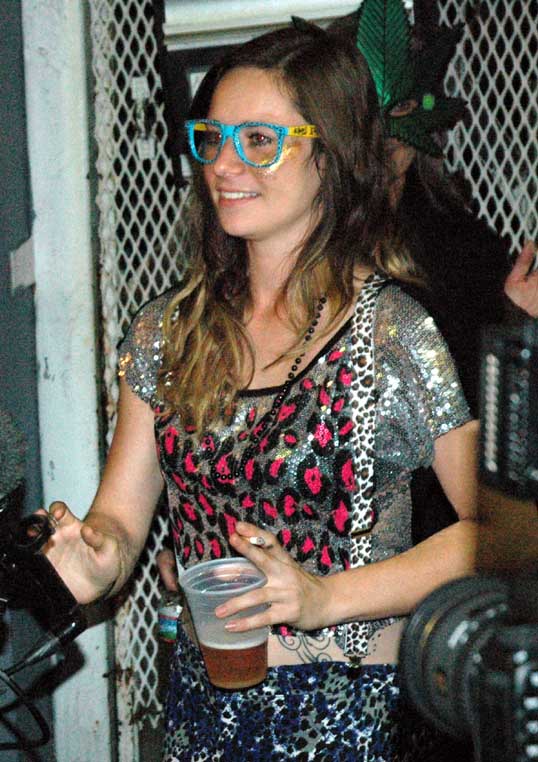

New Orleans, French Quarter, Halloween
French Quarter, New Orleans

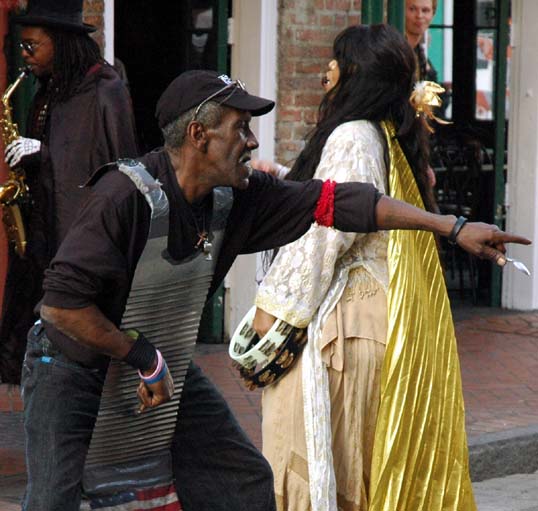

French Quarter, New Orleans, Halloween
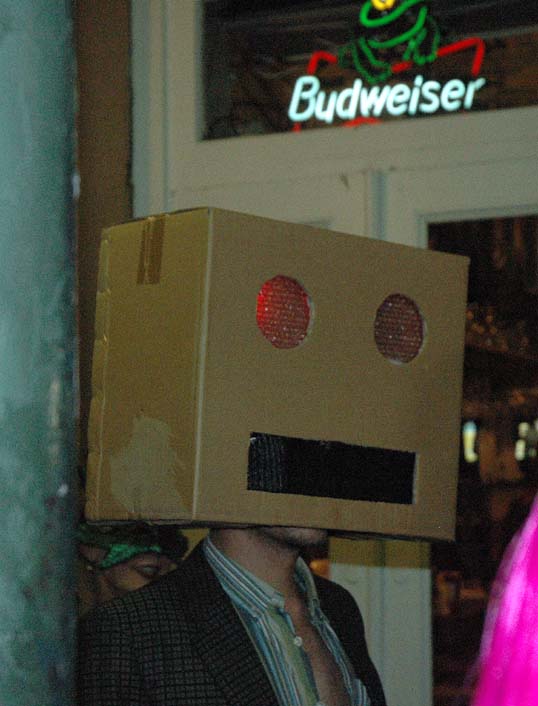


From the wonderful book, A Confederacy of Dunces, by John Kennedy Toole. In the story, Ignatius J. Reilly discovers and ends up working for a famous New Orleans Hot Dog Vendor. In the book, it’s Seven Paradise Vendors… in real life, Lucky Dogs.
Seven Paradise Vendors, Incorporated, was housed in what had formerly been an automobile repair shop, the dark ground floor of an otherwise unoccupied commercial building on Poydras Street. The garage doors were usually open, giving the passerby an acrid nos-trilful of boiling hot dogs and mustard and also of cement soaked over many years by automobile lubricants and motor oils that had dripped and drained from Harmons and Hupmobiles. The powerful stench of Paradise Vendors, Incorporated, sometimes led the overwhelmed and perplexed stroller to glance through the open door into the darkness of the garage. There his eye fell upon a fleet of large tin hot dogs mounted on bicycle tires. It was hardly an imposing vehicular collection. Several of the mobile hot dogs were badly dented. One crumpled frankfurter lay on its side, its one wheel horizontally above it, a traffic fatality. Among the afternoon pedestrians who hurried past Paradise Vendors, Incorporated, one formidable figure waddled slowly along. It was Ignatius. Stopping before the narrow garage, he sniffed the fumes from Paradise with great sensory pleasure, the protruding hairs in his nostrils analyzing, cataloging, categorizing, and classifying the distinct odors of hot dog, mustard, and lubricant. Breathing deeply, he wondered whether he also detected the more delicate odor, the fragile scent of hot dog buns. He looked at the white-gloved hands of his Mickey Mouse wristwatch and noticed that he had eaten lunch only an hour before. Still the intriguing aromas were making him salivate actively. He stepped into the garage and looked around. In a corner an old man was boiling hot dogs in a large institutional pot whose size dwarfed the gas range upon which it rested. “Pardon me, sir,” Ignatius called. “Do you retail here?” The man’s watering eyes turned toward the large visitor. “What do you want?”
“I would like to buy one of your hot dogs. They smell rather tasty. I was wondering if I could buy just one.”
Lucky Dogs cart – Bourbon Street, French Quarter, New Orleans
“May I select my own?” Ignatius asked, peering down over the top of the pot. In the boiling water the frankfurters swished and lashed like artificially colored and magnified paramecia. Ignatius filled his lungs with the pungent, sour aroma. “I shall pretend that I am in a smart restaurant and that this is the lobster pond.”
“Here, take this fork,” the man said, handing Ignatius a bent and corroded semblance of a spear. “Try to keep your hands out of the water. It’s like acid. Look what it’s done to the fork.”
“My,” Ignatius said to the old man after having taken his first bite. “These are rather strong. What are the ingredients in these.”
“Rubber, cereal, tripe. Who knows? I wouldn’t touch one of them myself.”
“They’re curiously appealing,” Ignatius said, clearing his throat. “I thought that the vibrissae about my nostrils detected something unique while I was outside.”

Ignatius J. Reilly, sculpture on Canal Street.
Ignatius is such a fan of the Paradise Hot Dog, he is able to get a job as a vendor, setting out on the streets of his beloved New Orleans, pushing a heavy cart.
This does not turn out well.
George, who was wandering up Carondelet with an armload of packages wrapped in plain brown paper, heard.the cry and went up to the gargantuan vendor. “Hey, stop. Gimme one of these.”
Ignatius looked sternly at the young boy who had placed himself in the wagon’s path. His valve protested against the pimples, the surly face that seemed to hang from the long well-lubricated hair, the cigarette behind the ear, the aquamarine jacket, the delicate boots, the tight trousers that bulged offensively in the crotch in violation of all rules of theology and geometry.
“I am sorry,” Ignatius snorted. “I have only a few frankfurters left, and I must save them. Please get out of my way.”
“Save them? Who for?”
“That is none of your business, you waif. Why aren’t you in school? Kindly stop molesting me. Anyway, I have no change.”
“I got a quarter,” the thin white lips sneered. “I cannot sell you a frank, sir. Is that clear?” “Whatsa matter with you, friend?”
“What’s the matter with me? What’s the matter with you? Are you unnatural enough to want a hot dog this early in the afternoon? My conscience will not let me sell you one. Just look at your loathsome complexion. You are a growing boy whose system needs to be surfeited with vegetables and orange juice and whole wheat bread and spinach and such. I, for one, will not contribute to the debauchery of a minor.”
“Whadda you talking about? Sell me one of them hot dogs. I’m hungry. I ain’t had no lunch.”
“No!” Ignatius screamed so furiously that the pas-sersby stared. “Now get away from me before I run over you with this cart.”
George pulled open the lid of the bun compartment and said, “Hey, you got plenty stuff in here. Fix me a weenie.”
“Help!” Ignatius screamed, suddenly remembering the old man’s warnings about robberies. “Someone is stealing my buns! Police!”

My son, Lee in front of a cart.

New Orleans Cemetery – Saint Louis #1
On our last trip to the Big Easy, we signed up for a New Orleans Cemetery tour from Tulane University.
The Cemeteries of New Orleans are famous – when you visit you notice them right away on your drive away from the airport. Because of the high water table, burial in the city is above ground in crypts. If you tried to stick a coffin underground it would come bobbing up in the first hurricane and go hurtling down the street.
The dense clusters of stone crypts packed into rows give the cemeteries of New Orleans the nickname, “cities of the dead.”
All the parents piled in to the bus on the Tulane campus for the trip to St. Louis Cemetery #1. The woman sitting next to us spent her time making desperate phone calls. She was from Rockaway in New York and her house had been destroyed by Hurricane Sandy. She had decided to go ahead and make the planned trip to visit her daughter at school so she could use the Internet to register for assistance while her husband remained behind trying to salvage what he could. There was a lot of irony in a parent from New York coming to see her daughter in New Orleans as a refugee from a devastating hurricane.
The tour was very interesting – mostly because of our tour guide. A spry elderly New Orleans native of French extraction – thick with that amazing melodious Cajun accent – she spoke a lot of the unique way of looking at life (and death) necessary for survival in a place as inhospitable to polite civilization as New Orleans. She spoke of the constant friction between the attitude of the New Orleans natives and the Americans… spoken as if they were aliens from another planet.
She said she didn’t understand the Americans, even though she was glad she was married to one, because, “Darling, somebody has to do the work.” She said, not long after she was married, her husband had to go in to the office on a Saturday,
“Honey, where’re you goin’,” she asked.
“I’m going to work.”
“What do you mean? It’s Saturday. Nobody works on a Saturday!”
The concept was completely incomprehensible to her.
Then she went on to describe the details of a New Orleans internment. She said, “Ah never though this was unusual. I thought everybody did it like this. When I went to another city I was stunned. Ah said ‘You did a hole? And drop a body down there? And cover it up?’ Ah couldn’t believe it.”
You see, I always knew about the above ground crypts in New Orleans, but I never understood the process. You see, these are family crypts – or in some cases, organizational crypts. They are built in two parts, an upper chamber and a lower one. A small opening at the back of the crypt connects the two.
When you die, there is no embalming… and no fancy metal or lined casket – just a pine box. They open the crypt and you go in the top chamber. There you wait, for at least a year and a day, until the next person expires. Then they open up the tomb, secure in the knowledge that the tropical heat and humidity have done their work, and there isn’t much left of you. Any surviving pieces of casket are removed and everything else is pushed back through the opening where it falls into the lower chamber, leaving room for the next occupant.
This is repeated as long as necessary. Some of the tombs had dozens of names on them, spanning well over a century.
Some of the details are fascinating. The walls of the cemetery are lined with small “wall tombs.” These are for when, as our guide said, “Somebody dies too soon, before the year and a day. They get stuck in the wall tomb until they can get moved back into the family crypt.”

Our tour guide in front of a typical New Orleans burial crypt.

A street in the City of the Dead. Family crypts on the left, wall crypts on the right.
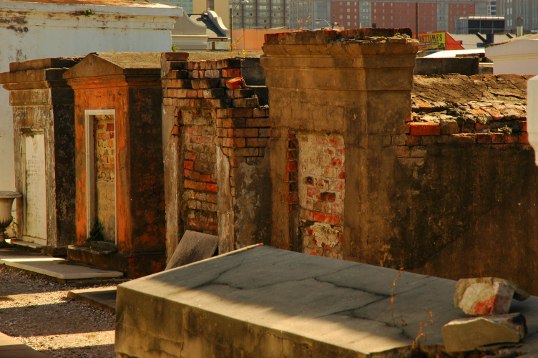
Older crypts, getting run down.

Wall crypts. Space is at a premium. Look at the tiny spaces at ground level.
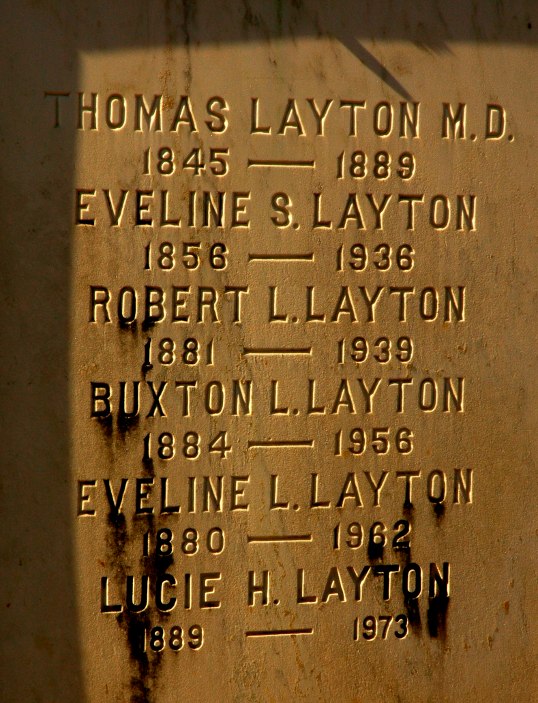
Layton family crypt. Over a century of family members.
Our guide said she was waiting for tomb space to open up and had saved money to buy in. “Space is limited, and in death like in life, it’s location, location location. I don’t want to go to my rest outside the city, I want a tomb in New Orleans.”

When a family dies out, nobody is left to take care of their crypt and it can collapse. Our guide said she had her eye on this spot in case it came up for sale.
New Orleans is over a hundred miles from the ocean, but it is barely dry. Rain comes quickly and unexpectedly… except it is always expected.
Luckily, there is a source of refuge in the Big Easy – whenever the skies open up, there is always a bar handy to seek shelter and good cheer.
Waiting for the St. Charles Streetcar, the rain came down, hard, so we ducked into The Avenue Pub (which happened to be right there).
The Avenue Pub is beer heaven. Open 24hrs. 7Days (never know when it’s going to rain). Their list of beers on tap is three pages long.
The Beer Buddha says:
“Honestly this category really isn’t fair; but why punish one bar because all the others can’t hold it’s jockstrap? We all know The Avenue Pub is THE beer bar in not only New Orleans but in Louisiana. Nothing against all the other bars in the state but you ALL know you have a long way to go to be mentioned in the same sentence with AP.”
Draft Magazine lists it as one of the 100 best beer bars in the country. They say:
“Only in New Orleans will you find a beer bar open 24/7. The staff is militant about clean beer lines and proper glassware, so even when you stumble in at 4 a.m. you get the best pint in the city. Choose from more than 47 rotating taps and about as many bottles, all focusing on American beer. Go for an exhaustive introduction to local NOLA Brewing or to people-watch from the balcony.”
The Complex City Guide has it at 12 in the 25 best Beer Bars in the country. They say,
“Louisiana may not be the first state you think of when you think of beer (sure, they’ve got Abita), but when you change state to city and beer to drunk, it’s no wonder that New Orleans has one of the best beer spots in the country. Avenue Pub features a rotating 47 taps on two floors (so you can get your exercise in between rounds) and once you mix that with some amazing Louisiana cuisine, you won’t be thinking about Bourbon Street no more. And the most important part, here in the land of to-go cups, the Avenue is open 24 hours a day. Yup.”
And all this is right there, right on the Streetcar Line, right when it starts to rain.
My only complaint – they don’t have Deep Ellum Brewing Company’s Pollinator on tap. Maybe I can send them an email.

The Avenue Pub, on St. Charles in New Orleans


A lot of taps.

No Orange Slices! No Muddling!
“There is something strange about agony; the memory of it can be terribly short-lived when the contrast of revival and a pretty spring afternoon have dispelled the regrets. One drink of vodka in a cheerful glass, in the company of good poetry and the scent of blossoms and earth might entice the most well intended to forgo promise of atonement until a worse time. I have at times been just less than amazed how one drink merges with the second, where at some unknown point a mental transformation sets in. I have never been able to ascertain at what point that is–not precisely–and I have been conscious of trying to catch that moment, to try and understand it, to try and prevent it from happening, or at least have a fair chance to decide whether or not to cross over into that other realm. Such an elusive thing, this is.”
― Ronald Everett Capps, Off Magazine Street
When you talk to someone that has visited New Orleans, they will tend to say, “Yeah, I’ve been there, I walked up and down Bourbon Street.” On our last trip, we spent a week in New Orleans and I never set foot on Bourbon. It’s all tourist, all the time, in a bad way. Trash tourist.
There is another street that has plenty of tourist in it, but in a good way. Magazine Street. I spent a lot of time on Magazine. Our Guest House was at Magazine and Race, not far out from downtown. But Magazine runs a long way. Decatur street in the French Quarter changes into Magazine as it crosses the neutral ground of Canal and then Magazine follows the curve of the river all the way through the Arts District, Garden District and Uptown until it pierces the gorgeous Audubon Park.
At every major cross street it holds a cluster of restaurants, nightclubs, shops, and everything else. In between are fabulous examples of the amazing New Orleans architecture, from Gothic old mansions to rows of shotgun houses.
A walk down Magazine is a great walk. Be careful, though – it is a long street. I still have memories and pains in my ankles from a stroll we took a couple years ago. Near the beginning, I turned an ankle on a bit of rough sidewalk broken pavement and then hiked too far from the car. The trip back will forever be etched in my mind as the “Magazine Street Death March.”

Magazine Street, New Orleans
(Click to view a larger version on Flickr)
I saw a bit on television about the uselessness of a college education. The reporter wandered New Orleans interviewing bouncers, bartenders, cooks, and pedicab drivers – even a woman reading tarot cards in Jackson Square. They all had college degrees – some multiple, many graduate degrees – yet they all were working in nightlife in New Orleans. The point of the piece was how useless the college was to these poor dupes – that in spite of their education, the best they could do was work in the New Orleans nightlife.
The main thrust of the concept may be true, but the reporter was missing the whole point. The folks he interviewed were doing what they wanted to do – not a single one of them expressed regret. They didn’t want to be investment bankers, teachers, or engineers; they wanted to be a part of New Orleans, as best as they could.
I guarantee that if you interview a pack of bankers, managers, and businessmen and ask them, if they could, would they want to drive a pedicab through the New Orleans night, tell fortunes under the Cathedral in Jackson Square, or hustle for the strippers on Bourbon, and they probably won’t tell you that they would d’ruther, but there will be a long pause and a wistful look into the air. It’s all a question of who has the courage and who doesn’t.
“there was something about
that city, though
it didn’t let me feel guilty
that I had no feeling for the
things so many others
needed.
it let me alone.”
― Charles Bukowski“Leaving New Orleans also frightened me considerably. Outside of the city limits the heart of darkness, the true wasteland begins.”
― John Kennedy Toole, A Confederacy of Dunces“There are only two things: love, all sorts of love, with pretty girls, and the music of New Orleans or Duke Ellington. Everything else ought to go, because everything else is ugly. ”
― Boris Vian“I’m not going to lay down in words the lure of this place. Every great writer in the land, from Faulkner to Twain to Rice to Ford, has tried to do it and fallen short. It is impossible to capture the essence, tolerance, and spirit of south Louisiana in words and to try is to roll down a road of clichés, bouncing over beignets and beads and brass bands and it just is what it is.
It is home.”
― Chris Rose, 1 Dead in Attic“People don’t live in New Orleans because it is easy. They live here because they are incapable of living anywhere else in the just same way.”
― Ian McNulty, A Season of Night: New Orleans Life After Katrina“Jesus just left Chicago, and he’s bound for New Orleans.”
―ZZ Top
Halloween, French Quarter, New Orleans

Tabasco, Crystal, or Louisiana
I don’t think there is such a thing as too much hot sauce, but this guy will disagree. Not even the cool Mardi Gras beads could protect him.
Notice he has all three of the Louisiana Hot Sauces… the Holy Trinity: Tabasco, Crystal, and Louisiana (Red Dot) Brand on the table in front of him. No establishment should have less.
But that means you have to choose. Life is full of tough decisions. Though I have great respect for Tabasco, and like the Red Dot, I am a Crystal man myself.

Finding a hotel in another city on the Internet is a funny thing… it’s not so much like looking for something blind as it is trying to make a decision, a choice, based on secondhand information where everyone is lying to you.
When Candy was researching a place to stay in New Orleans for our trip last week she kept coming across a place called St. Vincent’s Guest House. We’ve stayed a handful of places in the past, most notably the Prytania Park, and the Mandevilla B&B (both highly recommended BTW) but the St. Vincent was a lot (a lot!) cheaper.
I didn’t get too involved in the planning, and while we were flying to New Orleans I was really curious about what this place would be like. It was in a great location – right on Magazine Street in the Lower Garden District – close to downtown (and the quarter) and the St. Charles Streetcar.
But it was only going to cost us fifty dollars a night. What kind of Big-City hotel charges fifty dollars a night? In my mind I pictured an old run-down Motel 6, kicked out of the chain for excessive filthiness, occupied mostly by prostitutes, and a constant drug trade going on in the parking lot. Still, it’s only fifty bucks a night, we need to spend as little as possible, and all I need is a place to sleep – so I could deal with anything.
When we drove up and checked in, I quickly realized the truth could not be farther from this image. St. Vincent’s is a massive ancient brick edifice of classic New Orleans design with impossibly high ceilings, balconies with intricate cast iron railings, and one hell of a history to boot.

The imposing facade of the St. Vincent’s Guest House, facing Magazine Street in New Orleans. I had to move around a bunch of film crews and trucks to get this – they were shooting scenes for Treme. The St. Vincent must be a popular location – they did scenes for Red (the Bruce Willis film) there – now I’ll have to watch the damn thing.

The side of the St. Vincent Complex, from Race Street. We stayed on the second floor of the wing in the background, that’s the carriage house in the foreground.
From a faded clipping in the lobby:
History
St. Vincent’s was built in 1861 as an orphanage. It was founded by the Daughters of Charity order of nuns, however much of the funding was provided by Margaret Haughery. Margaret was an illiterate, Irish immigrant to New Orleans – she was a orphan herself and lost her husband and baby to yellow fever here in New Orleans. This was not unusual. Every summer up to 30.000 people here would die of mosquito born diseases such as yellow fever and malaria. Margaret’s tragic losses led her to dedicate her life to alleviating the suffering of children. She made a great fortune from her baking business and dedicated her wealth and compassion to philanthropic works. St. Vincent’s was among the greatest of these works. When Margaret died in 1882, the entire city closed down to mourn her loss and thousands followed her funeral parade, a fitting tribute to a truly great person. You will notice the clock on the roof of the carriage house at St. Vincent’s (across the courtyard) – this was willed to St. Vincent’s by Margaret as a final gift.
There is a lovely statue of Margaret between Prytania and Camp Streets, just near the 90 overpass. You may also like to visit St. Elizabeth’s orphanage, now owned by the Vampire novelist, Ann Rice. After the children turned seven, the girls were taken from ST. Vincent’s to St. Elizabeths. St. Elizabeths is in the Garden District on Napoleon Ave.
Still run by the Daughters of Charity in the 20th century St. Vincent’s became a refuge for unwed mothers. In 1901 it was discovered that mosquitoes were the cause of the summer epidemics and the city paved the streets and generally tried to eradicate the puddles of water in which mosquitoes breed. Without the annual epidemics New Orleans was in the happy situation of no longer having enough orphans for St. Vincent’s. St Vincent’s served as a refuge for unwed mothers and their children until the social revolution in the 60’s rendered such a refuge unnecessary. It remained empty for a couple of decades until brought back to life in 1994 as the Guest House you see today.

The clock on top of the carriage house, complete with cool sculpture hanging off the side.

Here’s a closeup of the sculpture on the clock on the carriage house. It’s called “New Orleans Gargoyle” by Thomas Randolph Morrison. Pretty cool, huh. You’re not going to see stuff like this hanging off the Hilton.
Now, the place was far from luxurious. It is primarily a hostel – with a constant flow of young hitchhikers and lost souls (some working at the house in one form or another for discount or free rent) and a wing of dormitories. They do have a spate of regular rooms and ours, being the cheapest, was pretty run down. The usual amenities were non-existent. The sheets had holes, the hot water sporadic, the walls were painted a bilious purple, the towels mismatched, the door key and lock of dubious quality and security, the television ancient and lacking a remote and the curtains didn’t come close to covering the entire windows. The drawers in the dresser didn’t fit, the ventilation rumbled, black sheetrock screws half-screwed into the molding provided clothes and key holders. The pool was covered in black plastic, the furniture mismatched, and empty whiskey bottles littered the common areas.
The only thing that bothered me, really, was a decidedly musty smell in the room, and it went away with a couple days of activity. To be fair, St. Vincent’s was obviously still being repaired from the damage inflicted by the last hurricane and a lot of water had gone through those old walls. We realized that, really, the whole city had that musty smell.
So it wasn’t the Hilton, it wasn’t even the La Quinta… but, my God, what history. New Orleans is a city accommodating and welcoming to spirits and everyone spoke about the ghosts of the orphans and their parents – yellow fever victims – still floating around the place. The hallways were lined with fine polished bronze sculptures. It seems a New Orleans sculptor – Thomas Randolph Morrison – displays all his bronze work in St. Vincent’s. Art – paintings or interesting old photographs – covered the walls.

The sculpture-lined hallway at St. Vincent’s.

A sculpture facing a mirror.

A view out a hallway on the third floor. Like a lot of old buildings built in tropical climates it has very high ceilings (I estimate 20 feet high), balconies, and an open plan for ventilation.
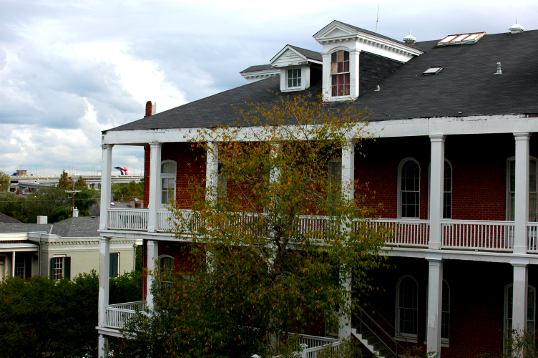
Our wing at St. Vincent’s. If you look closely on the horizon you can see the winged stack of a Carnival Cruise Ship on the Mississippi river.
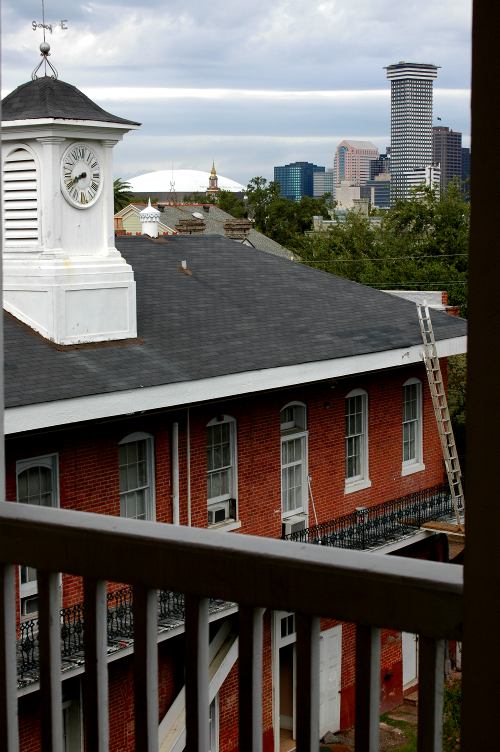
The carriage house at St. Vincent, with downtown New Orleans and the Superdome in the background.
Now, I certainly can’t recommend the place – it sure has its share of bad Internet reviews – but if you have a little imagination, a sliver of adventurous spirit and, most of all, an open mind, it’s a pretty damn cool place.
Plus, it’s in a great location and it’s only fifty dollars a night.

An old photo on the wall at St. Vincent’s Guest House, showing the original tenants, the young orphans that lost their parents to yellow fever, posed on the stairs.

The same spot, on the same stairs, today.

A tomb from Lafayette Cemetery #1
Everywhere in New Orleans you run into the ghosts of the yellow fever. This is a tomb from the Lafayette Cemetery #1 (not far from St. Vincent’s). I had to mess with the image, the top part was in deep shade. It reads:
Died of Yellow Fever
Sercy,
Born Aug. 29th 1878,
Died Aug. 30th 1878.
Mary Love,
Born Oct. 7th 1876,
Died Aug 30th 1878.
Edwin Given,
Born Dec. 3rd 1873,
Died Aug. 31st 1878.
Such is the Kingdom of Heaven.
In two days that family lost three children, age newborn, three, and five years old.
“Our lives are not our own. We are bound to others, past and present, and by each crime and every kindness, we birth our future.”
― David Mitchell, Cloud Atlas

Karma, Do-Ho Suh, New Orleans Museum of Art
Karma, a sculpture by Do-Ho Shuh, in the Besthoff Sculpture Garden at the New Orleans Museum of Art.
I rely on those below me to reach this height, and support so many others above, yet we are all blinded by our duties to the beauty around us. Trapped by the darkness of our burden. All we feel is the terrible weight.

 Bill Chance