The last photograph in the article – the one labeled, “Trail System in Richardson, Texas” was taken right behind my house. One reason we bought the place was because the trail was scheduled to go in (though it took a lot longer than promised). Now, I rarely ride my bike on the trail – it is so popular with families and, especially, people walking dogs on a leash, that I feel safer on the street.
I found the National Archives collection of photographs on Flickr a while back while looking for copyright-free images to use in practicing with digital image software. There is some really interesting stuff in here.
The light festival is responsible for 86 of the new public art pieces, which will be literally everywhere in the Arts District and at Klyde Warren Park on October 18. Rather than list them out individually, here’s a nifty interactive map to guide you through the exhibition, and here is a complete list of artists and works.
NASHER XCHANGE
Here are the artists and the locations of the work, all of which will officially open this Saturday, Oct. 19. Click on the links to find out more about the individual projects.
Congratulations to Alice Munro. She was awarded the Nobel Prize in Literature this week.
I’ve always said she is the unquestioned master of the short story. Glad to see someone working exclusively in the underrated form and genre of the literatry short story (pretty much) get this recognition. The only problem with reading Munro, as a short story writer, is that when you finish one of hers you realize that you will never be that good – that she has done something you will never be able to pull off.
There’s a new Pynchon novel out, Bleeding Edge. I’m not as excited as I have been in the past… (I have a lot to read) but still… I have to go read it.
What is the fastest? Enterprise, Milennium Falcon, TARDIS, Planet Express Ship, The Heart of Gold, Jupiter 2, Serenity, Battlestar Galactica, or Voyager I? I’m semi-ashamed to say I know all of these ships.
Takeaway from this article? Learn some programming.
In part, it’s not your fault. If you grew up and went to school in the United States, you were educated in a system that has eight times as many high-school football teams as high schools that teach advanced placement computer-science classes. Things are hardly better in the universities. According to one recent report, in the next decade American colleges will mint 40,000 graduates with a bachelor’s degree in computer science, though the U.S. economy is slated to create 120,000 computing jobs that require such degrees. You don’t have to be a math major to do the math: That’s three times as many jobs as we have people qualified to fill them.
I’m pretty alert to such problems these days. Soap doesn’t work. Toilets don’t flush. Clothes washers don’t clean. Light bulbs don’t illuminate. Refrigerators break too soon. Paint discolors. Lawnmowers have to be hacked. It’s all caused by idiotic government regulations that are wrecking our lives one consumer product at a time, all in ways we hardly notice.
What is nice is that these are almost all “connector trails” – designed to allow bicycling trails to be used as transportation corridors, rather than something to stroll along with your kids on Sunday afternoon.
The group’s Regional Transportation Council will vote Thursday on a plan to use more than $13 million to benefit nearly a dozen biking and pedestrian projects in the Dallas-Fort Worth area. The efforts are intended to provide transportation alternatives to motor vehicles, especially by connecting the projects to existing paths.
“They can’t be purely focused on recreation,” said Karla Weaver, a program manager at the Council of Governments. “We wanted to help to get some more concrete stuff in for active users.”
No surprise here, interruptions make you stupid. I find The Pomodoro Technique to be very useful to focus concentration for a short time, get important and difficult tasks completed, generate ideas, and help me ignore interruptions while still keeping up with things.
Ride with the flow of traffic, the teacher said, or be prepared to “spend the rest of your day in the hospital and the rest of your year filling out insurance paperwork.”
And always live up to these buzzwords, even when fellow travelers do not: predictable, visible, assertive, alert and courteous.
The crowd at Ciclovia Dallas on the Houston Street Viaduct with the Dallas downtown skyline
Local officials who want a more lively town center and a development team seeking to restore a landmark hotel were hoping to put a new watering hole on Main Street. Then they ran smack into New Jersey’s strict, Prohibition-era alcohol laws, which restrict the number of liquor licenses per town. Flemington had just three—two belonging to establishments in strip malls and one for a Veterans of Foreign Wars hall.
Having a decent bar, it turns out, is helpful to reviving small downtowns, development experts say. So, in February, the developers came up with a novel but expensive solution, buying the Italian restaurant that owned a license and eventually transferring it to the downtown hotel. The price: about $1 million for the permit alone.
Now I’m waiting for an HBO series made from Gravity’s Rainbow.
It may be more of a coincidence than anything else, but I live in one of these and spend time every year in seven of the twelve, including the top five.
When I first saw this, I thought, “Oh, this has to be fake.” As time goes by (and a couple of hours is an eternity in internet-time) it looks like it might be real. At any rate, it’s one hell of a strange photo, real or not.
The reason the saying “No pain, no gain” is so common is because it’s true: If you never feel discomfort when you exercise, you’re not getting all the benefits. What separates great athletes from mediocre ones isn’t only talent and training – it’s also how well they can handle discomfort.
I was tired, turned on the TV, and saw a little of the White House Correspondents’ Dinner – and was appalled. The phrase that kept wafting through my mind was, “let them eat cake.” The next day I found this article, which echoed my thought.
“The breaking point for me was Lindsay Lohan,” Tom Brokaw recently said. While this statement could apply to so many circumstances, he was specifically referring to the annual gala event known as the White House Correspondents’ Dinner. “[W]hat we’re doing with that dinner, as it has been constituted for the past several years, is saying, ‘We’re Versailles. The rest of you eat cake,’” Brokaw added in a striking rebuke of what the night (which has evolved into a whole weekend of festivities) has become. There will come a day soon when members of the press will ask themselves why they did not listen to Brokaw. The political media has a credibility problem, and the WHCD is not helping.
I guess I have a low tolerance for narcissism (hypocritical for someone that has a blog – the most narcissistic thing there is), especially in elected officials – which are supposed to be servants of the people.
A worthy list. I have read most of these, and the rest were on my to-read. It’s nice to see so many short story collections on here. The Road is not one of my favorite Cormac McCarthy novels. But its only competition in this century is No Country for Old Men – which I would give the nod to, but that is arguable. I’m going to have to look into those Author’s Picks.
Nothing sums up the deliciousness of a Taco Bell Crunchwrap Supreme more concisely than the love letter to it on the daily humor website McSweeney’s. All of the Crunchwrap’s beauty is perfectly summarized in that piece: the convenience of not having to choose between a soft or crunchy tortilla, the patches of sour cream randomly placed throughout it, and a creamy, indulgent nacho cheese sauce that is the ying to the meat’s yang. And it’s all wrapped together in a soft tortilla shell that makes it easy to enjoy one-handed without making a mess.
Music is definitely getting worse over the years. There are a couple on the 1960’s list that I thought were pretty good songs (Downtown, Windy) but the other two…. Well, there’s one on the 1980’s that has sentimental value for me (Mickey, I can’t believe that made #1 – it really does suck) but otherwise that is a bunch of rank music. I would imagine that the 90’s and the ought’s would be even worse. What even makes a #1 song anymore anyway?
I didn’t make it to this beer festival in Fort Worth – I still haven’t completely recoverd from the Big One at Fair Park a couple of weeks ago… But had I realized it was sponsored by Paste Magazine – one of my favorite things, I might have made the trip.
A big shout out to Lakewood Brewing (located only a couple miles from where I live) in this nice writeup.
DALLAS is known for its conservative manner, an obsession with American football and oil—not so much for its culture. But recently, that has been changing.
I’m glad to have stumbled across this article. I actually had a teacher (seventh grade, I think) spend a day or so and taught the class how to do square roots on paper. A skill that will be very useful when the zombie apocalypse comes and our calculators stop working. Oh, and if memory serves, after learning the square root method (the same one in the linked article, I remember “bringing down the next two”), we quickly went over a way to do cube roots. Only a couple of us could do that. I don’t remember how, which is cool… because who would ever have a reason to do cube roots on paper?
Amir Omar is a two-term city councilman, running for mayor, against the wishes of the city’s established powers.
The Dallas Morning Snooze made the statement: “It’s telling that every former mayor and every council member who now serves with the two candidates endorse Maczka, 48, over Omar, 41.” They say it as if that was a good thing.
In fifty years, if not much sooner, half of the roughly 4,500 colleges and universities now operating in the United States will have ceased to exist. The technology driving this change is already at work, and nothing can stop it. The future looks like this: Access to college-level education will be free for everyone; the residential college campus will become largely obsolete; tens of thousands of professors will lose their jobs; the bachelor’s degree will become increasingly irrelevant; and ten years from now Harvard will enroll ten million students.
….
How do I know this will happen? Because recent history shows us that the internet is a great destroyer of any traditional business that relies on the sale of information.
The average American spends 50.8 minutes travelling to and from work every day. That time could be better spent exercising, working, making and enjoying a healthy meal or—for the indulgent—sleeping in.
I am fascinated by street photography but am frustrated by the poor quality of the images produced under the less-than-idea conditions that are always encountered. Johnny Tergo solved that problem – mount a portable high-quality photography studio, complete with lights, in a truck, pointing out the passenger side, and drive around shooting.
Most of our readers are aware that Social Security is a Ponzi scheme not a savings program, that the vaunted trust fund is an accounting mirage, and that nothing much is being done about it by anyone. But sometimes it takes some concrete numbers to properly get your head around what’s really going on.
America’s urban landscape is changing, but in ways not always predicted or much admired by our media, planners, and pundits. The real trend-setters of the future—judged by both population and job growth—are not in the oft-praised great “legacy” cities like New York, Chicago, or San Francisco, but a crop of newer, more sprawling urban regions primarily located in the Sun Belt and, surprisingly, the resurgent Great Plains.
While Gotham and the Windy City have experienced modest growth and significant net domestic out-migration, burgeoning if often disdained urban regions such as Houston, Dallas-Ft. Worth, Charlotte, and Oklahoma City have expanded rapidly. These low-density, car-dominated, heavily suburbanized areas with small central cores likely represent the next wave of great American cities.
Dallas Skyline from the Soda Bar on the roof of the NYLO Southside hotel.
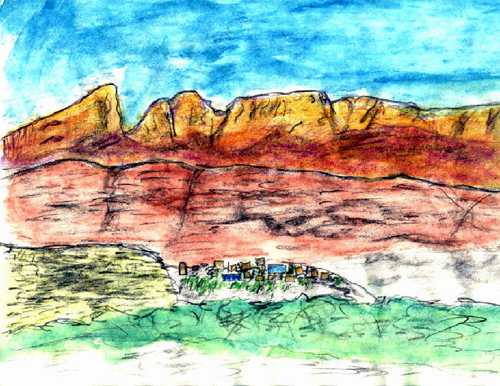
A sketch I made of Boquillas, Mexico, in 2001
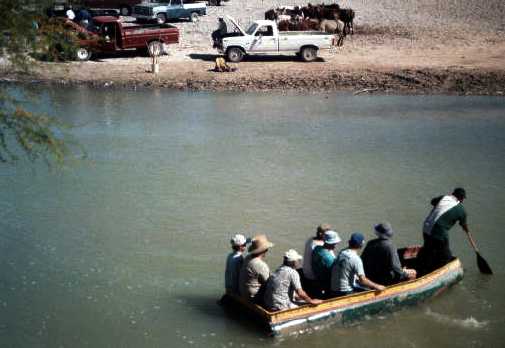
Well over a decade ago, I went to Big Bend, my favorite place on earth, and crossed over to Boquillas, Mexico, to have some tacos and enjoy the international flavor. At that time, you paid a dollar to a guy with a rowboat (with the name “Frijoles” hand-painted on the transom) to get you across the Rio Grande. No passport, customs, or anything like that. It seemed silly, given that the river can be walked when it is low, and there is no real civilization for hundreds of miles in any direction.
After 9/11, of course, this all came to a screeching halt. No more unauthorized border crossing. The village of Boquillas was crippled by the disappearing tourist traffic. What a shame. It was gone forever.
Well, as it turns out, not forever. Now I have to get my passport in order and get ready to make that long drive to West Texas.
Seattle’s $30 million carbon neutral Bullitt Center, billed as the world’s greenest commercial building, will feature what its owner, the Bullitt Foundation, calls an “irresistible stairway” when it opens at the end of the month. The elegant, light-filled escalier offers panoramic views of downtown and Puget Sound. It’s intended to conserve energy and provide physical exercise for occupants. Will it be a lesson to companies trying to get employees to make healthier choices?
We all know climbing stairs is good for us: It’s a good workout and can even save time. In 2011, researchers at a Canadian hospital found that when they had doctors take the stairs rather than the elevator, the doctors saved an average of 15 minutes per workday—and they were required to walk, not run.
But despite the benefits, few office buildings do anything meaningful to encourage stair climbing. Many workplaces have grim, fluorescent-lit, concrete passages hidden away behind fire doors. Some all but prohibit stair use, in part due to post-9/11 security concerns.
The building where I work has very inviting, entertaining, stairs with nice views. However, it was built a while back and does not meet current fire codes. That’s why stairways are so grim – because of the codes that forbid clear openings between floors (because they encourage the spread of fire). I wonder how the Seattle building gets around that problem.
—–
OK… Well, The internet provides the answer. They had to change the codes to build the building.
“We were shocked to learn that it is flat-out illegal to build this sort of ultra-green building in any city in America,” says Bullitt Foundation President Denis Hayes. “But Seattle changed its building code to allow super-green buildings to meet performance standards as an alternative to prescriptive standards. We wanted the design flexibility to construct a building that used less than one-fourth the energy of a (standard) code building.”
Although lost to us through a regretful combination of valium, alcohol, and Disney dreams, Kinkade’s abrupt end does not, however, signify the end to his ™. A digital immortal, his empire continues to expand post-mortem. Despite failing gallery schemes, his virtual gallery is growing. The “Kinkadian Master Style”, or official imitators, will continue to create new works through his website. Similarly, his impact remains ever present on visual blogs like tumblr. It is on these sites that iterations of his work are always being created. One current meme is to “Kinkade” an image, by adding his copyrighted cottages, or by filling any background with swaths of his paintings. It is unlikely Kinkade would be flattered by these depictions, but imagining the man, he would prefer being ironicized rather than irrelevant.
The part that perked my ears up occurs at the 21:00 mark.
Amir Omar: “What I will tell you though, and a place where I think (…) we ought to, do things not only to differentiate our city and make it more marketable to others, but also in its own little way to send a message that there are multiple means of transportation and that is to absolutely find ways to make our city more walkable and, although we’ve made some strides on things like bike lanes there are opportunities sitting there, right now, that are incredibly low-cost opportunites, yet there are ways for us to increase the number of bike lanes we have around Richardson substantially. And so those are the kinds of things, the low hanging fruit if you were, that I think we could do that would be able to begin to be making an impact and at least send a message.
Moderator: Some people on the blog say that those bike lanes were put in on Canyon Creek so that people have a lower, slower traffic route through the neighborheed.
Laura Maczka: That’s a fact. That’s the truth.
Amir Omar: It’s a dual purpose and probably the primary purpose was to slow traffic down, but the fact of the matter is…
Moderator (interrupting): Do people use those bike lanes?
Ami Omar: Absolutely. I hear from them all the time.
Moderator: Why have I never seen anybody, not one, never, in a bike lane?
Amir Omar: (after rebutting the statement by the moderator and talking about his Fitness Challenge) …and would come to me and say, “Thank Goodness for the bike lanes you are putting in.” So I know that, (…) whatever you may say when you have a whole lot of cycling lanes, you will see is a lot more people cycling because the infrastructure has to be there.
The part that raises my hackles is the moderator and his, “I never see anyone in the bikes lanes,” rant. First, he mentions Canyon Creek, which is the nice, old money part of Richardson, where everybody drives big, expensive SUVs (and the center of Laura Mackza’s support). Maybe nobody rides bicycles there, but in my neighborhood, the bike lanes get used. A lot. And not only by me.
And I even cross over and ride the bike lanes in Canyon Creek every now and then.
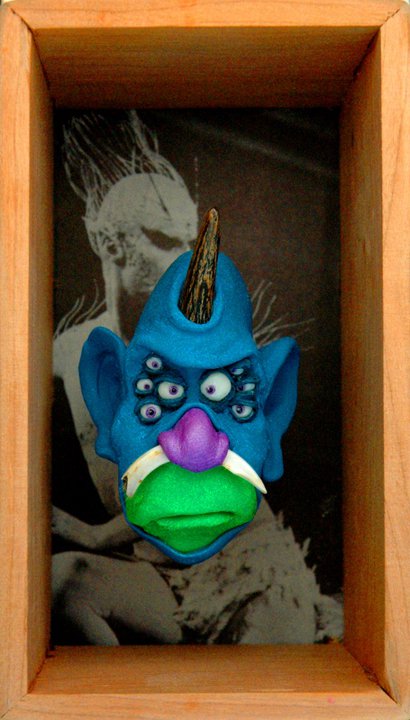
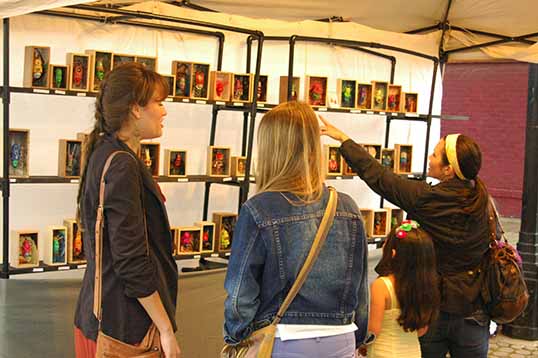
This week is the Deep Ellum Arts Festival. It’s my favorite one – it has become very popular but still maintains a bit of an edge to it.











 Bill Chance