Sunday Snippet, Freshman Physics by Bill Chance

“I am now 33 years old, and it feels like much time has passed and is passing faster and faster every day. Day to day I have to make all sorts of choices about what is good and important and fun, and then I have to live with the forfeiture of all the other options those choices foreclose. And I’m starting to see how as time gains momentum my choices will narrow and their foreclosures multiply exponentially until I arrive at some point on some branch of all life’s sumptuous branching complexity at which I am finally locked in and stuck on one path and time speeds me through stages of stasis and atrophy and decay until I go down for the third time, all struggle for naught, drowned by time. It is dreadful. But since it’s my own choices that’ll lock me in, it seems unavoidable–if I want to be any kind of grownup, I have to make choices and regret foreclosures and try to live with them.”

― David Foster Wallace, A Supposedly Fun Thing I’ll Never Do Again: Essays and Arguments
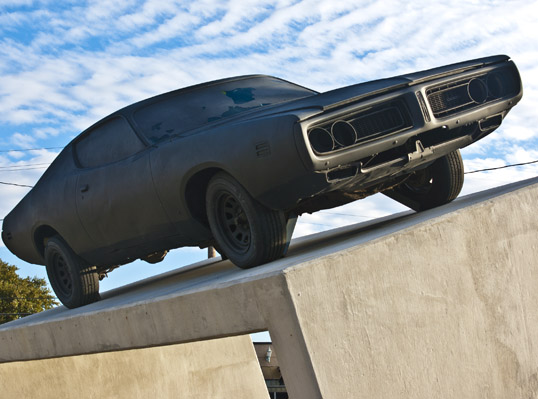
Design District Dallas, Texas

Freshman Physics

Fifty years later, Eugene remembered Professor Viper.

“You have to understand the difference between velocity and acceleration. Velocity is always positive, at least in the direction of motion, but acceleration can be positive or negative. You can be moving in one direction, very fast, but accelerating in the other direction.”

“Imagine you are in a Mustang, with a big supercharged V8, screaming down the road. But you swing the wheel, skid around backwards, and start smoking your tires. You are still moving, your velocity, down the road, but you are facing, and accelerating in the other.”

Eugene remembered perking up at this.

First, what a completely insane analogy. Professor Viper must have been some sort of car freak. Eugene wasn’t – he didn’t even have a driver’s license, let alone a car. It was like listening to an alien speak in English, but an alien way of looking at the world.

Second, well, he had done the same thing the night before. He had gone out for beers with a bunch of people and drank too much, stayed out too late. That was why he was nodding off in the lecture… until Professor Viper made the crazy analogy. Eugene and Martha has staggered out from the bar at closing time with all their friends and they had started piling into the car they had come in.

Eugene was worried because the driver had really been throwing them back. Then he spotted Frank, a quiet guy from the floor below – he barely knew, getting into his own car a couple parking spots down. He looked steadier than the others.

“Martha, let’s ride with Frank instead,” he said to his girlfriend.

“Why? We barely know him.”

“I think he’s sober.”

He was wrong. Frank was totally smashed. It was just that he was quiet and better at standing without swaying. But behind the wheel, he was a terror. His car was that heavy Midwestern hopped-up American hunk of steel and was very fast and very loud.

Eugene remembered sitting and sliding on the front bench seat with Martha between him and Frank as they roared down the street. They swerved through and intersection and skidded around in a three sixty with Frank and Martha screaming in drunken glee as the headlights swung in a wide arc and illuminated the terrified faces of the people in the other cars.

Somehow they avoided hitting anything and made it back in one piece. Eugene swore he would never get in a car with Fran and would always check his driver out and never ride with a drunk again. There was a lifetime of cabs in front of him and he was fine with that.

And now, the very next day, Professor Viper was talking about skidding and velocity and acceleration. It was all too much.

Class ended and Eugene walked up the hill to the dormitory where he and Frank lived. He called Martha and she said she might come over later, she was tired and hung over. There was a knock on his door and Matt, another friend that lived on Frank’s floor, came in.

“Hey Eugene, I wanted to tell you something.”

“What?”

“It’s Frank. I was talking to him. And he said he was going to steal Martha from you. He met her last night, you both rode back with him and he really likes her. He says he’s going to get her from you.”

“Really?”

“Yeah.”

“Jeez, what should I do?”

“I don’t know. I just wanted to warn you.”

And that’s what happened. Frank had that car and Eugene didn’t even have a license. He didn’t have a chance.

The two of them were married their Junior year and at graduation, Martha was eight months pregnant.

The three of them stayed in town after graduation, why go anywhere else? Fifty years. Frank and Martha split up in a few years and Frank left the state. Eugene never talked to Martha again, but the town wasn’t that big and he heard about her every now and then. Last year he discovered that she was not only a grandmother, but a great grandmother.

“Let’s see,” Eugene thought to himself, “A mother for twenty years, then a grandmother for twenty more… a grandmother at forty then a great-grandmother at sixty-something…” The math was easy. He was thinking about this, stretched out in his hospital bed, when the machine on the stand to his right gave a chime and made a whirring noise.

The dose moved down the tube into the needle on the crook of his arm and everything went warm and fuzzy and the half century old memories that seemed so crystal clear went away. Eugene shook his head to try and bring them back. He wondered if they ever would return.

“The degree of slowness is directionally proportional to the intensity of memory. The degree of speed is directionally proportional to the intensity of forgetting.”
― Milan Kundera, Slowness

Short Story of the Day, Flash Fiction, Spring Fever Dreams, by Suzanne W. Vincent

“You can cut all the flowers but you cannot keep Spring from coming.”

― Pablo Neruda

Artwork, Dallas Area Rapid Transit Spring Valley Station, Richardson, Texas

From my blog (I called it an “Online Journal” then), The Daily Epiphany, Monday, August 6, 2001 – Almost Exactly twenty years ago.

Spring

A long time ago I noticed a sign along the Interstate Loop along my drive to work. The sign promised “Pure Texas Spring Water” and sure enough, by the sign, water ran out of the ground, bubbling up and then running down to stain the gutter of the highway and down to a street curb drain. I parked and walked to the spring, taking a picture of the sign and writing about it in my journal.

In the time since, almost a year, I have driven by that spot almost every day (though I’ve changed jobs, that part of my commute is the same). I allowed myself the fantasy of imagining that it really was a spring, an old relic of geology, a fold of shale, maybe an ancient beach, forcing a bit of water to the surface, surviving the excavation and grading of the giant loop road.

Now, the illusion has been shattered. There are four little tiny blue plastic flags mounted on short wires stuck in the ground – squaring off the spot where the water gurgles up.

Now I know that it is a leaky pipe and someone is getting ready to finally dig it up and fix the thing. I’m glad they will stop the waste but somehow, my morning commute will be even a bit more dreary.

Some humor concerning a water leak on the highway.

And a piece of flash fiction for today:

Spring Fever Dreams, by Suzanne W. Vincent

from Flash Fiction Online

Sunday Snippet, Witness Protection by Bill Chance

“It is forbidden to kill; therefore all murderers are punished unless they kill in large numbers and to the sound of trumpets.”

― Voltaire

Rusted with Gun Deep Ellum Dallas, Texas

Witness Protection

Nile Franks had always wanted to be a G-man. He read stories of the FBI when he was a kid and dreamed of the badge, the gun, and the mysterious respect. Nile was a handsome, athletic and smart kid and was able to work relentlessly toward his goal.

After college he worked at a crime lab in his home state for a few years, until he was able to apply as a special agent. He was not able to make it into the FBI, but the Federal Marshals were hiring, so he decided to go that route.

He spent a few years in routine warrant execution and drug property seizure work. He kept to the straight and narrow, despite the temptations of corruption and received his notice of promotion to the Federal Witness Protection Program.

Nile received training in document production (since this was a Federal Program, they could issue new Social Security numbers and cards, even state driver’s licenses), witness relocation, and protection. After he finished his training and passed his exams, he was transferred to the department, where he met his supervisor.

“Well, Franks, welcome aboard,” Elmer Wynn said to him.

“Thank you sir,” Nile replied, “I am sure I’ll be able to do the job as required.”

“How was your training?” Wynn asked. “Do you have a pretty good idea about what we do?”

“Very clear sir, it was quite comprehensive.”

“Well, forget about it. The training we give is a bunch of shit. We don’t do anything like that at all.”

“Really?” Nile was shocked, what could possibly be different?

“Really. You realize that all the people in the program are actually criminals? The worst of the worst. And they are all snitches. That makes them the worst of the worst of the worst.”

“Well, yes, I know that. But… Well, sometimes… We have to deal with… for the better good.”

Wynn snorted. “For the better good? Exactly.”

There was a long pause while Wynn looked Nile up and down.

“You know Franks, if you don’t want to do this job you need to leave, leave now, before I go any further.”

Nile was stunned. What the hell was Wynn talking about? But he had come too far already.

“No, sir, I do want to do this job.”

“Alright then. Now, Franks, do you think it’s strange that in this day and age, with everything connected together, with cameras everywhere, with privacy a thing of the distant past… Don’t you think it’s strange that we are able to make one person disappear without a trace and another brand new one appear out of thin air?”

“Well, I know the job is difficult….”

“Difficult my ass… it’s impossible. And our budget. It’s cut every year. Year after year.”

“Well, OK, but….”

“But what? Shit, things were getting so much out of control, a few years ago, we were losing our clients, we couldn’t hold it together. We had to do something. For example, in the next room, a very secure soundproof room is a New Jersey developer. He made a fortune building projects all over the state. His biggest expense, more than concrete or steel or labor, was bribing every official from the zoning board to the governor. He said, ‘that’s just how things work.’ Every mobster on the east coast is looking for him. They know we have him. What do you think the odds are that we can get him anywhere safely?”

“He can go out west.”

“Out west? You gotta be kidding me. There is no ‘out west.’ Time has sped up and space has disappeared. We will work our asses off and spend our whole budget and he won’t last a year. And he doesn’t deserve a year.”

“What can we do?”

“Do? We figured it out. It’s simple, really. Cheap, foolproof.”

Wynn reached into a desk drawer and removed a service Glock, checked the chamber, and set the gun down on the desk between them.

“He’s in the next room, take care of it.”

“What? That’s insane!”

“No it isn’t. He’ll disappear – just like he’s supposed to. We have it all arranged. Nobody will know, nobody will suspect, everybody will think we did our jobs perfectly. We can spend the travel budget on ourselves. You every want to go to Seattle? It’s nice this time of year.”

“That’s impossible. I would never do such a thing.”

“That’s what they all say. I’ve heard it before. About a third of the agents they send us really can’t do it. But of course, we can’t have that. We can’t have anyone knowing the truth.” Wynn picked the Glock back up.

“What do you mean? You’d kill me?”

“I told you to think hard before we had this conversation. We’re the Federal Government. We know how to make people disappear. Anyone. It’s your choice. Right now. Him or you.”

Wynn placed the Glock back down on the desk. Nile picked it up and turned it around in his hand.

He knew what he had to do. He had no choice.

What I learned this week, July 31, 2021

Isaak swimming a little at the NorthBark Dog Park, Dallas, Texas

Swimming gives your brain a boost – but scientists don’t know yet why it’s better than other aerobic activities

I was thinking this morning about things that I miss from when I was younger – and swimming is one of them. When I lived in Panama I used to swim across open water (in Lake Gatun) – sometimes a mile a day. Now, it all seems like a dream.


New Orleans Lafayette Cemetery No. 1

A new start after 60: ‘I was sick, tired and had lost myself – until I began lifting weights at 71’

Joan Macdonald faced growing health problems before she began lifting weights, shattering preconceptions about what’s possible in your eighth decade


The Stainless Internet (Detail) George Tobolowsky 2015, Stainless Steel Hall Sculpture Garden Dallas, Texas

The Day the Good Internet Died

I remember the early days of the internet – there was such excitement and feelings that the possibilities were endless – especially at work. Those slowly died (were murdered, actually) and the digital world became the oppressive monster we all know today. What a shame.


Recycled Books Denton, Texas

5 Digital Libraries Where You Can Download Ebooks for Free

So little time, so many books.


Children’s Waterpark, Waxahachie, Texas

Megaripples may be evidence of giant tsunami resulting from Chicxulub impact

I just like the word, “Megaripples.”


Woman writing in a Moleskine Notebook, Wichita, Kansas

Why Emotionally Intelligent Minds Embrace the Rule of ‘Writing in Reverse’

Learn to ‘write in reverse,’ and change the way you communicate.


Accidence

“Every balcony is a poem, a chant — a muscle! But whoever lives with that extra blueprint luxury of a balcony lives on the wrong side of a cross-section, on the busy, narrative-addled side of something like an ant-farm window, a brazen architectural arrangement selling cheap peeks into the naked sideshows of the quotidian — even the grisly. Step right up! Behold! A ten story wall of solid twitching muscle!”

—-Director Guy Maddin in Paste Magazine on his short film Accidence

Manor House Balcony, downtown Dallas, Texas

After watching and enjoying The Forbidden Room I was working through the selection of Guy Maddin films streaming on The Criterion Channel. And I now have a new favorite movie.

It’s a nine minute short called Accidence. It is an obvious homage to Hitchcock’s Rear Window. The entire film is a continuous take (zoomed in and out with a bit of panning) of the side of an apartment block – thirty units in all. There is a view of the balconies, some windows into the apartment interiors, and a glimpse of things moving up and down the stairs.

Ok, so it’s only nine minutes long… but you can’t watch it only once. On first viewing it is a confused ant-like cacophony of people on and off of their balconies. But as you watch it again and again, patterns emerge and a story is created. It is a story of doppelgangers, violence, families, boredom and drama. And a fuzzy white dog.

Who is the murderer? Who is the victim? Are they the same person?

I have watched it maybe forty times and will watch it many more. I still see new things. Watch the balloon for example. There is a red ghost that appears against the brick a couple of times – I think I figured out who that is.

Weird, wild stuff.

The Forbidden Room

I just respect audiences to understand that that’s what goes on in movies. I just try to make movies that respect the intelligence of the audience. Respect that they understand that the narrator is always unreliable and respect that they understand that the medium can do whatever it wants.

—-Guy Maddin

Filming a Mexican Music Video in Klyde Warren Park.

The last few days I’ve been perusing the depths of the streaming service from The Criterion Collection – more specifically, looking at the films that are going away at the end of July.

I have discovered a director that I had never known before – a Canadian named Guy Maddin. He makes very unusual and unique films – many of which are done in a style that looks a lot (at first glance, at least) like something made in the early part of the twentieth century – high contrast, black and white or oversaturated color, little dialog with occasional title cards…. such as that. Very odd and crazy stuff.

One film that I watched and really, really liked was The Forbidden Room. After a brief introduction from Marv, who talks about how to take a bath – the plot begins on a doomed submarine carrying a cargo of unstable explosives. There is a knock on a hatch and a woodsman is revealed – drenched in fresh water – and neither he nor the crew can figure out how or why he is there. And then things get really weird.

The structure of the movie is like a series of Russian nesting dolls. Stories inside of stories inside of stories. It is surprisingly consistent about working its way back out again.

There is even a song “The Final Derriere” from a favorite band of mine from decades ago, Sparks.

I was able to look beyond the weirdness and had a good time watching it. In the trailer above, Sight and Sound magazine said, “Has more ideas in ten minutes than most filmmakers have in their entire oeuvres.” And that is what I liked – the interesting concepts, themes, and characters come from the screen like bullets from a machine gun.

Guy Maddin has some other work on the channel that go back into the ether in a few days. Have to get crackin’.

1Q84

“Why do people have to be this lonely? What’s the point of it all? Millions of people in this world, all of them yearning, looking to others to satisfy them, yet isolating themselves. Why? Was the earth put here just to nourish human loneliness?”
― Haruki Murakami, Sputnik Sweetheart

The moon rising over the Dallas skyline and the pond at Trammell Crow Park. From the October Full Moon Ride.

It started on May 5 and ended a week ago – I read all of 1Q84 by Haruki Murakami. The book is roughly a thousand pages long and I read it in conjunction with my Difficult Read Book Club. We used to meet every week at the Wild Detectives Book Store in Bishop Arts. Since Covid put the kebash on all of that we have met on Zoom for the last two books, Brothers Karamazov and 1Q84.

It’s really a great way to read a long/difficult book. There is a weekly goal of a certain number of pages so the herculean task is split into manageable chunks. There is a group of like minded folk to bounce questions off of and keep you interested. Plus, it’s a lot of fun.

Was the book good?

Yes, it was very good – I enjoyed it immensely. I is for everyone?

No. It is a very odd book, with an unusual structure. It is amazingly politically incorrect. It makes no sense in a lot of places. No spoilers, but the ending definitely does not tie up all the loose ends.

Here’s a guy that really didn’t like it:

He is looking for a conventional narrative (evidence for this are all the books on the shelf behind him). 1Q84, like I said, is not a conventional narrative. It exists in its own world.

Here’s one of the many, many folks that liked the novel:

I like his take – and I like the drink he made.

Our Difficult Reads Book Club will have a party soon at the Wild Detectives to celebrate in person reading 1Q84 and Brothers Karamazov – which we read earlier. At the party we will find out what our next book will be – it will be a shorter work so we can finish before Christmas. I’m excited, can’t wait.

Short Story of the Day, Flash Fiction, Everything They Are Running From And a Few Things They Are Running Towards, by Matt Kendrick

“Think of the fierce energy concentrated in an acorn! You bury it in the ground, and it explodes into an oak!”

― George Bernard Shaw

Running of the Bulls, New Orleans

From my blog (I called it an “Online Journal” then), The Daily Epiphany, Sunday July 27, 1997 – Exactly twenty four years ago.

Pissing in the Street

My house is a set of two rectangular blocks. One for the main residence and another, set at right angles, for the garage. Simple, cheap, boring. The only break in the monotony is one corner of the house is missing; a space carved away for the front door. This space also is a cube; a square negative room. We put a little bench there, I’m growing English Ivy up the brick wall side and around the edges on the ground. Crape Myrtles line the west side, bushes line the front. I have been letting the plants grow, trimming them when necessary but mostly letting them find their own way; painting in with green. The Crape Myrtles are now big enough to develop the smooth, curvy bark that is so attractive. I am trying to create a little restful garden spot here; a connection with the outside world.

Late Saturday night I sat out there on the bench to do some writing. I had put in an outlet for Christmas lights, it powered up my laptop so I didn’t have to worry about batteries. It was after midnight and surprisingly warm and muggy. I was sweating through my T-shirt but it was still nice to get out into some more or less fresh air. I expected some peace and quiet out there.

The entire neighborhood is a fractal expansion of my rectangular house. Rectangular lot; rectangular block; rectangular subdivision. It is set on a bias. Parallel to the closest Interstate. All laid out for the maximum profit for the long-bankrupt developer; subject to the sacred call of the auto. The suburb was literally thrown together, get ’em built, get out. Now it is a boring, sleepy village within a city. Full of families (who would live here if they didn’t have kids?). Lawns mowed, identically edged, trees, shrubs, cars, trucks, boats, RV’s.

I expected silence out there. The walls of the house are a powerful barrier; more mental than physical. Within the cocoon, the illusion of suburban life is complete; kitchen (fridge and microwave), couch, TV, (computer) the stops on the limited journey of an illusion of life. The background A/C hum supplies the white noise that destroys any vibrations leaking in from the real world. Simply walking through the door and sitting outside the walls is subversive, against the tenets of American Suburb Family Law.

I expected silence out there. There was a rumble in the distance. The isosceles triangle of Interstate Highways that mark out the area where we live provide a clamor of rubber on concrete, creaking steel, squealing tires, booming horns, the hiss of eighteen wheel compressed air leaving brake cylinders. The call of a race of steel giants racing along; my presence unknown and unimportant; life itself rushing along the asphalt, going to God knows where.

Against this rhythm in the distance the symphony of my neighborhood was completed by the melody and accompaniment of local sounds. Someone was having a hell of a fight. I couldn’t tell where it came from; it sounded like the house directly across, but that house was dark; sound does travel on a calm, warm night. The sounds of battle might be coming from a long way off. Male voices, female voices, maybe six or so in all. Screaming, cussing (I couldn’t pick out individual words, but somehow the shouted obscenities could be identified for what they were), the sound of tinkling glass. This went on for ten or fifteen minutes; then the sound of squealing tires and it ended.

I expected silence out there. A house across my street has some teenage daughters, there are always guys in cars hanging out there at night; like alley cats or dogs in heat. A pickup truck roared down the road and screeched to a halt in front of their house. As the truck rumbled the horn honked on and on. Then it sped off, returning in a couple minutes with another car. The honking resumed. I couldn’t see much, I was screened by the bushes, but I could tell by the sounds that a bunch of people were out milling around. Nobody paid any attention to me as I typed; I’m not sure if they saw me or not but I’m sure that if they looked I was visible, my face lit by the screen on the laptop.

I expected silence out there. I heard a noise, liquid, running. Someone was pissing in the street. It was a lot; I know that kind of a piss, beer piss. Looking out through the leaves all I could see was a bare stomach and chest; young, slim, bejeaned; illuminated bright red from the filtered brakelights of the still idling pickup. The cacophany didn’t lessen with the urinating. I couldn’t tell how many voices were mingled in a melange of obscenities, lies, boasts, teasings, the usual testosterone late night drunken summernight pickup revelry.

The little impromptu party continued. It sure didn’t sound like fun, or sexy, or youthful. It was almost tired, frustrated, even mean. There was some stupid shoving, the house door slammed twice, tinkling of broken glass on the sidewalk, and the vehicles roared away. They circled the block twice and were gone.

I finished my typing and found that Candy had woken up and discovered the front door unlocked. I rooted around in the ivy for a half hour until I found the hiding place for the extra key. I didn’t want to ring the bell, It would wake the kids and scare my wife.

Candy says that all kids hang out like those folks were, it’s harmless. She’s right, of course, twenty-odd years ago I spent more than one night hanging out near some cute-young-thing’s house, drinking beer and boasting. They must be out there a lot; it’s not unusual to find beer cans or brown broken glass in our yard, the Mazda has an extra dent where someone bounced a quart bottle off the hood, a couple times there’s been tire tracks in our yard.

Maybe I’m being an old fuddy-duddy but I’m not entirely at ease with those kids out there, only a few feet and some sheetrock and siding away from my sleeping sons. Or maybe I’m jealous, wishing my days of hanging out weren’t receding so far into the past, that my stomach doesn’t look like the one on the guy pissing in the street.

And a piece of flash fiction for today:

Everything They Are Running From And a Few Things They Are Running Towards, by Matt Kendrick

from Cheap Pop

Matt Kendrick Homepage

Matt Kendrick Twitter

Sunday Snippet, Freight Elevator by Bill Chance

“When the elevator doors open there is only one other person inside it, a homeless man with electric blue sunglasses and six plastic grocery bags filled with rags. “Close the doors, dammit,” he yells as soon as we step inside. “Can’t you see I’m blind?”

…….

From the back, the homeless man shoves between us, his bounty rustling in his arms. “Stop yelling,” he shouts. though we stand in utter silence. “Can’t you tell that I’m deaf?”

― Jodi Picoult, My Sister’s Keeper

Dallas, Texas

Freight Elevator

“Well, are you ready to call it a night?”

“Not really.”

“Do you want to go to an after hours bar or something?”

“Not really.”

“I’ve never been to where you live. Can we go to your place?”

“I still live with my parents, you know that. Their apartment is tiny, I sleep on a futon in my mother’s sewing room. I’ve never been to where you live either. You live alone. We have to go there.”

“But my apartment is… really small.”

“Is it clean?”

“Of course. But…”

“It’s big enough then.”


I had always wanted to live in the center of the city… on the island itself. I was tired of feeling like an outsider, a tourist. But rents were so high and I never had and will never have any money. For a year I rode that interminable train ride, rocking elbow to elbow with the other strap-hangers. I would look through the rental listings, hoping, hoping. Finally….

Walking to meet my new prospective landlord past the block after block of tents filling the sidewalk, most a bilious purple-orange color. The government has spent untold millions on buying thousands of tents to “solve” the homeless problem and distributed them – surprised when they were snapped up and the population living on the streets blossomed even more. I looked at the rows of nylon and filth and wondered if I could do that. I have camped a lot over my life but never on a sidewalk beneath the glass canyons of downtown. A lot of valuable parking was taken up by bathroom trailers provided by the city that had necessities and showers, but still….

The address on the listing was a huge hulking brick building. It looked like an ancient factory, divided up into a filing cabinet of tiny living spaces. There were very few windows and only one door. I was repelled at first, but realized that a place at this affordable price was not going to be in a new shiny glass tower with a grid of balconies repeating up into the sky. This was my dream, but it was going to be modified by the real world.

“You are right,” the rental agent said, “this used to be a factory. I have no idea what they made here, but whatever it was, it was huge, as you will see.”

We walked through a maze of sheetrock walls, obviously thrown up to divide some massive assembly room into a warren of rented cubicles. We arrived at a wall that was taken up by a giant steel vertical door with a peeling number “1” stenciled onto it. Of to one side was a single simple round button with an upward facing arrow. The rental agent pushed this. There was a heavy shuddering and a low loud metallic groan. After a minute of this the door slowly raised up, revealing a shallow space delineated off by a translucent plastic divider. In the middle was an ordinary door, with a peephole. It was labeled 1-12 A.

“Well this is it,” the rental agent said. She took out a key and unlocked the door.

“I don’t understand.”

“Like I said, the factory made huge, giant, heavy, something-or-others. They moved them up or down on this gigantic freight elevator. Other than the stairs, it’s the only way to reach the upper floors in this part of the building. Since it was now being used for pedestrians most of the elevator was wasted space. We built this partition and were able to rent out the area behind it. Come on in, take a look.”

“The walls are metal mesh?”

“The back and side walls, yes. But beyond them are only concrete. There is actually a kind of window in back between every two floors. It lets in a nice light as you go past.”

“It moves?”

“Of course it does. All the other residents us it to get up and down. But there is the partition and a locked door.”

“The partition doesn’t look all that opaque.”

“Oh, there’s enough for privacy. And you can make as much noise as you want. You can play music. Folks on an elevator don’t care about that.”

“I see the stove and ‘fridge. But no sink. And no bathroom.”

“On eleven you have access to an old janitor’s closet. A big sink, and we put in a shower and toilet. It’s yours. Your door key fits. Just go up to eleven, get off, down the hall, one left, then a right. I’ll show you.”

“I don’t know if I can live in a place like this. It goes up and down. People at the front all the time. It’s crazy.”

“It’s cheap.”

“It’s the only place I can afford.”

“I’ve heard that before.”


Well, it turns out she loved my apartment. She liked the feeling of going up and down so much that, late at night, when the other people were all home asleep she’d go out the front door and push all the buttons. That would keep my place moving for a while. She loved watching the concrete walls slowly shift up and down.

She crawled out of the hatch on top and put plants on the window sills so she could watch those go by. She bought a watering can with a long spout so she could drip water through the mesh into her plants as we moved past them.

The only problem is that she likes to make a lot of noise in bed when she think people are in the elevator up front. She rearranged the lamps so that we sometimes throw obscene shadows on the translucent wall. It bothers me a little but nobody’s complained yet.

As a matter of fact I think she likes this tiny apartment more than me. If we broke up, I’m afraid she would throw me out.

And I’ll never find another place I can afford.

What I learned this week, July 24, 2021

Republic Tower, Dallas, Texas

Loneliness: Coping with the gap where friends used to be

One bad (possibly the second worst) thing about being old is how difficult it is to make friends. Good friends you have had for a long, long time drift away and new ones are hard to come by. Is it impossible?


Deep Ellum, Dallas, Texas

Fully Oligarchic Luxury Californication

The tech elite have joined forces with progressive visionaries to establish a model of America’s feudal future.


Scott Burns: What history tells us about stock market returns

As I think/dream about retirement, the stock market becomes very, very important to me.


Thanksgiving Square, Dallas, Texas

Changing Habits: Interview with Dr. Amy Bucher, a Behavior Change Designer

I recently caught up with Dr. Amy Bucher, the author of Engaged, a compelling guidebook on designing products and services that change people’s lives. She talks about behavioral design, the science of crafting products and services in such a way as to shape or influence human behavior. Here is our conversation.


Timeboxing: The Most Powerful Time Management Technique You’re Probably Not Using

Timeboxing is the nearest thing we have to productivity magic, yet most people don’t utilize it. Here’s how to overcome the top 3 reasons why.

“I can’t seem to get enough done.”

“I’m always distracted.”

“Why can’t I focus?”

I hear these complaints from my clients and readers all the time.

But when I recommend perhaps the most effective technique ever devised to help people stay on track, most of them balk.

“You want me to plan every minute of my day?”

Yes! Now what are you waiting for?


From Todd Alcott’s Pulp Tarot

The Pulp Tarot

A new Tarot deck, designed by graphic artist Todd Alcott, drawing inspiration from midcentury pulp illustrations

I use a Tarot deck to help generate fiction writing ideas. I just have an ordinary (cheap) Rider-Waite tarot deck – but I look at more artistic and interesting decks – it could be a rabbit hole – but if I had a little more money I know I’d buy a few.

From Todd Alcott’s Pulp Tarot

The attack of the garish, gaudy Evil Dream Hippies

Is Dreaming Real?

When you’re lucid, it can feel so real the distinction ceases to matter.