North of where I live is a patch of thick creek-bottom woods known as the Spring Creek Nature Area. I’ve been going there for years – to walk around or ride my bike on the complex of paved trails that loop through the forest. It’s a nice spot… a place to forget that you are in the middle of a giant city.

The looping trails through the Spring Creek Natural Area converge on a little footbridge over the creek. There is a nice bench there – a good place to rest and get away from the city for a few minutes.
I had read rumors that there were a couple of old cemeteries within this woodland stretch. A little bit of web searching and careful observation of the Googlemap aerial view of the area and I was pretty sure I had spotted the locations. I am not obsessed – but I find old cemeteries to be interesting. They are the only remaining mark that a lot of the early settlers left on the land here.
I had stopped off at one in the middle of a Plano neighborhood a month or so ago and now I thought I’d take a look at the one in Spring Creek.
So the other day, once my bike ride had been cut short by an unexpected flat, I left my car at Renner and 75 and walked down to where I figured the graveyards might be. It was a hot day and walking was not easy, even though I had brought a bottle of cold water. The cemeteries are not in the Nature Area exactly, but on private property, but judging by the trails and dirt roads penetrating the scrub and trees, I was not the first to venture back there.
After a short hike I came across a small family plot, with a rusting iron inner fence and a new black wrought iron palisade around that. This was the burial place for the scion of the Routh family, Jacob Routh, his wife, Lodemia, and two unmarried daughters. The plot is overgrown with vegetation and I didn’t feel like climbing the fence, so I never was able to see the daughter’s tombstone. The Routh name is still heard all over the Metroplex, especially now that Routh street pierces right through the heart of the uptown entertainment district.
It’s a very peaceful spot, perched right above a steep, deep, dropoff of native limestone down to the creek below. I can picture it over a hundred years ago, part of a ranch made of rolling hills rising up from the creek bed. It’s where a pioneer would choose to spend the rest of eternity. Somehow, I don’t think they would mind the fact that the plot is being overgrown, slowly returning to the way it used to be.
Around to the side of the tombstones of the four family members are two small markers. I could barely see these through the underbrush – couldn’t make out the dates. One had three names, Sharon, Rinnet, and Theda. The other simply said “Fluffie.” These are obviously pet graves… horses and a dog, probably. In those times, a family’s animals would have been very important, worthy of a carved stone in the main cemetery plot.

Jacob Routh’s tombstone in the family plot deep in the woods at the Spring Creek Nature Area in Richardson, Texas.

Pet grave marker.

I couldn’t get a good shot without climbing the fence… but it says “Fluffie.”
I left the small cemetery and followed an old road down through a little creek and up a hill, almost emerging onto a new road that winds through the glass and granite high-rise office buildings of the Richardson Telecom Corridor. Shielded from civilization by a thick grove of trees is a larger cemetery, containing about a hundred or so graves. It was fenced – I did not enter even though there were some gaping holes in the wire. Near the locked gate was a couple of crumbling benches and an official historical marker.
It reads:
Marker Number: 14532
Marker Text:
Brothers Jacob, George Washington, Joseph and Thomas Jefferson Routh, and their sister Elizabeth Routh Thomas, were cousins of the Vance Family which held the original land grant that encompassed this site. Jacob Routh (1818-1879), a Baptist minister, acquired the 440-acre J. V. Vance survey in 1851, and brought his mother and other relatives from Tennessee to Texas. The Routh family were instrumental in the establishment of the community surrounding their land. Routh family members helped to organize a school, church, and store in addition to the family cemetery.
Early Collin County settlers Nancy De Lozier Beverly (1806-1851)and seven year old William Klepper, along with an unknown child whose parents were camping nearby at the time of his death, were already buried on this site when Jacob Routh set aside one acre as a family burial ground. Jacob’s mother, Elizabeth Mashman Routh (1788-1852), died soon after her arrival in Texas and was the first family member to be interred here.
Jacob Routh, his wife Lodemia Ann Campbell, and two unmarried daughters, Rose and Clara Routh, are buried several hundred yards north of the cemetery in a private plot. Of the approximately two hundred graves here, fewer than one hundred are marked. The last burial to occur here was that of Serefta Ellen Campbell Miller, who was born in 1836 and dies in 1922. The Routh cemetery continues to serve as a record of the pioneers of north Texas. (1998)

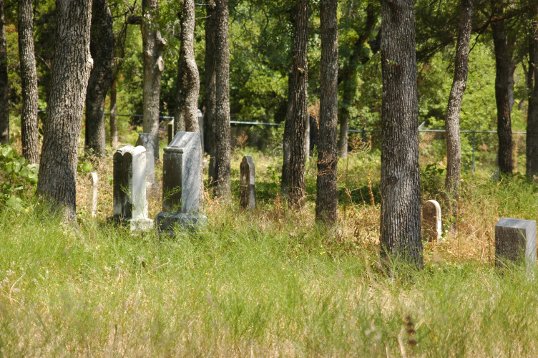
I walked around the fence and snapped a couple shots through the wire. Like the smaller plot this one was overgrown, with large mature trees grown up between the crumbling markers.
The sun was burning down and I had seen what I wanted and returned the way I came, taking time to explore a couple side trails that meandered through the woods down to the creek in a couple different spots. I hope that land doesn’t get developed any time soon, I’d like to see the the Spring Creek Nature Area expand… I’d like to see those cemeteries both protected and also, paradoxically, continue to return to the wild state they started from.











 Bill Chance