Curtains, Nasher XChange, Entry Nine of Ten

Previously in the Nasher XChange series:

  1. Flock in Space, Nasher XChange, Entry One of Ten
  2. X , Nasher XChange, Entry Two of Ten
  3. Fountainhead , Nasher XChange, Entry Three of Ten
  4. Moore to the Point, Nasher XChange, Entry Four of Ten
  5. Buried House, Nasher XChange, Entry Five of Ten
  6. dear sunset, Nasher XChange, Entry Six of Ten
  7. Music (Everything I know I learned the day my son was born), Nasher XChange, Entry Seven of Ten
  8. Black & Blue: A Cultural Oasis in the Hills, Nasher XChange, Entry Eight of Ten

Insomnia is an exquisite torture. Life must be boring for those who sleep well.

There is a different world in the wee hours of the morning – a world of offbeat television. I grew up with only three television channels – plus maybe a PBS station if you lived near a big city. Then I discovered those channels that you had to use a funny circle of wire antenna screwdrivered into little posts labeled UHF. The kind that you had to tune in by hand – no clicking channel selector. One UHF channel featured old monster movies. All night long. I’d watch them in the pitch black kitchen on a tiny portable television.

Now there are a thousand digital channels – and after a certain time, the channel matrix guide simply says “Paid Program.” Everything is for sale….

Once I saw an infomercial for a product that appeared to be a pointed delta-shaped piece of metal with a large plastic handle attached. You would plug in in, add water through a tiny port, and then rub it over a wrinkled garment. The wrinkles would disappear.

“It’s a miracle,” the pitchman would exclaim.

“It’s an iron,” I’d shout at the television. “They’ve been around for centuries.”

The next exhibition in the series of Nasher XChange works was the one that required me to go the least distance. I basically had to roll over and look at the television.

Denton’s Good/ Bad Art Collective filmed a 28 minute infomercial in a downtown office building. They had a call for volunteers, but I wasn’t paying enough attention and missed the casting call. That was the first part of the exhibition. The next was a static display of the studio they had built on an empty floor of the skyscraper. I had ridden my bike past this many times, but decided (for no real reason) not to stop and look. I wanted to see the infomercial blind, in its native habitat, so to speak, the bedroom television.

My DVR wasn’t working, so I set my alarm for the middle of the night, on a worknight, but it wasn’t needed. Like Gregor Samsa, after a night of uneasy dreams, I awoke, reached over, groggy, but conscious, and pawed the button before the buzzer was able to do its duty.

I clicked the remote and then waited for the Good/Bad Art Collective’s promised subversive infomercial to start. Instead, there was Deborah Norville and Inside Edition. What was this? I watched while Deborah talked about the freaky, the hopeless, and the lurid – a parade of freaks moving between strange eccentricity, and eccentric strangeness. It left me wanting to rinse my eyeballs and afraid of falling asleep – what dreams would this stuff bring?

Maybe I was too early, so I watched the next half-hour. Here, suddenly, was Larry King, selling Omega XL – a miracle material made from green mussel lips (instead of fish) or something like that. The claims were so outrageous and odd – this is truly another world, where truth is lies and money is king.

And that was all I could take – I reset the alarms, mashed the remote and before I knew it, was on to work the next day.

Checking the Good/Bad page the next day I learned there was a mistake, a lack of communication and the mock infomercial was delayed for 24 hours.

So I woke again and watched the real thing. There was the sleazy announcer in front of a bank of multicolored draperies. Every now and then there was an interlude with the volunteer actors and a phone number (What walks on four legs in the morning, two legs in the afternoon, and three legs in the evening) – I should have called the number, I’m sure it was something Good/Bad subversive – but I didn’t.

Something was wrong with the pitchman – he would stumble and clutch his head. Finally, he collapsed, apparently deceased. His feet protruded from the curtains.

The funny thing is, I have no idea what the man said. I was paying attention, I heard him clearly. It seemed to make some sort of sense at the time, but that is another world, that time of night, and the ideas don’t make the transition to the light of day.

Insomnia is an exquisite torture. Life must be boring for those who sleep well.

Photo by Good/Bad Art Collective

Photo by Good/Bad Art Collective

From the Nasher Website:

Good/Bad Art Collective is a Denton, Texas based group of artists that created well over 250 events in Texas and New York from 1993-2001. For the Nasher XChange exhibition, the Good/Bad Art Collective is creating a project entitled CURTAINS that will be part one-night event, part exhibition and part television broadcast exploring notions of viewership and interaction. The Collective’s XChange project will be their first major project in more than 10 years, and coincides with the 20th anniversary of the group.

In the months leading up to the opening of XChange, the Collective will produce a 28-minute infomercial, which will be filmed in a newly created television studio on an empty floor of Bryan Tower, a downtown Dallas highrise managed by Spire Realty. At the one-night opening event on Saturday, October 19, 2013, attendees will be given the opportunity to participate in the filming of the infomercial. Visitors throughout the run of XChange will be able to walk the space in which the infomercial was filmed and see sculptural elements used as props during the opening and in the finished infomercial, as well as select edits of video documenting the one-night event. The finished infomercial will be broadcast on late night and early morning television timeslots in local, regional, and national markets.

Throughout its ten year history over 110 artists and creatives were members of the Good/Bad Art Collective, developing unique one-night events of art, music, and film programming at a break-neck pace, resulting in what The Village Voice described as “Fluxus with ADD.” Partly inspired by conceptual art programs at the University of North Texas offered by artist Vernon Fisher, the group created installations and events that were often interactive, humorous, and thought-provoking.

Past large-scale projects include Very Fake, But Real (1997), a one-night-only event at DiverseWorks Art Space, Houston, in which they built an exact replica of their Denton studio inside the gallery and used the surrounding interior space as a roller skating rink and concert hall; and We’re On Our Way to Dinner, But We Have to Pick Up Something First (1999) for a photography exhibition at the Arlington Museum of Art in which they transformed the mezzanine of the museum into a 1970s-style garden apartment building and used one of the spaces to throw impromptu surprise parties for each of the guests at the opening, installing the polaroid photographs on the apartment refrigerator for the duration of the exhibition

Fountainhead , Nasher XChange, Entry Three of Ten

Previously in the Nasher XChange series:

  1. Flock in Space, Nasher XChange, Entry One of Ten
  2. X , Nasher XChange, Entry Two of Ten

Charles Long
Fountainhead
Northpark Center, Dallas, Texas

In keeping with my project of going to all ten of the Nasher XChange sites without using a car, after work I rode my commuter bike over to the nearest DART station, locked it up in a Bike Lid, and took the train down to Park Lane station.

I walked across Central Expressway to get to the shopping center. That felt really strange – Northpark is the cold dark center of the Dallas upper crust car culture. Swarms of honking, smoking metal carapaces jammed themselves along the frontage roads while a thick stream clogged the freeway lanes below.

There were other people on the sidewalks, working their way to or from the mall. A thin trickle of what were obviously employees – from retail, cleaning crew, restaurant workers – dishwashers to waiters, all wearing weary uniforms, trudging home or dragging their way to work, shift after shift.

I waited a long, long time for a walk signal, then crossed the penultimate road. I reached the other side and was moving on down the sidewalk when I heard the distinctive squeal of brakes and skidding rubber on concrete. Then came that awful sound of expensive sheet steel rending – a pop and crunch. A thin rancid cloud of burnt tire treat floated by.

I turned and looked into the mass of automobiles to see the horde slowly sorting itself out with the green light. One young man in an old sedan sporting a very fresh dent in the front grille came slowly sorting himself out of the fray, winding from lane to lane until he escaped the traffic. He made a right turn and I expected him to pull over and wait for his victim, but he suddenly accelerated and then, he was gone… like a fart in the wind.

A hit and run.

It was all too fast for me to think. No chance to make a note of a license, I’m not even sure of the color, let alone the model of the car.

While I walked away I saw a shiny Lexus SUV pull over with its back end smashed. A couple of other cars pulled up beside, and a clot of women piled out, all standing on the sidewalk and gesticulating.

I turned and began to cross the vast parking lot into the cavernous mall on foot.

Fountainhead Charles Long Northpark Center Dallas, Texas

Fountainhead
Charles Long
Northpark Center
Dallas, Texas

Virtual money flowing across the surface of the sculpture. Fountainhead Charles Long Northpark Center Dallas, Texas

Virtual money flowing across the surface of the sculpture.
Fountainhead
Charles Long
Northpark Center
Dallas, Texas

From the Nasher Website:

Charles Long, a Long Branch, NJ native, currently resides in Mt. Baldy, CA. His sculptures have explored the abstract autonomous art object as a psychological investigation into the nature of self and others and have been made from diverse media such as coffee grounds, rubber and hair from Abraham Lincoln.

For his Nasher XChange commission, Long plans to create an interactive, waterless fountain entitled Fountainhead that extends his ongoing investigation into the viewer/artwork relationship through the use of new technologies. The installation performs every function of a traditional fountain, only virtually.

Projected images of sheets of dollar bills move serenely down the surface of a sculpted monument, flowing like water, instantly adapting to every nook and curve, accompanied by a serene soundtrack scored especially for it. Three kiosks topped with interactive screens face the monolith and offer an opportunity for visitors to donate money to one of the three designated charities, much like the coins tossed into the Trevi Fountain are donated to charity. After payment is tendered, visitors are encouraged to flick a virtual coin off of the screen toward the sculpture resulting in an exuberant splash of dollars going in every direction. The three designated charities were selected by the artist and Nasher Sculpture Center director, trustees and staff.

“In creating this new work for Nasher XChange I was conscious of the social role that sacrifice has played throughout history. In Fountainhead, I sought to encourage the passerby to give up something of value before an anticipating audience. It’s a bit of harmless fun, yet it echoes ancient public sacrificial ceremonies and it seems pertinent to be doing this kind of sacrifice today in this very popular shopping center where visitors have been seeing public art for decades,” said artist Charles Long. “One of my interests as a sculptor has been to play with the image of value and art, and in this work I wanted to see what a massive fountain of money issuing endlessly forth might feel like as a public spectacle. There is decadence, but then there is this social act of giving. I chose charities proximally close to the lives of the participants so that their giving had a more tangible meaning.”

Nasher XChange will extend the museum’s core mission beyond its walls and into Dallas’ diverse neighborhoods, alongside key community partners, to present advances in the rapidly expanding field of sculpture, raise the level of discourse on the subject within the city, and contribute to broader national and international conversations on public sculpture. As the only institution in the world exclusively dedicated to collecting, exhibiting, and researching modern and contemporary sculpture, the Nasher Sculpture Center is uniquely positioned to investigate this growing practice of sculpture in the public realm.

Nasher XChange also references the history of the Nasher Collection itself: from the time of its early formation, major works from it were displayed at NorthPark Center, the indoor shopping mall created in 1965 by Raymond Nasher, and that tradition of making museum-quality art available for everyday enjoyment continues today. Millions of people every year have the opportunity to experience this fascinating and significant art located throughout NorthPark Center.

Long has been interested in the intersection between art, sound, and viewer participation since he collaborated with the band Stereolab in the mid-90’s to create sculptures with sound components that could be accessed through headphones. In his latest public art piece, Pet Sounds, Long evolved his ideas as new technological possibilities were developed with a special focus on activating sound through touch.

Long is an internationally exhibited artist with more than thirty solo shows at such venues as Site Santa Fe; St. Louis Art Museum; Orange County Museum of Art, Newport Beach; Sperone Gallery, Rome; London Projects, UK; and Tanya Bonakdar Gallery, NYC. Long has taught at California Institute of the Arts, Art Center College of Art and Design, Otis College of Art and Design, Harvard University and currently is faculty and chair of the UC Riverside Department of Art.

Fountainhead Charles Long Northpark Center Dallas, Texas

Fountainhead
Charles Long
Northpark Center
Dallas, Texas

I donated five dollars to the North Texas Food Bank. You swipe your credit card, push the button. There's an artificial splash and the  cash projected on the fountain swirls around in a virtual splash

I donated five dollars to the North Texas Food Bank. You swipe your credit card, push the button. The cash projected on the fountain swirls around in a virtual splash

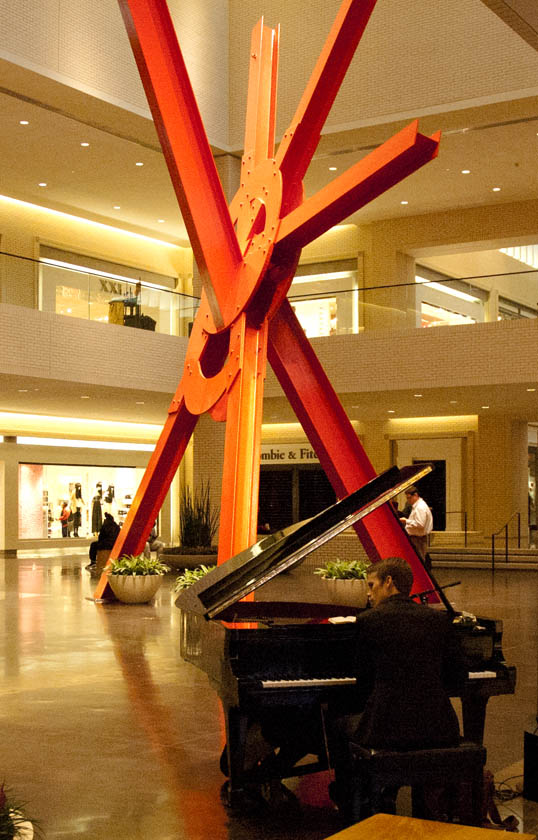
Ad Astra

Northpark Center, Dallas, Texas (click to enlarge)

Northpark Center, Dallas, Texas
(click to enlarge)

Mark di Suvero
Ad Astra, 2005
Painted Steel
48 x 25 feet

Other works by di Suvero in the Dallas area – Proverb and Ave

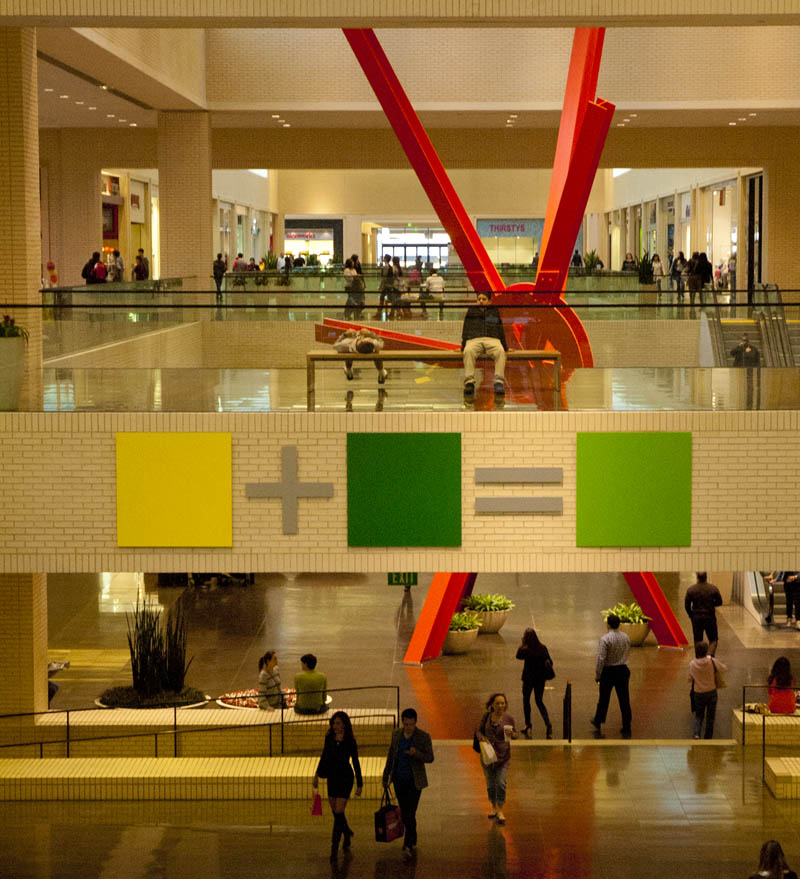
Pamela Nelson and Robert A. Wilson
Color Equations, 2007
4′ x4′ Placards (aluminum with glossy vinyl Surface

I took the train to the Park Lane station and walked across Central Expressway to Northpark Center to look at one of the Nasher Xchange sculptures there. To walk to Northpark is a subversive act in itself. It is the epitome of car culture, of consumer culture, of upper crust shopping culture.

I felt like I was an alien, a barbarian spy infiltrating a pecunious fortress.

Of course Northpark is more than a mere shopping experience. It is the heart of Raymond Nasher’s real estate empire and the main source of the funds he used to build his incredible collection of sculpture and his museums, including Dallas’s Nasher Sculpture Center. There are some incredible artworks installed in the mall.

So I had to walk around and look at them. It is a very odd and unique setting for some amazing art. To be there looking at sculpture and not toting little bags with designer names or logos on them…. it was surreal.

Ad Astra, Mark di Suvero Northpark Center Dallas, Texas

Ad Astra, Mark di Suvero
Northpark Center
Dallas, Texas

Ad Astra, Mark di Suvero Northpark Center Dallas, Texas (click to enlarge)

Ad Astra, Mark di Suvero
Northpark Center
Dallas, Texas
(click to enlarge)

Arcady

“In the beginning, God created the earth, and he looked upon it in his cosmic loneliness.

And God said, “Let Us make living creatures out of mud, so the mud can see what We have done.” And God created every living creature that now moveth, and one was man. Mud as man alone could speak. God leaned close to mud as man sat, looked around, and spoke. “What is the purpose of all this?” he asked politely.

“Everything must have a purpose?” asked God.

“Certainly,” said man.

“Then I leave it to you to think of one for all this,” said God.

And He went away.”
― Kurt Vonnegut, Cat’s Cradle

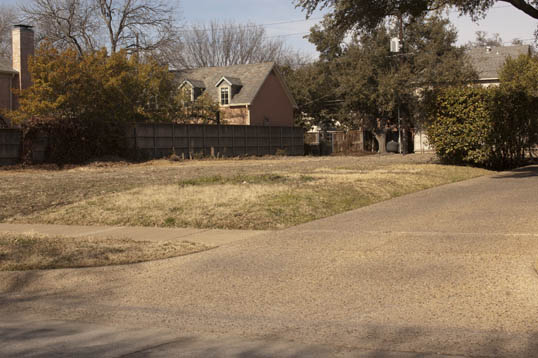
4320 Arcady, Highland Park, Texas - a few months ago

4320 Arcady, Highland Park, Texas – a few months ago

Candy and I sometimes like to go to estate sales. Midweek we receive emails with lists of various sales throughout the city and, if I have time, I’ll go through the list, looking for interesting sales.

I don’t go to the sales so much to buy anything other than the occasional art object (I have enough useless crap already) – I go for the stories. You see, an estate sale – especially one where the owner has passed away after a long and interesting life – is a mirror into the past. It’s a museum displaying a person’s… a complete stranger’s entire collection of heart-ache and the thousand natural shocks that flesh is heir to. These timeless treasures are arranged and papertagged with a string and a price so the slouching horde can shuffle through, pawing at the lot.

It’s an afternoon’s entertainment.

A few months ago, I was clicking through the emails, looking at the collections of photos, trying to find something a little more curious and compelling than the ordinary run-of-the-mill when a certain address caught my eye.

4320 Arcady

I knew where Arcady street was. That’s the heart of the most expensive neighborhood in the most expensive town in the Metroplex – Highland Park. That’s where the rich and famous cavort in their multi-million dollar mansions. Plus, it is mostly old money – the rarefied world of the bloated upscale opulent set – a world I will never see, a life I will never lead. Maybe a glimpse.

I printed a map.

When we arrived, the place was not quite what I expected. The house was beautiful, an old Mediterranean Style two story with a red tile roof. And it was old. For Dallas, it was very old. It was like stepping back into a time machine.

There wasn’t much for sale and that was ancient and worn out. Still, I loved the old house, loved the high ceilings, loved the original windows – opened by metal hand-cranks with cracked ropes leading to sash weights inside the walls, loved the tiny white hexagonal tile in the bathrooms and kitchen (sometimes called “Dallas Tile”) loved the formal staircase, loved the deep wood of the floors… I even loved the thick old dust that coated everything like a blanket of compressed time. I wanted to find out more, so I headed to the huge bookcase that lined one wall of the living room.

There were University of Texas Yearbooks from 1942 and 1943. There were a couple of scrapbooks filled with old cartoons clipped from magazines in the 1950’s along with jokes written in a careful, elegant script (the kind everyone used to write in). Now, I wish I had bought the scrapbooks, but I put them back. Nothing else gave a clue.

I went out to the garage to talk to the person putting on the sale. He said, “The house has already been sold, I heard it was for three million. After this sale, it’s going to be torn down. The buyer is going to put up a new house on the lot.”

That made me sad. I looked down the street at the rows of fake Gothic mansions – all intended to look like English Manor homes shrunk down a little and plopped down right next to each other in the blistering heat of Texas. They all looked the same.

Now, I understand a little. The Arcady house had a tiny kitchen, and only a couple of miniscule bathrooms. That would never do. But it could be saved… a cleverly designed addition… a modern attached kitchen….

No, it would never work. People that live on Arcady street in Highland Park don’t understand uniqueness or preservation. It is an exclusive club they desperately want to join and to fit in you have to live in the proper house.

At home I did some searching. I found that the property had been bought by a builder and he had a replacement already designed by an architect named Wilson Fuqua. Ok.

I also found out who had lived in the house. It was a woman named Catherine Duls. Her father was a well-known Harvard educated attorney named William H Duls. I believe he built the house and moved his family there when his daughter was three. She lived there her entire life until she passed away at the age of 89.

Catherine played tennis at the University of Texas and worked at the SMU law library. Her friends called her Kitty. In her obituary, someone wrote, “ I loved her beautiful voice and Southern drawl, her gorgeous hair and complexion, and her fabulous sense of humor. She was complicated, intelligent, and wise. I appreciated her so very much. She will truly be missed.”

The other day, I had some work not too far away and because the traffic was lighter than I thought, arrived early enough to take a short detour down Arcady.

The house is now a vacant lot.

4320 Arcady, now

4320 Arcady, now

Faded Sign

I an old man,
A dull head among windy spaces.

Signs are taken for wonders. “We would see a sign”:
The word within a word, unable to speak a word,
Swaddled with darkness.

—-from Gerontion, by T.S. Eliot

Design District, Dallas, Texas (click to enlarge)

Design District,
Dallas, Texas
(click to enlarge)

There was a sign here once, on this very wall. I’m sure I must have seen it long ago when I passed this way before, when it was here, when it was whole, when it was relevant… to something. But what was it? What did it mean? Why is it gone now?

What terrible disaster befell the owners of the sign? It might have been a sudden death, an unexpected and unprepared tragedy. Most likely though, it was a slow dissolution over time, a deliberate failing covering decades, sluggish yet inexorable. Like the frog in cool water I imagine the involved never really felt the change, the lazily rising boil, an unseen poach of doom. Or maybe they felt a shadow of cataclysm, a hidden fear, dismissed as paranoia or lack of confidence, or deliberately ignored out of a fearful inability to face the inevitable.

Was it a proud name? A bit of art? Bright colors? A splash of neon phosphorescence? Clever typography?

It doesn’t matter, really. What is gone is gone. Dust is dust.

What you see now is all there is: cracked plaster, empty mounting holes circled with spall, streaks of rust stain on dusty stucco. The cold wind howls by.

Some might look at the bright side – maybe the missing sign is simply an indication that success was so sudden and bountiful the denizens were able to depart for greener shores.

I doubt it, though. This looks like a place that you visit on the way down, not heavenward.

The remains hint at letters, but are indecipherable. The past does not fit well with literacy. Entropy is not lucid.

Then I am on my way again. Maybe some day another sign will grace the wall.

Or at least a fresh coat of paint.

Poppies from the back

Poppies, by W. Stanley Proctor Liberty Plaza Farmer's Branch, Texas (click to enlarge)

Poppies, by W. Stanley Proctor
Liberty Plaza
Farmer’s Branch, Texas
(click to enlarge)

I was riding the DART Green line that runs out from Downtown Dallas Northwest, roughly following I35, and had a nice window seat. I was looking out at an area I don’t get to visit very often, looking for something… anything… interesting. Of course, one thing I always look for is public sculpture.

It was only a quick glimpse and I wasn’t sure what I saw. It looked like a nice little park with a nice little concrete walking trail around it. On the side facing the train tracks it looked like a sculpture, but I couldn’t be sure. Made of dark bronze metal, it spread out in a triangular shape, almost like a draped fabric.

In the split second I had, it almost looked like Batman sitting on a bench.

Since I didn’t know where I was, I memorized the next cross street and then looked it up on Google Maps. It was a new Farmer’s Branch park called Liberty Plaza.

I made a note.

The other day I was in the area for something else and decided to swing by and to get a closer look at what I had seen. I wondered if I had imagined the whole thing.

I wasn’t too far wrong. It was a sculpture called Poppies, by W. Stanley Proctor. It was not Batman, but a World War Two veteran. He had a long flowing coat and I had seen it from behind.

I have always been interested in art that looks completely different from a different direction. The classic example is the San Francisco de Asis Church in Taos, New Mexico – made famous by Georgia O’keeffe. I’ll never forget visiting it – I was surprised at how cool it looked from the front.

Front
Back

What I learned this week, January 31, 2014

Bob Mankoff picks his 11 favorite New Yorker cartoons ever


Not from the New Yorker:

you-may-be-a-wiener

(Not Quite Their Sense of Humor)
This was from an ad (a blow-in card to be exact) for the National Lampoon, back in the mid-70’s. I’m not sure why, but at the time I thought it was the funniest thing I had ever seen. I still sorta think it is.


I was thrashing around late last night in a fit of mountain cedar allergy related insomnia and turned the television on for distraction. I caught the end credits for some movie and was reminded that there is an actress named Imogen Poots.

Imogen Poots! What a great name. It seems to be her real, given name, too. I wish she wasn’t real, beacuse I’d love to use that as a character name.

Now I can’t.


Paleo-Powered Breakfast: Eggs Baked in Avocado


Paste Magazine has been going state to state, listing up and coming bands. They finally get to Texas.

12 Texas Bands You Should Listen To Now

Now! Dammit!

Dallas bands Fox and the Bird, and Mystery Skulls (though they are now in LA) are listed, plus Metroplex Music Quaker City Night Hawks (Fort Worth), and Bonnie Whitmore (Denton).


This Is the Williamsburg of Your City: A Map of Hip America


Cleaning your DSLR Sensor: Tips and Advice


7 Things You Must Carry in Your Car This Winter
Every car should have an emergency kit that includes supplies such as jumper cables and first-aid supplies. But there are some essential winter items you need to carry once the temperature drops. Plus: Why you should buy those winter tires.


The Barber of Seville Simulcast at the Cowboys Stadium

Another opera at the Death Star. B there or B []


The opposite of Paranoia isn’t Sanity, it’s Ignorance.


Murmuration

1980
They come like apocalypse, like all ten plagues rolled in one, beating across the sky with an insidious drone, their voices harsh and metallic, cursing the land. Ten million strong, a flock that blots out the huge pale sinking sun, they descend into the trees with a protracted explosion of wings, black underfeathers swirling down like a corrupt snow.

—-A Bird in Hand, T.C. Boyle

starlings

I ride my bicycle through the morning cold, along the trail, on my way to work. The concrete is suddenly sullied, covered in a crumpled layer of bird shit. The dank ammoniacal stench pierces the chill still air and my snot stoppered nose. Overhead the black mass screeches, ignoring the brakes in the road and the bike below. I wait for a green light and watch the thick clusters of foul fowl – some finally flee, caterwauling about, off for the day.

The patch of busy road has a Wendy’s and a McDonald’s flanking a deserted grocery store. There are a few patches of green grass and some lonely copses of trees. Plus a great parallel picket of equidistant wires high in the sky – carrying who know what in its copper cores – but working fine as a gargantuan perch for a hundred thousand starlings every night.

I have no idea what attracts the birds to this spot, but it surely must not make the owners of the restaurants very happy. Not too many customers enjoy the pelting of guano they get walking from their cars, or the Hitchcockian fright the geometric arrangement of squawking birds stirs in the soul.

The light turns green and I ride on.

The Birds, Hitchcock

The Birds, Hitchcock


After work I fight the urge to fall asleep and surf the web for a second. Today’s viral video is one that a couple of women shot from their canoe. It is a murmuration of starlings.

The comments are all about the amazing sight and the wonderful bounty of nature… but I can’t help but thing of the filthy mass of starlings that I have to deal with on my bike ride.


I settle down to finish a book I’ve been working through for a while. It’s a collection of Short Stories by T.C. Boyle, Greasy Lake and Other Stories. A few weeks back, I read about half of them (very good BTW) and went off for some other fare and am now returning to finish the text off.

I come across an interesting two part story, A Bird in Hand.

The first section, subtitled 1980, concerns a farmer trying to get a murmuration of starlings to leave a stand of trees on his property, the only bit of woods that he has. He tries to scare them, to poison them, to hunt them down, but they are too stubborn. It ends with his defeat, with the sound of his chain saw.

The second part of the story is set a hundred years earlier. It is the true story of the American Acclimatization Society – a group from New York City that was dedicated to introducing every bird species mentioned in Shakespeare’s writings to the New World.

In Henry IV, Part 1, Hotspur says, “I’ll have a starling shall be taught to speak nothing but “Mortimer,” and give it him, to keep his anger still in motion.”

That single mention of “starling” by the bard inspired Eugene Schieffelin of the American Acclimatization Society to free a few hundred European Starlings in Central Park.

They now have become one of the most hated and damaging invasive species, causing the collapse of native bird populations, untold crop damage, and even the disruption of air traffic.

It did make for a good story, though.