When I was a little kid I saw a Twilight Zone episode – A Kind of a Stopwatch. This guy is given a magical stopwatch – when the watch stops, time stops. When he stops the watch, he stops the world (except him). This is a Twilight Zone – so things don’t end well. While time is stopped, he robs a bank and accidentally breaks the watch. He is trapped.
A famous episode and rightfully so. Complete fiction – of course. But it scared the crap out of me. I was petrified of the idea of somebody else stopping time and never starting it. I would compulsively wave my hand in front of my face to convince myself that time was still moving.
After three hours, my body could sink the Titanic. The cold is savage, the kind of arctic hatchet only homeless people can comprehend. The Statue of Liberty costume doesn’t help. It’s thin and cheap; insulation clearly wasn’t a thought during the manufacturing process.
Today, a really good really short piece of writing. A whole life in a few paragraphs.
I always see the day-labor places – the shuffling folks in a line, the giant pickups or vans scooping up human misery – but, thankfully, have never been forced to find work there. As an adult I have never gone a long time – even in bad economic times – without meaningful, if not spectacular, employment. Once, long ago I had to move to a different city but I liked the new one better. I guess it’s that… well, if you are a rich guy or you are a big company I can make you money. My goal is to always make more than (sometimes many more than) ten times my salary in profit for my employer.
Flay everything open. Pry free the heart. It takes some nerve. What I mean is, it’ll hurt, but you can get at what you crave if you want it badly enough.
—-Kristen Arnett, Gator Butchering For Beginners
Alligator, Robert Tabak, Frisco, Texas
Sometimes fiction is about one thing but really about another thing. Today’s flash fiction is obviously about butchering an alligator but even more obviously not about butchering an alligator.
Also… when it comes to butchering an alligator – what is it like to be a beginner? More importantly what it is like to not be a beginner – to be, for example, the person that writes the instructions?
Afterward, our protestations of love poured forth simultaneously, linguistically complex and metaphorically rich: I daresay we had become poets. We were allowed to lie there, limbs intermingled, for nearly an hour. It was bliss. It was perfection. It was that impossible thing: happiness that does not wilt to reveal the thin shoots of some new desire rising from within it.
—-George Saunders, Escape from Spiderhead
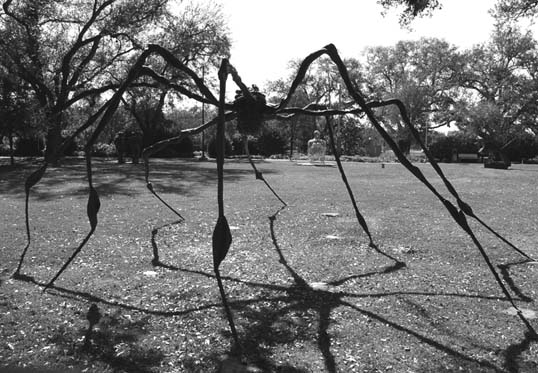
Louise Bourgeois, Spider, New Orleans
Trying to get through the isolation by reading more. Another short story today – a very good, if more than a little harrowing.
This story is touted as a famous example of dystopian fiction. It’s a peculiar type of dystopia… a personal hell… maybe a penance, maybe deserved. Still, even under those circumstances the important thing is that some humanity and some sympathy for your fellow man remains. Still remains. Even if it doesn’t do anyone any good.
Excellent read. One plus – it’s definitely not safe for work.
Mamzelle Aurlie certainly did not pretend or aspire to such subtle and far-reaching knowledge on the subject as Aunt Ruby possessed, who had “raised five an’ buried six” in her day. She was glad enough to learn a few little mother-tricks to serve the moment’s need.
—– Kate Chopin, Regret
Kids love the reflecting pool. The water is less than a quarter inch deep.
I, like a lot of people, read Kate Chopin’s The Awakening in college. I liked it – and it left a lasting impression – though I obviously wasn’t paying much attention because I thought it took place in Europe – France to be exact. It wasn’t until decades and decades later I realized it was set in New Orleans and Belle Isle – places I have become very familiar with. I guess I wasn’t that far off – it’s sort of France.
At an rate, here’s today’s story – a tale of a very different place and an even more different time than we live in now. But the people are the same, after all.
Tom’s barrel chest jerked up, then down at regular intervals, following the dictates of the hospital ventilator. Attached to the machine, he seemed all torso, his lower half an afterthought, like the straw-haired Resusci Annies that he’d haul around the high school gym during CPR units. That was long ago, when he was the coach and Helen was the music teacher and they were, improbably perhaps, in love.
—-Elisabeth Dahl, Lobsters
Crystal Beach, Texas
Today’s short story has a setting that, unfortunately, a good number of us are probably going to be experiencing soon… sitting in a hospital room with a loved one (or, technically, an ex-loved one) on a respirator.
In the opening paragraph of the story, quoted above, is a reference to Resusci Annies. From the context, I assumed this was a CPR mannequin, but I wasn’t sure. I looked it up and sure enough, that’s what it meant. But, as often happens with this internet thing and all its rabbit holes – I found a story as interesting, if not more, that the short story itself. The face of a mysterious French girl who drowned in the Seine in the 19th century ended up saving millions of lives.
One small part of the story:
The lyric “Annie, are you OK?” from the Michael Jackson song “Smooth Criminal” actually stems from American CPR training, in which students practice speaking to their unresponsive plastic patient, CPR Annie.
And then Gretel, who had survived such horrors with him, taken in an instant by something so absurdly commonplace as a chill, skin ashen, her body racked with coughing, until she lay silent and still and he by her bedside alone, feeling like a helpless boy again.
—-Dafydd McKimm, Gingerbread
Today’s piece of short fiction explores the question, “What happens when the fairy tale ends?” Well, everyone doesn’t live happily ever after – at least in this case.
But there is still hope, there is still a future – as long as we are brave, and tough, and open to a new solution and a new future. It may not be happily ever after but it can be the best we can do.
You’re in love; it’s great, you swipe on your phone and order: the next day a Taylor Swift clone shows up at your house. It’s not awkward, it’s everything you want.
—- Hugh Behm-Steinberg, Taylor Swift
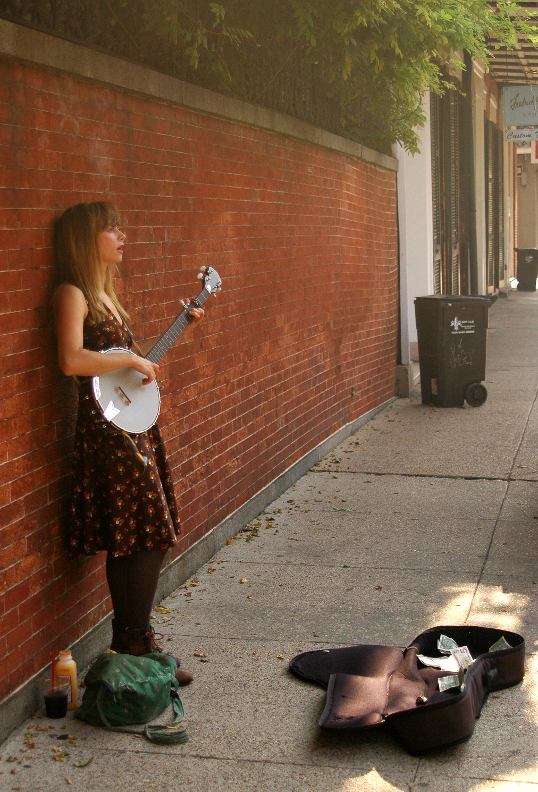
Banjo Player on Royal Street, French Quarter, New Orleans
Are you social distancing? Are you quarantined? What would be better than going online and ordering your own Taylor Swift?
A crackerjack piece of flash fiction. Click on the link and read it… it’s short and I know you have the time. That’s all we have right now is time. Ordinarily, I am not a big fan of writing in the second person… but in this case, it works. What do you think?
Roy and his mother managed to drag Spanky over the side and onto the floor, where he lay puking and gagging. Roy saw the remains of the reefer floating in the tub. Spanky was short and stout. Lying there on the bathroom floor, to Roy he resembled a big red hog, the kind of animal Louie Pinna had shoved into an industrial sausage maker. Roy began to laugh. He tried to stop but he could not.
—-Barry Gifford, Bad Things Wrong
Someone is having a bad day.
Somewhere, somehow last night while I was surfing around the internet I came across some photos from the David Lynch movie Wild at Heart. I read and discovered that the basic plot of the film was from a noorish novel by Barry Gifford – a writer I had never heard of.
He seems like the kind of writer you would like if you liked that kind of writer.
I’ll have to look for his books. His latest work is The Cuban Club. From the Publisher:
A masterpiece of mood and setting, character and remembrance, The Cuban Club is Barry Gifford’s ultimate coming-of-age story told as sixty-seven linked tales, a creation myth of the Fall as seen through the eyes of an innocent child on the cusp of becoming an innocent man.
Set in Chicago in the 1950s and early 1960s against the backdrop of small-time hoodlums in the Chicago mob and the girls and women attached to them, there is the nearness of heinous crimes, and the price to be paid for them. To Roy and his friends, these twists and tragedies drift by like curious flotsam. The tales themselves are koan-like, often ending in questions, with rarely a conclusion. The story that closes the book is in the form of a letter from Roy to his father four years after his father’s death, but written as if he were still alive. Indeed, throughout The Cuban Club Roy is still in some doubt whether divorce or even death really exists in a world where everything seems so alive and connected.
Sixty-seven linked tales – that sounds interesting. Today’s short story, from Barry Gifford’s website, seems to be one of the short tales – if not from the book, at least related to it.
While she was stacking dishes, she turned abruptly, dried her hands, and took the package from the bottom cabinet. Opening it, she set the button unit on the table. She stared at it for a long time before taking the key from its envelope and removing the glass dome. She stared at the button. How ridiculous, she thought. All this furor over a meaningless button.
Reaching out, she pressed it down. For us, she thought angrily.
—-Richard Matheson, Button, Button
The button on the Maestro’s shirt – detail from “The Storm” a mural on Ace Parking Garage at 717 Leonard Street, Dallas, Texas
Sunday, I came out into the living room to eat some eggs that I had scrambled with a few beans and some sausage. The television was on and a series of old Twilight Zone episodes were playing from the Syfy channel. Right when I sat down I Sing the Body Electric – which was written by Ray Bradbury and adapted into a short story of the same name (I was familiar with it) was on.
(2 minute preview)
I love the old anthology television shows – Twilight Zone, The Outer Limits… especially Alfred Hitchcock Presents. First, it’s fun to spot famous actors – Twilight Zone was the Law and Order of its time. I Sing the Body Electric had Veronica Cartwright in it.
But what I really like are the stories. So many of these were written by famous and extremely skilled short story writers. I am amazed at the work.
Sure enough, the next episode was Mute, by Richard Matheson. He was an amazingly prolific pulpy writer and you have seen his work everywhere (probably best known for I Am Legend – made into several movies) – he wrote sixteen episodes of The Twilight Zone alone.
I looked for a copy of the short story Mute online, but couldn’t find one. I did find another Richard Matheson story however:
This is a famous story – the basis for a shitty Cameron Diaz move called The Box.
It was also made into an episode of The Twilight Zone – this time the 80’s incarnation.
The ending of the television is very different than the short story – not sure which I like better… at any rate, Richard Matheson wasn’t happy the Twilight Zone Version and used a pseudonym as the author. So read the story and watch the show. Which one do you prefer?
Actually, in looking around, I found something that I really liked… probably the most realistic take on the story.








 Bill Chance