A Month of Short Stories 2014, Day 25 – The Half-Skinned Steer

A year ago, for the month of June, I wrote about an online short story each day for the month. It seemed like a good idea at the time. My blog readership fell precipitously and nobody seemed to give a damn about what I was doing – which was a surprising amount of work.

Because of this result, I’m going to do it again this year.

Today’s story, for day twenty five – The Half-Skinned Steer, by E. Annie Proulx

Read it online here:

The Half-Skinned Steer

I know Annie Proulx from The Shipping News – that wonderful novel about icy cold and family history. I knew that she wrote about the West, though. I knew that she wrote about Wyoming. Once I had a book of her stories – Close Range… I think it was, checked out but never was able to crack the cover.

So I was happy to find The Half-Skinned Steer online and an excuse to take the time to read it. It’s the lead story in the Close Range collection (which includes the better known Brokeback Mountain).

The Half-Skinned Steer is a story smeared across a long swath of time that winds around a timeless country. It is an illustration that you can take the boy off the ranch (a life so isolated and strange that the young man’s introduction to the mysteries of sex are from finding anatomically symbolic rock paintings done by ancient natives) but even after eighty years and a life riding an exercise bicycle in Massachusetts – you can’t take the ranch out of the boy.

It’s a rough, horrific story – about a rough and horrific life on a rough and beautiful land. But it’s told in language so languid and exacting that the snow, blood, and rock jump right off the page.

Pretty good stuff.

He dreamed that he was in the ranch house but all the furniture had been removed from the rooms and in the yard troops in dirty white uniforms fought. The concussive reports of huge guns were breaking the window glass and forcing the floorboards apart, so that he had to walk on the joists. Below the disintegrating floors he saw galvanized tubs filled with dark, coagulated fluid.
A Month of Short Stories 2014, Day 24 – A Very Old Man with Enormous Wings

A year ago, for the month of June, I wrote about an online short story each day for the month. It seemed like a good idea at the time. My blog readership fell precipitously and nobody seemed to give a damn about what I was doing – which was a surprising amount of work.

Because of this result, I’m going to do it again this year.

Today’s story, for day twenty four – A Very Old Man with Enormous Wings

, by Gabriel Garcia Marquez

Read it online here:

A Very Old Man with Enormous Wings

Magical Realism is a tricky and mysterious thing. When done badly it is horrific. When done well, it is a thing of wonder. And, of course, nobody does it better than Gabriel Garcia Marquez.

I remember reading A Hundred Years of Solitude for the first time. It is a massive tome – but I was so enthralled at the text I never wanted it to end.

Reading magical realism in a short story is different than reading it in a long novel. If you spend enough time in that colorful world you get used to it and wonder why every day isn’t like that. But in a short story it comes as a shock – like gazing through a peephole into another universe.

Though you never find out who the very old man is or why he has those enormous wings (surely he is an angel – but what a decrepit one) and you never understand his speech – you feel for the poor wretch. Dragged from the mud and exhibited in a chicken coop until the owners become rich from the admission (and finally outshown by a spider woman) he still exhibits patience and understanding. It isn’t until his duty is done that he….

Well, read it and find out.

The curious came from far away. A traveling carnival arrived with a flying acrobat who buzzed over the crowd several times, but no one paid any attention to him because his wings were not those of an angel but, rather, those of a sidereal bat. The most unfortunate invalids on earth came in search of health: a poor woman who since childhood has been counting her heartbeats and had run out of numbers; a Portuguese man who couldn’t sleep because the noise of the stars disturbed him; a sleepwalker who got up at night to undo the things he had done while awake; and many others with less serious ailments. In the midst of that shipwreck disorder that made the earth tremble, Pelayo and Elisenda were happy with fatigue, for in less than a week they had crammed their rooms with money and the line of pilgrims waiting their turn to enter still reached beyond the horizon.

A Month of Short Stories 2014, Day 23 – God of the Razor

A year ago, for the month of June, I wrote about an online short story each day for the month. It seemed like a good idea at the time. My blog readership fell precipitously and nobody seemed to give a damn about what I was doing – which was a surprising amount of work.

Because of this result, I’m going to do it again this year.

Today’s story, for day twenty-three – God of the Razor, by Joe R. Lansdale.

Read it online here:

God of the Razor

I’m feeling bad, down, not in a good mood – so I give you what’s on my mind… unadulterated horror.

At least it’s well-written unadulterated horror.

Looking back, last year I had a story by Joe R. Lansdale… I do seem to be repeating a lot of authors. So be it.

Today’s story was the first thing that I ever read by Joe R. Lansdale – and it’s amazing I read anything else. I stumbled across it one day and read it – I’ve revisited it to see if it was a horrific as I remembered it.

It was. It is. Read it and see.

Joe R. Lansdale’s work spans a number of genres, but he always gives you the feeling that there is something horrible moving underneath… and sometime not so underneath.

At any rate, today’s story is not for the faint of heart. It’s a style of ultra-violence, of ultra-horror… where every sentence is crafted to hit all the things that you are afraid of – especially the scary shit that you don’t even dare to think about in your pitiful daily life.

On the other hand, it’s only words on the page. There’s nothing really there other than the usual twenty-six letters arranged in a certain order. Arranged in an order to bring forth basements of stagnant dark water full of rats feasting on decapitated heads, murderous slash-killers moving in moonlight possessed with the spirit of Jack the Ripper, and a man exploring an old house in search of antiques… that sort of thing.

This might not be the kind of thing you like – and that’s fine. I’m not sure it’s something that I like. But it is there and it’s something to see, and… well, be careful about reading it before you go to bed.

Sweet Dreams.

“I got this from Donny,” the young man said. “He got it in an old shop somewhere. Gladewater, I think. It comes from a barber kit, and the kit originally came from England. Says so in the case. You should see the handle on this baby. Ivory. With a lot of little designs and symbols carved into it. Donny looked the symbols up. They’re geometric patterns used for calling up a demon. Know what else? Jack the Ripper was no surgeon. He was a barber. I know, because Donny got the razor and started having these visions where Jack the Ripper and the God of the Razor came to talk to him. They explained what the razor was for. Donny said the reason they could talk to him was because he tried to shave with the razor and cut himself. The blood on the blade, and those symbols on the handle, they opened the gate. Opened it so the God of the Razor could come and live inside Donny’s head. The Ripper told him that the metal in the blade goes all the way back to a sacrificial altar the Druids used.”

A Month of Short Stories 2014, Day 22 – The Nightingale and the Rose

A year ago, for the month of June, I wrote about an online short story each day for the month. It seemed like a good idea at the time. My blog readership fell precipitously and nobody seemed to give a damn about what I was doing – which was a surprising amount of work.

Because of this result, I’m going to do it again this year.

Today’s story, for day Twenty Two – The Nightingale and the Rose, by Oscar Wilde

Read it online here:

The Nightingale and the Rose

There is no wittier writer in the history of the world than Oscar Wilde. I remember reading The Portrait of Dorian Gray as a kid and staring in wonder across the pages at the pithy quotes and aphorisms sprinkled throughout the text. These nuggets of wisdom and bile were a second story concealed within the main book – I had a feeling that Wilde was pouring his real beliefs and feelings into these witticisms as much as into the events of the main text.

The novel feels like it was written by compiling a long, long list of witty barbs – and only then constructing a story as a framework or trellis to display them on.

  • there is only one thing in the world worse than being talked about, and that is not being talked about
  • But beauty, real beauty, ends where an intellectual expression begins.
  • You seem to forget that I am married, and the one charm of marriage is that it makes a life of deception absolutely necessary for both parties.
  • Being natural is simply a pose, and the most irritating pose I know.
  • As for believing things, I can believe anything, provided that it is quite incredible.
  • Every portrait that is painted with feeling is a portrait of the artist, not of the sitter.
  • I can’t help detesting my relations. I suppose it comes from the fact that none of us can stand other people having the same faults as ourselves.
  • genius lasts longer than beauty.
  • The only way to get rid of a temptation is to yield to it.
  • The bravest man amongst us is afraid of himself.
  • It has been said that the great events of the world take place in the brain. It is in the brain, and the brain only, that the great sins of the world take place also.
  • I always like to know everything about my new friends, and nothing about my old ones.
  • Nowadays most people die of a sort of creeping common sense, and discover when it is too late that the only things one never regrets are one’s mistakes.
  • He was always late on principle, his principle being that punctuality is the thief of time.
  • I never talk during music–at least, during good music. If one hears bad music, it is one’s duty to drown it in conversation.
  • Nowadays people know the price of everything and the value of nothing.
  • Men marry because they are tired; women, because they are curious: both are disappointed.
  • She was free in her prison of passion.
  • Children begin by loving their parents; as they grow older they judge them; sometimes they forgive them.
  • To be in love is to surpass one’s self.
  • Women … inspire us with the desire to do masterpieces, and always prevent us from carrying them out.
  • There are only two kinds of people who are really fascinating — people who know absolutely everything, and people who know absolutely nothing.
  • There is always something ridiculous about the emotions of people whom one has ceased to love.
  • We live in an age when unnecessary things are our only necessities.
  • One can always be kind to people about whom one cares nothing.
  • It often seems to me that art conceals the artist far more completely than it ever reveals him.
  • Is insincerity such a terrible thing? I think not. It is merely a method by which we can multiply our personalities.
  • Each of us has heaven and hell in him.
  • I love scandals about other people, but scandals about myself don’t interest me. They have not got the charm of novelty.
  • Sin is a thing that writes itself across a man’s face. It cannot be concealed. People talk sometimes of secret vices. There are no such things. If a wretched man has a vice, it shows itself in the lines of his mouth, the droop of his eyelids, the moulding of his hands even.
  • Each of us has heaven and hell in him.
  • Nobody ever commits a crime without doing something stupid.
  • The husbands of very beautiful women belong to the criminal classes.
  • It is perfectly monstrous the way people go about nowadays saying things against one behind one’s back that are absolutely and entirely true.
  • Women love us for our defects. If we have enough of them, they will forgive us everything, even our intellects.
  • A man can be happy with any woman, as long as he does not love her.
  • I like men who have a future and woman who have a past.
  • Moderation is a fatal thing. Enough is as bad as a meal. More than enough is as good as a feast.
  • I admit that I think that it is better to be beautiful than to be good. But on the other hand, no one is more ready than I am to acknowledge that it is better to be good than to be ugly.
  • Scepticism is the beginning of faith.
  • The only horrible thing in the world is ennui,
  • To get back my youth I would do anything in the world, except take exercise, get up early, or be respectable.
  • The tragedy of old age is not that one is old, but that one is young.

Over the years I have become a big fan of quotations. Oscar Wilde is the never ending fount of the pithy quote. For that, if nothing else, I am grateful.

Today’s story is very short and simple tale – not enough room for any extraneous worlds of wisdom. Alas.

But it starts out as a romantic fairy tale and appears to be so until you reach the final, dying words. Never fear, though – Wilde’s bitter cynicism will not be denied.

“No red rose in all my garden!” he cried, and his beautiful eyes filled with tears. “Ah, on what little things does happiness depend! I have read all that the wise men have written, and all the secrets of philosophy are mine, yet for want of a red rose is my life made wretched.”

A Month of Short Stories 2014, Day 21 – The Skull

A year ago, for the month of June, I wrote about an online short story each day for the month. It seemed like a good idea at the time. My blog readership fell precipitously and nobody seemed to give a damn about what I was doing – which was a surprising amount of work.

Because of this result, I’m going to do it again this year.

Today’s story, for day twenty-one – The Skull, by Philip K. Dick.

Read it online here:

The Skull

Sometimes you are not in the mood for simile and metaphor – not feeling like subtle characterizations or complicated thematic structures – ready to eschew deep symbolism or confusing transcendence…. At times like that you want to read a yarn.

And that’s what I give you today… a yarn. Philip K. Dick has plenty of wild off-kilter stories to tell of alternate universes, alternate histories, or alternate lifestyle – but his plots are rock-solid. That’s why his work, though it never lifted him out of poverty while he was alive – have been made into so many well-known films (Total Recall, Blade Runner, A Scanner Darkly, Screamers, Minority Report, Imposter, Paycheck,The Adjustment Bureau… and more).

Here he tells a simple story, embellished with a little time-travel mystery and political comment concerning war-mongering and the McCarthy-era red scare thrown in. It’s one of his earliest works (1952) and one of the handful in the public domain.

He spins his yarn around an unlikely hero moving through time in a crystalline machine and lugging the eponymous body part in a plastic bag.

It’s more than a bit of fun.

The day was warm and bright. Conger’s shoes crunched the melting crust of snow. On he went, through the trees heavy with white. He climbed a hill and strode down the other side, sliding as he went.

He stopped to look around. Everything was silent. There was no one in sight. He brought a thin rod from his waist and turned the handle of it. For a moment nothing happened. Then there was a shimmering in the air.

The crystal cage appeared and settled slowly down. Conger sighed. It was good to see it again. After all, it was his only way back.

He walked up on the ridge. He looked around with some satisfaction, his hands on his hips. Hudson’s field was spread out, all the way to the beginning of town. It was bare and flat, covered with a thin layer of snow.

Here, the Founder would come. Here, he would speak to them. And here the authorities would take him.

Only he would be dead before they came. He would be dead before he even spoke.

A Month of Short Stories 2014, Day 20 – Where Are You Going, Where Have You Been?

A year ago, for the month of June, I wrote about an online short story each day for the month. It seemed like a good idea at the time. My blog readership fell precipitously and nobody seemed to give a damn about what I was doing – which was a surprising amount of work.

Because of this result, I’m going to do it again this year.

Today’s story, for day twenty – Where Are You Going, Where Have You Been?, by Joyce Carol Oates

Read it online here:

Where Are You Going, Where Have You Been?

or, if you prefer, a PDF version here:
Where Are You Going, Where Have You Been?

Well, after yesterday’s bloody and frightening short story, A Good Man is Hard to Find, I present you another one… even more horrific.

For some reason, I always associate these two stories with each other – there was a time I even conflated the authors a bit. Flannery O’Connor and Joyce Carol Oates are very different people with very different backgrounds – but both are masters of the grotesque and bizarre realities concealed in this strange world we find ourselves wandering lost in.

I’m not sure which story I like better. Probably today’s – because of its supernatural and symbolic undertones.

The author said it was inspired by the case of the “The Pied Piper of Tucson,” – serial killer Charles Howard ‘Smitty’ Schmid, Jr. But the evil Arnold Friend with his gold convertible and shoes stuffed with newspaper is stranger and more ghastly than any mere human killing machine. He is a pied piper – a strange and mutated siren that draws the young, doomed Connie through the only protection she has – a flimsy screen door.

A while back I wrote about another Joyce Carol Oates story, Life After High School… and it was today’s, I suppose, that convinced me the purpose of that story’s protagonist’s murderous intent. He wasn’t as experienced, skilled, or evil as Albert Friend and he failed – his victim escaped into a life after high school.

Poor doomed beautiful Connie. It’s a shame what happened to her… whatever it was.

Does make for a good story, though.

Sometimes they did go shopping or to a movie, but sometimes they went across the highway, ducking fast across the busy road, to a drive-in restaurant where older kids hung out. The restaurant was shaped like a big bottle, though squatter than a real bottle, and on its cap was a revolving figure of a grinning boy holding a hamburger aloft. One night in midsummer they ran across, breathless with daring, and right away someone leaned out a car window and invited them over, but it was just a boy from high school they didn’t like. It made them feel good to be able to ignore him. They went up through the maze of parked and cruising cars to the bright-lit, fly-infested restaurant, their faces pleased and expectant as if they were entering a sacred building that loomed up out of the night to give them what haven and blessing they yearned for. They sat at the counter and crossed their legs at the ankles, their thin shoulders rigid with excitement, and listened to the music that made everything so good: the music was always in the background, like music at a church service; it was something to depend upon.

A Month of Short Stories 2014, Day 19 – A Good Man is Hard to Find

A year ago, for the month of June, I wrote about an online short story each day for the month. It seemed like a good idea at the time. My blog readership fell precipitously and nobody seemed to give a damn about what I was doing – which was a surprising amount of work.

Because of this result, I’m going to do it again this year.

Today’s story, for day nineteen – A Good Man is Hard to Find, by Flannery O’Connor

Read it online here:

A Good Man is Hard to Find

When I was a little kid and we had to go on a long driving trip I would calculate the odds of us not arriving at our destination alive. That’s not normal for a little kid – but somehow the actual act of doing the calculations were a comfort to me. I knew the terrible stuff was there and my thinking, research, and ciphering gave me solid evidence that there was at least a possibility of getting through alive and uninjured.

In A Good Man is Hard to Find Bailey and his family, especially his monster of a mother, don’t do a very good job of calculating the odds – and pay for it.

What a great story. What horror.

I don’t know what is worse – the thought of the murderous Misfit and his henchmen out there waiting for you, shirtless, armed, merciless. Or the thought of being cooped up in a car for hours and hours with that Grandmother.

She didn’t want to go to Florida. In the end, she didn’t have to. Be careful of what you don’t wish for.

This is a story about the two sides of evil – real, horrible evil… and the small evil of self-centred ignorance. It is a story about grace – which seems to always come too late. And it is a story about the world and the doom that it presents.

Above all, it is a story.

They stopped at The Tower for barbecued sand- wiches. The Tower was a part stucco and part wood filling station and dance hall set in a clearing outside of Timothy. A fat man named Red Sammy Butts ran it and there were signs stuck here and there on the building and for miles up and down the highway saying, TRY RED SAMMY’S FAMOUS BARBECUE. NONE LIKE FAMOUS RED SAMMY’S! RED SAM! THE FAT BOY WITH THE HAPPY LAUGH. A VETERAN! RED SAMMY’S YOUR MAN!

A Month of Short Stories 2014, Day 18 – Araby

A year ago, for the month of June, I wrote about an online short story each day for the month. It seemed like a good idea at the time. My blog readership fell precipitously and nobody seemed to give a damn about what I was doing – which was a surprising amount of work.

Because of this result, I’m going to do it again this year.

Today’s story, for day eighteen – Araby, by James Joyce.

Read it online here:

Araby

When I read Araby… re-read, actually. Of course I’ve read it before… many times. It is part of Dubliners… and reading that is necessary to life, sort of like oxygen or water. I’ve read it many times and every time I read it I discover something new.

When I read Araby I thought of Harry Potter. I thought of The Hunger Games. I though of why I don’t like to read Young Adult Fiction very much.

You see, the overarching idea of Young Adult fiction is to portray an ordinary young person, one usually somewhat downtrodden but mostly terribly ordinary, and reveal that they are something special. The world opens up, and through struggle, shows how important the young person is, how necessary, and how extraordinary things will be from now on.

It isn’t hard to understand how attractive that is. It is escape, it is fantasy, it is hope. Everyone dreams of being a special person with special talents and a special destiny. A Young Adult work of fiction puts a structure on that hope and shows the way (through plenty of challenges) into a bright shining future.

It is, of course, complete bullshit.

“You are not special. You’re not a beautiful and unique snowflake. You’re the same decaying organic matter as everything else. We’re all part of the same compost heap. We are the all singing, all dancing crap of the world.”
― Chuck Palahniuk, Fight Club

And that is where literature comes in, real literature. Like Araby. It shows the truth.

Araby tells the story of a young man in the thralls of his first love. It is something we all experienced and all remember. He does not completely understand what is happening to him.

He does not understand what will happen in the future but decides to go with it anyway. He does not understand what will happen.

But he finds out.

The young lady changed the position of one of the vases and went back to the two young men. They began to talk of the same subject. Once or twice the young lady glanced at me over her shoulder.

I lingered before her stall, though I knew my stay was useless, to make my interest in her wares seem the more real. Then I turned away slowly and walked down the middle of the bazaar. I allowed the two pennies to fall against the sixpence in my pocket. I heard a voice call from one end of the gallery that the light was out. The upper part of the hall was now completely dark.

Gazing up into the darkness I saw myself as a creature driven and derided by vanity; and my eyes burned with anguish and anger.

A Month of Short Stories 2014, Day 17 – Black Box

A year ago, for the month of June, I wrote about an online short story each day for the month. It seemed like a good idea at the time. My blog readership fell precipitously and nobody seemed to give a damn about what I was doing – which was a surprising amount of work.

Because of this result, I’m going to do it again this year.

Today’s story, for day seventeen – Black Box, by Jennifer Egan
Read it online here:

The Tweets that comprise the story Black Box collected at Paste Magazine

I’ve been a fan of Jennifer Egan ever since reading (and writing about) A Visit From the Goon Squad. I had avoided that book because I didn’t like the look of the title, but once I dove in I loved the idea of interconnected short, short stories. The stories are arranged in a web across time, space, and a diverse group of characters. Fun.

The sort of thing I would like to do.

I have never been a big fan of Twitter. I send out notices of my journal entries and I use it to locate food trucks and things to do – or web sites to visit. I don’t like the fact that so many celebrities and, especially, politicians use it almost exclusively to send out their thoughts and ideas.

140 characters is simply not enough for the complexity and subtlety of the human condition. Mass communication using Twitter is laziness.

A couple years ago these two things came together. Jennifer Egan wrote a short story and sent it out, 140 characters at a time, over Twitter. it ran over ten nights on the New Yorker‘s NYerFiction account. Now, that’s interesting.

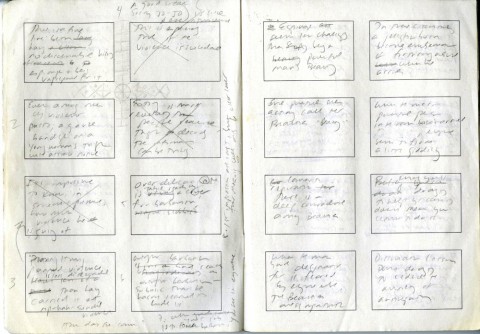
Especially when I looked into it and saw how much work she put into the project. It took her a year to write the piece – writing it out in longhand in Japanese notebooks printed with little boxes.

Jennifer Egan's handwritten version of the Twitter Short Story "Black Box."

Jennifer Egan’s handwritten version of the Twitter Short Story “Black Box.”

It’s a hypermodern spy story – chopped up with high tech gadgetry, a bevy of beauties, and a luxurious terrorist hideout.

I’m not sure if this experiment is an unqualified success. I wish I could have read it on its original ten-night airing – all those tweets in one sitting is a bit much. Still, it’s pretty cool and I’d like to consider how to break up a story into such tiny bites.

Here’s some more ordinary fiction from Jennifer Egan – if you like:

Safari

Ask Me If I Care

The opening of Jennifer Egan's Twitter Short Story "Black Box."

The opening of Jennifer Egan’s Twitter Short Story “Black Box.”

A Month of Short Stories 2014, Day 16 – Good People

A year ago, for the month of June, I wrote about an online short story each day for the month. It seemed like a good idea at the time. My blog readership fell precipitously and nobody seemed to give a damn about what I was doing – which was a surprising amount of work.

Because of this result, I’m going to do it again this year.

Today’s story, for day sixteen – Good People, by David Foster Wallace

Read it online here:

Good People

Good People is the first published excerpt from David Foster Wallace’s posthumously published incomplete novel The Pale King. Wallace hanged himself in 2008, at age 46. His father said that he had been suffering from depression for years and his medication had ceased to work. In the last few moments of his life, Wallace arranged his notes and computer files so his wife could find them.

His friend and editor Michael Pietsch took that material and molded it into its final published form. Despite being incomplete, the novel runs to over 500 pages.

I enjoyed this fragment (which, like a lot of David Foster Wallace’s novel chapters, stand fine on its own) because it contains a respect and fondness toward characters of faith – flawed as they are. The text is rough and rambling, reflecting the confusion in Lane’s mind.

The details – the uprooted tree, the man in the suit, the fishermen across the water – are carefully chosen and add layers of complexity to the simple story.

I wonder how much this piece is an homage to the Hemingway story Hills Like White Elephants? They are both stories about a couple making a choice where the word Abortion is never uttered.

A point not expressly made in the story, but one that comes to my mind is the one-way nature of time. Our past feels like a three dimensional cloud – full of inevitability, coincidences, and luck (good or bad). But the future feels like a set of steel rails where your only hope is to stay on the tracks, come hell or high water.

But neither did he ever open up and tell her straight out he did not love her. This might be his lie by omission. This might be the frozen resistance—were he to look right at her and tell her he didn’t, she would keep the appointment and go. He knew this. Something in him, though, some terrible weakness or lack of values, could not tell her. It felt like a muscle he did not have. He didn’t know why; he just could not do it, or even pray to do it. She believed he was good, serious in his values.