Short Story day 9 – A 32-Year Old Day Tripper

9. – “A 32-Year Old Day Tripper
Haruki Murakami
http://wednesdayafternoonpicnic.blogspot.com/2010/05/32-year-old-day-tripper_01.html

This is day nine of my Month of Short Stories – a story a day for June.

A very short piece – modern, non-plotted. If you want to get a feel for how important translation is, here’s an alternate translation and here’s another.

I have read quite a bit of Haruki Murakami – I think my favorite so far is his somewhat underappreciated Sputnik Sweetheart. His fiction is odd and slippery, sometimes sweet, sometimes horrific – always unpredictable.

If you are interested in his writing, don’t overlook his non-ficiton. I was impressed with Underground, a collection of interviews in the aftermath of the Aum Shinrikyo gas attack.

Today’s work by Murakami is a set of musings by a 32 year old man that has an eighteen year old semi-girlfriend (they meet one Sunday a month). Murakami began writing at age 29 – about the age of the narrator. Maybe the girl could be looked upon as representing his art – or maybe not.

His story of when he decided to write his first novel is amazing… From SPEIGELIn April 1978, I was watching a baseball game in the Jingu Stadium in Tokyo, the sun was shining, I was drinking a beer. And when Dave Hilton of the Yakult Swallows made a perfect hit, at that instant I knew I was going to write a novel. It was a warm sensation. I can still feel it in my heart. Now I am compensating for the old, open life through my new, closed life. I have never appeared on television, I have never been heard on the radio, I hardly ever give readings, I am extremely reluctant to have my photograph taken, I rarely give interviews. I’m a loner.

There is almost always a connection to music in his work – opera or western popular music. He owned a jazz club during the time he began writing. Like a lot of us (like me) he probably marks time with the music that he was listening to then – and certain songs bring back strong memories.

For example, a certain song and (especially) its video had been rattling around in my head from the 80’s. I remembered bits of it, and couldn’t shake it, but until I stumbled across the band mentioned in a Facebook group on an infamous old Dallas Nightclub (the Starck Club) I couldn’t remember what it was.

Here is the video:

Why has that stuck in my head for all these years?

Anyway… back to today’s story – I think it’s best not to try and overthink fiction like this. It’s best to let it sink in, read it a few times (on this one, read the other translations) and view it as a mood, or a crystal bit of emotion, or a wavy window into a specific time.

It’s actually the boringness of the girls that attracts them. They’re just playing a complicated game, a game they honestly enjoy. A game where they wash their faces with buckets full of the young girls’ boredom water, while they don’t let their lady friends have a single drop.
—-from “A 32-Year Old Day Tripper” by Haruki Murakami
Short Story day 8 – Thirteen Wives

8. Thirteen Wives
Steven Millhauser
http://www.newyorker.com/fiction/features/2013/05/27/130527fi_fiction_millhauser

This is day eight of my Month of Short Stories – a story a day for June.

Steven Millhauser is another contemporary, modern author that I have wanted to read. I have a couple (actual, real, paper) books of his short story collections very near the top of my to-read pile. He won the 1997 Pulitzer Prize for Fiction for his novel Martin Dressler. I was very happy to see that this story, Thirteen Wives, was available on the New Yorker website – and added it to my June reading (and blogging) list.

Over the decades, the New Yorker has been one of the best, if not the best, consistent source for quality short stories. My only complaints are that they keep going back to the same writers again and again (though these are of unquestioned skill and even genius) – plus there has developed such a thing as a “New Yorker Story” – I wish they would work a little harder on introducing more diversity in their fiction – but I’m picking nits here. Hat’s off to the The New Yorker and their support of the short story as an art form.

Unfortunately, now, for the first time, I have come across a short story this month that I didn’t like. Thirteen Wives isn’t really a story – it reads more like an essay on the various aspects and complex dimensions of a marriage. Sure, it’s dressed up in the first person and the narrator pretends that the thirteen wives are actually different women (though he does say, “Never have I considered myself to be a man with thirteen marriages but, rather, a man with a single marriage, composed of thirteen wives.”) – but the author’s intentions are clear.

And he doesn’t go far enough. It comes across as a paean to marriage… which is OK, I suppose… but he doesn’t push it enough to make it interesting. He doesn’t deal very well with the aspect of time…. A marriage that lasts several decades is something beyond this story’s parameters – he does say he married these thirteen wives over nine years. Nine years is nothing.

As I read each section, I’m afraid my reaction was, “OK, that’s well written, a witty turn of phrase… but so what? Is that all?”

But that’s just me. Looking around the ‘net – I see folks that thought the story was excellent and exactly what they were looking for. Read it yourself, tell me what you thing.

It’s the peculiar fate of my thirteenth wife to evoke innumerable pasts that aren’t hers; she is composed of my memories of other women. To see her is to experience all the women barely noticed in public parks and crowded bus terminals, the half-seen women sitting at wrought-iron tables under the awnings of outdoor restaurants or waiting in line at ice-cream stands at the edges of small towns on hot summer nights, all the women passing on suburban sidewalks through rippling spots of sun and shade, the briefly stared-at women rising past me on escalators with glossy black handrails in busy department stores, the silent women reaching up for books on the shelves of libraries or sitting alone on benches under skylights in malls, all the vanished girls in high-school hallways, the motionless women in wide-brimmed hats standing in gardens in oil paintings in forgotten museums, the black-and-white women in long skirts and high-necked blouses packing suitcases in lonely hotel rooms in old movies, all the shadowy women looking up at departure times in fading train stations or leaning back drowsily on dim trains rushing toward dissolving towns. My thirteenth wife is abundant and invisible; she exists only in the act of disappearing.
—-Thirteen Wives, by Steven Millhauser

Short Story day 7 – Sea Oak

7. – Sea Oak
George Saunders
http://www.barcelonareview.com/20/e_gs.htm

This is day seven of my Month of Short Stories – a story a day for June.

George Saunders is a writer that I’ve heard a lot of good things about, but have never been able to sit down and read yet. Mary Karr, in Time Magazine (in its 2013 list of the 100 most influential people) says, “For more than a decade, George Saunders has been the best short-story writer in English — not “one of,” not “arguably,” but the Best.”

Well, that certainly sounds like a recommendation.

In particular, I had wanted to read his collection, Pastoralia, and am not sure why I hadn’t. Therefore, I was happy to find today’s short story, Sea Oak, – one of the selections from Pastoralia – online, served up on a glowing, rectangular platter courtesy of the Barcelona Review.

So…..

I’m going to have to read more by George Saunders – I am not yet convinced – though I feel there is some greatness here.

I should like this more than I did. It’s amazingly well written, extremely imaginative, and exquisitely crude. The problem is that he has set himself up as a satirist of our modern world – and to satire reality television, rampant consumerism, spreading idiocracy, and the general breakdown of society into a foam of ridiculousness… well, welcome to my life. That stuff is sort of self-satirizing.

To make something like this worth your while, even as funny, sad, and well-written as it is – you have to care about the characters. At least one of them. Sea Oak… well, I almost cared, but every time I began to think about these as real people, the author would throw in another witty flourish, push the freakiness up one notch, turn everything up to eleven. I don’t mean that in a bad way, really… but it left me a little cold.

Maybe I was too tired when I was reading. After a day fighting futilely, desperately, and hopelessly against the very subjects of his fiction – it was wearing to have it thrown right back in my face.

So maybe I’ll rest up and read some more George Saunders… I know I will and I’ll almost certainly enjoy it more. I’ll let you know.

At Sea Oak there’s no sea and no oak, just a hundred subsidized apartments and a rear view of FedEx. Min and Jade are feeding their babies while watching How My Child Died Violently. Min’s my sister. Jade’s our cousin. How My Child Died Violently is hosted by Matt Merton, a six-foot-five blond who’s always giving the parents shoulder rubs and telling them they’ve been sainted by pain. Today’s show features a ten-year-old who killed a five-year-old for refusing to join his gang. The ten-year-old strangled the five-year-old with a jump rope, filled his mouth with baseball cards, then locked himself in the bathroom and wouldn’t come out until his parents agreed to take him to FunTimeZone, where he confessed, then dove screaming into a mesh cage full of plastic balls. The audience is shrieking threats at the parents of the killer while the parents of the victim urge restraint and forgiveness to such an extent that finally the audience starts shrieking threats at them too. Then it’s a commercial.
—-Sea Oak, George Saunders

Short Story Day 6 – Gooseberries

6. – Gooseberries
Anton Chekhov
http://www.eldritchpress.org/ac/gooseb.html

This is day six of my Month of Short Stories – a story a day for June.

After a string of modern and post-modern works, we swing back to a classic master – Anton Chekhov. He wrote a prodigious number of stories on a wide variety of subjects, but all of them were uniquely his own unmistakable style. Often known more as a playwright, his masterly short stories may be his greatest achievement.

I have always been a fan of his famous story, The Lady with the Dog -(audio version). A few days ago, I wrote about Joyce Carol Oates. She produced a story, The Lady with the Pet Dog, which was a modern adaptation of the same tale, told from the point of view of the woman (with the dog). Together, the Oates and Chekhov versions make for some good reading and an interesting comparison.

Today’s story, “Gooseberries” is one of Chekhov’s later works, and is full of his characteristic ambiguity, moral questioning, and general good cheer. It is very attentive to the minutiae of daily life and the author manipulates these details to define and enrich the message and morals that he wants to convey.

Three men spend the day talking, and one tells a long “story within a story” which, on closer inspection has a very close relationship to the outer, framing story. The inner tale fails to interest the listeners, which makes the outer story that much more subtle and effective.

In the end, nothing much happens and nothing is decided… the rain continues to fall and the odor of spent tobacco keeps a character awake late into the night. The moral ambiguities are not resolved – the brother, eating his gooseberries that he thinks are delicious while the narrator confides are bitter – acts like a pig, but is undeniably happy in the way that a person can when his dreams come true.

I think that Checkov is ultimately telling us that this in how life is – there are no guarantees and victory is simply a slight shade away from defeat – happiness is elusive, but so are good works. Selfishness is evil, but charity is an illusion. All you can hope for is to muddle through – but maybe this is a miracle in itself.

“If I were young.”

He suddenly walked up to Aliokhin and shook him first by one hand and then by the other.

“Pavel Koustantinich,” he said in a voice of entreaty, “don’t be satisfied, don’t let yourself be lulled to sleep! While you are young, strong, wealthy, do not cease to do good! Happiness does not exist, nor should it, and if there is any meaning or purpose in life, they are not in our peddling little happiness, but in something reasonable and grand. Do good!”

Ivan Ivanich said this with a piteous supplicating smile, as though he were asking a personal favour.

Then they all three sat in different corners of the drawing-room and were silent. Ivan Ivanich’s story had satisfied neither Bourkin nor Aliokhin. With the generals and ladies looking down from their gilt frames, seeming alive in the firelight, it was tedious to hear the story of a miserable official who ate gooseberries. . . . Somehow they had a longing to hear and to speak of charming people, and of women. And the mere fact of sitting in the drawing-room where everything — the lamp with its coloured shade, the chairs, and the carpet under their feet — told how the very people who now looked down at them from their frames once walked, and sat and had tea there, and the fact that pretty Pelagueya was near — was much better than any story.

—-Gooseberries, by Anton Chekhov

Short Story Day 5 – Symbols and Signs

5. – Symbols and Signs, by Vladimir Nabokov
http://www.newyorker.com/archive/1948/05/15/1948_05_15_031_TNY_CARDS_000214135

This is day five of my Month of Short Stories – a story a day for June.

Today we have another little jewel – this one published by the New Yorker in 1948, Signs and Symbols, by Vladimir Nabokov.

It reads so up-to-date, it’s hard to believe the story is sixty-five years old, published almost a decade before Lolita.

I don’t know if anyone else gives a damn, but I have been enjoying reading, researching, thinking about in depth, and writing a bit about each work… even if I am essentially doing a homework assignment each day for fun.

This story is an interesting one – much more complex and deep than it appears at first. It’s well known and a lot has been written about it:

It fascinates me how a great work of literature can spawn so many analytical studies – each one several times longer than the story itself.

I’ve been thinking a lot about a concept spelled out in the last article in the list – that of the difference between Story and Plot. The Story is what actually happens in the work of literature, in real time chronological and casual order. The Plot consists of these same events presented in the order and manner that they are in the narrative. The way the reader learns of these events is irrelevant to the Story – but the wide variety of Plots that can be applied is essential to the artistry and emotional impact of the work.

What Nabokov does with the plot – with the way he presents the story – is what makes Symbols and Signs resonate with a power and complexity hidden in its short length. He is telling multiple stories with the same plot – at least two and maybe three.

One trick he plays is to withhold from the reader certain key information that is needed to make the story complete. There are many questions:

  • Exactly how did the son attempt suicide?
  • Why is there a wagon wheel hanging in a tree in the painting he is afraid of?
  • There are subtle changes in the story (the title for example) between the New Yorker version and the subsequent versions – what is the meaning behind this?
  • What is the meaning of the specific cards mentioned in the deck that falls to the floor?
  • What are the rest of the ten flavors of jelly?

…. and so on. But the biggest mystery and the most perplexing for the reader is – Who makes the third phone call at the end of the story? Is the girl making another wrong number? Is it the hospital calling to report their son’s death? Has the son escaped and is begging to come home?

There are clues throughout the text to help answer these questions – though they are hidden and impossible to be sure about. Remember, that in addition to being a famous writer (and expert on butterflies) Nabokov took great joy and interest in the composition of Chess Problems. He says, “The strain on the mind is formidable; the element of time drops out of one’s consciousness”. Nabokov believed that the “originality, invention, conciseness, harmony, complexity, and splendid insincerity” of creating a chess problem was related to his writing. We should not be surprised to find riddles within riddles hidden in the story.

But even without the mysteries and puzzles and mental gymnastics the short story is a compelling one. It is so sad – you feel so much for the old couple – poor, waiting to die, buying a birthday present for their mentally disturbed son. There is an air of helplessness, leavened slightly by Nabokov’s keen sense of dark humor.

Here was Aunt Rosa, a fussy, angular, wild-eyed old lady, who had lived in a tremulous world of bad news, bankruptcies, train accidents, and cancerous growths until the Germans put her to death, together with all the people she had worried about.

I think about the boy’s rare and terrible mental problem. He is crippled by the thought that the entire natural world is a series of coded messages and communications about him. He must examine everything carefully and completely, all the time, under the horror that the whole world is purposed simply to defeat him.

But what of the opposite? The son is paralyzed with the belief that he is the center and purpose of the universe – but isn’t it more of a horror to believe that the universe is completely uncaring and even unaware of your existence?

That’s the terrible truth of the parent’s life. And there is nothing they can do about it.

All this, and much more, she had accepted, for, after all, living does mean accepting the loss of one joy after another, not even joys in her case, mere possibilities of improvement. She thought of the recurrent waves of pain that for some reason or other she and her husband had had to endure; of the invisible giants hurting her boy in some unimaginable fashion; of the incalculable amount of tenderness contained in the world; of the fate of this tenderness, which is either crushed or wasted, or transformed into madness; of neglected children humming to themselves in unswept corners; of beautiful weeds that cannot hide from the farmer and helplessly have to watch the shadow of his simian stoop leave mangled flowers in its wake, as the monstrous darkness approaches.
—-Signs and Symbols, Vladimir Nabokov

Short Story Day 4 – The School

4. – The School
Donald Barthelme
http://www.npr.org/programs/death/readings/stories/bart.html

I came upon the writings of Donald Barthelme in an odd, backward way. I stumbled across an article in the New Yorker (Good Losers, March 8, 1999) written by two of his brothers, Stephen and Frederick. It was an eloquent piece about an extremely successful family, the father a famous and influential architect and three sons that were noteworthy writers. The article was about two of them, Frederick and Stephen, who had become terribly addicted to gambling. It was fascinating and horrifying to read how these enormously talented and intelligent men were destroying their lives by driving down to the cheap casinos along the Mississippi coast and blowing all their livelihood on blackjack binges.

During the course of the article the brothers wrote about their older brother, Donald, and his revolutionary genius as an author. That interested me enough to do some research and to start to read his stuff.

Most of what Donald Barthelme writes are very short stories, flash fiction. They are unique and unusual bits of text – not what you are expecting or used to reading. They give up on a regular plot arc and make the reader figure out the meaning from a series of seemingly unrelated, often ridiculous statements, occurrences, or facts.

It’s a bit of an acquired taste. At first it was attractive to me because of its short nature – I figured I could read these little morsels of tales in some spare seconds here or there. But their simplicity turned out to be an illusion. The stories were more complex and deeper than they appeared on the surface. It took longer than I expected and were more work than I was prepared for – the tiny things had to be re-read and thought about.

Eventually, I came around. I haven’t read everything Donald Barthelme (or his brothers) have written – but it’s in the repertoire. I’ll get to it eventually.

Today’s selection, The School, is a good representative. We all have had the experience of being in a class of children keeping animals or plants in the classroom for educational purposes. Most have had the experience of having something die under these conditions – the shared sadness, responsibility, and disappointment. This very short work takes that experience and amplifies it to the point of ridiculous terror and then takes a very unexpected turn.

Read it, see if you like it.

At any rate, it’s the rare piece of serious fiction that reminds me of a Monty Python sketch (a reminder only – the tone and theme are very different) in the way this one does.

Of course we expected the tropical fish to die, that was no surprise. Those numbers, you look at them crooked and they’re belly-up on the surface. But the lesson plan called for a tropical fish input at that point, there was nothing we could do, it happens every year, you just have to hurry past it.
—-The School, from Sixty Stories, by Donald Barthelme

Short Story Day 3 – A Study in Emerald

3. – A Study in Emerald
Neil Gaiman

Click to access emerald.pdf

Now we find ourselves with a short story set in a nonexistent past, but not of the past (real or imagined) – the story is almost a decade old (it won the Hugo Award for Best Short Story in 2004) but it is a piece of the modern, internet world. You can call it a form of fan-fiction. As a matter of fact, it is a Crossover – the characters and style from Sherlock Holmes have been transplanted into the world of H.P. Lovecraft’s Cthulhu Mythos.

Not only that… it is a world of alternate history. In it, 700 years prior, Lovecraft’s Great Old Ones have… well, if you want to know what they have done, you have to read the thing.

Finally, it is in a unique and modern form. It’s published on the ‘net as a PDF – in the format of a Victorian Newspaper, complete with odd and disturbing advertisements. Take a close look at the ads, BTW, they are full of interesting references.

Clever and cleverer. The short piece manages to cram a lot of (alternate) history and backstory in and around its detective yarn.

Be careful about that yarn… you are forewarned. Nobody is who you think they are. Black is white and white is black. See if you can figure it out. If you can’t, the Wikipedia Page will illuminate it all for you.

So it is all clever and as skillfully put together as a Swiss Watch… but it is worth reading? Of course it is. It is a lot of fun. It is a puzzle inside a puzzle, wrapped in a puzzle. It is a pastiche. It is a homage. It is the sort of think you will like, especially if you like that sort of thing.

I shall not forget the mirrored surface of the underground lake, nor the thing that emerged from the lake, its eyes opening and closing, and the singing whispers that accompanied it as it rose, wreathing their way about it like the buzzing of flies bigger than worlds.

That I survived was a miracle, but survive I did, and I returned to England with my nerves in shreds and tatters. The place that leech-like mouth had touched me was tattooed forever, frog-white, into the skin of my now-withered shoulder. I had once been a crack-shot. Now I had nothing, save a fear of the world-beneath-the-world akin to panic which meant I would gladly pay sixpence of my army pension for a Hansom cab, rather than a penny to travel underground.
—-from A Study in Emerald, by Neil Gaiman

June Short Story Month – A Story a Day

I read, more or less, a short story every day. Not every day, but most. Somedays, if I’m not working hard on a novel or other book, and the selections are shortish, I’ll read two or three. I have been doing that all my life. Let’s see… maybe three hundred short stories a year for maybe forty years – that’s in the neighborhood of twelve thousand short stories.

Seems like a lot.

So, it looks like May has been declared short story month. I’m not sure where I read that – or what person or organization actually declared the month. Probably some random blogger. I don’t think the Official International Board for Naming Months Shit had anything to do with it.

Anyway. I missed it. But it did get me thinking. After the gears stopped creaking and the smoke cleared I decided to make June my non-official short story month. I will read a story a day, take notes, and eventually write a blog entry on it.

I will definitely stick to my schedule on reading them – though I might wait before putting it online if there is something else I want to write about that day, so be patient.

The next step is to make a list. I went out to look for:

  1. Thirty One stories by different authors. Yes, I know that June only has thirty days… but thirty one seems like a better number. So it will drag over into July. So sue me.
  2. Stories that I don’t remember reading. This isn’t a firm rule, there are a couple that I read a while back that I want to revisit… but generally new stuff. This wipes out a long list of some of my favorite authors – Ballard, Poe, Denis Johnson, Flannery O’Connor, Lovecraft, Pynchon, Russell Banks… that would otherwise have featured positions because I have read, as far as I can tell, everything they wrote. Or at least all the short stories. On the other hand, there are a few authors on here that I have never read. I’m a bit ashamed of that and see this as a good opportunity for an introduction. Which ones? I’m not telling.
  3. I’m going for breadth, not quality. This is not a list of the best short stories, but an attempt at a wide sampling, hopefully to find something unknown, a new rabbit hole to fall down. I tried to select shorter works whenever possible – time is in great demand.
  4. Finally, I wanted them all to be available free, online, in some sort of readable format. So that all of you can read along if you wish. This was the most difficult and restrictive of the requirements. I’ll include a link with each entry.

This list may change – especially if a link goes dead. Any suggestions will be gladly accepted – if this works, I may do it again.

I thought it would be difficult to fill out the list, but it was very easy. I had to trim it down. I could have gone to a hundred without much trouble.

When I write a review I am careful to only give a tiny hint of a plot – I detest spoilers. Hopefully, I can come up with something interesting to say about each story. Again, I hope that this may look interesting enough that somebody else will read at least a few of these and throw their opinions up.
I’ll start tomorrow… and here’s the current list so far:

1. – The Fall of Edward Barnard
W. Somerset Maugham
http://www.online-literature.com/maugham/the-trembling/3/

2. – Heat
Joyce Carol Oates
http://www.classicshorts.com/stories/heat.html

3. – A Study in Emerald
Neil Gaiman

Click to access emerald.pdf

4. – The School
Donald Barthelme
http://www.npr.org/programs/death/readings/stories/bart.html

5. – Symbols and Signs
Vladimir Nabokov
http://www.newyorker.com/archive/1948/05/15/1948_05_15_031_TNY_CARDS_000214135

6. – Gooseberries
Anton Chekhov
http://www.eldritchpress.org/ac/gooseb.html

7. – Sea Oak
George Saunders
http://www.barcelonareview.com/20/e_gs.htm

8. Thirteen Wives
Steve Millhauser
http://www.newyorker.com/fiction/features/2013/05/27/130527fi_fiction_millhauser

9. – “A 32-Year Old Day Tripper”
Haruki Murakami
http://wednesdayafternoonpicnic.blogspot.com/2010/05/32-year-old-day-tripper_01.html

10 – The Crawling Sky
Joe R Lansdale
http://subterraneanpress.com/magazine/spring_2011/fiction_the_crawling_sky_by_joe_r._lansdale/

Other works
(new story changes each week)
http://www.joerlansdale.com/stories.shtml

11. The Piece of String
Guy de Maupassant
http://www.classicshorts.com/stories/string.html

12. Paladin of the Lost Hour
Harlan Ellison
http://harlanellison.com/iwrite/paladin.htm

13. A Father’s Story
Andre Dubus

Click to access FathersStory.pdf

14. Beyond the Door
Philip K Dick
http://www.gutenberg.org/ebooks/28644

15. Wiggle Room
David Foster Wallace
http://www.newyorker.com/fiction/features/2009/03/09/090309fi_fiction_wallace

16. – The Ones Who Walk Away From Omelas
Ursula K LeGuin
http://harelbarzilai.org/words/omelas.txt

Click to access rprnts.omelas.pdf

17. The Dark Arts
Ben Marcus
http://www.newyorker.com/fiction/features/2013/05/20/130520fi_fiction_marcus

18. The Landlady
Roald Dahl
http://www.nexuslearning.net/books/holt-eol2/collection%203/landlady.htm
Man From the South
http://www.americanliterature.com/author/roald-dahl/short-story/man-from-the-south

19. Eyes of a Blue Dog
Gabriel Garcia Marquez
http://www.classicshorts.com/stories/bluedog.html

20. A Telephone Call
Dorothy Parker
http://www.classicshorts.com/stories/teleycal.html

21. Mexican Manifesto
Roberto Bolaño
http://www.newyorker.com/fiction/features/2013/04/22/130422fi_fiction_bolano

22. The Sandman
E.T.A. Hoffmann
http://www.fln.vcu.edu/hoffmann/sand_e.html

23. Hunters in the Snow
Tobias Wolff
http://www.classicshorts.com/stories/huntsnow.html

24 Red Nails (Conan the Barbarian)
Robert E Howard
http://www.gutenberg.org/ebooks/32759

25. The Use of Force
William Carlos Williams
http://www.classicshorts.com/stories/force.html

26. The Secret Room
Alain Robbe-Grillet
http://www.101bananas.com/library2/secretroom.html

27. From Hell’s Heart I Stab at Thee
Armando Vitalis
http://ubuntuone.com/6iBiMK1EvBCzdb8qqCgLdE

28. Pretty Boy
Richard Ford
http://www.guardian.co.uk/books/2005/jun/25/originalwriting.fiction5

29. The Garden Party
Katherine Mansfield
http://www.classicshorts.com/stories/TheGardenParty.html

30. Passion
Alice Munro
http://www.newyorker.com/archive/2004/03/22/040322fi_fiction

31. Carnation, Lily, Lily, Rose
Kelly Link
http://www.fenceportal.org/?page_id=2327

Bullsnake

I wanted to get in a (relative… for me) long bike ride today. I took my commuter bike and loaded it up with my Kindle, my camera, notebooks and pens, plus some extra water. My idea was to ride a bit, rest and read and then ride some more. I put together a route that wound through Garland, back across town to the Pearl Cup coffeehouse, then back home.

Nick is home and he rode with me east into Garland, then as we cut our way back he turned off and took the Owens Trail home. I was feeling a little off and decided I was getting overheated. It’s the first day over 90 – which soon won’t be very hot, but I haven’t acclimated to it yet – plus it’s very humid. So I hung out in a shade structure next to the athletic fields – drank some water and read a short story. Within a few minutes I felt a lot better.

I enjoyed talking sports with some guys that showed up with a truck full of coolers and grills that were setting up for an all-African soccer tournament later in the day. I took off, dropped down into the Spring Creek Natural Area and then under the highway to the Canyon Creek neighborhood.

The Pearl Cup has finally put a sign up and built a bike rack in front. Their mocha coffee had some nice latte art and plenty of caffeine and sugar. It was cool inside and I settled in with my Kindle to rest a bit.

A couple nights ago I finished a novel that I had found recommended in an article about the best books of this centuryThe True History of the Kelly Gang, by Peter Carey. It was a very well written, interesting book… and I’m glad I read it, but it didn’t speak to me in any personal way. Now that it is finished, I’m working on a huge collection of Joyce Carol Oates stories I carry on my Kindle – eleven new ones and more than two dozen classic stories from a forty year period. It’s called High Lonesome: New and Selected Stories 1966-2006.

Her writing resonates with me. As I read her harrowing, dark short fiction, my mind fills with ideas that I will have to write out. I fill pages in my Moleskine with short story ideas. Her writing shares with me the desire to explore the too-thin membrane between our illusion-filled world and the horrific void beyond.

So I drank my coffee drink and a dozen glasses of iced water, read some stories, and wrote some pages. Then I took off, riding back to the thick creekbottom woods of the Spring Creek Natural Area, did a lap of the loop trail, and plopped down on a favorite bench to crank through another story.

It happened to be a well-known story that I was familiar with – had read a couple times before. It was “Where Are You Going, Where Have You Been” (read it here for yourself). I hesitate to call it one of my favorite short stories… though I have to call it that – because there is no other word that fits. It is simply too disturbing to embrace fully. But it is a work of genius.

Though nothing explicitly bad happens in the tale – there is no doubt that the world has ended for poor Connie. So much in the story is ambiguous and subtly horrific. I was reading slowly, carefully, and paying complete attention to the words splashed across the Eink display. In the corner of my eye I saw a jogger going by… then he stopped and I heard a loud “Oh!”

I looked up.
“Don’t you see it?”
“What?”
“There, right there.”
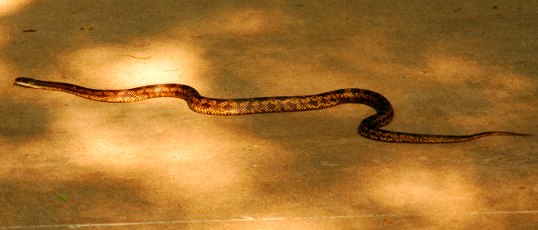
I looked carefully where he was pointing, on the concrete trail right in front of where he was standing. There it was, a snake. A big snake.

I stood up and we looked at it carefully (from a safe distance).

“I think it’s a bullsnake,” I said.

“Here, I’ll Wikipedia it,” the jogger said, pulling out his iPhone. “It looks like the right pattern.”

I have seen bullsnakes before. In seventh grade we had one in biology class. I have no real fear of snakes that I have seen (as opposed to snakes I haven’t seen, which scare me) so I would rush my work and play with the snake. One day I wasn’t paying close enough attention and the thing managed to slip through my collar at the back of my neck, slithering under my shirt and winding around my chest. A friend of mind jumped behind me and managed to grab the tip of its tail – then pull the thing out.

Another day, I moved my hand into its aquarium cage too fast and the bull snake reared back and struck at me. It was harmless, but it scared me – I was a lot more careful after that.

Today, the jogger and I watched the snake crawl through the clearing and across the trail. If I moved too close it would rear like it was going to strike and I’d jump back. It was slender but at least six feet long – reaching pretty much across the concrete trail. The jogger finally decided to move on.

I sat down and started reading again, keeping one eye on the snake as it slowly moved toward the thick woods. A family came across the bridge and saw the snake. The father, riding an expensive, fully suspended mountain bike stopped, and then went after his small son – who was on a little bike with training wheels and went straight for the snake. He had no fear.

The mother followed along behind, walking a small dog. She veered way off the path, walking the dog through the thick knee-high scrub and weeds to stay far away from the snake. So she was afraid of the snake she saw, and then exposed herself to the snakes (that are undoubtedly there) that she couldn’t see.

Finally the snake reached the woods and disappeared in an instant. I finished the story – somehow the presence of the snake added to the darkness and terrible foreboding of the story. The snakes are there, whether you know it or not – sometimes they come out… and remind you of what is waiting, hidden, behind the membrane of illusion.

I think this is a bullsnake.

I think this is a bullsnake.

Bullsnake

Bullsnake

A Visit From the Goon Squad

Again, it was time to decide on the next book for me to read. At one time, that meant perusing the bookshelves in my home – when we lived in Mesquite our entire hallway was lined with shelves chock-a-block with tomes (that’s been reduced to one small and two full-sized bookcases… and they are only half full – mostly non-fiction reference). Now it is a ritual of clicking through the collections in my Kindle… preferably sitting at my laptop, looking up information on each possibility. As the thread of my life is shortening my choice in reading is becoming more selective – there isn’t enough time. When I was young I would finish a book no matter how much I detested or was bored by it. Now, if it isn’t grabbing me, I hit the REMOVE FROM DEVICE selection.

I have had Jennifer Egan’s  “A Visit From the Goon Squad” for some time – having picked it out from a recommended reading list somewhere. It was something I was sure to like; a novel of tightly connected short stories that won the Pulitzer Prize and many other awards. It had to be good.

However, I had been putting it off. After thinking about it, I’ve realized that it was because I hated the title. “A Visit From the Good Squad” had very negative associations in my noggin’ – though I’m not sure what they were. My mistake was in taking the phrase “Goon Squad” literally – the book does not (in the book the “Goon” is time itself – the central metaphor for the story). I knew nothing about the details of the book (I’ve been trying to avoid plot summaries of books and films – life is a bit more exciting that way) and the title left a bad taste in my mouth.

As I was researching my choice in next-to-read I discovered that HBO is making a cable series out of the book. That was good enough for me. I clicked it into my “READING” collection and dug in.

It didn’t take long for me to realize that (a) the book is very, very good… and (b) the stories are connected in a complex web of space, time, and human connections. I was not going to be able to keep track of everything without help. So I dug out a Staples Bagaase Composition Book (one of the great inventions of all time) and three fountain pens (turquoise, gold-brown, and purple – to help keep different threads separate) and took notes as I read. I wrote down each character, their age, the year (as best as I could figure) and all the connections between them.

By the end of the book I had about twelve pages of concise notes. Not all the possibilities worked out – but I can’t imagine enjoying the stories as much as I did without this effort. It was kind of fun to sit there annotating as I read… sort of like being back in school again.

About halfway through I thought that I probably wasn’t the first person that had this need to outline “A Visit From the Goon Squad” and a quick web search revealed that I wasn’t. Two resources were particularly useful – a detailed timeline of the interlocked stories of the most important dozen characters, and a wonderful 3-D construct, an Interactive Character Map of the denizens of the novel and their relationships with each other. With these resources at my disposal my note-taking became redundant but I forged ahead – a little sloppier – and did discover a couple of connections not noted in the online references.

Having gone into this book from “How to Live Safely in a Science Fictional Universe” I was relieved to find a more conventional narrative – one with real people and settings. Still, there are a few postmodern touches – especially in the fact that one chapter is told in PowerPoint.

I cared deeply about the characters and wanted to see them happy – which is a good thing, if not always (or even very often) possible. After all, time is a goon, and we are all due our visit from the goon squad.