“Let us toast to animal pleasures, to escapism, to rain on the roof and instant coffee, to unemployment insurance and library cards, to absinthe and good-hearted landlords, to music and warm bodies and contraceptives… and to the “good life”, whatever it is and wherever it happens to be.”
― Hunter S. Thompson, The Proud Highway: Saga of a Desperate Southern Gentleman
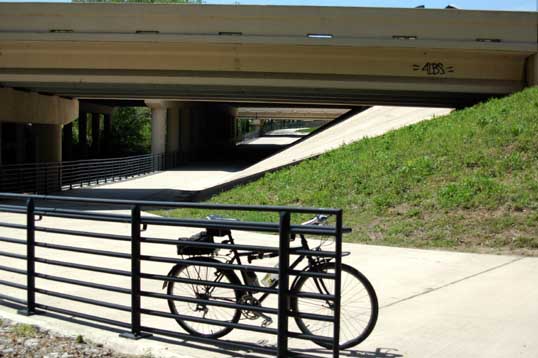
High Five Interchange, from the Cottonwood Bicycle Trail, Dallas, Texas
(location)
“We are all alone, born alone, die alone, and — in spite of True Romance magazines — we shall all someday look back on our lives and see that, in spite of our company, we were alone the whole way. I do not say lonely — at least, not all the time — but essentially, and finally, alone. This is what makes your self-respect so important, and I don’t see how you can respect yourself if you must look in the hearts and minds of others for your happiness.”
― Hunter S. Thompson, The Proud Highway: Saga of a Desperate Southern Gentleman, 1955-1967
“It is from the bystanders (who are in the vast majority) that we receive the propaganda that life is not worth living, that life is drudgery, that the ambitions of youth must he laid aside for a life which is but a painful wait for death. These are the ones who squeeze what excitement they can from life out of the imaginations and experiences of others through books and movies. These are the insignificant and forgotten men who preach conformity because it is all they know. These are the men who dream at night of what could have been, but who wake at dawn to take their places at the now-familiar rut and to merely exist through another day. For them, the romance of life is long dead and they are forced to go through the years on a treadmill, cursing their existence, yet afraid to die because of the unknown which faces them after death. They lacked the only true courage: the kind which enables men to face the unknown regardless of the consequences.”
― Hunter S. Thompson, The Proud Highway: Saga of a Desperate Southern Gentleman, 1955-1967
“We can complain because rose bushes have thorns, or rejoice because thorn bushes have roses.”
― Abraham Lincoln
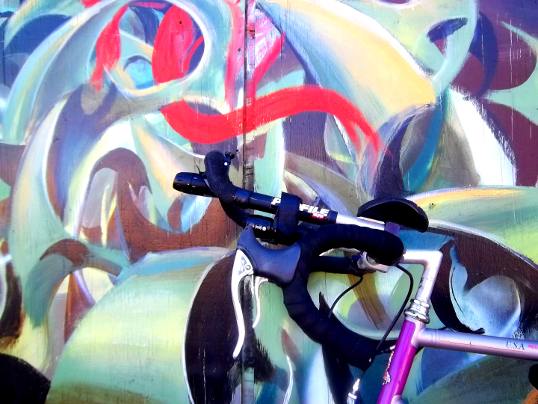
Up close, there are only brush strokes, you can’t see what you are looking at.
“What I need is perspective. The illusion of depth, created by a frame, the arrangement of shapes on a flat surface. Perspective is necessary. Otherwise there are only two dimensions. Otherwise you live with your face squashed up against a wall, everything a huge foreground, of details, close-ups, hairs, the weave of the bedsheet, the molecules of the face. Your own skin like a map, a diagram of futility, criscrossed with tiny roads that lead nowhere. Otherwise you live in the moment. Which is not where I want to be.”
― Margaret Atwood, The Handmaid’s Tale
Only with distance, in space and time, comes clarity.
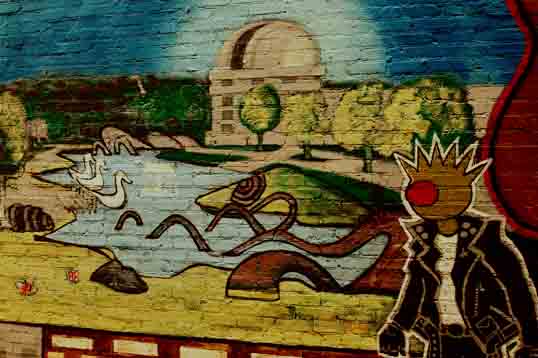
Graffiti, Deep Ellum, Dallas, Texas
“A portrait is not a likeness. The moment an emotion or fact is transformed into a photograph it is no longer a fact but an opinion. There is no such thing as inaccuracy in a photograph. All photographs are accurate. None of them is the truth. ”
― Richard Avedon
“The alchemist picked up a book that someone in the caravan had brought. Leafing through the pages, he found a story about Narcissus.
The alchemist knew the legend of Narcissus, a youth who knelt daily beside a lake to contemplate his own beauty. He was so fascinated by himself that, one morning, he fell into the lake and drowned. At the spot where he fell, a flower was born, which was called the narcissus.
But this was not how the author of the book ended the story.
He said that when Narcissus died, the goddesses of the forest appeared and found the lake, which had been fresh water, transformed into a lake of salty tears.
‘Why do you weep?’ the goddesses asked.
‘I weep for Narcissus,” the lake replied.
‘Ah, it is no surprise that you weep for Narcissus,’ they said, ‘for though we always pursued him in the forest, you alone could contemplate his beauty close at hand.’
‘But… was Narcissus beautiful?’ the lake asked.
‘Who better than you to know that?’ the goddesses asked in wonder. ‘After all, it was by your banks that he knelt each day to contemplate himself!’
The lake was silent for some time. Finally, it said:
‘I weep for Narcissus, but I never noticed that Narcissus was beautiful. I weep because, each time he knelt beside my banks, I could see, in the depths of his eyes, my own beauty reflected.’
‘What a lovely story,’ the alchemist thought.”
― Paulo Coelho, The Alchemist
I am working on trying to minimize my reliance on the automobile here in the most car-centric of cities and have wanted an independent (aka not Starbucks) Coffee shop that is a good bike ride from my house for a long time. My wish finally came true. There is an excellent place down on Henderson, The Pearl Cup, that I have frequented and enjoyed… but it is a long and difficult drive from my house (and no train station nearby).
Almost a year ago they announced they were building a new location in Richardson. I began plotting a bicycle route to the place. It’s on the other side of a giant highway from where I live, in a more upscale neighborhood, but I was able to find a route with a good highway crossing (underneath) and that had most of the way on trails or dedicated bike lanes, with the only remaining roads low traffic.
It’s a hair under seven miles – about the perfect distance. Not too far, but fourteen miles round trip is a good workout.
This weekend was a beautiful warm day, so I was able to make to ride out. It’s a really nice route across Richardson, with some varied scenery along the way.
Bike trail along the creek near my house.
The first bit is down the Huffhines branch of Duck Creek on the last few yards of the Glenville trail. One of the reasons we bought our house was that they had planned and funded the trail in the creek behind us. We never thought it would take six years to get the thing finally built… but now it is.
And then north under the powerlines on the Owens Trail. A lot of bike routes in the Metroplex are through powerline right of way. It’s not very scenic, but gets the job done.
Spring Creek Natural Area.
The nicest park of the ride is through the thick creekbottom woods of the Spring Creek Nature Area.
Under the Highway
Then under Highway 75 along a creek bridge. The city is working on bicycle/pedestrian crossings of the highway, with success in the northern part of the city.
Along Highway 75
Up the highway on the east side, then down busy Renner road. A lot of fast cyclists use the road, but I’m slow and lazy and poke along the trail.
Bike Lanes on Custer Road
The last little bit is down a dedicated bike lane on Custer. These dedicated lanes have been popular and are cropping up all over the city. The only problem is that there is often parking in these lanes which forces the bikes through the “door zone” – so riders have to go slow and careful, looking into each parked car as you go by.
The Pearl Cup’s Outdoor Patio and Shady’s Burger Joint.
And finally, the coffee shop. A great place for some Java and maybe a book or some writing. Next door they opened up a burger place, Shady’s. Candy met me there for lunch. They had a nice selection of craft beers – Dogfish Head, Devil’s Backbone, and a couple others – but no local beers. We talked to the owner and suggested he get some Deep Ellum or Lakewood on tap.
So it was a nice lunch, and a nice ride – one I hope to be making a few more times.
Most of you know about Cowboys Stadium. A lot of folks call it Jerryworld, after Jerry Jones, of course – but I refer to it as the Death Star. It is a structure of almost unimaginable size. When you are driving around the Dallas-Fort Worth Metroplex, the thing will, often unexpectedly, be spotted looming on the horizon like a giant scoop of steely ice cream. You will look, and then realize how far away it is. I’ve seen the thing from just west of Mesquite – a good forty miles away.
Cowboys Stadium – The Death Star
Its purpose, of course, is to be the home of the Dallas Cowboys, America’s (nowadays mediocre) Team. But it is also used for other purposes, from concerts to monster truck rallies. I’ve seen a basketball game there.
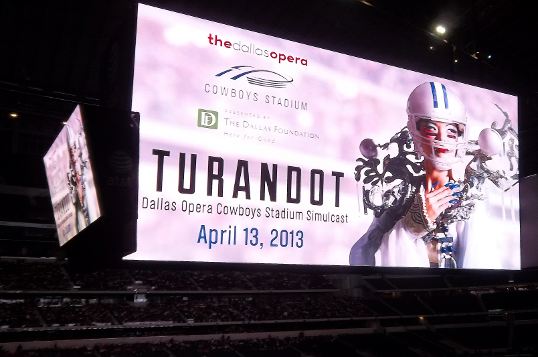
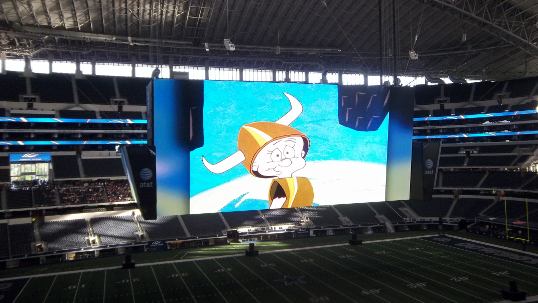
Other than its gargantuan size, the stadium’s most famous attribute is its video screen. A four-sided apparatus (two large screens on the sides, and two small ones on the ends) that hangs down from the roof over the field, it simply has to be seen to be believed. The first thing that strikes you is the size – 72 feet tall and 160 feet wide. But what is jaw-droppingly amazing is the quality and brightness of the picture it displays. It is better than real… it is real life re-imagined on a grand scale.
I have to admit, the main reason I wanted to go was simply the uniqueness of the event. Grand, full-scale, opera being piped live into the gargantuan shrine of huge sweaty sportsmen… this was something I had to see – the collision of two very different worlds. I picked up tickets for Candy and I, and marked the calendar to drive out there.
We had our doubts. I had seen some light opera over the years, but never a whole production of grand opera. What would it be like on a giant video screen? Candy especially didn’t think it would be all that – and almost didn’t go. She asked, “It isn’t long is it?”
“Yes, it’s very long.”
“They aren’t singing in another language are they?”
“Yes, it’s in Italian, but there will be subtitles.”
In the end, we made the drive. There were twenty-nine thousand people there. I don’t think there have been very many live opera performances with (counting the folks at the Winspear) thirty five or so thousand spectators. Before the festivities started, the crowd was pretty restless and innervated.
I wanted to get there on time because before the opera itself started they showed a cartoon on the big screen. It’s what most folks think of when they think of opera – What’s Up Opera, with Bugs Bunny and Elmer Fudd. You know… “Kill the Wabbit! Kill the Wabbit!”
Elmer Fudd on the Giant Screen
And then, after another mini-opera modeled after Julia Child baking a chocolate cake and a bunch of interviews, the performance started.
It was greatness. It was fucking amazing. It was fantastic. It was a thing of exquisite beauty.
When you see little bits of a Grand Opera – the overdone costumes and makeup, the melodramatic stories, the talking-in-music – it seem sort of silly, weird, and overly precious. But when you put it together like this, done well, it is an overpowering emotional experience.
I remember, in the middle of the third act, looking sideways at the massive crowd packed into the steeply sloping seats staring out at that video screen, mouths gaping, completely taken in, enraptured. I don’t see how anyone with anything approaching an open mind could not be amazed and enthralled at what they saw.
Oh, and Candy loved it too. She had brought her iPad so she could read if she was bored. It never came out of its case. She said it was beautiful and amazing. She was especially impressed with Antonello Palombi, the tenor playing Prince Calàf. Here’s an interesting story from his Wikipedia Page:
On 10 December 2006 he was thrust into the media spotlight in Franco Zeffirelli’s new production of Aida at La Scala, which opened the theatre’s 2006/2007 season. During the second night of the run, Palombi took over the role of Radames when Roberto Alagna walked off the stage after booing from the loggione (opera fans who sit in the less-expensive seats at the very back of the Scala). Palombi entered on stage wearing jeans and a black shirt to finish the act, and returned in costume after the interval to sing the remainder of the opera.
Nobody was booing from Cowboys Stadium. It’s pretty odd to see folks giving a standing ovation to performers that aren’t even there.
How was it on the screen? Not bad. Some of the closeups were a little strange – seeing things like beads of sweat or imperfections in makeup blown up to the size of a schoolbus was disconcerting. They did as good a job with the sound as they could – the vast open space echoes terribly, of course, but they had extra speakers and subwoofers lining the field and it wasn’t as bad as you would think.
So – now I’m pumped. I really want to see one of these live now. Remember, those folks are singing live… really live – they are not miked. The purpose of the simulcast was to introduce folks to something they might not otherwise see and get them interested… and it worked, in spades.
Oh man, in October they are doing Carmen at the Winspear…. I wonder if I can save enough money for tickets.
America’s urban landscape is changing, but in ways not always predicted or much admired by our media, planners, and pundits. The real trend-setters of the future—judged by both population and job growth—are not in the oft-praised great “legacy” cities like New York, Chicago, or San Francisco, but a crop of newer, more sprawling urban regions primarily located in the Sun Belt and, surprisingly, the resurgent Great Plains.
While Gotham and the Windy City have experienced modest growth and significant net domestic out-migration, burgeoning if often disdained urban regions such as Houston, Dallas-Ft. Worth, Charlotte, and Oklahoma City have expanded rapidly. These low-density, car-dominated, heavily suburbanized areas with small central cores likely represent the next wave of great American cities.
Dallas Skyline from the Soda Bar on the roof of the NYLO Southside hotel.
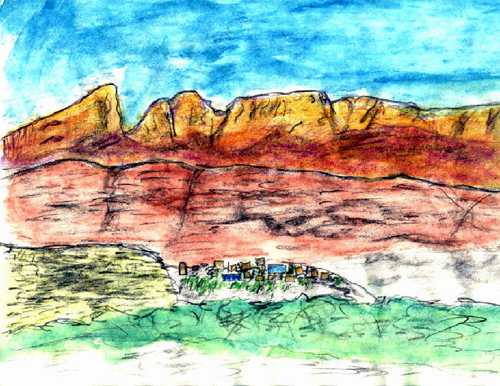
A sketch I made of Boquillas, Mexico, in 2001
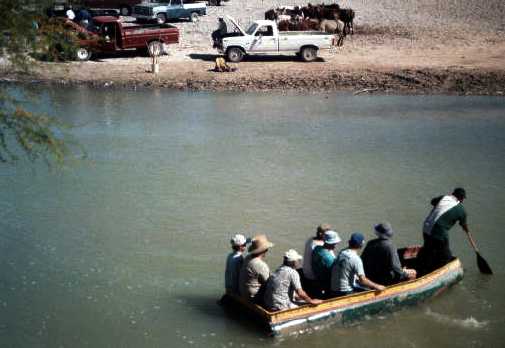
Well over a decade ago, I went to Big Bend, my favorite place on earth, and crossed over to Boquillas, Mexico, to have some tacos and enjoy the international flavor. At that time, you paid a dollar to a guy with a rowboat (with the name “Frijoles” hand-painted on the transom) to get you across the Rio Grande. No passport, customs, or anything like that. It seemed silly, given that the river can be walked when it is low, and there is no real civilization for hundreds of miles in any direction.
After 9/11, of course, this all came to a screeching halt. No more unauthorized border crossing. The village of Boquillas was crippled by the disappearing tourist traffic. What a shame. It was gone forever.
Well, as it turns out, not forever. Now I have to get my passport in order and get ready to make that long drive to West Texas.
Seattle’s $30 million carbon neutral Bullitt Center, billed as the world’s greenest commercial building, will feature what its owner, the Bullitt Foundation, calls an “irresistible stairway” when it opens at the end of the month. The elegant, light-filled escalier offers panoramic views of downtown and Puget Sound. It’s intended to conserve energy and provide physical exercise for occupants. Will it be a lesson to companies trying to get employees to make healthier choices?
We all know climbing stairs is good for us: It’s a good workout and can even save time. In 2011, researchers at a Canadian hospital found that when they had doctors take the stairs rather than the elevator, the doctors saved an average of 15 minutes per workday—and they were required to walk, not run.
But despite the benefits, few office buildings do anything meaningful to encourage stair climbing. Many workplaces have grim, fluorescent-lit, concrete passages hidden away behind fire doors. Some all but prohibit stair use, in part due to post-9/11 security concerns.
The building where I work has very inviting, entertaining, stairs with nice views. However, it was built a while back and does not meet current fire codes. That’s why stairways are so grim – because of the codes that forbid clear openings between floors (because they encourage the spread of fire). I wonder how the Seattle building gets around that problem.
—–
OK… Well, The internet provides the answer. They had to change the codes to build the building.
“We were shocked to learn that it is flat-out illegal to build this sort of ultra-green building in any city in America,” says Bullitt Foundation President Denis Hayes. “But Seattle changed its building code to allow super-green buildings to meet performance standards as an alternative to prescriptive standards. We wanted the design flexibility to construct a building that used less than one-fourth the energy of a (standard) code building.”
Although lost to us through a regretful combination of valium, alcohol, and Disney dreams, Kinkade’s abrupt end does not, however, signify the end to his ™. A digital immortal, his empire continues to expand post-mortem. Despite failing gallery schemes, his virtual gallery is growing. The “Kinkadian Master Style”, or official imitators, will continue to create new works through his website. Similarly, his impact remains ever present on visual blogs like tumblr. It is on these sites that iterations of his work are always being created. One current meme is to “Kinkade” an image, by adding his copyrighted cottages, or by filling any background with swaths of his paintings. It is unlikely Kinkade would be flattered by these depictions, but imagining the man, he would prefer being ironicized rather than irrelevant.
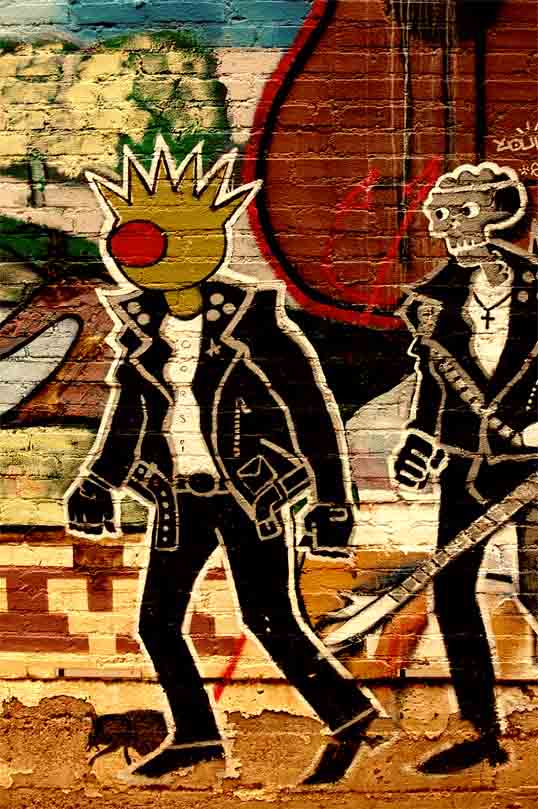
Graffiti in an alley in Exposition Park, Dallas, Texas
Olivehead
I like the scene painted in the graffiti, especially in the second photo, because you can see one of my favorite things – the Patricia Johanson sculptures in Leonhardt Lagoon in nearby Fair Park.
A pond in Fair Park. The red paths are part of a massive sculpture by Patricia Johanson. I have always loved those red paths running through the water, weeds, and turtles. A neglected jewel in the city.
“Don’t walk behind me; I may not lead. Don’t walk in front of me; I may not follow. Just walk beside me and be my friend.”
― Albert Camus
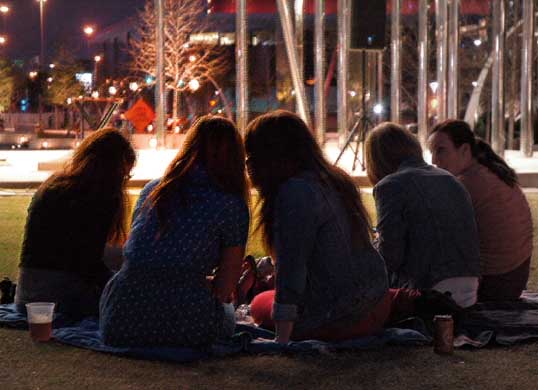
Klyde Warren Park, Dallas, Texas
“Is it possible, in the final analysis, for one human being to achieve perfect understanding of another?
We can invest enormous time and energy in serious efforts to know another person, but in the end, how close can we come to that person’s essence? We convince ourselves that we know the other person well, but do we really know anything important about anyone?”
― Haruki Murakami, The Wind-Up Bird Chronicle
“Don’t flatter yourself that friendship authorizes you to say disagreeable things to your intimates. The nearer you come into relation with a person, the more necessary do tact and courtesy become. Except in cases of necessity, which are rare, leave your friend to learn unpleasant things from his enemies; they are ready enough to tell them.”
― Oliver Wendell Holmes Sr.












 Bill Chance