“But we must come to realise that every word is perfect, including those we scratch out. As my pen moves across this page the whole world writes. All of human history combines at this mere moment now to produce in the flow of this hand a single dot: Who are you and I, dear friends, to contradict the whole past of the universe? Let us then in our wisdom say yes to the flow of the pen.”
― Luke Rhinehart, The Dice Man
Decatur, Texas
Legend has it that a local, Will Cooper, was credited with the phrase, “Eighter From Decatur.” Will played dice with his sweetheart Ada by his side. He would roll the dice and yell “Ada from Decatur, county seat of Wise,” for luck. The expression was spread by the travelling home guard and Army regulars. The phrase eventually turned into “Eighter From Decatur,” when a hard eight roll of the dice was needed.
Decatur, Texas
Hard Eight…. That reminds me of one of my favorite movies – I’ll bet you haven’t even seen it – I’ll make that bet – it’s better odds than a hard eight.
“Don’t be afraid to be confused. Try to remain permanently confused. Anything is possible. Stay open, forever, so open it hurts, and then open up some more, until the day you die, world without end, amen.”
― George Saunders, The Braindead Megaphone
“It is always important to know when something has reached its end. Closing circles, shutting doors, finishing chapters, it doesn’t matter what we call it; what matters is to leave in the past those moments in life that are over.”
― Paulo Coelho, The Zahir
Opening & Closing Fritz Bultman Bronze, 1975 Poydras Street, New Orleans
Looking at the photo I took, I had a hard time making sure I had the title and sculptor right. Photos online looked so different. I realized that the sculpture looks completely different from various angles.
Now I need to go back. I need to go back, walk around the sculpture, and look at it from all sides. Shame it’s in the middle of a street – I’ll have to risk it.
“Cities, like dreams, are made of desires and fears, even if the thread of their discourse is secret, their rules are absurd, their perspectives deceitful, and everything conceals something else.”
― Italo Calvino, Invisible Cities
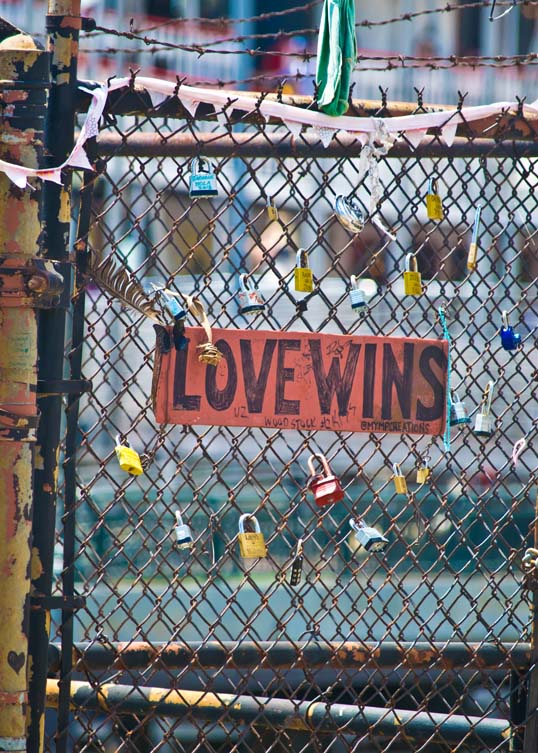
“In the end, love wins. It does win. We know it wins. When a person dies, love isn’t turned off like a faucet. It is an amazingly resilient part of us.”
― J.K. Rowling
“The thing I hate the most about advertising is that it attracts all the bright, creative and ambitious young people, leaving us mainly with the slow and self-obsessed to become our artists.. Modern art is a disaster area. Never in the field of human history has so much been used by so many to say so little.”
― Banksy
El Pajaro y la Nina by Ray Smith, 2016 Mexico/New York, Material Reclaimed Tires/Poured Concrete Poydras Street, New Orleans
It is said that ‘change’ is the only real constant. It may very well be fact, but then again, even facts change and that may be the fact that governs us all.
—- James Surls, artist statement
Standing Vase With Flowers, James Surls, 2010 Colorado, Bronze and Stainless Steel Poydras Street, New Orleans
“Anyone whose goal is ‘something higher’ must expect someday to suffer vertigo. What is vertigo? Fear of falling? No, Vertigo is something other than fear of falling. It is the voice of the emptiness below us which tempts and lures us, it is the desire to fall, against which, terrified, we defend ourselves.”
― Milan Kundera, The Unbearable Lightness of Being
Crystal Beach, Bolivar Peninsula, Texas
Now, here is is, the first day of a spanking new year. And I have these goals for 2018 – I’ve worked hard on these… and the main three are:
Read 100 books
Write 50 Short Stories
Ride 3000 miles on my bike.
Since this is only the beginning, I didn’t want to get behind right at the start. So I cheated on the reading a hundred books – and jumped the gun by starting two weeks early. I’m up to six so far… which is good. I’ve already written one short story – so I’m OK there.
But I am stuck in a beach house with no bicycle and freezing cold… incredible wind… what we used to call a blue norther. I had planned on a little flexibility on my goal – knowing that I get sick over the winter and need other means to keep up with my goal.
At home, I have two exercise bikes – so I decided that riding one of those is worth ten miles for each hour riding. That way I can keep up if I’m forced inside.
At the beach house I thought about it and decided that, in a pinch, I can walk to make up the goal. Only in emergency situations, like now – the first day. After some thought and internet research, I decided on a three mile walk, at a brisk pace, would equal ten miles of riding. I walk at about three miles per hour, so that’s about an hour – which corresponds with riding or stationary. Also, that’s in addition to whatever I walk on a normal basis – the usual strutting around doesn’t count.
So at the end of the day, I layered on as much as I could (the temperature was below freezing and the wind was… really strong. I walked out to the beach and watched the kids fire off the last of their fireworks, then headed out down the beach. There is a little creek that emerges from the dunes and blocks off the rest of the beach from where we were and I knew that to that creek and back would get me to the three miles I needed.
I started out into the wind, pulling my hood closed so I was looking out a tiny circle at the water on the right and the dunes on the left. The moon was full, so there was plenty of light. It was very cold. But I started walking.
And it put me into the thought of all the other times over my life that I had walked on the beach, especially at night. From Panama to Nicaragua, to South Padre Island over spring break (That was a long drive from Lawrence, Kansas) to this very beach over the years with my kids growing larger and larger.
There is a rhythm of walking on the beach, in the wet sand between the surf and the loose part (in Texas it is generally allowed to drive on the beach, so, especially at night, you want to stay close to the surf), as the time and the miles go by all those old memories become telescoped in to the present day, the experience of being and moving along a border between two worlds.
It was a lot easier to walk back with the wind behind me. So now I have the equivalent of ten miles of bike riding on the first day of January. Still on track – so good, so far.
“This is the story of Isaac and his time in America, the last turning of the centuries, when the hubris of men led them to believe they could disregard even nature itself.”
― Erik Larson, Isaac’s Storm: A Man, a Time, and the Deadliest Hurricane in History
Oblique Strategy:Children -speaking -singing
When our kids were young we used to come over Thanksgiving, or over New Year, or both – to rent a beach house at Crystal Beach on the Bolivar Peninsula, just east of Galveston, Texas. In the off season you could rent an old rickety beach house for almost nothing. It was great with high maintenance kids like ours- there were only two directions they could go on the beach and nothing they could destroy. It was the best of times.
We had to stop going because in 2008 Hurricane Ike wiped the low sandy Bolivar Peninsula clean.
Now, ten years later, a lot of the beach houses have been rebuilt. Their stilts are noticeably higher now, heavier and more numerous. So we rented one for New Year’s – Lee came from New Orleans and Nick from North of Houston.
It’s great to be back, the only problem is the weather is awful – cold, rainy, and very windy.
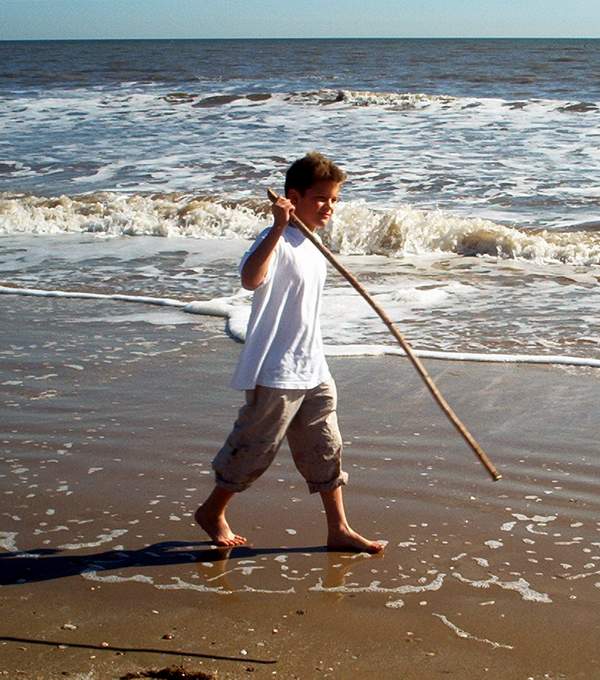
Lee walking in the surf at Crystal Beach. I checked my old blog entries – this was December 29, 2002. Fifteen years ago, almost to the day.
Lee walking in roughly the same spot, fifteen years later. There was no sun and it was very cold and windy. Same ocean, though.
“If you were different from anybody in town, you had to get out. That’s why everybody was so much alike. The way they talked, what they did, what they liked, what they hated. If somebody got to hate something and he was the right person, everybody had to hate it too, or people began to hate the ones who didn’t hate it. They used to tell us in school to think for yourself, but you couldn’t do that in the town. You had to think what your father thought all his life, and that was what everybody thought.”
― John Kennedy Toole, The Neon Bible
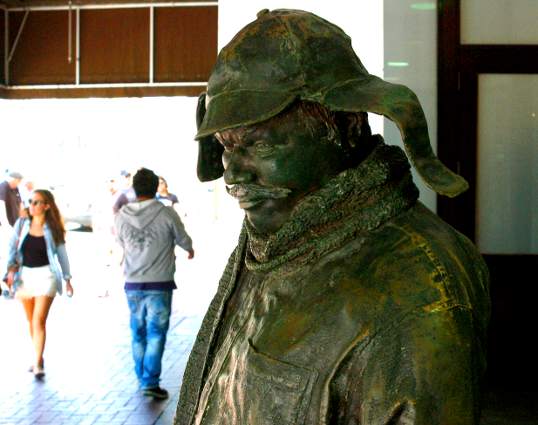
Ignatius J. Reilly, sculpture on Canal Street.
Oblique Strategy:Always first steps
Six down, ninety-four to go.
While working on my goals for 2018 I decided to set a goal of reading a hundred books in the year. Thinking about it, I decided the only way to pull this off was to read short books. I made a list of 66 short novels and wrote about it. Thinking more about it, I was excited enough to jump the gun and start the 100 books immediately.
Next up is The Neon Bible, the first, and next to last novel by John Kennedy Toole. He is the author that wrote the famous A Confederacy of Dunces and created the amazing character, Ignatius J. Reilly.
It is not as well known as Confederacy of Dunces, and the author didn’t even seem to think much of it. He said, “In 1954, when I was 16, I wrote a book called The Neon Bible, a grim, adolescent, sociological attack upon the hatreds caused by the various Calvinist religions in the South—and the fundamentalist mentality is one of the roots of what was happening in Alabama, etc. The book, of course, was bad, but I sent it off a couple of times anyway.”
So I picked up the book, with low expectations, but it had a slim page count, and I loved A Confederacy of Dunces – so I was sure it would be worth the effort and time.
And it was – not entirely successful as a novel, even as a bildungsroman, but it contains some amazing scenes and descriptions of life in a hell-hole little city in a beautiful Mississippi valley. It’s pretty observant and socially aware for something written by a sixteen year old.












 Bill Chance