A gecko in the watering can.

gecko by chancew1
gecko, a photo by chancew1 on Flickr.

The terrible heat continues…. It’s always hot here in the summer, of course, but this is crazy. When I left work today, going out into the parking lot, it literally felt like I was walking into an open oven door.

At any rate, I took this picture a few years ago… it looks cool and relaxing somehow.

——————————————————————————————————————————-

Oh, and here’s some music from a band I really like… and you have never heard of. They are called “My Favorite” – I have no idea where I first heard their stuff, but I really liked it. They broke up in 2005, I don’t know anything about what’s happened to their members since. They did have some fans.

Music never really goes away though, does it.

What I learned this week, July 22, 2011

Hakuna Matata

Hakuna Matata

Goals are important, but they are only metrics. A goal is useful for making sure you are on the right track, but it doesn’t work very well for motivation. To get where you need to go, you need to concentrate on the journey. If all you look at is the final goal, you will be overwhelmed and will fail. Look at the next step. If you enjoy the journey and are able to make yourself take that next little baby step, always, no matter what, then you will be unstoppable.


If you put the water bladder in your hydration pack upside down, you will get thirsty very quickly.


A prime lens on an SLR produces a picture that is sharper than one from a zoom.


With today’s tools, the idea of waiting for approval from the minions of a multinational sounds as lazy and self-defeating as a band that won’t burn CDs until they get a major label record deal. Just as musicians have to know their way around a sound board, writers need facility with the layout and design software used to create books, the ins and outs of formatting for ebooks; they need design sense enough to guarantee that their book looks good inside and out.

We used to wait passively for the pearly gates to open and then gratefully pass our manuscripts through to hallowed ground. In music and in books, those days are gone forever. And good riddance.

—- With Traditional Publishing Dies the Passive Writer-Victim by Leonce Gaiter in the Huffington Post


The problem is that these are all goods and services, …, and goods and rights are not the same things. People tend to concur upon rights …, and they do not depend upon others to supply and pay for their rights. With goods, there is always a political argument: about the value of the good, who is to get it and who is to pay.

from A Fling with the Welfare State, by Noemie Emery


If you want to be on the cutting edge – you have to be prepared to bleed.

Man Between the Ponds

Man between the ponds

Man between the ponds

There are these two flood control ponds down in the park at the end of my street. Every day, every damn day, I drive to work down my alley, facing the ponds, and then make a left turn over a little bridge and past them. Every day.

In the evenings the ponds are popular with walkers, picnickers, and fishermen (though I have never seen anyone actually catch anything). But during the day, the area is pretty much deserted, save an occasional walker on the trail.

A while back as I was making my left turn, I thought I caught a lone figure out of the corner of my eye. I was not paying much attention, though, I was thinking about work, so I put it out of my mind quickly. But the next day, I saw the same thing.

The next day, I paid a little more attention. Sure enough, there was a black-clad figure out in the middle of the ponds. The two ponds are separated by a concrete apron – during wet seasons the water flows over this spillway. Lately, however, under drought conditions, this area is as dry as a bone. There is still some water leaving the ponds, not much more than a trickle, it must be seeping through under the concrete.

But why would someone be standing out there? I thought I saw a city truck down by the road, maybe it was a workman digging out algae or repairing a pipe or something.

Then the man disappeared. I didn’t know if he was gone for good, or simply making his appearance during some time other than my morning commute.

And then he was back. This time I could see clearly enough to realize that this was a black-clad person out between the ponds doing some exercises, probably Tai Chi Chuan or some variation. I could see him progressing smoothly through his set of exercises and movements.

It was an arresting sight. The dark figure, clear, yet distant enough that I could not make out any details, moving, mysterious. There are a lot of people that practice various martial or meditative arts, usually in small groups, in the park or around the ponds, but nobody has chosen such a dramatic location as the apron between the ponds.

I started carrying my camera in the passenger’s seat in the morning in hopes of getting a picture. For a week the man didn’t show, but then this morning, there he was. I must have caught him at the end of his routine, he was standing motionless. I snapped a couple of shots and drove on. I don’t know how long he stayed there in that position.

I wonder if he is there on the weekend, on a day that I don’t have to rush out to work. I might walk a little closer, wait until he is finished, ask him details of what he is doing and why.

Or maybe I’ll let him remain a mystery – a distant dark figure out between the ponds, a monument to discipline and relaxation to be glimpsed for a second through a car window on days while I’m hurrying off to the rat race.

Then and Now – The Dallas High Five

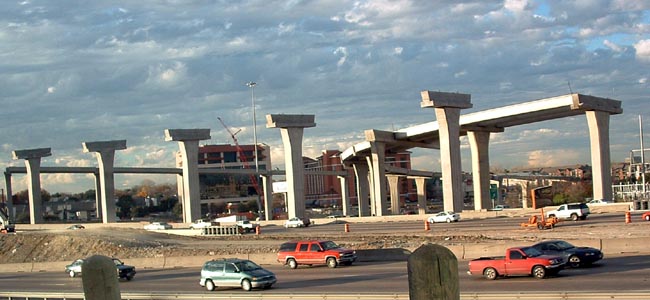
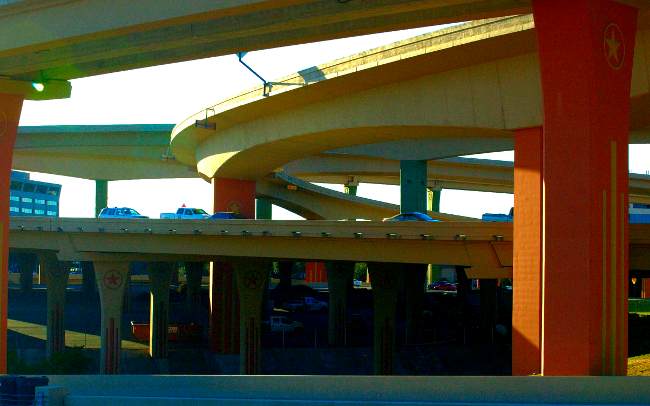
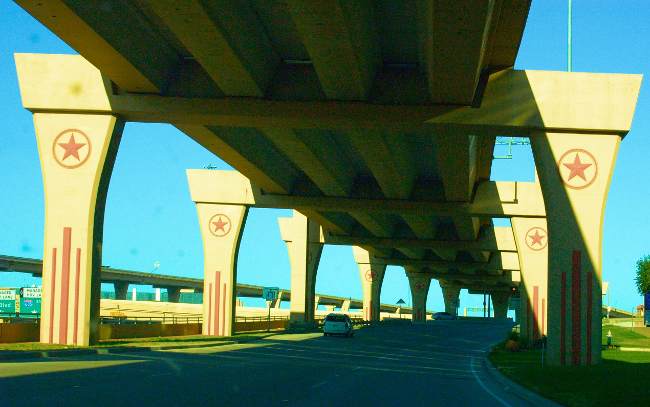
The Dallas High Five is a giant highway interchange near where I work. It was amazing, over a number of years, watching it go up.

Then:

High Five, in its infancy

High Five, in its infancy

High Five, Then

High Five, Then

Skeleton of the High Five

Skeleton of the High Five

Now:

Now

Now

high ramps

Towering Ramps


Traffic


Ramp

Ramp

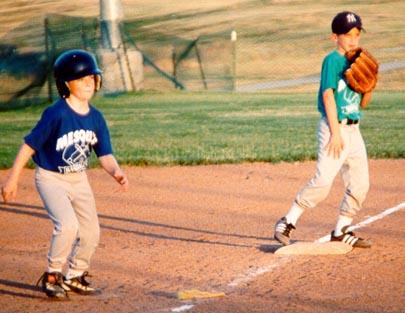
Then and Now, Lee gets a hit

Nick and Lee are playing on a softball team on Sunday evenings. One of the other kid’s parents said, “It wasn’t that long ago I was their little league coach – and now they’re playing in an old-man softball league.”

Nick at third base

Nick at third base

Lee gets a hit

Lee gets a hit

I know it’s different kids in the two pictures – but it’s late, I’m busy… and this is what I’ve got.

Speaking of baseball, everybody was watching “The Sandlot” the other day. The kids loved this movie – this is one of the ones that they watched over and over. It was unusual in that I liked it as much as they did. A classic.

People can talk about the “Best Onscreen Kiss.” I don’t think there is any doubt – it is when Squints puts the move on Wendy Peffercorn.

Michael Squints Palledorous walked a little taller that day. And we had to tip our hats to him. He was lucky she hadn’t beat the CRAP out of him. We wouldn’t have blamed her. What he’d done was sneaky, rotten, and low… and cool. Not another one among us would have ever in a million years even for a million dollars have the guts to put the moves on the lifeguard. He did. He had kissed a woman. And he had kissed her long and good. We got banned from the pool forever that day. But every time we walked by after that, the lifeguard looked down from her tower, right over at Squints, and smiled.
—-The Sandlot

Then and Now – Lee likes shiny things

Then:

Lee at MLS soccer gameT

Lee at MLS soccer game

Lee, outside a soccer game at the Cotton Bowl. He likes shiny things

This was a game in 2002 where, in honor of the visiting Clint Mathis, everybody (that wanted one)  got free Mohawks – all the kids on Nick’s soccer team did. .

2011 Mardi Gras

2011 Mardi Gras

Lee, New Orleans, 2011 Mardi Gras. He still likes shiny things.

Then and Now – Lee Studying

Then:

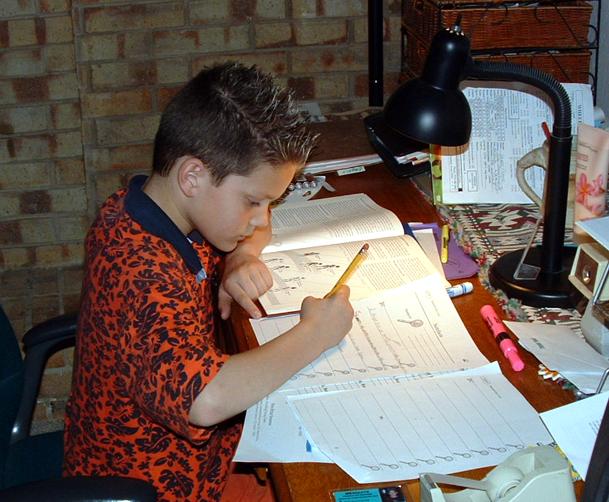
Then - Lee Studying

Then - Lee Studying

This picture was taken out in our converted garage in Mesquite. I’m not sure when, Maybe sixth grade?

Now:

Lee studies now

Lee studies now

Lee in Architecture Studio, Tulane, Freshman year.

Then and Now at the Nasher Sculpture Center

Some time long ago – I think it was the early spring of 2004 – Lee and I went down to the newly-constructed Nasher Sculpture Center in the still nascent Arts District of Dallas. I took some pictures of him, and wrote it up into my journal, The Daily Epiphany, at the time. It was popular enough that I re-wrote it into a magazine article and it was published in a local magazine, Richardson Living,  (I’ll dig up what I wrote and put it up here when I get some time). The folks at the Nasher liked it so much they sent me some free tickets.

Now, about seven years later, Lee and I went down there again and I took some more pictures. Like most museums the artworks move around quite a bit – so nothing was exactly the same. Lee has, of course, grown a bit, and my camera is different. The trees in the Nasher garden have grown a lot. In 2004, the place felt like a finely tended garden – now it’s more like a forest glade.

It was hot as a humid blowtorch today, and the light wasn’t very good, so the pictures aren’t great. I wanted to go early in the morning, but the house was full of sleeping college age boys, nobody slept much last night, and it took some doing to get myself enthused and then roust them up and out the door.

Night (La Nuit) by Aristide Maillol

Night (La Nuit) by Aristide Maillol

This is Lee sitting on a wall in front of Night (La Nuit) by Aristide Maillol.

Lee sitting by Night, 2004

Lee sitting by Night, 2004

Seven years ago, the sculpture was out in the grassy garden area.

Eve, by Rodin

Eve, by Rodin

Eve, by Auguste Rodin

Eve, by Rodin, 2004

Eve, by Rodin, 2004

Bronze Crowd, by Magdalena Abakanowicz

Bronze Crowd, by Magdalena Abakanowicz

Bronze Crowd, by Magdalena Abakanowicz

Bronze Crowd, by Magdalena Abakanowicz - 2004

Bronze Crowd, by Magdalena Abakanowicz - 2004

Richard Serra - My Curves are Not Mad

Richard Serra - My Curves are Not Mad

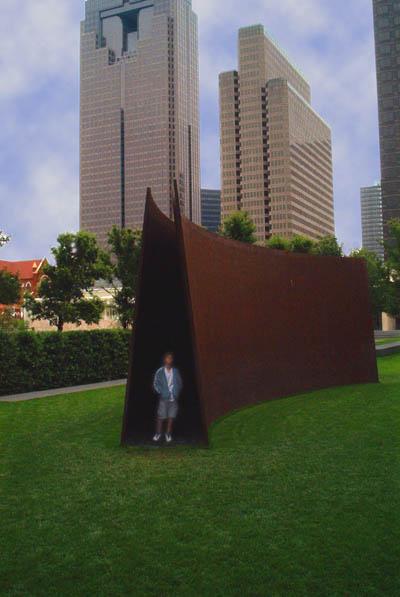
One sculpture that is still in the same place is Richard Serra’s My Curves Are Not Mad.  That’s not surprising – it weighs fifty tons or so and I read somewhere that they had to do some serious work on the foundation when the museum was built. I did this by memory, but it looks like I stood in the exact spot I did seven years ago. You can really see how much the trees have grown.

My Curves are Not Mad - Richard Serra, 2004

My Curves are Not Mad - Richard Serra, 2004

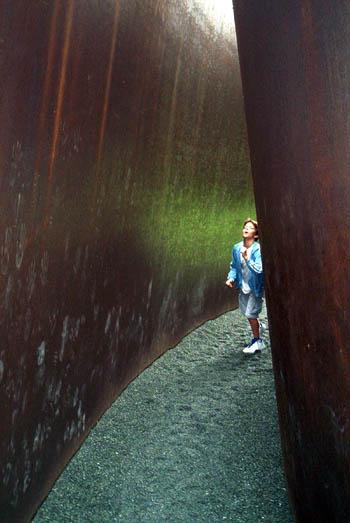
Inside My Curves are Not Mad - 2004

Inside My Curves are Not Mad - 2004

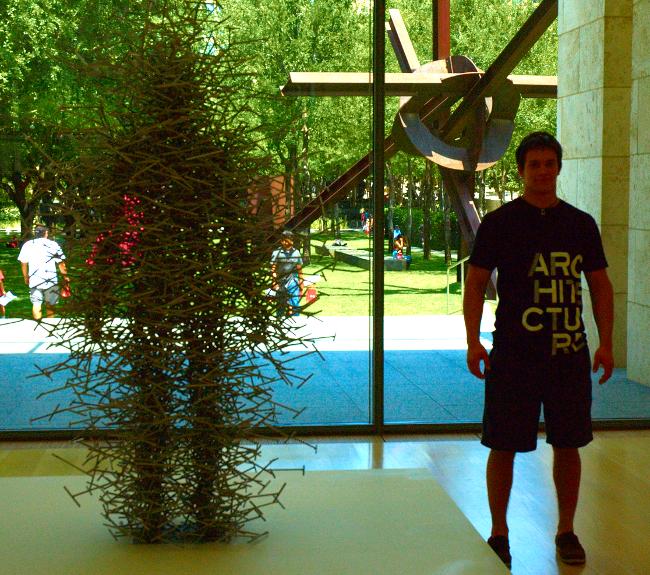
Quantum Cloud XX (tornado) by Antony Gormley

Quantum Cloud XX (tornado) by Antony Gormley

Quantum Cloud XX (tornado) by Antony Gormley used to be down at the bottom of the garden. I liked it there, it looked like a ghost emerging from the shrubbery. It’s always been one of my favorite pieces and I still like it. Actually, today I was glad it had been moved into the air conditioning.

Untitled (Sprawling Octopus Man), by Thomas Houseago

Untitled (Sprawling Octopus Man), by Thomas Houseago

Untitled (Sprawling Octopus Man), by Thomas Houseago, is part of a temporary exhibit, called Satuesque.

Hammering Man, by Jonathan Borofsky

Hammering Man, by Jonathan Borofsky

Everyone that has lived in Dallas for a long time remembers Hammering Man, by Jonathan Borofsky, because it used to grace Raymond Nasher’s shopping mall, Northpark. I love it that he was allowed to stay in the city.

Pen Porn

We all have our addictions. I don’t think you can get away from them. I don’t think you want to get away from all of them.

Addictions are what make life worth living. Giving in to them is the spice that makes it worth getting out of bed in the morning (unless, of course, you are addicted to sleeping late). The trick is to choose your addictions.

There are addictions that are always bad. You see these on Intervention. Crack, for example… I think I can say that this is an addiction that is always bad. So don’t give in to your inner crackhead, channel him somewhere else.

Then there are addictions that might not be always bad, but are inappropriate, overly embarrassing, or catastrophic for you, personally. If I became addicted to anything overly expensive – say fast cars, supermodels, or gambling – I would be in big trouble.

So being the useless geek that I am, I tend toward useless, geeky addictions. One of the most obvious ones I’ve picked up lately is a rather silly obsession with fountain pens. I’ll talk more about that later, but today we will simply take a look at today’s single fix – and table the larger questions for another day.

Over that Internet thing… from that online commerce site that sort of rhymes with flea spray… I bought a cheap macro lens adapter for my camera. I did this for the sad purpose of being able to wallow in my stupid addiction in one more ridiculous performance method – I want to take pictures of pens.

Pen Porn.

And we’ll leave it at that. Judge if you must, it makes no difference to me. It is an addiction.

It came in the mail – an unmarked, brown paper package. I eagerly unwrapped my simple purchase, stuck it on the front of the lens, and put together a quick assemblage of tripod, desk lamps, and a cut up cylinder of translucent plastic (an old cover for a stack of blank DVDs) as a light tent.

I have a lot to learn about macro photography. I have a book. I’ll get better at it. But, of course, it is porn, so quality isn’t all that important, is it?

Today, let’s take a look at three different kinds of Sheaffer Nibs.

The nib is not only the most important part of a fountain pen, to a great extent, the nib is the fountain pen. It is the critical piece of hardware that conveys the ink from the pen body and deposits it onto the paper. Most people are familiar with a nib as a curved, triangular piece of metal with a narrow slit in the middle. Look close, and you will see a little rounded tip on the end that moves over the paper.

And that’s about it. Over the long decades, however, there have been many nib innovations and variations. I’ll take some pictures later of my Parker 51’s (if this raises the hair on the back of your neck, God help you… it does mine) but today we’ll look at three examples in the history of the Sheaffer nib.

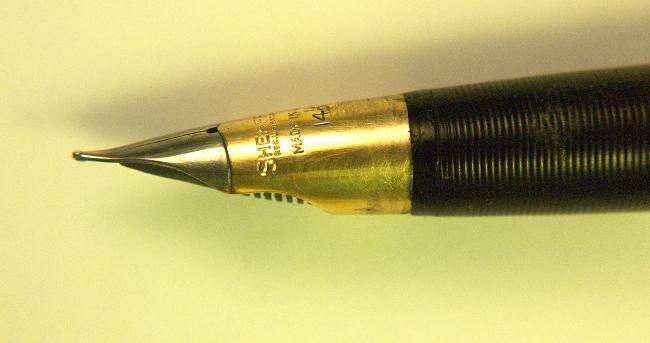
First, we have the conical Triumph Nib. This is probably my favorite nib of all time. It is as stiff as a nail, but is very smooth and reliable, and it looks cool.
Sheaffer Triumph Nib

Sheaffer Triumph Nib

This is a Sheaffer two tone, touchdown filling pen, probably from around 1950 or so. I bought this one from a grubby pile of crap under the trees at Canton, rebuilt it, and now it writes like a champ.

The Triumph Nib ruled Sheaffer’s top of the line pens until the end of the 1950’s and the emergence of the Pen For Men (I do not have a Pen For Men, or PFM, it is really the only pen I really lust after. They were not very popular when they came out and are therefore rare, collectible, and expensive today. I simply can’t afford one) and its Inlaid Nib. The Inlaid nib dominated the Sheaffer line from 1959 to the present.

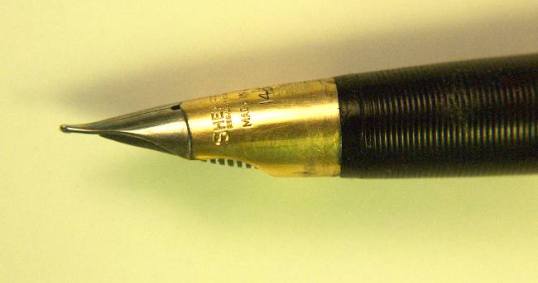
Sheaffer Inlaid Nib

Sheaffer Inlaid Nib

This is a humble example of an Inlaid Nib. It is from a small Imperial from about 1965 – 1970. It is a bit different because it has a “V” shaped triangular cut-out, rather than the longer diamond shaped one. It is a small, cartridge filling pen, nothing fancy, but it writes really well. I have some orange-colored translucent ink in it, you can see a bit of ink on the nib.

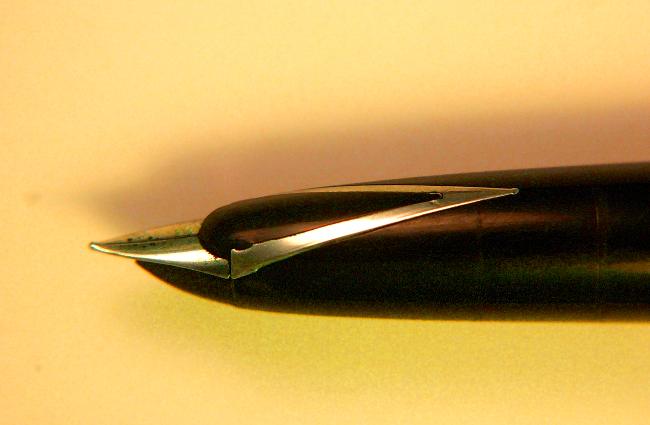
Finally, we have an oddball. This is a Sheaffer “Dolphin” nib. You can see the odd hump that gives it its name. The Dolphin is simply a cheap imitation of the more tony inlaid nib. It is a design that is supposed to look like an inlaid nib, but is really an ordinary nib with a bit of plastic and metal stuck on top of it to make it look better.

Sheaffer Dolphin Nib

Sheaffer Dolphin Nib

It may be cheap, but it works fine, this pen, again, is a very smooth and reliable writer. It is a cartridge fill. Candy gave me a touchdown filling Dolphin nib desk pen from an antique store in Granbury for Father’s Day – it is waiting for me to restore it – maybe this weekend. I love touchdown filling pens.

Sheaffer Pens

Sheaffer Pens

What is a touchdown filling pen? You’ll have to wait. More porn to come.