All You Feel Is A Caress

“Water does not resist. Water flows. When you plunge your hand into it, all you feel is a caress. Water is not a solid wall, it will not stop you. But water always goes where it wants to go, and nothing in the end can stand against it. Water is patient. Dripping water wears away a stone. Remember that, my child. Remember you are half water. If you can’t go through an obstacle, go around it. Water does.”
― Margaret Atwood, The Penelopiad

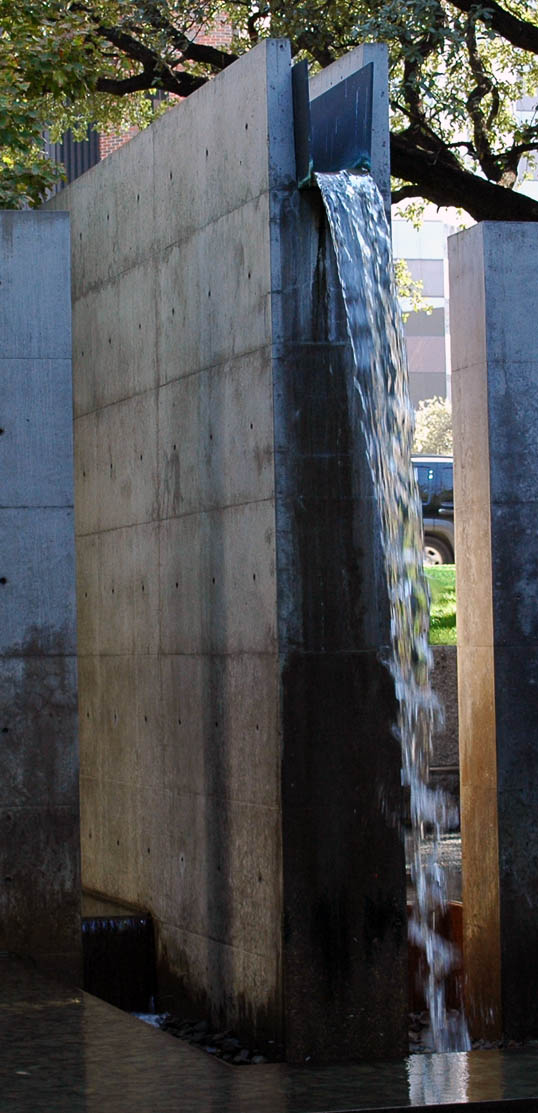
Water feature in a pocket park off of Ross Avenue,  Dallas, Texas

Water feature in a pocket park off of Ross Avenue,
Dallas, Texas

Climbing

“I thought climbing the Devil’s Thumb would fix all that was wrong with my life. In the end, of course, it changed almost nothing. But I came to appreciate that mountains make poor receptacles for dreams.”
― Jon Krakauer, Into the Wild

Commerce Street Bridge Park, Dallas, Texas

Commerce Street Bridge Park, Dallas, Texas

“Jumping from boulder to boulder and never falling, with a heavy pack, is easier than it sounds; you just can’t fall when you get into the rhythm of the dance.”
― Jack Kerouac, The Dharma Bums

Shade Structures

“since some people had told me that I was ugly, I always preferred shade to the sun, darkness to light”
― Charles Bukowski, Ham on Rye

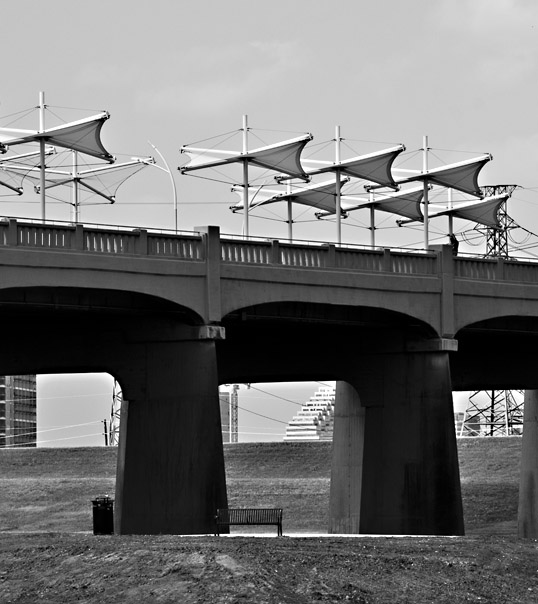
Shade structures on the Continental Avenue Bridge Park, Trinity River Bottoms
Dallas, Texas

Continental Bridge, Dallas, Texas

Continental Bridge,
Dallas, Texas

My Xootr folding bicycle, Trinity River Bottoms, Dallas, Texas

My Xootr folding bicycle, Trinity River Bottoms, Dallas, Texas

Art at the Deep Ellum Dog Park

Artwork in Bark Park Central
Deep Ellum
Dallas, Texas

deep_ellum_dp1

deep_ellum_dp3

deep_ellum_dp2

Snøhetta Pavilion

As I was working my way through South Dallas on my bicycle exploring three of the Nasher XChange sites – between Flock in Space and Black & Blue: A Cultural Oasis in the Hills – I took a look at the GPS on my phone to make sure I wasn’t lost. I realized that I wasn’t far from something I wanted to visit. Even though I was behind schedule and getting tired I would be passing close enough to make a side trip.

So I did.

I turned off of Bonnie View Road into a neighborhood until I reached College Park. Past some guys playing basketball I found what I was looking for – a new park pavilion designed by the Oslo-New York firm Snøhetta. A review of the structure had shown up in the Dallas paper and aroundgathering some architectural praise.

It looked pretty interesting, enough for me to visit.

Snøhetta Pavillion, College Park, Dallas, Texas (click to enlarge)

Snøhetta Pavillion, College Park, Dallas, Texas
(click to enlarge)

Picnic Tables and Grills, Snøhetta Pavillion, Dallas, Texas (click to enlarge)

Picnic Tables and Grills, Snøhetta Pavillion, Dallas, Texas
(click to enlarge)

I couldn’t stay long, but it was pretty cool in person. An ingenious design – unusual, yet in harmony with the site. Striking, yet useful. It seems to have been economical to build and designed to last a long time.

The picnic tables and outdoor grills were an unexpected treat – I loved the design of these. I didn’t think there was much you could do with public picnic tables – but these were unique and cool.

Later, at home, I did some web research and found a publication that extolls the virtues of the Pavilions in Dallas parks – listing a whole slew of them.

Now that I’ve finished with the Nasher XChange, maybe that’s something I can cycle through town and look at. Picnic Pavilions are pretty pedestrian objects and I have to say I haven’t noticed them for a long time.

But isn’t that the point? To try and ride around my own city and notice things that everyone usually ignores?

Maybe so.

Textures

The third sculpture in Lubben Plaza, after Harrow and Journey to Sirius is Gateway Stele.

The textures of art, nature, and architecture juxtaposed in the downtown urban setting.

The textures of art, nature, and architecture juxtaposed in the downtown urban setting.

GATEWAY STELE
1994
by Jesus Bautista Moroles
Rockport, Texas

Recalling the ancient post-and-lintel portal form, “Gateway Stele” is made of Fredricksberg granite in a universal statement of civilizations coming together. It is functional, both as a passageway to be walked through, and as a place to remain, sitting on the surrounding natural bench.

Jesus Moroles:

“In my work, I don’t intentionally follow the history of civilization, because I think it is the history of the stone that comes out in forms. The stone has a much longer history than civilization, and it is natural for stone to be used in this way.

The idea for ‘Gateway Stele’ comes from the traditional stele form, which is a monolithic stone with hieroglyphic writing. The posts of this portal have my writing in the patterns of squares cut into the stone. Just as we can’t translate the cryptic messages in the ancient stele, my ‘writing’ has no real translation, but it is meant to be interpreted on a visual basis.”

Gateway Stele

Gateway Stele

The impact of the portal is somewhat diminished by the fact that it guides the viewer into a parking lot – complete with a little cluster of valet parking attendants standing around smoking.
Journey to Sirius

In Lubben Park, next to “Harrow” is the two-part sculpture “Journey to Sirius.” I thought it looked like early video game characters – specifically giant Space Invaders – but the artists’ plaque says it was inspired by Dogon Art and Architecture.

"Journey to Sirius" by George Smith, Lubben Park, Dallas, Texas

“Journey to Sirius” by George Smith, Lubben Park, Dallas, Texas

JOURNEY TO SIRIUS

1992
by George Smith
Houston, Texas

Inspired by the art and architecture of the traditional African society known as The Dogon in the West African Republic of Mali, “Journey to Sirius” incorporates two monumental structures formed of welded steel plates addressing one another diagonally across a bed of black rock.

George Smith:

“For more than ten years I have been producing sculptures inspired by The Dogon. This fascinating African society resides in a spectacular rocky region of the Republic of Mali called the Bandiagara Escarpment. The Bandiagara cliffs stretch for 125 miles parallel to the Niger River with many sections reaching a height of 2,000 feet. It is these steep, rocky cliffs that brought about the ideas used in the creation of ‘Journey to Sirius’.

On the face of the cliffs, The Dogon create their art and architecture, which consists of carvings and drawings representing mythical ancestors that are part of their elaborate cosmology, including the mythical star, Sirius.

The geometrical surfaces of the two super structures in ‘Journey to Sirius’ are an interpretation of the natural geometry found on the face of the Bandiagara cliffs and represent matter; while the sculptural forms that cantilever from the structures represent spirit and were inspired by the cliff paintings and high relief carvings found on the cliff dwellings of the Dogon.”

"Harrow" and "Journey to Sirius"

“Harrow” and “Journey to Sirius”

"Journey to Sirius"

“Journey to Sirius”