“Every balcony is a poem, a chant — a muscle! But whoever lives with that extra blueprint luxury of a balcony lives on the wrong side of a cross-section, on the busy, narrative-addled side of something like an ant-farm window, a brazen architectural arrangement selling cheap peeks into the naked sideshows of the quotidian — even the grisly. Step right up! Behold! A ten story wall of solid twitching muscle!”
—-Director Guy Maddin in Paste Magazine on his short film Accidence
Manor House Balcony, downtown Dallas, Texas
After watching and enjoying The Forbidden Room I was working through the selection of Guy Maddin films streaming on The Criterion Channel. And I now have a new favorite movie.
It’s a nine minute short called Accidence. It is an obvious homage to Hitchcock’s Rear Window. The entire film is a continuous take (zoomed in and out with a bit of panning) of the side of an apartment block – thirty units in all. There is a view of the balconies, some windows into the apartment interiors, and a glimpse of things moving up and down the stairs.
Ok, so it’s only nine minutes long… but you can’t watch it only once. On first viewing it is a confused ant-like cacophony of people on and off of their balconies. But as you watch it again and again, patterns emerge and a story is created. It is a story of doppelgangers, violence, families, boredom and drama. And a fuzzy white dog.
Who is the murderer? Who is the victim? Are they the same person?
I have watched it maybe forty times and will watch it many more. I still see new things. Watch the balloon for example. There is a red ghost that appears against the brick a couple of times – I think I figured out who that is.
I just respect audiences to understand that that’s what goes on in movies. I just try to make movies that respect the intelligence of the audience. Respect that they understand that the narrator is always unreliable and respect that they understand that the medium can do whatever it wants.
—-Guy Maddin
Filming a Mexican Music Video in Klyde Warren Park.
The last few days I’ve been perusing the depths of the streaming service from The Criterion Collection – more specifically, looking at the films that are going away at the end of July.
I have discovered a director that I had never known before – a Canadian named Guy Maddin. He makes very unusual and unique films – many of which are done in a style that looks a lot (at first glance, at least) like something made in the early part of the twentieth century – high contrast, black and white or oversaturated color, little dialog with occasional title cards…. such as that. Very odd and crazy stuff.
One film that I watched and really, really liked was The Forbidden Room. After a brief introduction from Marv, who talks about how to take a bath – the plot begins on a doomed submarine carrying a cargo of unstable explosives. There is a knock on a hatch and a woodsman is revealed – drenched in fresh water – and neither he nor the crew can figure out how or why he is there. And then things get really weird.
The structure of the movie is like a series of Russian nesting dolls. Stories inside of stories inside of stories. It is surprisingly consistent about working its way back out again.
There is even a song “The Final Derriere” from a favorite band of mine from decades ago, Sparks.
I was able to look beyond the weirdness and had a good time watching it. In the trailer above, Sight and Sound magazine said, “Has more ideas in ten minutes than most filmmakers have in their entire oeuvres.” And that is what I liked – the interesting concepts, themes, and characters come from the screen like bullets from a machine gun.
Guy Maddin has some other work on the channel that go back into the ether in a few days. Have to get crackin’.
I was an architect, she was an actress. I drew the Eiffel Tower upon her dress. So we could see the world… The flash burnt our shadows right into the wall. But my best friend and I will leave them behind in Hiroshima. I will keep her secrets, I will change my name. My sweetheart and I are saying goodbye to Hiroshima.
—-My Favorite, Burning Hearts
The opening of Hiroshima Mon Amour
I have been taking too much pleasure in the NBA playoffs and as always happens when you take too much pleasure in something it all went to shit. My team, after a fantastic start, crashed and burned and went down to humiliating and ignominious defeat.
My lesson learned, again, I turned the game off and switched over to the always reliable backup – The Criterion Channel (the best streaming money you can spend). I cruised through the copious selection of marvelous and recherché moving picture shows and settled on a classic that I have never seen, Alan Resnais’ Hiroshima Mon Amour.
Resnais had made his reputation with a string of documentary films, including the first-rate Night and Fog, about the Nazi death camps. He was approached to make a similar nonfiction work about the Hiroshima bomb and traveled to Japan to start work. He realized that he could not make a simple documentary about that horror, especially for Western audiences (who, in the 1950’s, generally thought of the bomb as the end of the war) and proposed he make a fictional film instead.
He hired the novelist Marguerite Duras to write the screenplay and made a groundbreaking film. The surface plot is about a French actress (played by the luminous Emmanuele Riva) in Hiroshima to make a documentary about the bombing – she has a brief but intensely passionate affair with a Japanese architect (played by the equally riveting Eiji Okada). They have only thirty-six hours before she must go back to Paris.
But time in the film isn’t the same as it is in the real world. The story is told in conversations between the couple, in flashbacks, in dream sequences, in bits of newsreel footage.
The fourteen minute opening sequence is an amazing kaleidoscopic montage surrounding a scene of two naked bodies writhing in passion while radioactive dust falls from the sky and sticks to their sweat-drenched skin.
The film is full of questions, symbolism, conundrums wrapped in enigmas, doubling (the actress has had forbidden affairs with soldiers of both of the West’s enemies in WWII) and all the other accouterments of the French New Wave.
Despite all this, the film is watchable to anyone tired of the MCU. If nothing else, you can look at Emmanuele Riva and her expressive face (at eighteen and thirty four) as she is buffeted by history, war, the past, and the passion of today.
Emmanuele Riva in Hiroshima Mon Amour
Decades ago I stumbled across an obscure New York band called My Favorite. I have been a bit of a fan ever since. Watching the movie I realized that one of their “popular” songs, Burning Hearts, was inspired by the movie. Cool.
Yesterday I had time to watch another movie on The Criterion Channel so I scrolled through the offerings and found one I wasn’t expecting. It was called Smooth Talk and was made in 1985. It was directed by Joyce Chopra and featured Laura Dern in her first starring big screen role (a year before Blue Velvet).
I have no idea how I have missed this movie over all these years. You see it is loosely (actually not all that loosely) based on one of the most crackerjack of short stories – Joyce Carol Oates’ ” Where Are You Going, Where Have You Been?”.
And there was “Where Are You Going, Where Have You Been?”. I first read this as a teenager and it made a huge impression on me. I have re-read it every few years and it hasn’t lost its power.
The story is based on the true story of “The Pied Piper of Tucson” – a serial killer that seduced and eventually murdered teenage girls in that desert town. Oates read the story in Life magazine (she refers to the killer as a “Tabloid Psychopath”) and then wrote the story as “Death and the Maiden.” She was especially fascinated by the fact that the Tucson teens didn’t realize this monster was a man in his 30s attempting to look young and many went along with the killings, keeping his secret.
During revision she made the story less about the killings and more about the teenage girl. The ending is ambiguous, though you get the feeling that it’s not going to end well.
I remember thinking that the story was unfilmable – it has too many phantasmagorical elements, an enigmatic conclusion, and too much inside the girl’s head. But it looks like I was wrong.
The movie follows the short story surprisingly well. Obviously, it has to expand on the story quite a bit. Rereading the story, there is a lot to it that is spread out in the first half of the film. The girl’s mother has a bigger, more nuanced part – though a lot of that may be due to the genius of Mary Kay Place. Laura Dern has the young, beautiful, flighty, 15 year old, self-obsessed, stubborn, teenager-y, Connie down perfectly. The story moved up into the 80’s where it fits better anyway, and the setting of a mall and big teen hangout hamburger stand across a busy road is dead-solid right.
****Spoiler Alert****
But at its mid-point the story and the movie take a sudden, terrifying turn. An odd, dangerous man named Arnold Friend (A Friend) shows up in an old Gold landyacht convertible with mysterious writing on it. He proceeds to talk to Connie, left at home alone, and tries to talk her into going for a ride with him.
That is the first big difference, to me, between the story and the movie. In the story Arnold Friend is a borderline supernatural force, odd and mysterious (Is he wearing a wig? What is it with his boots? How does he know so much?). It is that character that I considered to be unfilmable. Treat Williams plays him in the movie and he is a bit too good looking and slick – though he does convey his own aura of danger and dread. I guess seeing the devil made flesh was going to be a letdown – but the movie was still interesting and harrowing.
And then, at the end, unlike the story, you find out, sort of, what happened after Connie went off for a ride with Arnold Friend. He doesn’t kill her, he brings her back. In both versions it is implicit that her going with him was an act of heroism – she went to save her family from danger. Once she returns she seems to have grown a backbone. She tells Friend firmly that she never wants to see him again and then has a reconciliation with her sister. That is not how the story is leading – but it is a valid take and an interesting, almost happy, ending.
She agrees with me on the short story being ultimately unfilmable:
“Where Are You Going, Where Have You Been?” defines itself as allegorical in its conclusion: Death and Death’s chariot (a funky souped-up convertible) have come for the Maiden. Awakening is, in the story’s final lines, moving out into the sunlight where Arnold Friend waits:
“My sweet little blue-eyed girl,” he said in a half-sung sigh that had nothing to do with [Connie’s] brown eyes but was taken up just the same by the vast sunlit reaches of the land behind him and on all sides of him—so much land that Connie had never seen before and did not recognize except to know that she was going to it.
—a conclusion impossible to transfigure into film.
And she acknowledges the choice used in the different ending:
The writer works in a single dimension, the director works in three. I assume they are professionals to their fingertips; authorities in their medium as I am an authority (if I am) in mine. I would fiercely defend the placement of a semicolon in one of my novels but I would probably have deferred in the end to Joyce Chopra’s decision to reverse the story’s conclusion, turn it upside down, in a sense, so that the film ends not with death, not with a sleepwalker’s crossing over to her fate, but upon a scene of reconciliation, rejuvenation.
Serial killer inspires brilliant terrifying short story which is developed into a movie about a flighty young girl finding herself and her place and purpose. This is truly the best of all possible worlds.
It is a restless moment. She has kept her head lowered… to give him a chance to come closer. But he could not, for lack of courage. She turns and walks away.
—- Kar-Wai Wong, In the Mood for Love
The other day I watched Chunking Expresson my streaming Criterion Channel. The movie was not what I expected (though I’m not sure what I was expecting) but enjoyable when taken on its own terms.
Over the weekend I was able to sit down and watch another Kar-Wai Wong film, one that is possibly even more well-known than Chungking Express – In the Mood for Love.
The English title of the film comes from the Bryan Ferry song (though the song does not make an appearance in the movie – only the trailer)
The song was originally recorded in 1935, and there are many versions – this is the best:
Again, the film was unexpected – but enjoyable. Be forewarned – not much actually happens in the film, it’s definitely a movie where you sit back and let it wash over you. It is a beautiful film, with beautiful people wearing amazing costumes. It is a film of mood, of things not said, of ultimate regret.
The ending is a departure from the style (and location) of what comes before – but like the best of endings that take a turn (if not a twist) in the last few minutes, thinking about it, there is no other way it could end.
I have had a visit to Angor Wat on my bucket list for a long time. Now I really want to go there. Who knows what secrets are locked up between those ancient stones?
Also, I wish I wasn’t on a low-carb diet… I want to carry around an old dented green steel vacuum bottle full of hot noodles.
We’re all unlucky in love sometimes. When I am, I go jogging. The body loses water when you jog, so you have none left for tears.
—-Chungking Express
I saw an interview with Martin Scorcese a while back where he described the Marvel movies as “Theme Park Movies.” He went on to say that if you enjoy them, good for you, but don’t let them crowd out “real” movies from the limited screen real estate.
I agree. I am superheroed out. Maybe, some day, I’ll watch another comic book movie… but right now I don’t think I could make it all the way through. Life is too short.
Yesterday I made time to sit down and watch Chungking Express – a Hong Kong comedy/drama/romcom by director Wong Kar-wai. I’m not going to write a full review, mostly because a review pretty much always contains spoilers and in my latter years I try really hard to see films spoiler-free. I want to give anyone coming to my site the same consideration.
I knew nothing about Chungking Express (for some reason, I thought it was about a train) and was very, very pleasantly surprised. It has a unique structure – it is not a theme park movie – yet it is very enjoyable and not hard to watch.
It is one of Quentin Tarantino’s favorite movies (the structure has some resemblance to Pulp Fiction). He has an excellent YouTube video about the film – it’s divided into two parts. You are supposed to watch the first part before seeing the film, then come back and watch the rest (though even the second half is pretty spoiler-free).
A great movie – and Tarantino does know of what he speaks.
After seeing this movie I’ll never buy a can of pineapple without looking at the expiration date… and never listen to California Dreaming the same way.
And I discovered there was a movie made when I was one year old from the book The Brothers Karamazov. I didn’t want to watch the movie until I finished the book, but I did watch the trailer.
And now that I’ve finished the book I went searching through the streaming channels and found it on Turner Movie Classics.
The movie was surprisingly good. Of course there is no way to cram an eight hundred page novel into one movie, but it was still enjoyable. The philosophical content was pretty much gone – no mention of The Grand Inquisitor or of the torture of children. What was left behind was melodrama rather than great art – but good melodrama nonetheless.
A couple of points:
Grushenka was played by the actress Maria Schell who had starred in Gervaise, the adaptation of Zola’s L’assommoir which I wrote about last year. I was disappointed in her Grushenka (probably my favorite character in the book) – her beauty was put to good use, but she grinned and hammed her way through the part. I think she missed the depth and pathos of Grushenka.
One shock when you see the trailer is that Alyosha (Alexei) (the so-called “hero” of the book) is played by an impossibly young William Shatner. It’s crazy to see Captain Kirk in a monk’s habit and haircut. Alexei is the quiet, reserved, and religious brother – not exactly Kirk material. The shocking thing is how good a job he does with the part. It is nice to see Shatner in a part where he is not chewing the scenery.
The story is concentrated on Dimitri. It’s a shame that Ivan gets such little screen time. He is in many ways the more interesting brother. But there isn’t time for more and to a great extent the more Yul Brynner the better.
And finally, the ending is completely changed. Gone is the bittersweet and ambiguous ending of the novel and in its place, a Hollywood happy ending.
A disappointment, I guess, but it is Hollywood, not a vast Russian tale of subtle philosophical ideas after all.
You killed Komoko, Smith, and sooner or later you’re gonna go up for it. Not because you killed him, because I think in a town like this, you can get away with it. But because you didn’t have guts enough to do it alone. You put your trust in guys like this – and Hector here – not the most dependable of God’s creatures. And one of these days, they’re gonna catch on that you’re playin’ ’em for a sap. And then what are ya gonna do? Peel ’em off, one by one? And in the meantime, one of ’em’s gonna crack and when they do, you’re gonna go down – but hard. ‘Cause they got somethin’ on ya, Smith. Something to use when the goin’ gets tough. And it’s gettin’ tougher every minute.
—-Bad Day at Black Rock
Bad Day at Black Rock (1955 Poster)
Does everybody nowdays do this “television hierarchy” thing? TVs used to be a major purchase – only a little less expensive than a car – and would last for years. I remember my grandfather had one of the first remote control televisions. It had a little handheld box with tuning forks in it. You would mash a button and it would hit a fork, sending out an ultrasonic sound, and the TV would hear it. Volume up and down, channel up and down, TV off, and mute. He used the mute the most – hated listening to commercials. He used to want a TV with a coin slot in the back so he could pay for shows instead of watching commercials. This wasn’t so long ago – I remember this shit. The modern galaxy of entertainment with streaming and all would blow his mind.
But back to what I was saying…. Televisions are now so inexpensive and the technology is leaping ahead, we are buying new TVs every year. And there is a hierarchy. The newest, biggest one goes into the living room, the next biggest and newest goes in the bedroom, and the third – the smallest and oldest (yet still only two years old and pretty damn big and good) goes in my office in front of my exercise bike.
So I was hooking up that TV and adding all the proper streaming services and wanted to test The Criterion Channel (my favorite) – so I shot through the menu fast and random and selected Bad Day at Black Rock – for no real reason, just as a test.
It turned out to be crackerjack and I ended up watching the whole thing.
Bad Day at Black Rock stars Spencer Tracy as a mysterious on-armed man getting off a train at a town so isolated and forlorn the train doesn’t even stop there unless it’s a special request. Black Rock seems to have only nine people or so left, and only one of them is a woman (though that woman is a young Anne Francis – which counts for a lot. I remember her from Forbidden Planet – so I guess she has experience in being the only woman in a forlorn spot). Spencer Tracy is on a mysterious mission and the townsfolk have a terrible, mysterious secret, and I won’t do any spoilers.
The film is billed as a Western and it is set in the West, right after WWII, but it is more of a Noir Thriller. Though it does have the Western theme of good guys and bad guys and the plot requires every one to choose their sides and work up the courage to stick.
Everybody is in this movie. I mentioned Spencer Tracy and Anne Francis… plus Robert Ryan, Dean Jagger, Walter Brennan, Lee Marvin, and Ernest Borgnine. Tracy was nominated for a Best Actor Oscar for the role but lost out to Ernest Borgnine, also in this film, for his role in Marty.
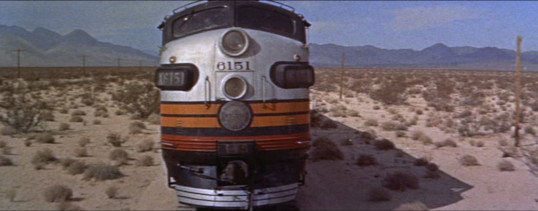
The first shots of the movie are of a train hurtling across a vast, empty desert. The original plan was for a shot of the train moving fast, directly at the camera. But it was too dangerous to fly a helicopter in front of an approaching train. The stunt pilot had the solution. He filmed the train as it backed away. Then they reversed and sped up the film – for the perfect opening shot.
“- Colonel Kane: Maybe we’re just fish out of water.
– Col. Richard Fell: What was that?
– Colonel Kane: I just think about sickness, cancer in children, earthquakes, war, painful death. Death, just death. If these things are just part of our natural environment why do we think of them as evil? Why do they horrify us so? Unless we were meant for someplace else.”
—-The Ninth Configuration
Dallas Arboretum
I had a very busy and stressful week at work and it kept going until late Friday. It left me enervated and exhausted. There are things that I need to do and things that I want to do but I wasn’t up for anything. To unwind and decompress I decided to sit my lazy ass down in the living room and watch a random movie or two from the Criterion Channel.
For no particular reason I picked a film from 1980 (though it felt very sixties-ish) the directorial debut by the author of the Exorcist, William Peter Blatty – The Ninth Configuration, starring Stacy Keach and a pile of character actors from the time.
My reading group is plowing through The Brothers Karamazov (and I am really enjoying it). As I’m sure you know, one of the themes of TBK is the question of the existence of God and, if he doesn’t exist, what is the basis for morality, if there is one. Very heavy stuff. It turns out that is the theme of The Ninth Configuration also – musings on God and Morality and Sin and Redemption. It’s the same themes, but instead of 19th century Czarist Russia the story is set in a castle in the Pacific Northwest that has been converted into an asylum for soldiers left insane by their experiences in the Vietnam War. Plus one patient – an astronaut that went raving crazy with fear on the verge of his flight to the moon.
It is a movie of its time – it doesn’t age all that well – but it is an interesting work of genius. It starts out silly and clunky – I was on the verge of giving up – but around the halfway point it veers off into new territory. There are revelations and surprises and a really crackerjack bar fight.
When it was over I made the mistake of clicking around the Criterion Channel menus and ended up watching a second film – the 1922 silent version of Nosferatu. I have, of course, seen the imagery from the movie – but had never sat through the film itself. It was fun to see the original vampire film. Count Orlof (Dracula, really, the names were changed due to the fact they never obtained rights to Bram Stoker’s story) is what a vampire would really be like – terrifying, yet strangely sad and pitiful. Vampires have become cool and sexy – that doesn’t make much sense to me. The undead should be shabby and wretched, like in Nosferatu, even if they are terrible and incredibly dangerous.
“The Greek word for “return” is nostos. Algos means “suffering.” So nostalgia is the suffering caused by an unappeased yearning to return.” ― Milan Kundera, Ignorance
I enjoyed watching The Devil’s Backbone last night I decided to cruise onto The Criterion Channel again and find something else. It had been a difficult day (aren’t they all?) so I wanted something entertaining (maybe campy) and nostalgic – plus something I didn’t have to think too hard about.
High school is such an influential time – so many things things from those tender years are locked in your very soul.
During that brief precious time one thing that I did was go three times a week to movies shown at the US Embassy. These were free, shown on 16mm, and flown from country to country as a service for embassy and military overseas. Sort of a taste of home away from home. They weren’t first run movies – most were up to a year old… sort of what might be shown in a dollar theater today (or last year). After the embassy was destroyed in the earthquake these were shown in the Marine guard quarters or sometimes at our house. I learned to run the 16mm reels – which was more difficult than you would think.
At any rate, this thrice-weekly showings were a big part of my life – I never missed a film. I would see a film or two in a “civilian” theater too – so for a lot of my formative years I was seeing at least four random movies in a week. The source of a lifetime addiction.
Though an occasional “classic” would slip through, most of these movies were pretty bad and a lot of them weren’t exactly appropriate for children. No harm done.
One group of schlocky flicks to come through the embassy was pretty much the entire catalog of classic 1970s Hammer Horror. The most memorable films – the ones burned into my paltry gray matter – were the Dracula films starring Christopher Lee.
It was a film series, many of them led into each other, roughly. There was:
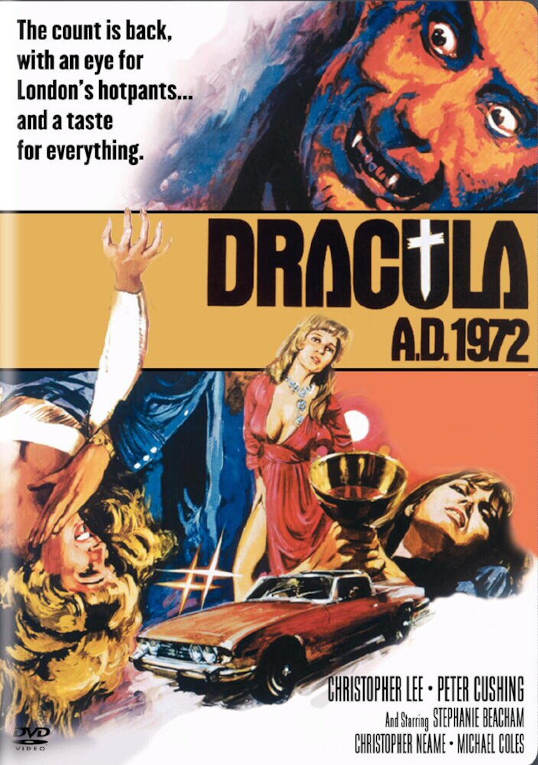
Dracula The Brides of Dracula Dracula: Prince of Darkness Dracula Has Risen from the Grave Taste the Blood of Dracula Scars of Dracula and Dracula A.D. 1972
I pretty much remember all of them except the first two (they were a bit before my time). It’s amazing how many plot points, bits of eerie music, spouts of blood, and spectacular cleavage that I still remember to this day. Those are the things that an adolescent male mind is particularly sensitive to.
So, tonight, I spotted Dracula A.D. 1972 on the list of Criterion Collection films and sat down to watch it.
First of all, it isn’t a very good movie – arguably the weakest Dracula film – and it has not aged very well. Dracula is killed in 1872 and then resurrected in swinging London, 1972, to prey on a group of decadent hippies including Van Helsing’s great-granddaughter. It has a third-rate Austin Powers vibe that doesn’t fit very well with the whole evil blood-sucking thing.
I can’t really recommend it on quality… but on nostalgia mindless entertainment… it fits the bill.






 Bill Chance