A Month of Short Stories 2017, Day 23 – The Call of Cthulhu By H. P. Lovecraft

Tales of the Cthulhu Mythos

Over several years, for the month of June, I wrote about a short story that was available online each day of the month…. It seemed like a good idea at the time. My blog readership fell precipitously and nobody seemed to give a damn about what I was doing – which was a surprising amount of work.

Because of this result, I’m going to do it again this year – In September this time… because it is September.

Today’s story, for day 23 – The Call of Cthulhu by H. P. Lovecraft
Read it online here:
The Call of Cthulhu by H. P. Lovecraft

The most merciful thing in the world, I think, is the inability of the human mind to correlate all its contents. We live on a placid island of ignorance in the midst of black seas of infinity, and it was not meant that we should voyage far. The sciences, each straining in its own direction, have hitherto harmed us little; but some day the piecing together of dissociated knowledge will open up such terrifying vistas of reality, and of our frightful position therein, that we shall either go mad from the revelation or flee from the deadly light into the peace and safety of a new dark age.

—-H. P. Lovecraft, The Call of Cthulhu

I have written about H. P. Lovecraft before – I wrote about how I first read him here… and I wrote about a great really bad movie I saw decades ago based on the Cthulhu Mythos.

Today I guess I’ll mention a sort of silly story. I was in the Garland, Texas library a few years ago, perusing the fiction aisles. The fiction, as is the usual convention was arranged by author. At the end of each case was the start and end of the author’s names… such as Smith-Thompson, or Adams-Baker. In the C section it had Clark-Cthulhu. That caught me off guard. I didn’t know that Cthulhu had written any popular fiction. I checked the stacks and there was a collection of short stories set in the Cthulhu Mythos written by a variety of authors and the person that cataloged the book mistakenly thought that Cthulhu himself, the great evil one, born on the planet Vhoorl in the 23rd nebula from Nug and Yeb had actually penned the tome himself.

I really wanted that little plastic sign and considered prying it off myself when nobody was looking. Unfortunately, I am too honest for that. When I moved to Richardson I stopped going to the Garland library on a regular basis and the last time I visited the fiction section had been reorganized and the sign was gone.

You have to take my word for it. Ph’nglui mglw’nafh Cthulhu R’lyeh wgah’nagl fhtagn.

H. P. Lovecraft:

The oldest and strongest emotion of mankind is fear, and the oldest and strongest kind of fear is fear of the unknown.
—-from Supernatural Horror in Literature

H.P. Lovecraft

Fading Away and Vanishing

“It’s funny, but certain faces seem to go in and out of style. You look at old photographs and everybody has a certain look to them, almost as if they’re related. Look at pictures from ten years later and you can see that there’s a new kind of face starting to predominate, and that the old faces are fading away and vanishing, never to be seen again.”
― Alan Moore, Watchmen

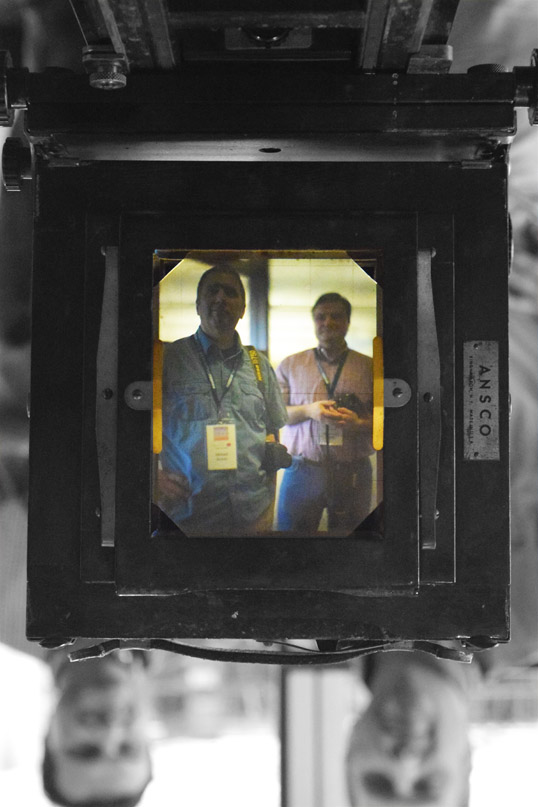
Inverted image from tintype camera. Dallas Library

In 2014 I ran into Scott Hilton of Project Barbatype at Cobra Brewing where he was shooting tintype photographs of Beard Contestants – it was pretty cool.

A while back, I ran into him again at the Dallas Library, where he gave a fascinating lecture on his project an on tintype photography in general. I took a shot of Mark Snaps and Mr. Holga from the Dallas Photowalk Thing standing behind his camera. Yes, the photo is upside down.

Ghosts In the Library

“I woke up as the sun was reddening; and that was the one distinct time in my life, the strangest moment of all, when I didn’t know who I was – I was far away from home, haunted and tired with travel, in a cheap hotel room I’d never seen, hearing the hiss of steam outside, and the creak of the old wood of the hotel, and footsteps upstairs, and all the sad sounds, and I looked at the cracked high ceiling and really didn’t know who I was for about fifteen strange seconds. I wasn’t scared; I was just somebody else, some stranger, and my whole life was a haunted life, the life of a ghost.”
― Jack Kerouac, On the Road


Window Reflection, Dallas Public Library

A Month of Short Stories 2015, Day Twenty One – The Library of Babel

The last two years, for the month of June, I wrote about a short story that was available online each day of the month… you can see the list for 2014 and 2015 in the comments for this page. It seemed like a good idea at the time. My blog readership fell precipitously and nobody seemed to give a damn about what I was doing – which was a surprising amount of work.

Because of this result, I’m going to do it again this year.

Today’s story, for day twenty one – The Library of Babel, by xxxxx

Read it online here:

The Library of Babel

Imagine, if you will, an infinite library. Well, not exactly infinite – because there is a finite number of letters in each book and the library has been demonstrated to not contain duplicates – therefore there is a finite (though very large) possible number of books. Instead of infinite then, it is endless… you will never reach the edge.

Let it suffice now for me to repeat the classic dictum: The Library is a sphere whose exact center is any one of its hexagons and whose circumference is inaccessible.

The galleries are hexagonal, with five shelves each along four walls. There are hallways leading away, these halls contain tiny restrooms and closets where the visitor can sleep standing up. There are vast ventilation shafts that give a good idea of the infinite… I mean endless nature of the library.

Well, you don’t really have to imagine this place, this library, this world, because it is described in detail in today’s plotless story – The Library of Babel. Borges’ works are intellectual and fantastic – yet somehow I find them mysteriously emotional and affecting. It’s a lot of work for a short short story – but it’s worth the effort.

At least I think so.

The methodical task of writing distracts me from the present state of men. The certitude that everything has been written negates us or turns us into phantoms. I know of districts in which the young men prostrate themselves before books and kiss their pages in a barbarous manner, but they do not know how to decipher a single letter. Epidemics, heretical conflicts, peregrinations which inevitably degenerate into banditry, have decimated the population. I believe I have mentioned suicides, more and more frequent with the years. Perhaps my old age and fearfulness deceive me, but I suspect that the human species — the unique species — is about to be extinguished, but the Library will endure: illuminated, solitary, infinite, perfectly motionless, equipped with precious volumes, useless, incorruptible, secret.

A change in the weather is sufficient to recreate the world and ourselves.

“Just for the record, the weather today is calm and sunny, but the air is full of bullshit.”

― Chuck Palahniuk, Diary

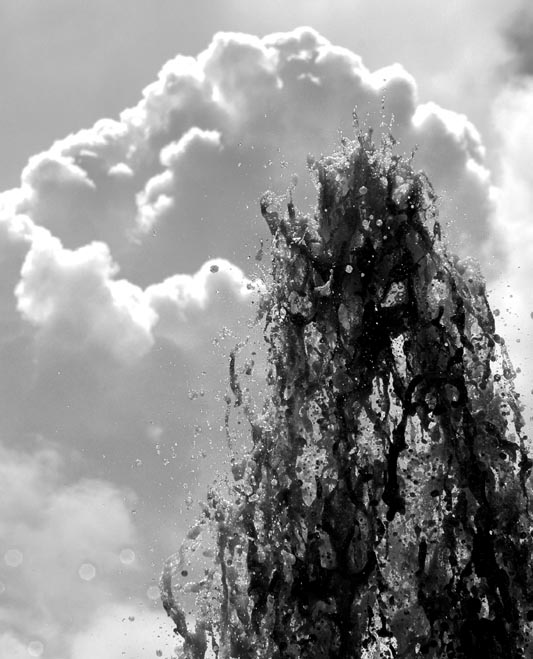
I have a bit of a bike ride planned for later on this afternoon, but as I drove to the library to return a book due today I saw a huge thunderstorm building in the west. We’ll see. At least this time I had my camera in my car.

Everybody talks about the weather, but nobody does anything about it.

-Mark Twain

I love the rain. I want the feeling of it on my face.

-Katherine Mansfield

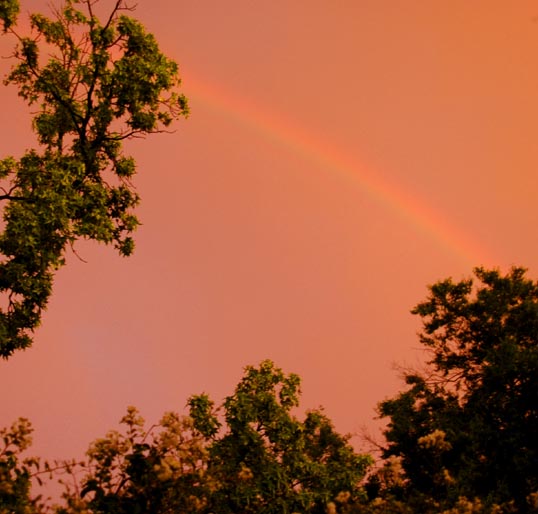
I spent yesterday afternoon rebuilding the bottom bracket on my mountain bike. When I went out to test it, the sky opened up before I could get to the end of the block. At least there was a nice evening rainbow.

A change in the weather is sufficient to recreate the world and ourselves.

-Marcel Proust

The Quest for the “Blank Claveringi”

Illustration by Jean L. Huens for the Saturday Evening Post. Done for the short story “The Snails,” by Patricia Highsmith.


A while back, viewing a hyper-realistic sculpture of hundreds of snails climbing a beer stein to their doom jarred loose an ancient flake of memory from the cobwebby and calcified ruins inside my skull. It was a memory of a short story from my childhood. It’s funny how strangely strong, yet distorted, these moth-eaten impressions can be. I remembered a story about a man on an island looking for giant man-eating snails and coming to a bad end.

Little bits, which may or may not be accurate… I remembered reading it in a magazine; I remembered an illustration showing the snail; I remembered a long, slow battle to the death between the man and the snail. Oh, I did remember being shocked at the ending. I think the story was written in the first person and I was confused at the death of the protagonist… who was telling the tale?

Now that the memory was jarred loose, it had to be teased out or it would drive me nuts. So, off to the Internet. It didn’t take too many crude search queries to quickly realize that many people had been looking for this same story. It didn’t take much more work to find the name of the story, “The Quest for the ‘Blank Claveringi.’”

I was surprised to read that the story was by Patricia Highsmith, the Forth-Worth born (though she fled quite effectively to Europe) author of “The Talented Mr. Ripley” and “Strangers on a Train.” The author had a particular affection for snails – from the book Snail, by Peter Williams:

So attached was the author Patricia Highsmith to snails that they became her constant travelling companions. Secreted in a large handbag or, in the case of travel abroad, carefully positioned under each breast, they provided her with comfort and companionship in what she perceived to be a hostile world.

The story was included in an Alfred Hitchcock collection of tales for youngsters, “Alfred Hitchock’s Supernatural Tales of Terror and Suspense.” That must have been where I read it, not in a magazine. The only problem is that the book seems to have first come out in 1973 and I felt like I was younger than that when I read it. But again, memories are funny, I must have got it wrong.

A quick check of the Richardson Library’s website and I found the book. So I went down there, grabbed it off of the shelves (It was odd looking for the book in the children’s section – it was such a horrific story) and I sat down and read it.

That was the story from my childhood. Of course, a lot of it I didn’t remember, but there can’t be too many tales set on an island with a scientist fleeing from a man-eating snail. If you wonder about the title – “The Quest for the ‘Blank Claveringi,’” the protagonist, Avery Clavering, is fantasizing about getting the new species of giant snail, about the size of a Volkswagen, named after him… though he can’t decide on the genus (thus the “Blank”).

I was wrong about the story being in first person. It is told from the protagonist’s point of view and does go inside his head – that must have been what threw me. The horror of the story is real – the snail is slow, of course, but relentless. The hero can walk faster than the snail, but the island is small and the thing will eventually catch up. He has to sleep sometime.

I enjoyed the story and made a note of reading some more Highsmith. Looking in the front of the book, I discovered that the story was part of a collection called, “The Snail-Watcher and other stories.” The library had that one too, and I checked it out. That collection has at least two horrific snail-related tales… I guess the woman did have a thing for slimy mollusks.

In the front of that collection I found another clue – it said, ““The Quest for the ‘Blank Claveringi’” originally appeared in slightly altered form in The Saturday Evening Post, as “The Snails.”

Back to the Internet. A little searching found that the story was in the June 17, 1967 issue of The Saturday Evening Post. I would have been ten years old then… and that felt about right. I checked the library archive, and they had the 1967 ‘Post in bound form in the archives. The woman at the information desk didn’t seem to understand what I wanted (“Yes, we have magazines… 1967?”) but eventually I was able to get her to go back and retrieve the volume for me. I had to sign a form and give up something (my library card) as collateral to get the tome, and I did.

It was really cool to sit down at a library study station and look through a set of forty-five year old magazines. The ads, the photographs, the illustrations…. pretty damn cool.

I found the story, with an excellent illustration by Jean-Louis Huens. In the white space above the title, someone had written in pencil, “This is what I wanted you to read.” So, I am not the only person on a quest for this story, not even the only one to end up in the archives of the Richardson Public Library.

I took a photo of the illustration with my phone and then sat there and read the story again. Since I had cruised through the Alfred Hitchcock version only a few minutes before, I immediately began to notice differences in the text. At first they seemed minor, only polishings, or rearrangements of phrases. But as I neared the end, the story veered and suddenly it was a completely different tale altogether.

This was probably the version I had read as a ten-year-old child. I seemed to remember another person on the island, and that was only true on the Saturday Evening Post Version. Though the only real significant difference between the two is in the last handful of paragraphs, the thrust of the two plots diverged completely. While the Hitchcock version was an existential tale of the futility of man against the inexorable power of nature, the second was a revenge tale of murder and madness.

I really don’t know why the story was rewritten so savagely, though I think I did like the Hitchcock version (which I assume is the revised tale) a tiny bit better.

At any rate, I checked out two of her books of short stories – The Snail-Watcher and other stories, and Little Tales of Misogyny (a slim volume of very short works about very bad people). I really should not read this kind of stuff. What I am reading is a very strong influence on what I am writing and these stories play into my natural tenancies toward repulsive scribbling.

But it is what it is. As a matter of fact… I have to write something tomorrow for my Sunday Snippets…. Maybe something about giant Volkswagen-sized man-eating snails…. maybe a sequel. What would happen if someone brought a snail back to the mainland?

Snails can reproduce frighteningly fast under the right conditions, you know.

Sunday Snippet – The Revenge of the “Blank Claveringi”

All the Information in the World

In my surfing a few days ago I came across, as I’m sure you did, the news that after 244 years Encyclopedia Britannica was giving up on its print edition.

We never had Britannica in our house – it was too expensive. We had a cheaper, more “modern” looking set… I don’t remember the brand. Of course, my schools – every school (I went to… I think twelve different ones)  library had a set of Britannicas. I wasn’t a big fan of them; they seemed too stuffy for my taste. I loved the top-line World Book (which looks like it is still in print) – I remember when I discovered the transparent acetate pages that showed the human anatomy in several layers. It seemed like amazing information luxury to me.

Most kids used the various encyclopedias to plagiarize their school reports, usually cribbing the short paragraphs out verbatim.  I, on the other hand, used to read encyclopedias cover to cover, from AA, through Z, and on to devour each annual update and addendum. I loved reading them. I’d read my books at home, then I devour the ones in the school library, then on to the history sets (I loved these because they were in chronological order) and finally the long shelves of Time/Life educational books.

Sitting here, writing this, I remember the hours spent turning the pages, the slight fungus odor of the old paper, the weight of the editions as they came off the shelf, the nasty paper cuts – I remember following the footnotes and then the memory of getting to the same article in alphabetical order. I retained a surprisingly large amount of information – not sure how much good it did me. The tomes were good on dry facts but not so much on wisdom.

I am not overwhelmed with wistful nostalgic sadness, though. Plenty of people are full of woe that an age has passed and they lament the disappearance of such a totem of their youth. My thoughts run in a different direction. What I think about is what a kid that, in a vain attempt to satisfy his unquenchable curiosity, was forced to read encyclopedias cover to cover, volume to volume, could have done if he had been born a few decades later and had access to the internet. It would have been like drinking from a fire hydrant.

I’ve been seeing headlines like, “Encyclopedia Britannica killed by Wikipedia!” That is not true at all – Wikipedia is a great thing, but sometimes you want information that wasn’t written by nineteen-year-olds. There will always be a place for the verified truth.

“This has nothing to do with Wikipedia or Google,” Encyclopaedia Britannica Inc. President Jorge Cauz said. “This has to do with the fact that now Britannica sells its digital products to a large number of people.”

The top year for the printed encyclopedia was 1990, when 120,000 sets were sold, Cauz said. That number fell to 40,000 just six years later in 1996, he said. The company started exploring digital publishing in the 1970s. The first CD-ROM edition was published in 1989 and a version went online in 1994.

The final hardcover encyclopedia set weighs 129 pounds and is available for sale at Britannica’s website for $1,395.

An entire set costs more than an iPad. A low-end tablet is half that.  There is an iOS app which is free, but has a $1.99 a month subscription for unlimited content.

If you went back in time to, say 1969, and said, “Hey, for half the cost of that shelf full of heavy books, I’m going to give you a little book or pad, about the size of a magazine, that you can take anywhere with you and when you touch it, the content you are looking for will appear on it, more or less instantly. It will be in full color, with sound and full-motion television, when appropriate. You’ll have to throw the old, paper ones away, though. To keep it updated you’ll have to pay two dollars a month. Oh, and if you need a break you can play Angry Birds on it too.”

What do you think the reaction would have been? It makes me think of Arthur C Clarke’s third law- Any sufficiently advanced technology is indistinguishable from magic. A fully loaded iPad would have looked like magic in 1969. And that’s 1969! I remember 1969. I was twelve. I was reading encyclopedias in 1969.

I wish I had had an iPad.

This is me in 1969 (or so). I look like a kid that read encyclopedias cover to cover.

#Britannica

No More Encyclopedia Britannica

The Death of the Encyclopedia

Encyclopedia Books–The End of an Era

Throw the book at ‘em

Encyclopedias and Wikis

Goodbye Britannica, We Will Miss You!

Death of a Salesman Part 2: Encyclopaedia Britannicas Going Out Of Print

Encyclopedia Britannica going 100% Digital

Britannica encyclopedia out of print but the bibles still going strong

Encyclopedia Britannica to end print editions

No More Print edition of Encyclopaedia Britannica

Encyclopaedia Britannnica RIP

WILL YOU MISS THE ENCYCLOPEDIA?

No more Encyclopedia Britannicas in book form

The World on a Shelf

Encyclopedia Britannica is going digital only.

Encyclopedia Britannica to End Print Editions

No More Encyclopaedia Britannica Books

My Encyclopedia Britannica Set is Dusty but Not Forgotten

Encyclopedia Britannica

Encyclopaedia Britannica To Stop Publishing Books After 244 Years

Goodbye Encyclopedia Britannica

My thoughts on a lost era: Encyclopedia Britannica to stop printing books

Closing the Book: Encyclopedia Britannica Goes All Digital

read / end of an era

Encyclopedia Britannica ends publication after 244 years

CHECK OUT SOME THINGS THAT ARE GOING BYE BYE

End of an encyclopedic era

Wikipedia and the Internet just killed 244-year-old Encyclopaedia Britannica

Rule Britannica

Encyclopedia Britannica Goes Out of Print

ENCYCLOPAEDIA BRITANNICA, PRINTED NO MORE

Encyclopaedia Britannica To End Print Editions

Encyclopaedia Britannica wiped out by Wikipedia, selling final print edition

Encyclopedia Britannica Goes Out of Print

Library Book Sale

The Richardson Library had their annual big-ass book sale this weekend down in the crowded basement multi-purpose room. This used to be a massive deal to me. I would get a huge donated shopping bag at the entrance and fight my way along the long tables piled with paperbacks or heaped with hardcovers – the stacks screaming, protesting the weight. I would fill my brown paper bag until the kraft was tearing, pay my fee, and eagerly get my haul home.

Now, though, I have my Kindle. There are more books hiding in that slim slip of plastic than I can possibly read in the few remaining years I have allotted to me. I feel fairly certain that I will pass through this vale of tears with more than a few files left unopened.

Kindle

Call Me Ishmael

Still….

I almost skipped the book sale, but I went more out of nostalgia than any logical purpose – though I do know there are books that I’ve been looking for that are not out in digital format. Plus, it is sometimes nice to have a real, physical paper book – something you can give away or curl up with when your peepers are tired of pixels.

So I eschewed a shopping bag and simply pushed myself past all the enervated shoppers. Once more into the breach.

A good part of the large but cramped basement room was dominated by a handful of families that knew each other. They had a fleet of the massive baby carriers (barely smaller than the aircraft variety) that blocked entire aisles and provided a perch for their pre-reading hellions to reach out their snot-and-saliva encrusted paws and pull teetering piles of books onto the floor while giggling like giddy gibbons. Their slightly older siblings were grabbing stuff out and exclaiming wisdom like, “I only want books about dogs!” or “Are you SURE this is a childrens’ book?” while their mothers clucked loudly at each other with self-satisfaction at the precociousness and preciousness of their satan-spawn procreations.

Finally, after forever, this boiling mass of distraction and pain moved out the front and could be heard arguing over the price of their purchases in the hallway. The sound in the room was reduced to a certain low growl made up of the combined almost-inaudible grunting of the serious bargain hunters scooping up endless tomes that they had never known of until today but could simply not live without. This is a sober business. The air-conditioning, installed under a government lo-bid contract, struggled to cut the heat and miasma of used book mold-spores and bargain-hunting sweat.

So, did I buy anything? You betcha.

Hardbacks were only two dollars and paper seventy five cents. It would be a crime to let this opportunity go unheeded.

I bought a really nice hardback copy of Alice Munro‘s Open Secrets. Someone at work expressed a love of short stories yet had never read any Munro (yeah, I know…). I want to reread “The Albanian Virgin” carefully and outline it – it is the most amazingly structured piece of short fiction I’ve ever seen and I want to try and figure out how she does it.

On a whim I grabbed a paperback collection by John McPhee. This one is called Table of Contents and is a collection of his amazing short non-fiction. I can always read me some McPhee and come out of it knowing something I didn’t before.

After choosing these two light bits of bon-bon I thought for a minute and hauled out a big hunk of meat – the nine-hundred page posthumous magnum opus 2666 by Roberto Bolano. I have had my eye on this gigantic pile of translated text for a bit. For some reason I thought it would be fun to attack it as a fortress of paper rather than a cloud of bytes. Will I ever actually read it?

Probably. If I live long enough. Stick around and find out.

The parking lot had been full and I had to hike almost to the post office to get to my car. A thin older man scuttled by me, on his way in. He stopped and stared at the burden under my arm.

“Hey, I want all three of those books! I was worried they would be all picked over by now!”

He shot off towards the maelstrom of the book sale. If he had waited I would have sold him the three I had… at only a slight profit.