“It is good to have an end to journey toward; but it is the journey that matters, in the end.”
― Ursula K. Le Guin, The Left Hand of Darkness

Margaret McDermott bridge, bike/pedestrian path, Dallas, Texas
“It is good to have an end to journey toward; but it is the journey that matters, in the end.”
― Ursula K. Le Guin, The Left Hand of Darkness
Margaret McDermott bridge, bike/pedestrian path, Dallas, Texas
“I only went out for a walk and finally concluded to stay out till sundown, for going out, I found, was really going in.”
― John Muir, John of the Mountains: The Unpublished Journals of John Muir
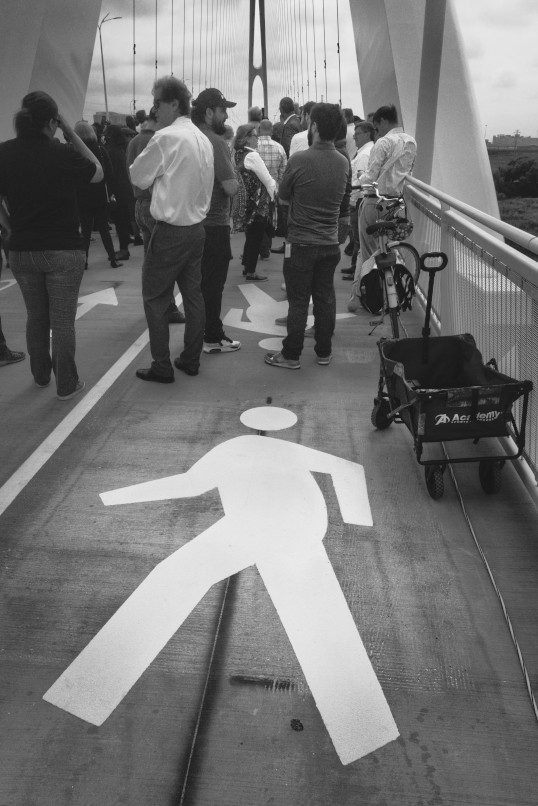
Margaret McDermott bridge, pedestrian path, Dallas, Texas
“It’s creepy, but here we are, the Pilgrims, the crackpots of our time, trying to establish our own alternate reality. To build a world out of rocks and chaos.
What it’s going to be, I don’t know.
Even after all that rushing around, where we’ve ended up is the middle of nowhere in the middle of the night.
And maybe knowing isn’t the point.
Where we’re standing right now, in the ruins in the dark, what we build could be anything.”
― Chuck Palahniuk, Choke
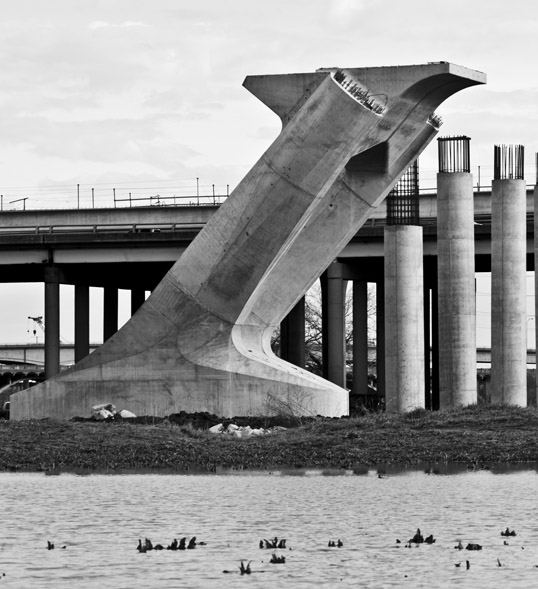
Let me check the date on this photo – sometime mid 2015… six years ago. It actually seems like longer than that. They had already been working on the bridge/highway complex for three years, they started in 2012. This was the base of one arch, down in the Trinity River bottoms, near downtown Dallas. I was down there on my bicycle, riding the muddy gravel paths. The other half of the arch was further along – reaching up into the sky.
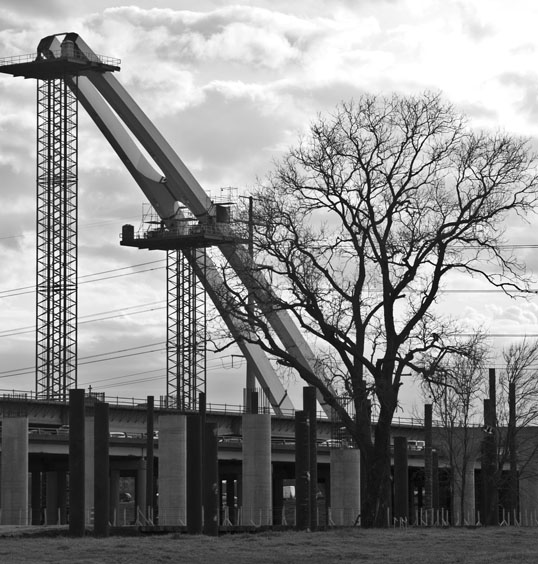
These massive arches, designed by Santiago Calatrava were never intended to support the roadway. That would be too expensive and unnecessary – a simple concrete causeway was all that was needed. The immense, soaring arches would cost 125 million dollars and support a bicycle/pedestrian bridge – and look good.
As a cycling advocate I had very mixed feelings about this. Of course, another route across the river was welcome – but 125 million dollars was way too much – that money could do a lot of good in man other places. Well, nobody asked me – and they went ahead and built the Margaret McDermott Bridge – way behind schedule and way, way over budget.
And then things went from bad to worse. When the thing was finished, it was discovered that corners had been cut, the bridge cable fasteners were not properly tested, and the thing was in danger of falling down in high winds.
I had resigned myself to never having the bridge opened… after all these years, but I was wrong. A couple of weeks ago I received in invitation to ride my bike across the bridge during a grand opening ceremony. Now, truth be told, most of my cycling friends had already rode around the safety barricades and crossed the bridge over the last couple of years – but I never did. So I was excited to go down there and ride across.
I rode up right when a news camera was running.
There were about a dozen bike riders – we picked up our… what do you call them? The things that you pin to your shirt at an event? Running bibs? Yeah, that must be it – it says “Printed by Boulder Bibs.”

And off we rode. It was fun – I’ll be back. There are steep spots – especially on the north (pedestrian) side. I need to look at moonrise – the bridge will be fun at night – the view of the downtown skyline is spectacular.
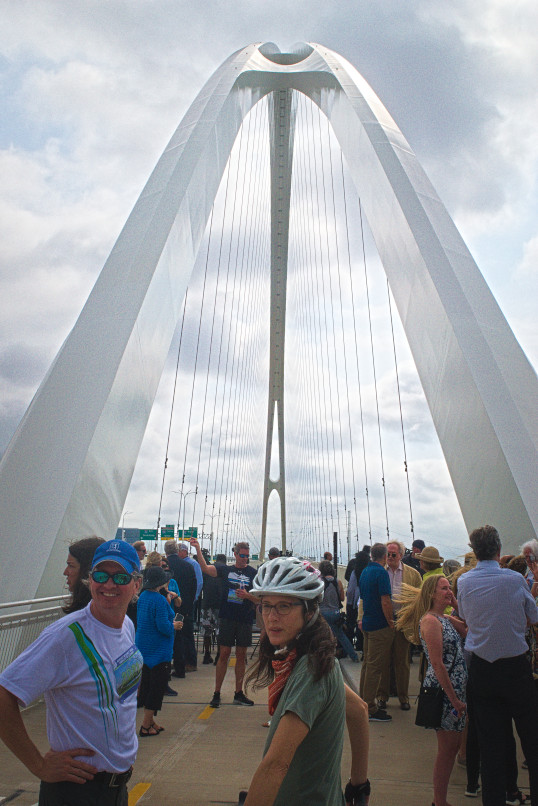
Folks at the ribbon-cutting. The arches are spectacular from the bike/pedestrian lanes – maybe they are worth the money.
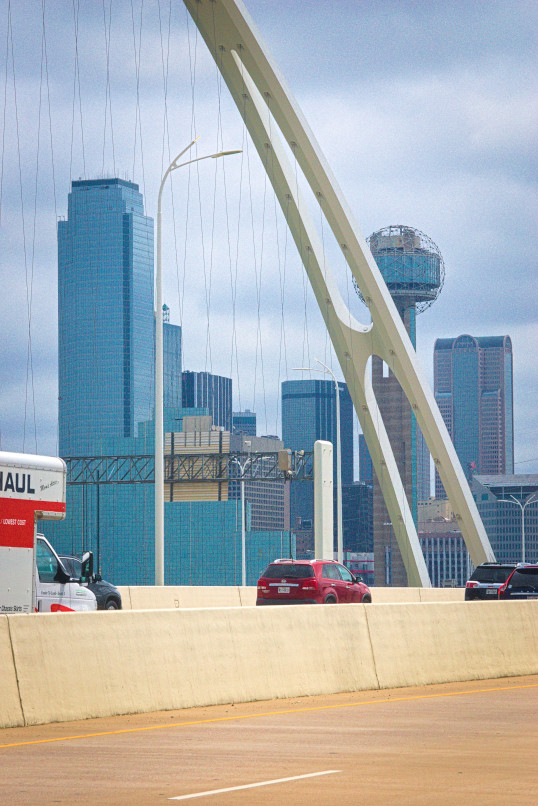
View of downtown from the bike lane on the bridge.
The ceremony made all the news shows. Here’s a good one – you can see me from behind riding my bike near the end, at the 1:56 mark.
“Why do people have to be this lonely? What’s the point of it all? Millions of people in this world, all of them yearning, looking to others to satisfy them, yet isolating themselves. Why? Was the earth put here just to nourish human loneliness?”
― Haruki Murakami, Sputnik Sweetheart
We’re a couple weeks into the Difficult Reads Book Club devouring of Haurki Murakami’s long novvel 1Q84. Tonight, we had our Zoom meeting to discuss chapters 8 through 14.
One cool thing, for me, was when one of the two point-of-view protagonists, Tengo, went into a Tokyo bookstore, Kinokuniya. I liked that because there is a Kinokuniya bookstore in Plano, Texas, not very far from where I live, and it’s one of my favorite places.
I stumbled across the bookstore online and knew I wold love the place. It’s not so much the books… it’s the other stuff. The place is a cornucopia of pens, fountain pens, art supplies, notebooks, paper… all that sort of stuff.
I had a tough time finding it the first time I went up there. It’s actually a big room off of the food court of a big Asian grocery store at Highway 75 and Legacy Drive. It’s packed with cool stuff. I’ve bought a couple pens there, some ink, and, especially, a few packs of fountain pen friendly paper (Tomoe River ).
The place is crowded… chock-a-block with cool stuff. I could look for hours. So what I do is set goals for myself and start setting a little bit of money aside. When I reach my goal, I’ll drive down to Kinokuniya and treat myself to something with the cash I’ve accumulated.
This is truly the best of all possible worlds.
“Likewise—now don’t laugh—cars and trucks should view the bike lanes as if they are sacrosanct. A driver would never think of riding up on a sidewalk. Most drivers, anyway. Hell, there are strollers and little old ladies up there! It would be unthinkable, except in action movies. A driver would get a serious fine or maybe even get locked up. Everyone around would wonder who that asshole was. Well, bike lanes should be treated the same way. You wouldn’t park your car or pull over for a stop on the sidewalk, would you? Well then, don’t park in the bike lanes either—that forces cyclists into traffic where poor little meat puppets don’t stand a chance.”
― David Byrne, Bicycle Diaries

I have not been out riding my bike nearly enough – not enough miles and not enough riding with people. So when I read that some folks were riding from the Forrest Lane DART station over to the end of the Northaven Trail for the groundbreaking of the planned bridge over Highway 75 I thought I’d go. I did cheat and drive down to the station with my bike in the back of my car – so it was going to be a short ride.
A city like Dallas has a lot of bike trails and dedicated lanes – but a lot of them were put in as recreational opportunities – for the neighborhood to walk their dogs or get in a few miles of exercise – not as transportation corridors. That lead to what I call “choke points” – barriers to car-less transportation. The most common are highways, which can be impossible to cross without a car.
And the worst of these highways is 75, which slashes Dallas in half north to south.

The Northaven trail is a fairly new trail that runs through north Dallas all the way from 75 in the east almost to Love Field in the west. On the other side of 75 is the White Rock creek trail, which connects through miles of East Dallas trails – but it isolated by the highway.
For the last few years, work has been going on to connect these two with a bridge over the highway. Finally, funding has been established, a design has been finished and approved, and work is about to start. Two years from now, we should have our bridge.
And today was the groundbreaking ceremony. The mayor of Dallas was there, Dallas county officials, City Council Members, Park Board Members and more – they all wanted their turn to pontificate about how hard they have been working and how much credit they deserve. It went on for way too long for anyone in the audience – but that’s fine – if their egos and political careers need some service, so be it, as long as we get our bridge.
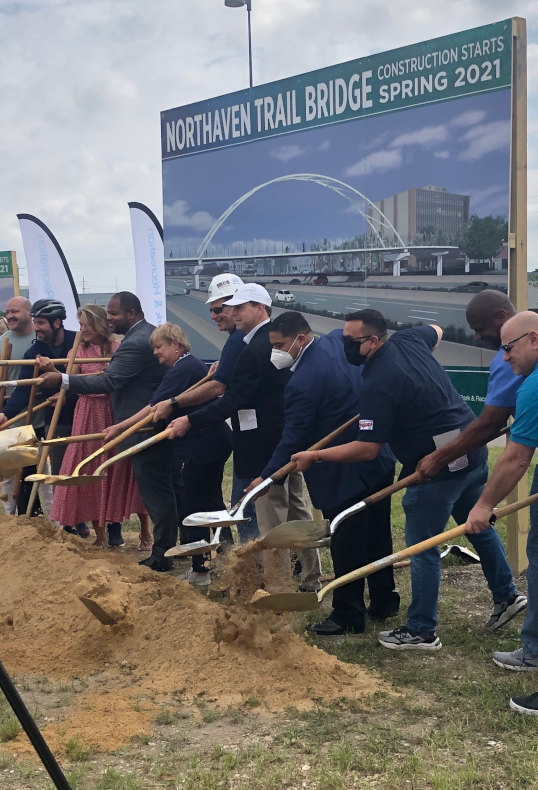
I had a good time. I was able to meet a good number of friends that I had not talked to since before COVID. That was nice.
And best of all, I learned a new route back under Highway 75 that joins up with the White Rock Creek Trail, Cottonwood Trail, and Forest Lane DART station where I parked my car. There is a little known footpath through a tunnel under the highway. You have to ride on a sidewalk along the frontage road for a few hundred feet, but it’s a good way to get across. Not the best looking path, but it works.

So why do we need the bridge? A path like this doesn’t give any opportunities for politicians to shovel sand.
“There are people in the world so hungry, that God cannot appear to them except in the form of bread.”
― Mahatma Gandhi

I read this article in the Dallas Paper today:
What happened to Dallas’ Mrs. Baird’s bread factory? Curious Texas investigates (dallasnews.com)
Delightful smells of flour, butter and sugar from Mrs. Baird’s baking plant filled the intersection of Mockingbird Lane and Central Expressway for almost 50 years.
But in 2001, the North Texas queen of bread closed down. What once was a highly efficient plant is now a Southern Methodist University data center and tennis complex.
The bakery’s absence left one reader asking Curious Texas: “Whatever happened to Mrs. Baird’s Bread?”
Executives made the decision to close the Dallas factory because its location didn’t allow much room for growth.
I have strong memories of the old Mrs. Baird’s bread factory at Mockingbird and 75.
In early 2001, during a difficult time, I took the kids (then nine and ten years old) with some of their friends down there for a tour of the factory. I didn’t realize that it would be gone in a few months.
From my journal –
After the bowling, we drove down into Dallas for a prearranged tour of the Mrs. Baird’s bread factory. They make white sandwich bread and powdered sugar donuts. I’m not sure if the kids learned anything, but I thought it was pretty cool. I liked the giant pans of dough.
They gave us samples to try right off the line. The donuts were hot and crunchy and a lot better than when you buy them at a gas station or something. Then we came to the ovens, and the tour guide pulled a fresh loaf right off the line, sliced it, slathered it with some butter, and let each of us eat a chunk. I’m not a huge fan of regular sliced white bread, but this – hot, fresh, and fragrant – was delicious. I wonder what they do after they wrap the bread to make it so bland.
The tour was over pretty quickly, only about a half hour. The kids were given presents – paper hats, brochures, and bags of sugared mini donuts. I loaded six into the MiniVan and proceeded to make a wrong route decision and drove right into a big traffic jam.
Stuck in city traffic with a van full of kids eating donuts is not a fun thing. Luckily, I was able to bail off the freeway and wind my way home by the back roads without much trouble. Still, the seats had a thick coating of powdered sugar before we made it home.
I still remember the taste of those donuts and the fresh bread. It was so, so much better than the plastic wrapped product peddled over the next few days in the stores. I always think they had a room full of giant evil flavor-removing machines hidden away somewhere.
There was another time, a couple of years earlier, that I learned something about that bread factory. I was at a meeting on the air pollution – specifically the high ozone levels of the Dallas-Fort Worth Metroplex. Ground level ozone is a complex phenomena which is mostly generated by the mixture of VOC (Volatile Organic Compounds – mostly solvents, like gasoline), Nitrogen Oxides, and sunlight which causes the normal O2 to convert into the toxic and unstable O3. – EPA page on Ground-level Ozone
I was at the conference talking to the guy next to me.
“I work for Mrs. Baird’s,” he said.
“The bread company? Surely you don’t have any air pollution.”
“No, you’re wrong. Every day we make hundreds of tons of bread dough. The yeast gives out a tremendous amount of ethanol, which evaporates in the ovens. It’s all VOC and we are have a terrible problem complying with the air pollution regulations.”
The newspaper article talks about running out of space – but I know a big reason the plant closed (and production moved to a more rural – and ozone compliant area) is the air pollution caused by the rising bread. You always think of pollution being caused by giant, ugly factories – but it can come from something as simple and necessary as baking bread.
“He takes a kitchen chair and sits in the yard and all the ducks come around. He holds up the cheese curls in one hand and caramel popcorn in the other and his audience looks up and he tells them a joke. He says: So one day a duck come into this bar and ordered a whiskey and a bump and the bartender was pretty surprised, he says, “You know we don’t get many of you ducks in here.” The duck says, “At these prices I’m not surprised.* And he tosses out the popcorn and they laugh. ‘Wak wak wak wak wak. I was shot in the leg in the war.’ Have a scar? ‘No thanks, I don’t smoke.”
― Garrison Keillor, Truckstop and Other Lake Wobegon Stories
There’s a park at the end of my block with a couple of flood-control ponds (the drainage from the ponds runs in a creek/ditch behind my house). Despite their utility in times of rain and excessive urban runoff they are quite attractive.


My neighborhood is called Duck Creek, because of the eponymous body of water that runs diagonally through the place, but there are also plenty of ducks. This is the time of year that the baby ducks are hatched and groups of them are herded around by their parents.

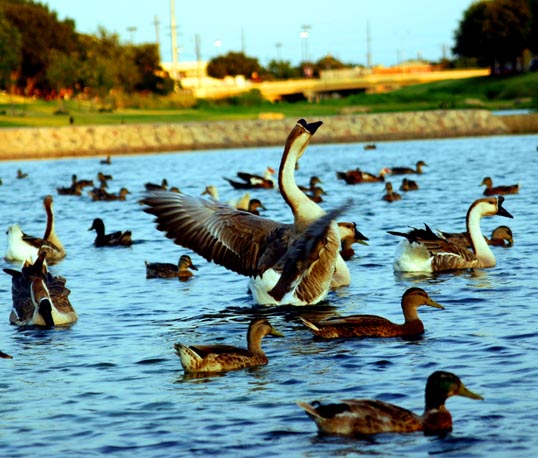

The problem is that there is a little, low dam at the end of the ponds. The water flows over it – during the summer it’s not much more than a trickle. Unfortunately, often a baby duck gets swept over this dam and separated from their loving duck family. They can’t get back over the dam, even though it isn’t more than a couple feet high.
The rest of the ducks then have to go over the dam to rescue their sibling. Then they have to waddle up the bank and cross a fairly busy street to get back into the pond.
People in my neighborhood have been complaining to the city about this and today, I discovered that there is a new construction project going. The city is making a concrete duckling ramp so that they can get up and over that low dam.

Excuse all the trash in the photo – it tends to collect there – a crew comes by periodically to pick it up.
I’ll go back in a few days, once the wooden forms are removed and see if the little ducks are actually using their ramp – I’m sure they will. Maybe the turtles will too. I’m sure the snakes will.
Does this count as infrastructure?

A new review assesses what it takes to maintain endurance and strength when circumstances interfere with your usual training

We think of our future selves as strangers.

More Important Than Escaping Higher Taxes

Turns out mothers all over the world are telling a lot of the same outrageous fibs.
Your brain is more complex than you probably realize. Let neuroscientist Lisa Feldman Barrett expand your mind.

To be human … means constantly to be in the grip of opposing emotions, to have daily to reconcile apparently conflicting tensions.
– Stephen Fry, Bafta Lecture, 2010
The owner of the Raven bookstore, in Lawrence, wants to tell you about all the ways that the e-commerce giant is hurting American downtowns.

(click to enlarge)
Book With Wings
Anselm Kiefer
Modern Art Museum of Fort Worth

TV

I took the test. I’m not. Not even close.

Graffiti in Deep Ellum. This warrior is nothing if not well-muscled… plus he is carrying off his prize of war.
Weight lifting, also known as resistance training, has been practised for centuries as a way of building muscular strength. Research shows that resistance training, whether done via body weight, resistance bands or machines, dumbbells or free weights, not only helps us build strength, but also improves muscle size and can help counteract age-related muscle loss.
More recently it’s become popular among those looking to lose weight. While exercises such as running and cycling are indeed effective for reducing body fat, these activities can simultaneously decrease muscle size, leading to weaker muscles and greater perceived weight loss, as muscle is more dense than fat. But unlike endurance exercises, evidence shows resistance training not only has beneficial effects on reducing body fat, it also increases muscle size and strength.

Mural
Deep Ellum
Dallas, Texas

Downtown Square, McKinney, Texas
I hate talking on the phone… always have. I thought I was the only one.
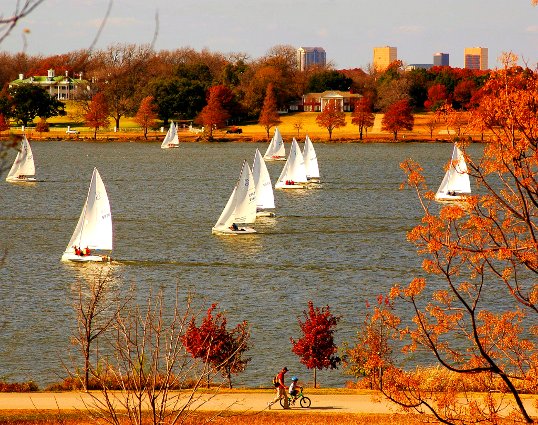
Sailboats on White Rock Lake, Dallas, TX
“Ice burns, and it is hard to the warm-skinned to distinguish one
sensation, fire, from the other, frost.”
― A.S. Byatt, Elementals: Stories of Fire and Ice

Here in North Texas the temperature is above freezing now and everything is slowly returning to normal. The biggest thing now are all the busted pipes – I know more than a few folks that have tremendous water damage. We were without water for a few days – a frozen pipe somewhere – but when the thaw came the pipes held. We were without power for a few stretches – rolling blackouts – but those weren’t a big problem for us. It was sort of nice to be without electricity for a bit – the temperature dropped but it was an excuse to bundle under the blankets.
The saddest thing at our house was we discovered two frozen young rabbits in the yard as the snow melted. I’m sure there was a lot of that.
There is a wire photo going around of the water fountain behind the library here in Richardson – in articles like this one.

When I saw it, I remembered I had discovered it frozen five years ago and wrote a blog entry about it.
It looks like its a little more frozen this time, but it’s the same place. I do know the city leaves the water running to protect the pipes and it gets like this fairly often.

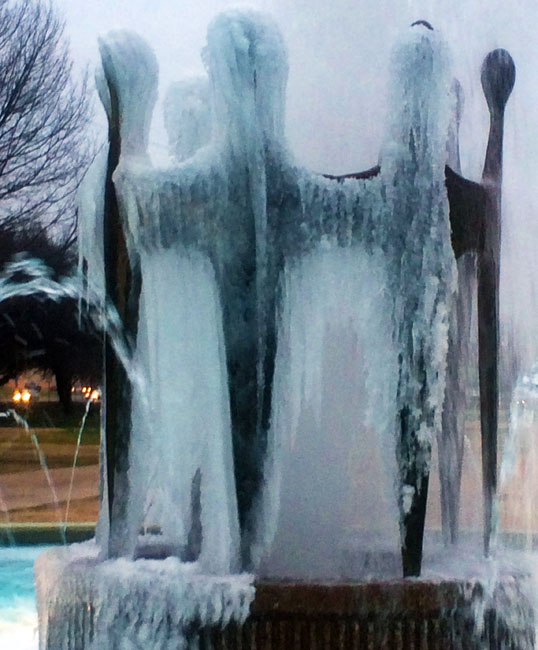
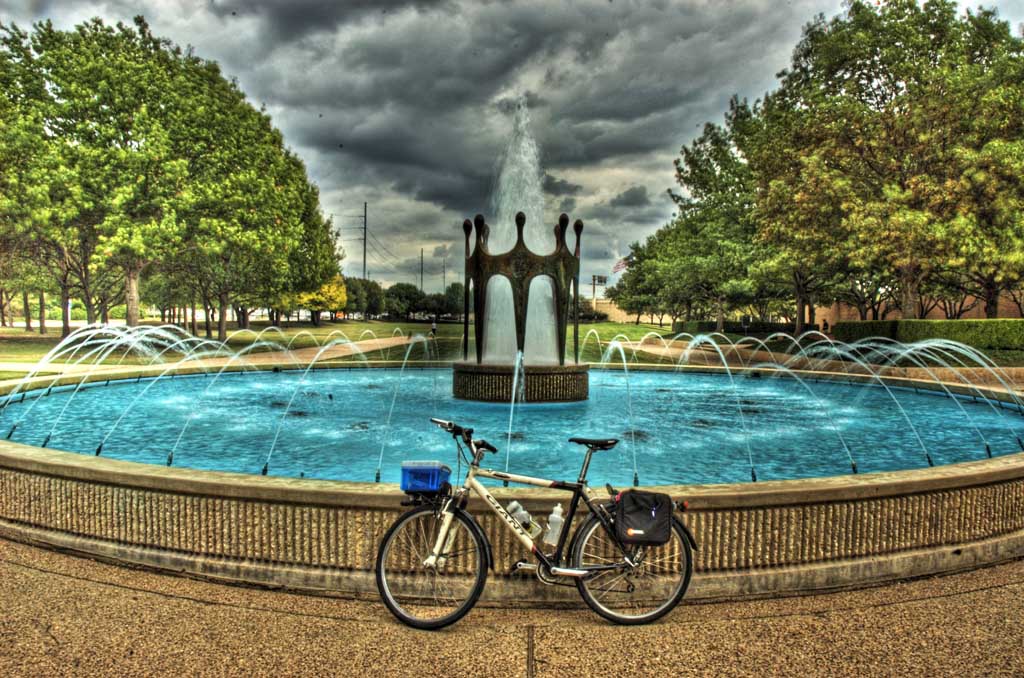
Here’s the fountain on a warm day along with my cargo/commuting bike:
 Bill Chance