A blogger, surroundedbyimbeciles that has stopped by here has a picture of himself at the Great Sand Dunes National Park as his avatar. He wrote a blog entry about it, check it out.
I knew I had two scanned photographs of Nick at the same spot, one taken in 1996 and one taken in 2001.
I dug around and found the photos and the blog entry I wrote in 2001 to go along with them.
Here’s the eleven year old entry from my archives…. July 3, 2001.
I’ve been to the Great Sand Dunes before, twice. Once, six years ago or so, a year before I started my journal the whole family stopped on the way from Santa Fe to Buena Vista. In 1997 I came here alone, on a solo trip around Colorado. I spent a couple days and camped here, and wrote about it.
Medano creek, this late in the summer, is barely a trickle, and right after we arrived we crossed it and immediately started climbing the dunes. Even when we were walking the wide expanse of level sand before the dunes actually start I had my doubts about whether I could make the seven hundred foot climb up the piles of sand. It’s tough walking and at over eight thousand feet, the altitude doesn’t help much when you’re old and fat and out of shape like me. As soon as the steeper slopes started and Nick and Lee coursed ahead, shooting up the dunes like active ten-year-olds I knew there was no way I could make it all the way. My lungs were burning and my legs felt like Jello.
I decided that I could try to get as far as I could, though. I’ve done this before so I remembered how painful and discouraging uphill walking on sand can be – so I thought I’d be patient, walk a while, rest a while, and see what happened. The day was getting hot, too.
Nick and Lee pushed on ahead and pretty quickly they disappeared. Once you get into the dune field closer ones hide the highest dunes. One good thing about dune hiking is that you can’t really get lost and it’s a lot easier coming back down than going up – so it’s hard to get stranded in the sand.
Each dune I’d climb I divide into three sections in my mind. I’d climb the first third, then pause to try and catch my breath. The second third would be tougher, I’d have to stare at my feet and force them to take little baby steps until I reached my interim goal, exhausted, so I would sit down and rest until I felt my pulse return to normal. The third third would be easy after that long rest, and I’d settle in when I reached the top so I could enjoy the view.
By patiently munching through each set of dunes, higher and higher, I soon found myself walking the last slope to the highest dune, and not feeling too bad. I was worried that Nick and Lee would be impatient and head back down before I reached them, but they were there, digging around in the sand.
There was a gaggle of teenagers with sophisticated hiking gear – daypacks with integrated hydration systems and carbon fiber hiking poles- already there. They referred to Nick or Lee, who had been up there with them for a while before I arrived, as “the kids.” One of the teenagers was trying to impress his girl by talking about Lawrence of Arabia.
“No,” Nicholas said, “This isn’t like that, this is like Dune.”
We posed for a photo, then Nick headed back down to check on Candy.
I had a tough time getting Lee to go. There is another high dune, maybe five miles away, and Lee pitched a fit when I told him we couldn’t walk to it.
The teenagers left, then some guy from Switzerland walked up and we talked a bit while Lee dug holes in the sand.

Lee digging in the high dune
“A beeg sander-boxer,” the guy said, in his thick accent, “Een Switzerland, children haf only small boxen wit sander.” He was on a driving trip from Santa Barbara and I think the distances in the American West threw him a little. “Too far for little time,” he said. I said I was from Dallas and he asked if that was over a hundred miles from there. When I told him it was seven hundred miles he looked perplexed.
Meanwhile, Lee had walked over the next dune and was stomping out a giant, “LEE WAS HERE,” in the sand. The dunes are dry and hot on the surface, but surprisingly, are wet only an inch or two down. If you drag your feet it makes a dark line of wet sand, only to disappear a few seconds later.
A cloud blew down from the mountain and it began to rain. “Rain in zee desert!” the guy from Switzerland exclaimed. I convinced Lee to head down then, I was afraid of lightning up on the exposed dune.
“That’s more sand than I’ll ever have to play in,” said Lee.
“Don’t worry, you can play in more at the bottom.”
“Not as much as up here.”
The walk down was a lot easier than the one up. The hot day was suddenly cool from the rain, the dry yellow sand at first mottled, then dark from the falling water. By the time we reached Medano creek it was over and the sun came out again.

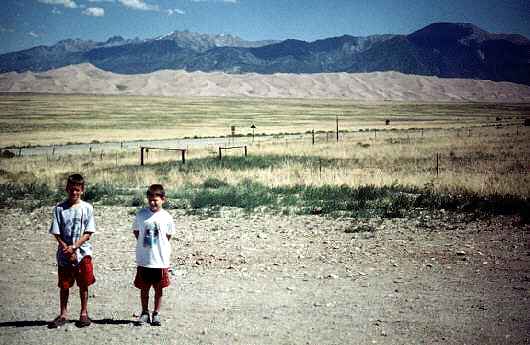
Nick and Lee in the parking lot at the edge of the Monument. 2001
Nick and Lee standing in the parking lot of a gas station right outside the Great Sand Dunes National Monument. The dunefield is a lot bigger than it looks, the tallest dune is seven hundred feet high or so. The mountains behind are the Sangre de Cristo range, several are over fourteen thousand feet high.
Lee busied himself in the creek, making a dam. While he worked I chatted with a Park Ranger – he had brought down a special sand wheelchair for a park guest. It had huge red balloon tires so it could be pushed across the soft sand. The Ranger said that the sand was twice as hard to walk in or to climb as firm ground.
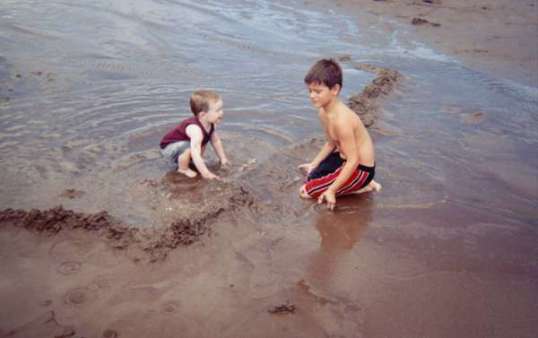
Lee getting help with his dam in the creek.
Meanwhile, Lee’s dam was stretching in a ragged arc across a portion of the creek. Medano creek is odd because of the load of sand it carries (the creek is what helps corral the dunes in place, it carries escaping windblown sand back around to the upwind side of the dunes) the stream is constantly moving around in little pulses and rushes as the sediment raises the bed of the creek itself. It was a good lesson in hydrology for Lee, with several lessons:
1: Don’t make a dam out of sand.
2: Little leaks soon become very big leaks.
3: The more you patch the little leaks the higher the dam gets and the faster the little ones get bigger.
4:Eventually, your dam is toast.
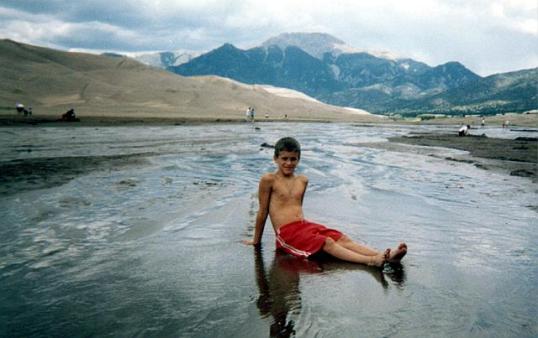
Nick in 2001
I posed Nick in this picture at that spot because I wanted to compare it to this picture.
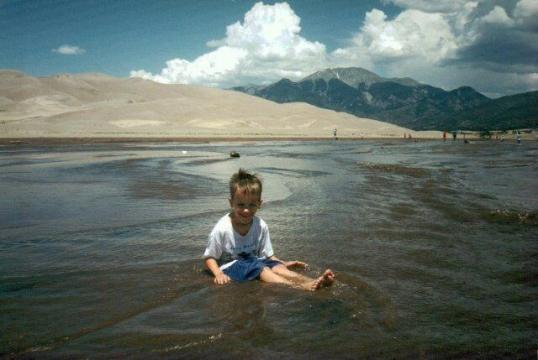
Nick in 1996
This was taken in early June 1996. There is a lot more water in the creek due to spring melting snow. This picture was taken a couple weeks before I started this journal.
This is Nick, Lee, and I, taken at the top of the highest dune at The Great Sand Dunes National Monument. The thing is a lot taller than it looks in this picture – we had to climb seven hundred feet of sand to get there.

The three of us on the highest dune in 2001.
One good thing about keeping a blog (notice I still called it a “journal” – blogs were pretty new in 2001, though I’d been writing online every day in a journal for five years by then) is the preservation of memories. Until I reread this from my archives I had forgotten so many details – the Swiss Tourist that was flabbergasted at the sheer size of the American West, the teenagers with their high-end camping gear, the fact that at ten years old Nick knew what Dune was. In 2001 the Great Sand Dunes was still a National Monument – it became a full fledged National Park in 2004.
This is more than ten years old. Nick and Lee are both well into college now. I would love to go back there with them, pose Nick in the creek again as an adult. But there is so much to do now, so much to do and so little time to get it done in. Everything is so difficult.





 Bill Chance