“What is happening to me happens to all fruits that grow ripe.
It is the honey in my veins that makes my blood thicker, and my soul quieter.”
― Friedrich Nietzsche

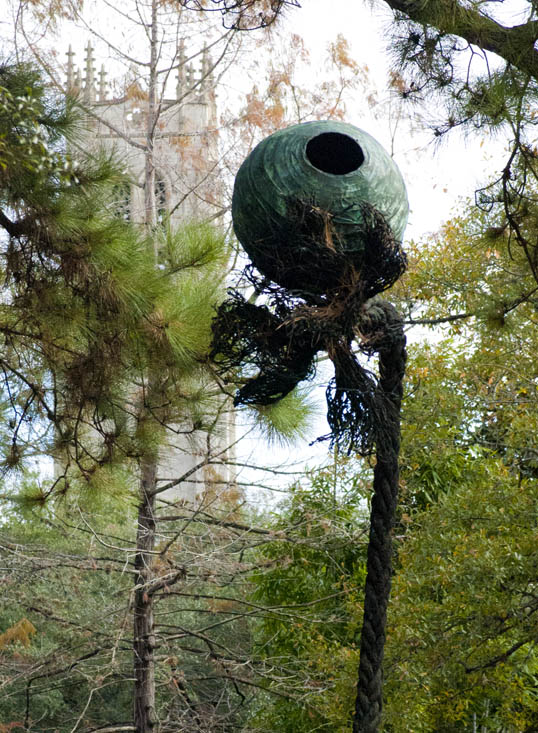
Andrew Rogers
Australian
Ripening
1999
Frisco, Texas
“What is happening to me happens to all fruits that grow ripe.
It is the honey in my veins that makes my blood thicker, and my soul quieter.”
― Friedrich Nietzsche
Andrew Rogers
Australian
Ripening
1999
Frisco, Texas
“I think to myself:
I don’t want to survive this one
I want to burn up in the wreckage”
― Henry Rollins, The Portable Henry Rollins
Bryan Hunt
American, Born 1947
Big Twist
1978
Bronze
Cullen Sculpture Garden, Houston Museum of Fine Art
“A small daily task, if it be really daily, will beat the labours of a spasmodic Hercules.”
― Anthony Trollope

Paul Manship
American, 1885-1966
Hercules Upholding the Heavens
1918
Bronze
The Museum Of Fine Arts
Houston, Texas
“The power of the machine imposes itself upon us and we can scarcely conceive living bodies without it.”
—-Raymond Duchamp-Villon

Large Horse by Raymond Duchamp-Villon
My favorite sculpture – one I have gazed upon many times in the Nasher Sculpture Center, here in Dallas, is Large Horse by Raymond Duchamp-Villon. I wrote about it more than three years ago.
At the time I said:
I like to stare at it, walk around it. I’ve taken some pictures of it. I would like to take some more.
To me, it’s clear that it is a statue of a horse – but that horse has been morphed into a complex machine, full of pushrods, pistons, and gears. It has an impressive, solid bulk, but feels like it is about to propel itself out through the glass and speed down the street in a blur, smelling of ozone and oil.
It is cast in very dark bronze – almost black. It swallows a lot of the light, but what does escape is subdued by the power and mass of the horse. It shines with dark energy.
The sculptor was a cavalry doctor in World War I and must have had a close relationship, knowledge, and a deep connection with his horses. He chose this animal to convert into a cubist bronze. He was able to preserve the essential horseness of the shape while implying the obsolescence of the animal – overtaken by the more powerful, rugged, and easily controlled energy of machines.
Duchamp-Villon died too young. He contracted typhoid fever during the war. He died before he finished this sculpture. All he left was the finished small scale model. After his death, his famous brother, Marcel Duchamp (Nude Descending a Staircase) finished the job and had the sculpture cast in full-sized bronze.
Thanks.

Large Horse, by Raymond Duchamp-Villon
Over the holidays, I was in Houston to visit my mother and my sister and her family and was pleased to discover another Duchamp-Villon’s Large Horse in the Cullen Sculpture Garden at the Houston Museum of Fine Art.
It was like running into an old friend unexpectedly.

Large Horse, by Raymond Duchamp-Villon, in the Cullen Sculpture Garden, Houston, Texas
Gargoyle
n. A rain-spout projecting from the eaves of mediaeval buildings, commonly fashioned into a grotesque caricature of some personal enemy of the architect or owner of the building. This was especially the case in churches and ecclesiastical structures generally, in which the gargoyles presented a perfect rogues’ gallery of local heretics and controversialists. Sometimes when a new dean and chapter were installed the old gargoyles were removed and others substituted having a closer relation to the private animosities of the new incumbents.
—-Ambrose Bierce, The Devil’s Dictionary
When in New Orleans, sometimes we stay at the interesting St. Vincent’s Guest House. The place is decorated with the wonderful bronze sculptures of Thomas Randolph Morrison. Especially notable is the work entitled “New Orleans Gargoyle” hanging off the clock tower – a horrible monster grinning while offering his victim’s disembodied head to passers-by.
I had read that there was another copy of this sculpture hanging around New Orleans. A developer had converted an industrial building in a run-down area into luxury condominiums and had hung the sculpture on the side of the building to help attract attention.
With a little online sleuthing I found the thing was at the corner of Chippewa and Jackson. In the Lower Garden District. It was an easy ride over to snap a photo. The light wasn’t perfect (the statue was half in shade) and I couldn’t get too close (the property was fenced and gated) – but it was cool to see the guy hanging there, leering, and showing off his prize.

New Orleans Gargoyle,
Thomas Randolph Morrison,
New Orleans, Louisiana
“They heard somewhere in that tenantless night a bell that tolled and ceased where no bell was and they rode out on the round dais of the earth which alone was dark and no light to it and which carried their figures and bore them up into the swarming stars so that they rode not under but among them and they rode at once jaunty and circumspect, like thieves newly loosed in that dark electric, like young thieves in a glowing orchard, loosely jacketed against the cold and ten thousand worlds for the choosing.”
― Cormac McCarthy, All the Pretty Horses
Pioneer Plaza
Dallas, Texas

Dallas, Texas
Pioneer Plaza
Dallas, Texas
Taken during the DART to Art, Rail & Ride

Bronze Fly at Pioneer Plaza, Dallas, Texas
The giant bronze sculpture of a cattle drive at Pioneer Plaza in Dallas is a very popular tourist attraction. Hordes of snap-happy folks mill around posing while raising their phones to get something to upload. The stationary wave of metal cattle forever guided by three cowboys is an impressive bit of public art – one that simultaniously awes the throng while reinforcing every Dallas Stereotype (cattle, cowboys, size, tackiness, gaudy, cliche) in the book.
When I visit I always climb to the cowboy on the top of the rise (that the herd of Longhorns is plunging from – down and across a draw) to look at something very small on the hidquarters of his horse. There is a bronze horsefly stuck there – a tiny detail donated by the sculptor to the more observant art fan.
I must not be the only one. The patina is worn fron the little fly-shaped lump of metal – giving it a virgin bronze color. The rubbing hands of crowds of tourists keep the horsefly gleaming in the afternoon sun.
Barbara Hepworth
Sea Form (Atlantic)
Bronze, 1965
Dallas Museum of Art, Sculpture Garden
Dallas, Texas

Sea Form (Atlantic)
Barbara Hepworth
(click to enlarge)
“The sculptor carves because he must. He needs the concrete form of stone and wood for the expression of his idea and experience, and when the idea forms the material is found at once. […]
I have always preferred direct carving to modelling because I like the resistance of the hard material and feel happier working that way. Carving is more adapted to the expression of the accumulative idea of experience and clay to the visual attitude. An idea for carving must be clearly formed before starting and sustained during the long process of working; also, there are all the beauties of several hundreds of different stones and woods, and the idea must be in harmony with the qualities of each one carved; that harmony comes with the discovery of the most direct way of carving each material according to its nature.”
—- ‘Barbara Hepworth – “the Sculptor carves because he must”‘, The Studio, London, vol. 104, December 1932
“I have always been interested in oval or ovoid shapes. The first carvings were simple realistic oval forms of the human head or of a bird. Gradually my interest grew in more abstract values – the weight, poise, and curvature of the ovoid as a basic form. The carving and piercing of such a form seems to open up an infinite variety of continuous curves in the third dimension, changing in accordance with the contours of the original ovoid and with the degree of penetration of the material. Here is sufficient field for exploration to last a lifetime.”
“Before I can start carving the idea must be almost complete. I say ‘almost’ because the really important thing seems to be the sculptor’s ability to let his intuition guide him over the gap between conception and realization without compromising the integrity of the original idea; the point being that the material has vitality – it resists and makes demands.”“I have gained very great inspiration from Cornish land- and sea-scape, the horizontal line of the sea and the quality of light and colour which reminds me of the Mediterranean light and colour which so excites one’s sense of form; and first and last there is the human figure which in the country becomes a free and moving part of a greater whole. This relationship between figure and landscape is vitally important to me. I cannot feel it in a city.”
—-Barbara Hepworth ‘Approach to Sculpture’, The Studio, London, vol. 132, no. 643, October 1946


 Bill Chance