The Wasp Factory

“I had been making the rounds of the Sacrifice Poles the day we heard my brother had escaped. I already knew something was going to happen; the Factory told me.” – Iain Banks, The Wasp Factory, opening lines.

The Wasp Factory is the first novel by Iain Banks, published in 1984, and the minute I saw the opening sentences I knew I would read the whole book. He had plenty of time to think through the opening, and it is crackerjack. How can you not be irresistibly intrigued by a first person narrator (probably unreliable), “Sacrifice Poles,” an escaped brother (escaped from what?), and a “Factory” (capitalized) that foretells the future.

I had seen mentions of the book here and there – mostly associated with strings of adjectives such as: dark, disturbing, violent, disgusting, hard to read, gruesome, grotesque, unparalleled depravity, monstrous, shocking… and plenty more. Well, so far so good. Then I found it mentioned in a book titled 500 Essential Cult Books. That was enough for me to move it to the front of my to-be-read queue.

Always, when I read a first-person work of fiction, I like to start to work out how reliable the narrator is. In “The Wasp Factory” the protagonist, Frank Cauldhame, is surprisingly honest, reliable, and self-aware. Especially considering he is a sixteen year old serial killer (though he claims his days of killing human beings are over) eunuch, living on an isolated island with his father, trying to deal with life through an endless series of violent, cruel, and depraved rituals – a litany of horrific obsessive compulsive behaviors that, while nasty and disgusting, are the only defense that he has against the hopeless situation that he is trapped in.

As the book goes on Frank’s constructed mythology begins to make internal sense. His series of altars, rites, and symbolic defenses begins to come together as a terrible religion that he has developed in response to a hostile world. For me, one of the surprisingly disturbing sections was a relatively innocent night Frank spends drinking at a pub on the mainland with a friend of his. He drinks way too much and struggles through a horrible night of sickness and vulnerability. It serves as a reminder of how helpless he is once he ventures away from his carefully constructed bulwarks of ritual.

It is a first novel, however, and sometimes you can almost hear Iain Banks thinking, “Let’s see – how can I up the horror a little bit more, what to do next? What taboos can I break now? What will crawl out from under this next rock?” It’s a harrowing ride, but if you are willing to go along with it – there are rewards. Frank is an undeniably unforgettable character and one that you will be glad you met in fiction – because you certainly won’t want to meet him in real life.

Don’t invite him to your family picnic.

The novel picks up momentum, unveiling secret after mystery after shocking revelation. Frank’s brother is on his way home, his father is beginning to seriously unravel, and even the island itself seems about to unleash some final cataclysmic horror as the novel comes to a terrifying climax.

It is at this point that the novel did let me down a little bit. The promised Götterdämmerung never does arrive. Instead there is a “twist” ending – which, although it certainly isn’t expected and does explain more than a few mysteries – for me, it failed to really satisfy the promise of the earlier story. It left me flat – which is a shame, because the rest of the novel was really something – though I’m not sure exactly what.

If nothing else, The Wasp Factory is a unique and polarizing piece of literature. A lot of people have written about the book, with a lot of widely varied opinions. I spent way too much time surfing around looking at WordPress Blogs that discuss The Wasp Factory. Read through some of these – you might learn something.

Blog Reviews of The Wasp Factory

What I learned this week, November 11, 2011

Looking around the shelves at a used book store I came across a copy of 500 Essential Cult Books. I’m casting around for something to read right at this moment.

I didn’t buy the book, but I did sit down with it, some index cards, and a Parker 21 that I carry, and sat down at a table to go through most of the 500.

My first impression is that I was shocked at how many of the books I had already read… somewhere around half. The books were divided into categories and some I had read almost all of the selection.

At any rate, I filled a couple cards with books that I had not read and that looked interesting. Some I already have in my library or Kindle, most I do not. Here’s the list, in no particular order:

  • Generation X – Douglas Coupland
  • Nausea – Jean Paul Sartre
  • Been Down so Long it Looks Like Up to Me – Richard Farina
  • Cathedral – Raymond Chandler
  • A Feast of Snakes – Harry Crews
  • Perfume – Patrick Suskind
  • The Sheltering Sky – Paul Bowles
  • VOX – Nicholson Baker
  • The Wasp Factory – Ian Banks
  • We Need to Talk About Kevin – Lionel Shriver
  • Almost Transparent Blue – Ryu Murakami
  • Bad Behavior – Mary Gaitskill
  • Cocaine Nights – J. G. Ballard
  • The Ginger Man – J. P. Donleavy
  • Atomised – Hichael Houellebecq
  • Young Adam – Alexander Trocchi
  • Wonderland Avenue – Danny Sugarman
  • A Hero of Our Time – Mikhail Lemontov
  • How Late it Was, How Late – James Kelman
  • Of Love and Hunger – Julian Maclaren-Ross
  • D. B. C. Pierre – Vernon God Little
  • Nelson Algren – A Walk on the Wild Side

I’ve been reading a lot about the “Bubble in Higher Education.” One of the interesting articles in that vein is called, Where Have All the Chemists Gone?   It links to a New York Times article – Why Science Majors Change Their Minds (It’s Just So Darn Hard)

You can read both of these articles and decide what you think about it on your own, but it does bring back an experience of my own, one I’ve talked about ad nauseum – but still…. I think I’ll write it down here. This is something that happened almost forty years ago… so maybe the trends identified in the articles aren’t so new after all.

I remember my first freshman chemistry class at the generic big Midwestern public university. It was held in a large old gothic auditorium (since burned down) where they played the basketball games back in the twenties and thirties. The professor walked out on the first day and said, “This is Chemistry 301, Introduction to Chemistry for Chemistry Majors. You should only take this class if you are going to get a major in Chemistry. There are three hundred and fifty students in this class. We graduate about forty chemists a semester. You need to do the math. If you don’t think you can make it through this class, drop as soon as you can to minimize the damage to your academic career.”

I was stunned when about a dozen kids walked out at that point. How low must their self-esteem be to give up at that point (or maybe they realized they were in the wrong classroom). The first exam took over half the class. The mid-term dropped half of those that were still left. At the end of the semester the class was well under a hundred. The really bad thing was that, three years later, Physical Chemistry took a third of those that had made it that far (I still believe that P-Chem is one of the absolute evils in the world – I know if any other chemists are reading this – I just gave you a nightmare).

A few years ago I was at a meeting of the American Chemical Society in Arlington (I remember there were three Nobel Prize Winners at the dinner) and the the topic was improving chemistry education. I was talking to a professor afterward about how to increase the enrolment of chemists and he said, “Actually, in my experience, most of the student that can be chemists, are chemists… what we need is to increase the understanding of some of the basic tenets in the non-chemist population.” This was a guy that should know what he was talking about.

Oh, and the article talks about how grades are lower in STEM classes than in, say, business or liberal arts. No shit. My goal in chemistry was to graduate, that was it (I consider my bare C- in P-Chem I and II to be one of the greatest accomplishments in my life. I managed to pass two semesters in a subject where I had absolutely no idea what the hell was going on at all). In the decades since, I don’t think I have ever had anyone ask me my GPA. I have hired a few chemists in my day and if I ever had a job applicant with a 4.0 and a major in chemistry (In reality I never have seen or heard of such a thing) I would not hire them. To get a 4.0 in a chemistry curriculum you would either have to be too smart to be in the same world as I am, or some sort of mutant that could not relate to ordinary human beings in any meaningful way.


Another list of “Must Eat At” places in New Orleans.

New Orleans – A Foodie’s Paradise

  • Gumbo at the Gumbo Shop
  • Crawfish Etouffee at Chartres House Café
  • Jambalaya at Coop’s Place
  • Red Beans and Rice at Joey K.’s
  • Muffulettas at Central Grocery Co.
  • Beignets at Café Du Monde
  • Bananas Foster at Brennan’s
  • King Cakes at Sucre
  • Po’ Boys at Parkway Bakery & Tavern

I’ve been to six of the nine… though some were a long time ago. I wrote about Joey K’s the other day. Last year I set out to find the best Shrimp Po-Boy in New Orleans, and Parkway was the best, IMHO.


How to make pancakes from scratch

Wallet Pancakes

Why imitation syrup is better than the real thing

How to make the best diner pancakes in america


a new word for our time
ineptocracy


Man, I would love to snag a 2011 Rangers World Championship Cap. I wonder what impoverished tropical hell hole I’d have to go to so I could buy one of some poor dude’s head.

Where does World Series Runners-Up Gear Go?


A few more Scopitones. Starting to scrape the bottom of the barrel.

I used to Love the Tijuana Brass, back in the day. This song and Scopitone is not why.

Great Hair… terrible rock and roll.

There have been some very good versions of Telstar over the years. This is not one of them. Plus odd and wildly inappropriate footage.

Petula Clark… one of the greats. There was “Downtown”, “I Know a Place”, “My Love”, “Colour My World”, “A Sign of the Times”,  and “Don’t Sleep in the Subway.”

Oh…. and this:

And, last but least… The absolute worst:


The Complete Stories of J. G. Ballard

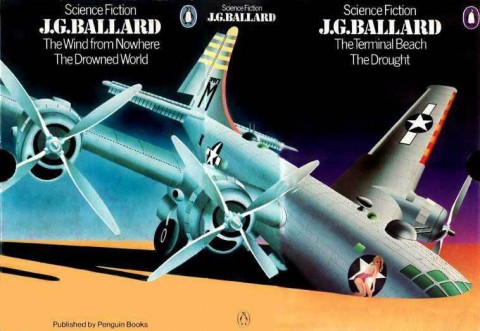
I’ve written about J. G. Ballard before. I mentioned his collection of short stories, Vermilion Sands, as an influential part of my youth. Also, not too long ago, I read his novel, High Rise, and gave it praise.

Now, a collection of Ballards complete short story oeuvre has fallen into my grimy paws and thought I know better, I keep reading away at it. We are talking about ninety eight stories here and a single page short of twelve hundred in total. That is a lot of words. This is no small feat. This is a long-term reading task. I have better things to do.

But I can’t help myself. I do so love his writing. His strange, aloof characters. His horrific, yet familiar, dystopian societal landscapes. The way he never really quite explains exactly what’s going on (this is especially true of his short stories – his novels are much more straightforward). He also has a way with titles – all the way from “The Cloud Sculptors of Coral D” to “Why I Want to Fuck Ronald Reagan.”

There is also the fact that I read a lot of these when I was a kid. The stories are in the book in chronological order and I can feel years of my life falling away as I remember when I first came across these.

Some made a big impression on my. I remember “Manhole 69” as being a claustrophobic tale of three men that had been surgically altered so that they did not need to sleep. Slowly their world began to pull in around them until they were trapped in a tiny space… the manhole. It creeeped the bejeebers out of me when I read it in high school. So now I reread it and… well, my memory was pretty much spot on.

There was the novella “The Voices of Time.” It too left me with a strange uneasy feeling that has persisted for forty-odd years. I remember a strange mandala cut into the bottom of an abandoned swimming pool and animals mutating in very odd ways (frogs growing lead shells, a sea anemone developing a nervous system) but little else. This time I’m reading more carefully, taking a few notes, reading with decades of literary experience…. I think it was better the first time – complete with the veil of mystery. Well, it didn’t make that much difference… there is still plenty of mystery.

So, I don’t think I’ll keep going to the end unstopped. But the stories will always be there and if I have an hour or so I’ll crank through another. Maybe in a year or so I’ll have read them all.

That’s an interesting idea – an entire prolific life’s worth of short stories, read in order. You feel like you get to know a man that way.

What I learned this week, September, 9, 2011

I have gathered a garland of other men’s flowers, and nothing is mine but the cord that binds them.

—-Montaigne


An economic crisis is nature’s revenge on those who make and those who accept false promises; it is a holocaust of lies when the dross is burned away and only what is real and true remains. Think of cotton candy melting and charring in the flame of a blowtorch; that is what is happening to the secure retirements that “caring” blue politicians and “committed” blue union leaders promised gullible state workers.

—- from Rhode Island Pension System Collapsing – by Walter Russell Mead (read the whole thing)

I seem to be linking to Walter Russell Mead a lot.


How Bikes Could Transform Dallas

Constructing a city for the car alone shackles all to the burdens of car ownership and maintenance costs. In a city with a poverty rate of 23 percent and household transportation costs approaching 25 percent of income, fewer and fewer can afford to participate in the local economy, getting from point A to point B, without a miserable two-hour DART bus commute. Without choice in the transportation network, Sun Belt cities will go the way of the Rust Belt. A monoculture of transportation follows a monoculture of the very industry that produced it into collapse. Nobody thought Detroit would collapse when it was dubbed the Paris of the West. Paris, however, is alive and well. And so is bicycling in that world-class city.

—-From D MagazineBicyclist


The Shortlist for the 2011 Man Booker Prize is out:

The six books, selected from the longlist of 13, are:

Julian Barnes The Sense of an Ending (Jonathan Cape – Random House)

Carol Birch Jamrach’s Menagerie (Canongate Books)

Patrick deWitt The Sisters Brothers (Granta)

Esi Edugyan Half Blood Blues (Serpent’s Tail)

Stephen Kelman Pigeon English (Bloomsbury)

A.D. Miller Snowdrops (Atlantic)

I have not read any of these. Have to take a good look (don’t think I can read all of them in time). Any recomendations?


You don’t have to know what it is that you are eating in order to have a delicious meal.


Writing Tips for the Week

Eight Secrets Which Writers Won’t Tell You

by Ali

  • Secret #1: Writing is Hard
  • Secret #2: We All Struggle With Procrastination
  • Secret #3: We Put Ourselves Into Our Work
  • Secret #4: First Drafts are Always Crap
  • Secret #5: Each Piece Exists in a State of Flux – and it’s Never “Finished”
  • Secret #6: We Do it Because We’re Obsessed
  • Secret #7: Money does matter
  • Secret #8: We All Struggle With Self-Doubt

I had forgotten how much I enjoy a good, steep hill.


Even a titan like Starbucks is struggling in this difficult economy.

Yet, the little Vietnamese Coffee Shops in San Jose are thriving.

What could be the difference?

The Alchemist

“Don’t forget that everything you deal with is only one thing and nothing else. And don’t forget the language of omens. And, above all, don’t forget to follow your destiny through to its conclusion.”

—- Paulo Coelho, The Alchemist

Working cranking through my reading list – on a race with death – so many books, so little time – I queued up Paulo Coelho‘s The Alchemist. It’s a famous book, and has been recommended. I was happy to see that it was a slim volume – all the better for getting there in time.

You can say that the omens instructed me to read the book. I never cross the omens if it is at all possible.

The book is in the form of a fable… actually, it is a fable. It bears a strong resemblance to “The Man Who Became Rich through a Dream” from 1001 Nights (a folktale of Aarne-Thompson-Uther type 1645).

Is this a bad thing? I don’t think so. There are a lot of folk tales out there – any story told has been told before. I need to work on a list of these archetypal tales – I wonder how many can be updated into the big, evil city? Can I kill people in them?

I was of two minds reading the Alchemist. It’s a simple tale and I wanted more. But maybe that was simply my prejudice – I wasn’t expecting a fable, so I wasn’t satisfied with a fable.

But I’ve been to the desert and I know how it talks to you. I’ve never seen the pyramids but I can imagine what they would look like towering over the dunes by moonlight.

Now that I’m done, though, and moving on – I’m glad I read the thing. I’m not sure if I learned that much… I’ve heard it before. I wonder about the people that say, “This book will change your life,” – I guess that depends on what your life was before… but if a tale of symbols, omens, and following your own special destiny is a new and revolutionary concept for you … good luck with all that.

I wonder if an Alchemist has to learn Physical Alchemy? I’m a regular chemist, and p-chem almost killed me.

Oh, one more thing… even if it is a fable, it is one hell of a well-written one.

So, what do the omens tell me to read next…. maybe some nice, crude, violent crime noir. Something where some people die, people that don’t deserve it – people that follow their destiny to its conclusion… usually in some dark cold alley somewhere.

High-Rise

“Later, as he sat on his balcony eating the dog, Dr Robert Laing reflected on the unusual events that had taken place within this huge apartment building during the previous three months.”

—- Opening Line, High-Rise, by J. G. Ballard

It’s getting tough to decide on the next book to read. While I was considering the options I came across a few interesting articles comparing and contrasting the fiction of the late J. G. Ballard and the recent London riots.

I have been a fan of Ballard’s work for decades. It didn’t take me long to decide to dive in, especially when I discovered a copy of one of his classic works, one that I had never read, High-Rise.

About forty years ago, Ballard wrote three hyper-real novels about the relationships between society, technology, urban life, disaster, sex, and the monsters of the id. I have already read the excellent, interesting, and underrated Concrete Island and the infamous Crash. So I decided to complete the hat trick.

There are three minor characters and also the hero of High-Rise. The point of view circulates among Dr. Robert Laing, a medical school instructor that seems to be fleeing from the responsibilities of being a real doctor – Richard Wilder, a maker of documentaries that becomes overly attached to his video camera, and Anthony Royal, an architect that lives in a luxurious penthouse apartment.

These three live in a single forty-story condominium tower. It’s a brand-new building, part of a series of skyscrapers going up in a half-built complex on the outskirts of London. The three characters are representatives of the three classes in the building… that map out to their height above the ground. Wilder is from the second floor, where the lower classes live – although in this case they aren’t actually poor – they are made up of airline pilots, stewardesses, and television workers – wealthy enough all in any other setting. The middle part of the building, the largest section, from the shopping mall on the 10th floor up to about the swimming pool on the 35th and are represented by Laing- all professionals and respected members of the city at large.

Only the super-wealthy business tycoons occupy the top floors. At the very apex is Royal, who is credited with designing the building, though in reality, he only did the children’s playground on the roof and a few elevator lobbies.

The hero, the true protagonist is the building itself. It has a life and evil all its own… you can almost hear it speaking.

Pretty quickly, it becomes obvious that all is not right in this brave new world. There are obvious frictions between the three classes which spill out when the children of the lower floors try to use the swimming pool on the upper levels. The real trouble begins with parties. The innocent hedonism quickly becomes out of control, with plenty of illicit sex and bottles being thrown from balconies.

The three classes start out going to war with each other, complete with raiding parties and running battles over which group controls the important resources, such as the elevators and the garbage chutes. This is no Marxian polemic, however, and the three groups quickly lose their cohesion until it’s floor against floor, then small groups of apartments, then… well… let’s just say, things don’t end well.

Which, of course, is how I like it. I really enjoyed the book.

Ballard writes about such horrific descents into evil and madness with an almost geometric precision and symmetry. The building is designed just so, the cars are parked in a careful order, the balconies are arranged so everyone can see into everybody else’s’ business… once you think about it, the horrific events are not only understandable, they are inevitable.

It’s the sort of thing someone that had spent his childhood in a Japanese prisoner of war camp might have written.

A film is being made of the book, done by the director that made Cube – an interesting horror film with the best idea for efficient use of a simple filming set ever made.

He seems to be doing the film with the tower set in the middle of an ocean. I’m not sure if that is a good choice – one of the most interesting aspects of the novel is how, as things became worse and worse in the high rise, the residents became more and more insular, until they became, by choice, completely cut-off from the outside world. Also, in the book, there are more high-rises going up. Laing watches the one in front of his apartment being finished and then occupied. Near the end, he sees power going off in several floors over there – it is implied that the same horror that has infected his tower is spreading to the next. Set the building out in the ocean and you lose these details.

But… little concern. I’ll still go see the thing. I doubt if they can come up with a way to give it a happy ending. At least I hope not.

Library Book Sale

The Richardson Library had their annual big-ass book sale this weekend down in the crowded basement multi-purpose room. This used to be a massive deal to me. I would get a huge donated shopping bag at the entrance and fight my way along the long tables piled with paperbacks or heaped with hardcovers – the stacks screaming, protesting the weight. I would fill my brown paper bag until the kraft was tearing, pay my fee, and eagerly get my haul home.

Now, though, I have my Kindle. There are more books hiding in that slim slip of plastic than I can possibly read in the few remaining years I have allotted to me. I feel fairly certain that I will pass through this vale of tears with more than a few files left unopened.

Kindle

Call Me Ishmael

Still….

I almost skipped the book sale, but I went more out of nostalgia than any logical purpose – though I do know there are books that I’ve been looking for that are not out in digital format. Plus, it is sometimes nice to have a real, physical paper book – something you can give away or curl up with when your peepers are tired of pixels.

So I eschewed a shopping bag and simply pushed myself past all the enervated shoppers. Once more into the breach.

A good part of the large but cramped basement room was dominated by a handful of families that knew each other. They had a fleet of the massive baby carriers (barely smaller than the aircraft variety) that blocked entire aisles and provided a perch for their pre-reading hellions to reach out their snot-and-saliva encrusted paws and pull teetering piles of books onto the floor while giggling like giddy gibbons. Their slightly older siblings were grabbing stuff out and exclaiming wisdom like, “I only want books about dogs!” or “Are you SURE this is a childrens’ book?” while their mothers clucked loudly at each other with self-satisfaction at the precociousness and preciousness of their satan-spawn procreations.

Finally, after forever, this boiling mass of distraction and pain moved out the front and could be heard arguing over the price of their purchases in the hallway. The sound in the room was reduced to a certain low growl made up of the combined almost-inaudible grunting of the serious bargain hunters scooping up endless tomes that they had never known of until today but could simply not live without. This is a sober business. The air-conditioning, installed under a government lo-bid contract, struggled to cut the heat and miasma of used book mold-spores and bargain-hunting sweat.

So, did I buy anything? You betcha.

Hardbacks were only two dollars and paper seventy five cents. It would be a crime to let this opportunity go unheeded.

I bought a really nice hardback copy of Alice Munro‘s Open Secrets. Someone at work expressed a love of short stories yet had never read any Munro (yeah, I know…). I want to reread “The Albanian Virgin” carefully and outline it – it is the most amazingly structured piece of short fiction I’ve ever seen and I want to try and figure out how she does it.

On a whim I grabbed a paperback collection by John McPhee. This one is called Table of Contents and is a collection of his amazing short non-fiction. I can always read me some McPhee and come out of it knowing something I didn’t before.

After choosing these two light bits of bon-bon I thought for a minute and hauled out a big hunk of meat – the nine-hundred page posthumous magnum opus 2666 by Roberto Bolano. I have had my eye on this gigantic pile of translated text for a bit. For some reason I thought it would be fun to attack it as a fortress of paper rather than a cloud of bytes. Will I ever actually read it?

Probably. If I live long enough. Stick around and find out.

The parking lot had been full and I had to hike almost to the post office to get to my car. A thin older man scuttled by me, on his way in. He stopped and stared at the burden under my arm.

“Hey, I want all three of those books! I was worried they would be all picked over by now!”

He shot off towards the maelstrom of the book sale. If he had waited I would have sold him the three I had… at only a slight profit.

Cloud Atlas

Where are you right now?
In my hut in my back garden in West Cork.

 Where do you write?
Here, at my desk; in my notebook, in an armchair; on planes.

How do you write?
By recording in words the scenes that are workshopped and staged in my imagination.

What keeps you writing?
My addiction to it.

Who do you write for?
Me, and the rest of the world. Nobody else.

—- David Mitchell, in Untitledbooks

Cloud Atlas

Cloud Atlas

What is my favorite book? What is the best book I’ve read? —These are unanswerable questions. There are so many and my opinions at the very top shift over time like sands in the wind or shadows in my memory.

Still there is an upper stratum. This is occupied by fossilized memories of hours, days, sometime years spent poring over pages of labyrinthine structure, subtle metaphor, and deep, thick, and complex prose. This is the land of Pynchon, the landscape of Mason & Dixon, V, and, most of all Gravity’s Rainbow. That book took me twenty five years to read… and it was worth every second.

It is the land of Moby Dick, of Infinite Jest, of House of Leaves.

It is the land of Cloud Atlas.

If you catch me at the right time, I’ll tell you that Cloud Atlas is the best book I’ve read. Other times I’ll tell you it’s my favorite book. Rarely does a single entity spend time in both positions – as far as I’m concerned, that’s great praise.

David Mitchell’s Cloud Atlas is a complex book and one with a unique structure – but it’s not hard to read. The structure is very carefully planned out, logical, and executed with panache – not like the shambling monstrous recursive story of Gravity’s Rainbow.

The book is a collection of six different story threads. The first half of the book the stories are half-told, in chronological order. It starts in the South Pacific, in 1850, in a sort of Melvilish, three-stooges version of a whaleless Moby Dick. The story then jumps to 1931 where a bankrupt musician tries to scam himself back into a state where he can feed himself and love again. Then it leaps to California in the 70’s with a thriller set at a nuclear plant.

At this point the stories move into the future, starting with a publisher trapped in a nursing home. We then switch to a dystopian future where the clones begin to rebel. Finally, we arrive in the unknown distant future where mankind has thrown off or lost its technological skin and is back to telling tales around the campfire.

Here, the book turns and goes back, working its way through the same stories again for their second half denouement, in reverse order, until we are left back in the 19th century South Pacific.

What is the connection between these diverse threads? You will have to read the book to find out.

Does this scare you? Will you avoid this tome in favor of the newest vampire mystery? Shame on you. Or not. Whatever. It is definitely the kind of thing you will like, though, if you like that kind of thing.

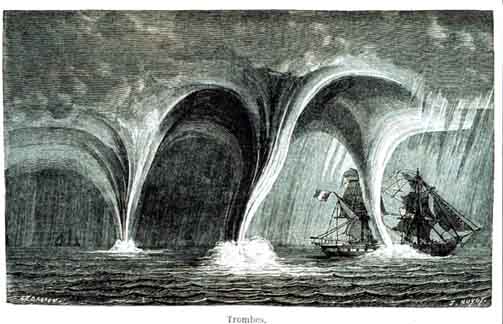
Waterspouts

Waterspouts

Why am I bringing up this odd and complicated book now? No matter how interesting?

I used to read a lot of movie reviews. I always tried to keep up on what was happening in the world of cinema. This was ruining my viewing enjoyment, however. I wanted to get back to that world of simple pleasure when I sat in front of the silver screen (or cathode ray tube [or light emitting diode (or liquid crystal semiconductor [ or tiny cloud of plasma-induced noble gas])]) unknowing about what was going to happen next. So I stopped reading movie reviews until after I had seen a film. I stopped following the pages outlining what was coming out next from what director.

Still, I stumble across bits of information now and then. That Interweb-thing is good for that, isn’t it?

This week I discovered that they are making a big-time, big-budget movie of Cloud Atlas.

It is one of the books that, when I was reading it, I thought, “This thing would be unfilmable.” Apparantly, someone disagrees with my assessment.

It seems it will have two directors – The guy that directed “Lola Rennt” will do the story threads that are set in the past and the Matrix director(s) will do the stuff in the future.

Big time actors too, Tom Hanks, Halle Berry, Hugo Weaving, Susan Sarandon, Jim Broadbent… It appears the actors will be playing more than one character spread across time (have to get your money’s worth out of Tom Hanks).

Well, I’m not sure how this will all play out – the book is unfilmable, really – but it will be interesting. I do hope it gets made. If it is good, it might be great. If it fails, it will be a glorious failure.

Storm

Storm

(whet your appetite) Short works online by David Mitchell

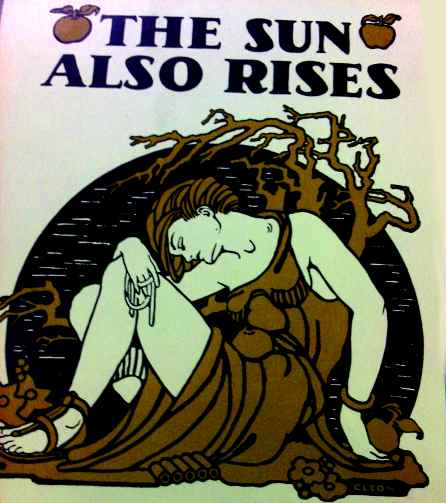
The Sun Also Rises

Sun

The Sun Also Rises

“In bull-fighting they speak of the terrain of the bull and the terrain of the bull-fighter. As long as a bull-fighter stays in his own terrain he is comparatively safe. Each time he enters into the terrain of the bull he is in great danger. Belmonte, in his best days, worked always in the terrain of the bull. This way he gave the sensation of coming tragedy.”

– Chapter 18, The Sun Also Rises, Ernest Hemingway

After another long day at work I drove to Love Field at ten to pick Nick up. He was returning from a few weeks in San Diego and out on a destroyer with the Navy.

While I was waiting at the baggage claim I finished reading Hemingway’s The Sun Also Rises.

As always, I am in awe of Hemingway’s tense terse prose and how he says so much with so little.

I have wanted to read this book ever since I read “The Drifters” by James Michener when I was in high school. There was a little bit of time that everybody was required to read “The Drifters.” The book made a big impression on me at the time, though I don’t remember any of it anymore. The only thing I remember is that the book made me want to go to Pamplona and run with the bulls.

Now I have to decide what to read next. Hundreds of books lie there, beckoning. So little time and so many stories.

Please forgive me. I’ve been thinking a lot about pride and seriousness. I want to work harder and do better on everything I do.

But right now I’m so tired. So I will bid a sweet adieu and trot off to dreamland. I’ll pick it up tomorrow.

Is Reading a Waste of Time?

Digging around in the archives of my old online journal... I found this entry from June 28, 2002. When I put it out in public – a lot of people had a strong opinion on this question – nobody thought that reading was a waste of time.  Despite this public consensus,  I still haven’t answered the question to my own satisfaction.

For example, despite the fact I’m a third of the way through a Hemingway novel, I haven’t had the time to pick up my Kindle in the last three days.

Nick reading Harry Potter.

Nick reading Harry Potter. Is this the first one?


There’s a kind of comfort in returning at the end of the day to the same people and watching them enter their lives more deeply.

—-Tobias Wolfe, on the novel

I came across this quote… about novels. After reading and thinking about it I realized how true it was.

For the last few months I’ve been reading collections of short stories or slim novellas, exclusively. Time has been very short. Plus, I’m working on a handful of stories myself – trying to get them ready to send off – and wanted to read the form and keep my mind and pen open to the myriad possibilities.

I felt the urge to bite into something more substantial, so I scanned my case of recently purchased, but unread, tomes and pulled out The Corrections, by Jonathan Franzen. I’m not interested in the media hoo-ha concerning this book and the author’s relationship with Oprah Winfry. I read some glowing reviews, though, so I thought it might be worth the read.

I’m maybe two-thirds through and the book is good. It started better than it is right now – Franzen seems to be repeating themes and situations, plus the center section feels a little padded – but it is well-written, with compelling characters. You can’t ask for much more.

What has taken me off guard is how much I’m enjoying reading the book. I catch myself looking forward to getting home, getting my stuff done, spending some time with Nick and Lee, getting in my daily writing, then settling down with the book (if I’m not too exhausted to stay awake). It feels like a deserved reward at the end of a long day.

It feels like a second life. I never thought about how the characters in a full-blown novel come, over the time it takes to get through the book, to occupy your imagination, your life of the mind. They become imaginary friends, shadow family members – unreal characters that, because they exist only within your own personal gray matter, share an odd intimacy with you.

The best thing is that, because they are only shadows of text and imagination, they are harmless. This second family can be as colorful as they want to be without causing problems in the real world. The more outrageous, dysfunctional, and insane, the better.

You can have flawed, unfaithful, even evil friends and relatives – with all the amusement that entails – but without them showing up at all hours to call in an old favor and demand you hide them from the police/mob/irate former lovers.

I used to buy books based on bulk. I’d dig through the used bookstores looking for massive tomes at low prices – sort of a cost per page value basis. I guess I was thinking about how much enjoyment – maximizing the time would I get from each book.

Over the years, I moved away from this philosophy of reading as my life became busier and busier and my time on earth becomes shorter and shorter.

I know a lot of successful people, type “A” personalities that are always rushing around getting things done, making lots of money, or fighting back the entropy that constantly attacks their living spaces. Most of them don’t read much. They view reading as a useless, frivolous, and wasteful activity.

Is reading a waste of time? It doesn’t accomplish anything. I consider watching television a waste of time (though I do watch too much, of course) – how is reading any different? How about going to films? Is that a waste? How is that different than TV?

If reading is a waste of time why do we work so hard to get our kids to do it? Fret so much when they would rather play with their friends – interact with real people rather than stick their solitary nose in a book?

Is reading a waste of time?

Are fish sticks considered seafood?