Trinity River
Dallas, Texas

(click to enlarge)

(click to enlarge)
Trinity River
Dallas, Texas
(click to enlarge)
(click to enlarge)
Barbara Hepworth
Sea Form (Atlantic)
Bronze, 1965
Dallas Museum of Art, Sculpture Garden
Dallas, Texas

Sea Form (Atlantic)
Barbara Hepworth
(click to enlarge)
“The sculptor carves because he must. He needs the concrete form of stone and wood for the expression of his idea and experience, and when the idea forms the material is found at once. […]
I have always preferred direct carving to modelling because I like the resistance of the hard material and feel happier working that way. Carving is more adapted to the expression of the accumulative idea of experience and clay to the visual attitude. An idea for carving must be clearly formed before starting and sustained during the long process of working; also, there are all the beauties of several hundreds of different stones and woods, and the idea must be in harmony with the qualities of each one carved; that harmony comes with the discovery of the most direct way of carving each material according to its nature.”
—- ‘Barbara Hepworth – “the Sculptor carves because he must”‘, The Studio, London, vol. 104, December 1932
“I have always been interested in oval or ovoid shapes. The first carvings were simple realistic oval forms of the human head or of a bird. Gradually my interest grew in more abstract values – the weight, poise, and curvature of the ovoid as a basic form. The carving and piercing of such a form seems to open up an infinite variety of continuous curves in the third dimension, changing in accordance with the contours of the original ovoid and with the degree of penetration of the material. Here is sufficient field for exploration to last a lifetime.”
“Before I can start carving the idea must be almost complete. I say ‘almost’ because the really important thing seems to be the sculptor’s ability to let his intuition guide him over the gap between conception and realization without compromising the integrity of the original idea; the point being that the material has vitality – it resists and makes demands.”“I have gained very great inspiration from Cornish land- and sea-scape, the horizontal line of the sea and the quality of light and colour which reminds me of the Mediterranean light and colour which so excites one’s sense of form; and first and last there is the human figure which in the country becomes a free and moving part of a greater whole. This relationship between figure and landscape is vitally important to me. I cannot feel it in a city.”
—-Barbara Hepworth ‘Approach to Sculpture’, The Studio, London, vol. 132, no. 643, October 1946
Even though it was over thirty years ago, I remember the first time I walked into Tango like it was yesterday. I had been living in Dallas for a couple years – living just off Lower Greenville in the Turtle Dove apartments behind the Granada Theater. Farther down the street, in Lowest Greenville, Shannon Wynne built a new nightclub.
It was a huge converted bank building – and it was something else. There was the big main room with a balcony all around – a great place for live music. There was a terrible restaurant in an unbelievably loud room off the balcony. The walls were lined with televisions, all screaming nasty early 80’s rock videos. Then, down a back stairway, was my favorite spot – the Aquarium Bar. This was an elevated dance floor – sort of like a big, rectangular boxing ring, that filled all but a narrow strip around the edge of the room. All night extremely loud dance music would boom from speakers only a couple feet over your head – while the lights spun and flashed. Behind some sort of glass wall costumed dancers would sometimes perform in fish suits… I think.
You had to be there.
I think the wildest night I was there was one concert – Brave Combo opened up for Joe “KING” Carrasco and the Crowns, with Johnny Reno and the Sax Maniacs playing backup. Believe it or not – the last set was filmed (badly) and is still available on blurry Youtube.
(If you have time to watch this video – check out the interviews – a young Mike Rhyner at 5:55 and a very, very young Lisa Loeb at 11:10)
The place was fantastic, but it lost money hand over fist and closed after little more than a year. The bank building was torn down and a Taco Cabana Mexican Fast Food restaurant went up in that spot.
But what most people remember Tango for was the frogs on the roof. While the bank building was being renovated Bob Daddy-O Wade was commissioned to make a half-dozen giant frogs to be placed on the roof. Dallas (at that time, especially) had no sense of humor and the city decided, in its infinite bureaucratic wisdom, that the frogs (two dancing, one each playing the guitar, saxophone, trumpet and maracas) were in violation of the city sign ordinance and had to come down.
The court battle made the national news:
New York Times Article on Tango’s Frogs – DALLAS SIGN PANEL BANS 6 GIANT PERFORMING FROGS
and after much hullabaloo they were exonerated and allowed to stay. Not long after that, the place went belly-up and the frogs were sold off.
Three went to the roof of a mega-gas-station south of Dallas. I used to see them down there whenever I drove to Austin and meant to stop and get some pictures (for old times’ sake) but never pulled it off. The other three (guitar, sax, and maracas) went to Chuy’s Mexican restaurant in Austin – then on to the Chuy’s in Nashville, where they still are.
Googlemaps Street View of Nashville – there are the frogs!
So now, after all these years, I read in the paper that the three frogs (the dancing pair and the trumpet player) have returned to town and have been placed on top of the Taco Cabana at the same spot were Tango used to sit. They even seemed to get permission from the city first.
I had to see this. I rode my bike down to the DART station – took the train to the underground CityPlace station and rode the extreme escalators up to the surface. It was a short bike ride on to Lower Greenville where, as clear as could be, were the three frogs up on the roof.
They had hired a talented local mural painter, Stylle Read, to repaint the frogs and bring them back to their state of glory, then mounted them up on the roof.
A lot of people were stopping and taking pictures of the frogs. Talking to them, I was the only person old enough to have actually been in Tango when it was open (most had never seen or heard of the frogs, a few had seen them at the gas station).
It’s sort of a silly thing, but I feel good that they have come home.

Dancing frogs on the roof of Taco Cabana

Artists’ Signatures – Bob Wade, and Stylle Read

Dancing Frogs and a 5 Dollar Chicken Fajita Bowl.
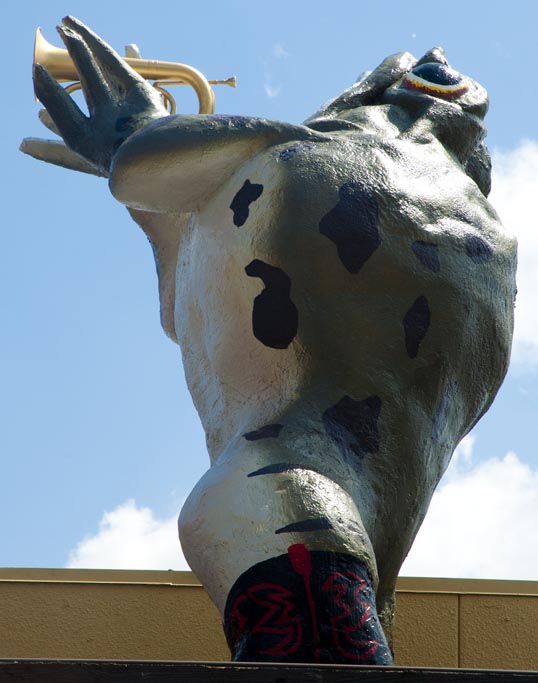
Frog Playing Trumpet.

They’re Back!
Vegetation growing on the wall near the entrance at the Dallas Museum of Art Sculpture Garden.
Dallas, Texas

Dallas Museum of Art, Dallas, Texas
“We are made aware that magnitude of material things is relative, and all objects shrink and expand to serve the passion of the poet. Thus, in his sonnets, the lays of birds, the scents and dyes of flowers, he finds to be the shadow of his beloved; time, which keeps her from him, is his chest; the suspicion she has awakened, is her ornament”
― Ralph Waldo Emerson, Nature
Tony Cragg
Stevenson, Bronze, 1939
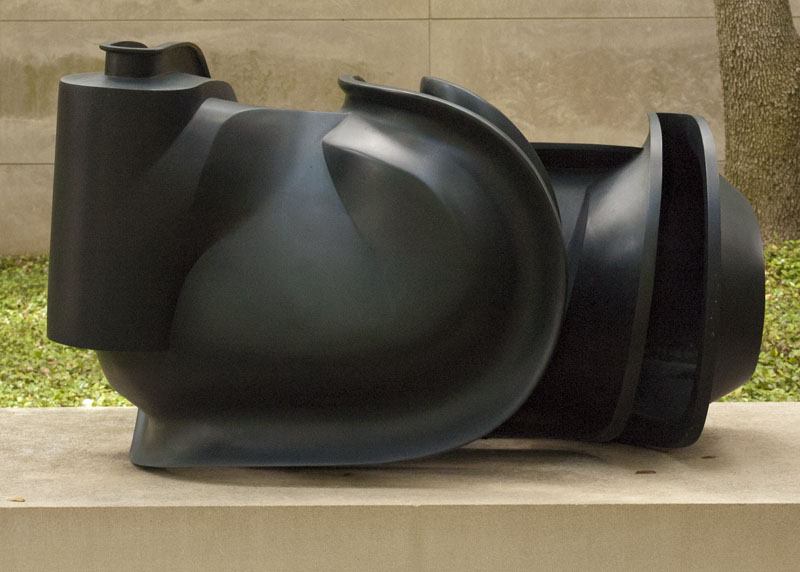
Tony Cragg, Stevenson, Dallas Museum of Art
(click to enlarge)
I’ve been a big fan of Tony Cragg ever since I visited his exhibition at the Nasher. It made me happy to discover this fantastic bronze in the garden of the Dallas Museum of Art.
Figure for Landscape
Barbara Hepworth
1960, Bronze
Dallas Museum of Art
Dallas, Texas

Figure for Landscape
Barbara Hepworth
(click to enlarge)

Figure for Landscape
Barbara Hepworth
What may this mean.
That thou, dead corpse, again, in complete steel,
Revisit’st thus the glimpses of the moon.
Making night hideous ; and we, fools of nature,
So horridly to shake our disposition,
With thoughts beyond the reaches of our souls?
Say, why is this?
—-Shakespeare, Hamlet
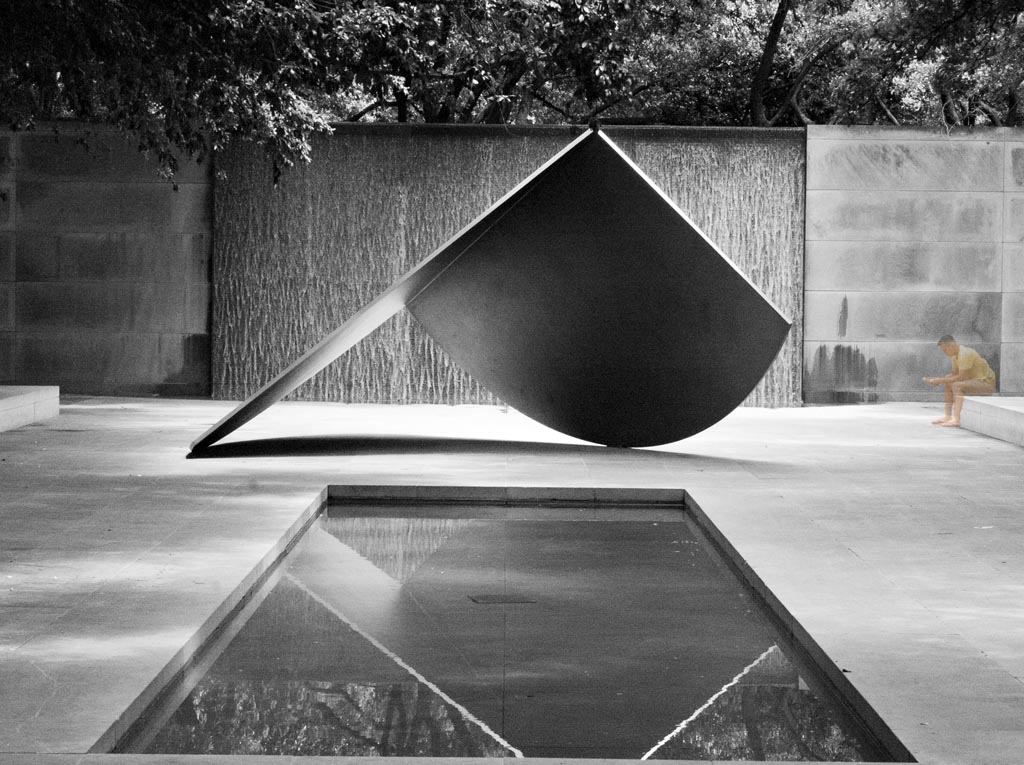
Dallas Museum of Art, Dallas, Texas
Untitled, Ellsworth Kelly
(click to enlarge)
Crow Collection of Asian Art
Dallas, Texas
Taken on the Stop and Photograph the Roses bicycle ride.
(click to enlarge)

1936 Monark Silverking, Fair Park, Dallas, Texas
(click to enlarge)
One of the riders on the Stop and Photograph the Roses bike ride met up with us about halfway through. He was delayed because he was picking up a “new” bicycle.
It was a 1936 Monark Silverking and it was way cool. Made of cast aluminum and swaged tubing it was a long way ahead of its time. I didn’t know that there were pre WWII aluminum bicycles.
We posed it in front of the Art Deco sculptures in Fair Park. I realized that the bike was made in the same year as the architecture. It shows.

1936 Monark Silverking, you can see the integrated lock – the key releases the steering tube which locks at ninety degrees.

Leonhardt Lagoon, Fair Park, Dallas, Texas
(click to enlarge)
I made it a point on the Stop and Photograph the Roses bike ride to swing by Fair Park. I love the Art Deco architecture, sculpture, and murals there. Plus, there is Leonhardt Lagoon, with the incredible 1986 walk-on sculpture by Patricia Johanson, Saggitaria Platyphylla (Delta Duckpotato).
“The lagoon was in the middle of Dallas’ largest park with four major museums along the shore, and it seemed a wonderful opportunity to convert it into a home for native wildlife—ducks, turtles, fish, shrimp, insects—by cleaning up the water and conceiving of landscaping as food. The “sculpture” was thought of as not just aesthetic, but rather a means of bringing people into contact with the plants and animals and the water.”
—-Patricia Johanson
It’s interesting, but there really is a Sagittaria Platyphylla (Delta Duckpotato) – it’s a water weed. The only thing is, the real thing is spelled slightly differently than the title of the sculpture (one G, two T’s). I’m sure she did this on purpose – for something of this size, you want to get it right.

Saggitaria Platyphylla (Delta Duckpotato)

Saggitaria Platyphylla (Delta Duckpotato)
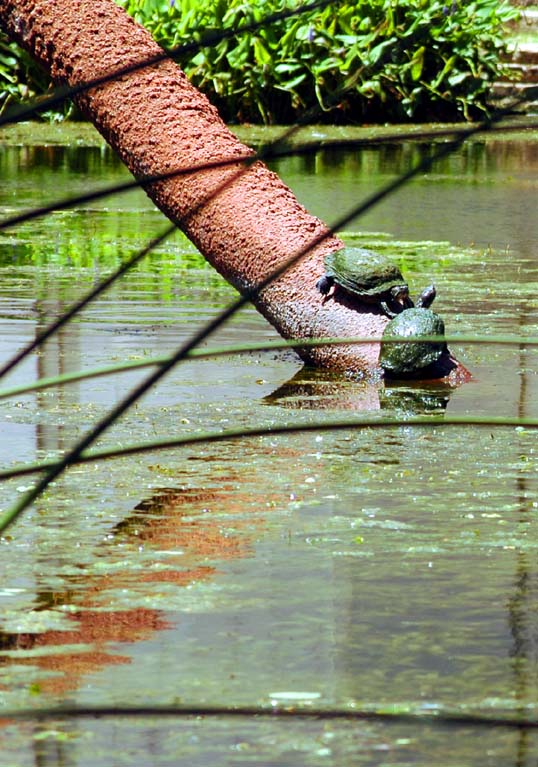
Saggitaria Platyphylla (Delta Duckpotato)

A pond in Fair Park. The red paths are part of a massive sculpture by Patricia Johanson. I have always loved those red paths running through the water, weeds, and turtles. A neglected jewel in the city.
 Bill Chance