Fair Park, Dallas, Texas

Fair Park, Dallas, Texas
If someone says “Six Flags” or even “Six Flags Over Texas” most people will think of the amusement park(s). Few outside of the Lone Star State know the historical implications of the six flags. There really have been six different flags flying over the state – a couple of them twice each.
First was the flag of Spain. From 1519-1685 and again from 1690-1821 most of Texas was a Spanish colony. In between, for the five years from 1685 to 1690, the area was under French rule. For more than a decade, from 1821 to 1836, Texas was a part of the newly-independent country of Mexico.
For ten years, from 1836 to 1845, Texas was a Republic… its own country. Some people think it was the only state to be independent, but that’s not true.
Then, in 1845, Texas joined the US as the 28th state, only to secede and join the Confederate States in 1861. Finally, in 1865, after the Civil War (or The War Between the States, as it is still called in the South) it rejoined the US.
Along the Esplanade, in Dallas’ Fair Park, are six huge porticoes lining a massive pool… three on the north and three on the south. Each portico represents one of the flags that flew over the state. There is a huge female statue outside each representing each country… I’ll look at them another time. What I want to show you is what is inside each portico.
Every entry boasts a massive mural painted on the wall. They are done in a beautiful, powerful, art deco style. I think they are among the coolest things in the city.
And they are virtually unknown. Each fall, millions attend the Texas State Fair and wander around eating their corny dogs, riding the ferris wheel, or looking at the newest car models or the fattest livestock and nobody bothers to peek inside the porticoes at the artwork – even though they are about forty feet tall.
I love to walk the mostly deserted park on non-fair days and look at the paintings. The ones on the south side, facing the north, have been beautifully restored. The ones on the north side, facing south – where the burning sun reaches in – are in worse shape and are very difficult to see because they are behind protective screens. I hope they are restored some time… I’m sure someone is working on it.
The murals are very difficult to photograph. They are in shade and reach up tall and wide in alcoves where you can’t get any distance away for a good shot.
So I did the best I could. If you have the time and are in town – go down and take a look for yourself. Otherwise… here you go.

The Esplanade pool at Fair Park in Dallas. You can see the huge porticoes on the south side on the right.


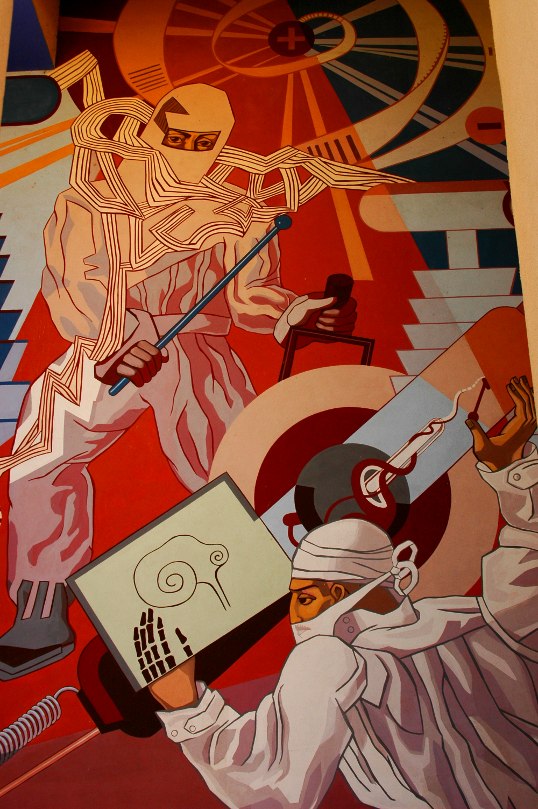
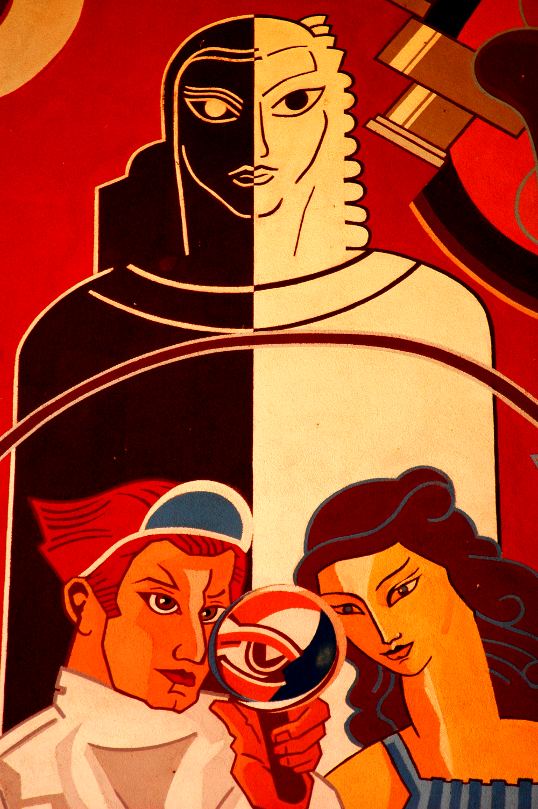

Art Deco mural from Fair Park in Dallas
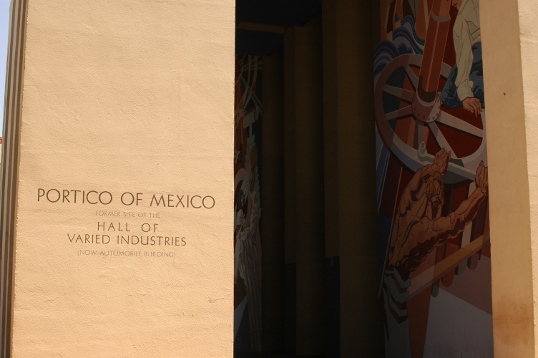
The huge murals are tucked inside the massive porticoes and are very difficult to photograph.

The northern three porticoes are facing the sun and their murals are badly faded.

I hope these are restored – they would be beautiful. This one includes a space ship – painted in 1936.

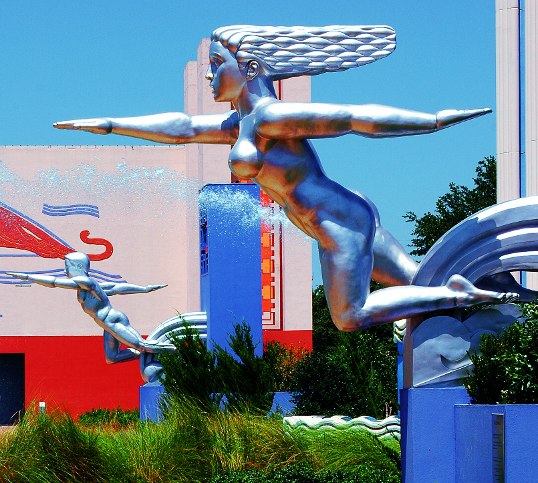
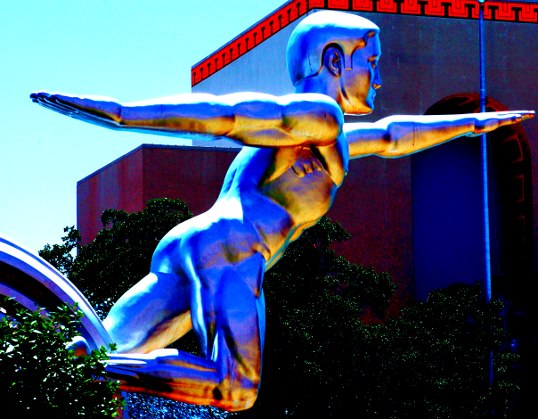
Fair Park is one of the underutilized gems in Dallas. Other than the few weeks of the Texas State Fair – the art deco wonderland goes neglected – shunned by most folks. I love to ride my bike down there and hang out – looking at the art. One of my favorite (among many) works is the sculpture Spirit of the Centennial, in front of the Woman’s Museum.
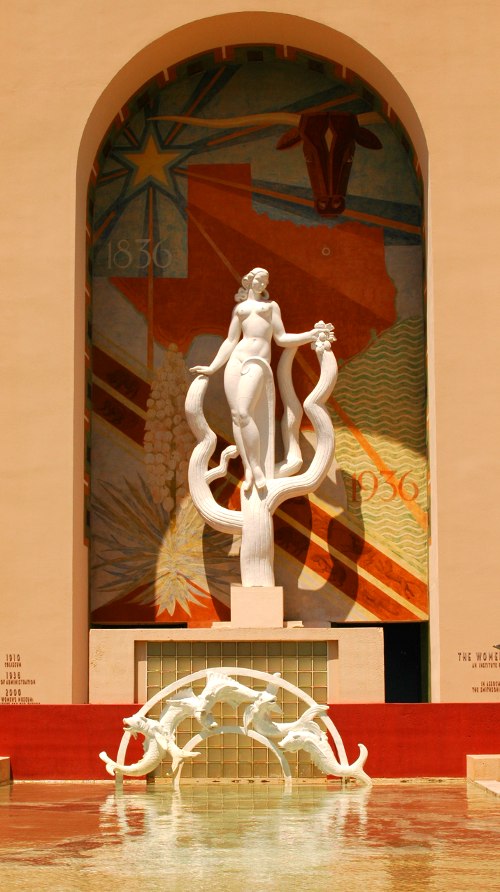
Spirit of the Centennial, Fair Park, Dallas
From Dallas City Hall:
Spirit of the Centennial Sculpture was designed by Raoul Josett and Jose Martin to sit in front of the Hall of Administration building (now the Women’s Museum). Carlo Ciampaglia designed the mural that serves as a backdrop to the sculpture, also titled Spirit of the Centennial. The woman featured in the sculpture has been a source of controversy with two different women claiming to have been the model. There is dispute over whether the model was Marry Ellen Bensterdt, a Duchess and 1930’s model, or the wife of K. Keiser, a big band leader during that era. Raoul Josett and Jose Martin also designed the Fish Fountain Sculpture, depicting flying fish swimming over a reflecting pond, which sits in front of the building. Stashka Star recreated renovated the Spirit of the Centennial mural and sculpture in 1998 and John Dennis recreated the Fish Fountain Sculpture in 2000.

When I went down to the Dallas Heritage Village and the Cedars Food Truck Park I took a little walk around the village. Back in the corner is a blacksmith’s shop. The master blacksmith was giving lessons to two students.
I stood and watched for a while. They had a coal fire going and would reach overhead and pump a huge pair of bellows to feed the fire and get the heat they needed. The students would pull their iron out of the fire and hammer it red-hot against an anvil.
This was really interesting. Maybe I’ll save some money up and buy myself a blacksmith lesson some time. It wouldn’t be very useful, but might be an interesting experience.

A blacksmith student hammering his work.
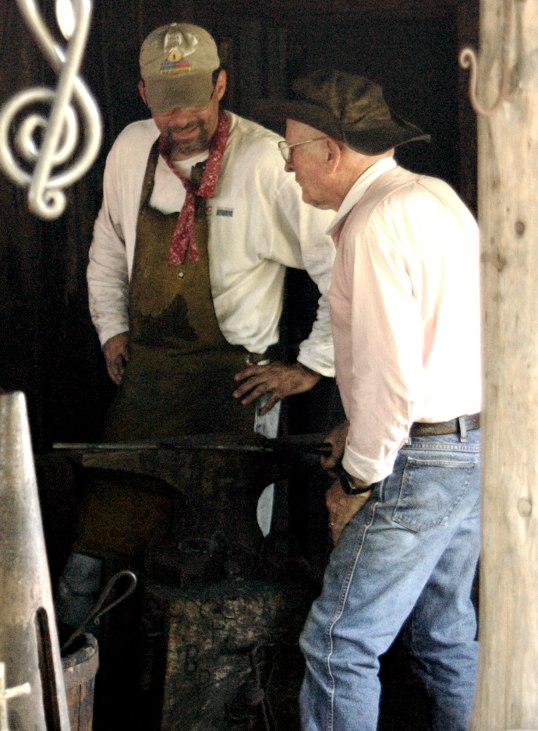
The teacher and the student.
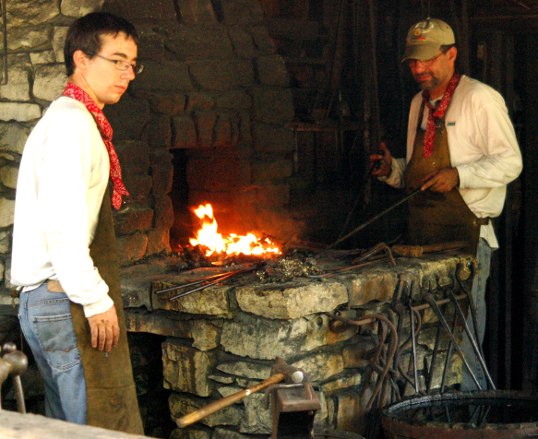
Working at the forge.
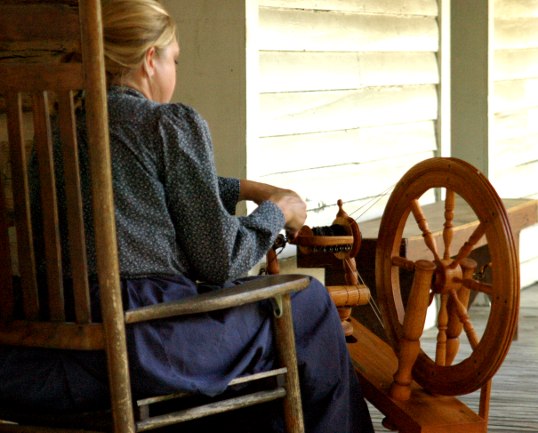
Near the blacksmith’s shop -a woman running a spinning wheel.
I was reminded of the blacksmith shop when, a couple weeks later, I was riding my bike around Fair Park. I was looking at and trying to photograph the series of amazing art deco murals on the six porticos along the Esplanade (I’m working on a blog entry… patience).
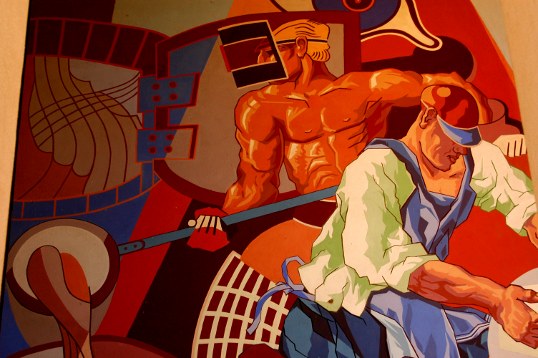
One of the murals shows a bare-chested smith hammering a piece of iron against a huge anvil. He is holding his hammer over his head, while next to him a helmeted welder is working away. A little more dramatic and artistic than the little blacksmith’s shop – but it’s the same general idea.
Art Deco mural from Fair Park in Dallas

 Bill Chance