Lucky Dogs

From the wonderful book, A Confederacy of Dunces, by John Kennedy Toole. In the story, Ignatius J. Reilly discovers and ends up working for a famous New Orleans Hot Dog Vendor. In the book, it’s Seven Paradise Vendors… in real life, Lucky Dogs.

Seven Paradise Vendors, Incorporated, was housed in what had formerly been an automobile repair shop, the dark ground floor of an otherwise unoccupied commercial building on Poydras Street. The garage doors were usually open, giving the passerby an acrid nos-trilful of boiling hot dogs and mustard and also of cement soaked over many years by automobile lubricants and motor oils that had dripped and drained from Harmons and Hupmobiles. The powerful stench of Paradise Vendors, Incorporated, sometimes led the overwhelmed and perplexed stroller to glance through the open door into the darkness of the garage. There his eye fell upon a fleet of large tin hot dogs mounted on bicycle tires. It was hardly an imposing vehicular collection. Several of the mobile hot dogs were badly dented. One crumpled frankfurter lay on its side, its one wheel horizontally above it, a traffic fatality. Among the afternoon pedestrians who hurried past Paradise Vendors, Incorporated, one formidable figure waddled slowly along. It was Ignatius. Stopping before the narrow garage, he sniffed the fumes from Paradise with great sensory pleasure, the protruding hairs in his nostrils analyzing, cataloging, categorizing, and classifying the distinct odors of hot dog, mustard, and lubricant. Breathing deeply, he wondered whether he also detected the more delicate odor, the fragile scent of hot dog buns. He looked at the white-gloved hands of his Mickey Mouse wristwatch and noticed that he had eaten lunch only an hour before. Still the intriguing aromas were making him salivate actively. He stepped into the garage and looked around. In a corner an old man was boiling hot dogs in a large institutional pot whose size dwarfed the gas range upon which it rested. “Pardon me, sir,” Ignatius called. “Do you retail here?” The man’s watering eyes turned toward the large visitor. “What do you want?”

“I would like to buy one of your hot dogs. They smell rather tasty. I was wondering if I could buy just one.”

Lucky Dogs cart - Bourbon Street, French Quarter, New Orleans

Lucky Dogs cart – Bourbon Street, French Quarter, New Orleans

“May I select my own?” Ignatius asked, peering down over the top of the pot. In the boiling water the frankfurters swished and lashed like artificially colored and magnified paramecia. Ignatius filled his lungs with the pungent, sour aroma. “I shall pretend that I am in a smart restaurant and that this is the lobster pond.”

“Here, take this fork,” the man said, handing Ignatius a bent and corroded semblance of a spear. “Try to keep your hands out of the water. It’s like acid. Look what it’s done to the fork.”

“My,” Ignatius said to the old man after having taken his first bite. “These are rather strong. What are the ingredients in these.”

“Rubber, cereal, tripe. Who knows? I wouldn’t touch one of them myself.”

“They’re curiously appealing,” Ignatius said, clearing his throat. “I thought that the vibrissae about my nostrils detected something unique while I was outside.”

Ignatius J. Reilly

Ignatius J. Reilly, sculpture on Canal Street.

Ignatius is such a fan of the Paradise Hot Dog, he is able to get a job as a vendor, setting out on the streets of his beloved New Orleans, pushing a heavy cart.

This does not turn out well.

George, who was wandering up Carondelet with an armload of packages wrapped in plain brown paper, heard.the cry and went up to the gargantuan vendor. “Hey, stop. Gimme one of these.”

Ignatius looked sternly at the young boy who had placed himself in the wagon’s path. His valve protested against the pimples, the surly face that seemed to hang from the long well-lubricated hair, the cigarette behind the ear, the aquamarine jacket, the delicate boots, the tight trousers that bulged offensively in the crotch in violation of all rules of theology and geometry.

“I am sorry,” Ignatius snorted. “I have only a few frankfurters left, and I must save them. Please get out of my way.”

“Save them? Who for?”

“That is none of your business, you waif. Why aren’t you in school? Kindly stop molesting me. Anyway, I have no change.”

“I got a quarter,” the thin white lips sneered. “I cannot sell you a frank, sir. Is that clear?” “Whatsa matter with you, friend?”

“What’s the matter with me? What’s the matter with you? Are you unnatural enough to want a hot dog this early in the afternoon? My conscience will not let me sell you one. Just look at your loathsome complexion. You are a growing boy whose system needs to be surfeited with vegetables and orange juice and whole wheat bread and spinach and such. I, for one, will not contribute to the debauchery of a minor.”

“Whadda you talking about? Sell me one of them hot dogs. I’m hungry. I ain’t had no lunch.”

“No!” Ignatius screamed so furiously that the pas-sersby stared. “Now get away from me before I run over you with this cart.”

George pulled open the lid of the bun compartment and said, “Hey, you got plenty stuff in here. Fix me a weenie.”

“Help!” Ignatius screamed, suddenly remembering the old man’s warnings about robberies. “Someone is stealing my buns! Police!”

My son, Lee in front of a cart.

My son, Lee in front of a cart.

What I learned this week,December 14, 2012

Why The Hot Sauce Industry Is The New Craft Beer Industry

and

Hot Sauce Goes Mainstream


11 Foods You Can’t Buy Anywhere Anymore


How to Make Beer

Check out this beautiful 1933 brewing guide from the pages of Popular Science.


Pint Sized
How nanobreweries—fledgling operations in garages and backyard sheds—are revolutionizing the American beer industry.


Pan’s Labyrinth to be Adapted into Stage Musical


The Decade’s 25 Most-Essential Foreign Films


Cook Your Meat in a Beer Cooler: The World’s Best (and Cheapest) Sous-Vide Hack


The Monster Collection of Moleskine Tips, Tricks and Hacks

Here and There – Chihuly and Winfrey Point

A photo I took a while back of the Chihuly Exhibit in the Arboretum, with White Rock Lake’s Winfrey Point in the distance across an arm of the lake. This huge glass sculpture is called “The Sun.”

Chihuly with Winfrey Point in the background, across the water.

Chihuly with Winfrey Point in the background, across the water.

A shot I took from a bicycle ride on Winfrey Point, with the Arboretum and the Chihuly Sun in the background.

Arboretum from Winfrey Point, a peloton of cyclists going by on the road.

Arboretum from Winfrey Point, a peloton of cyclists going by on the road.

204

He had met her through a mutual friend that thought they would be good for each other. On their first date, he had taken her to Olivier’s and it felt like they had known each other all their lives. They ate Creole Rabbit and Crawfish Étouffée.

She left him on a gray and drizzling day. He still goes to Olivier’s and watches for her, though he knows she won’t come walking in.

204

Dog and Master


“Outside of a dog, a book is man’s best friend. Inside of a dog it’s too dark to read.”
—- Groucho Marx

Another Set List on the Green

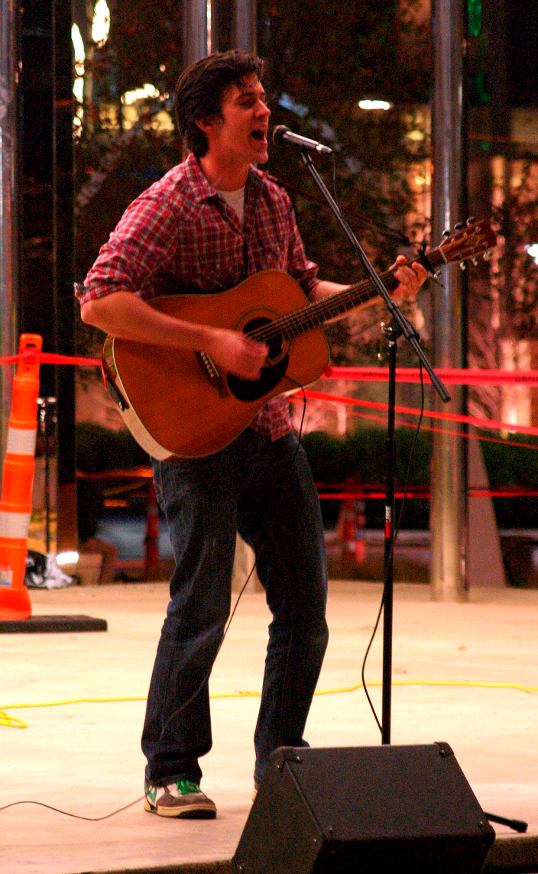
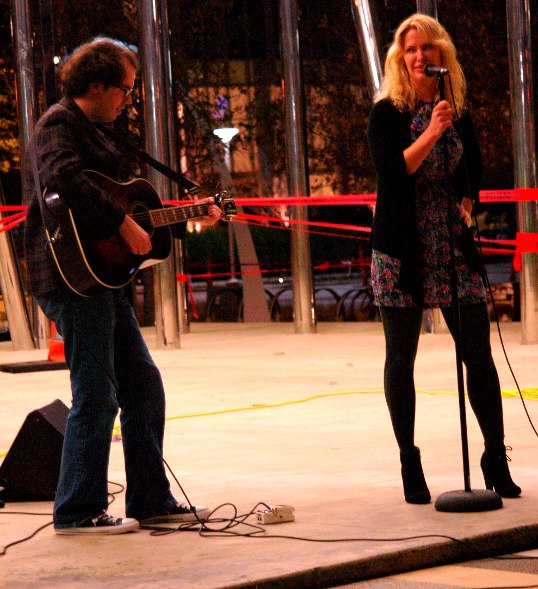
I had a lot of fun last week at the Set List on the Green – downtown Dallas in Klyde Warren Park. So much fun that, braving a bit of chill, I hopped a train and headed down as the sun set.

What Set List is about is, on Thursdays at 6:30 PM they have six local musicians take the stage for a half-hour set each. What is cool is the wide variety of talent (and, frankly, wide range of talent) on display. Though, not surprisingly, the musical stylings tend toward the folk/acoustic/country/songwriter sort of thing… your really don’t know what to expect.

It makes for a nice evening. A chair or blanket on the grass, a bit of sustenance from a local gourmet food truck, a beer or glass of wine from a nearby stand, and some good local music. I am compiling quite a list of music that I like and am able to follow them around the city… find stuff I like. It’s pretty damn cool, if you ask me.

This is only the second SOG (Setlist On the Green) and it’s the last of the season. Due to the impending cold weather (yes, it does get semi-cold here in Dallas in the dead of winter) they will be on hiatus until March. I’m looking forward to it starting up again… though if they go on Thursdays, they will compete with the Patio Sessions nearby…. so little time, so many choices.

At any rate, the lineup this week:

next_week_set_list

This time, I did drag my camera along.

Arianne Gray

Arianne Gray

Tyler Lowe

Tyler Lowe

Nicholas Altobelli

Nicholas Altobelli

Claire Fowler

Claire Fowler

Carl Sullivan and the Rising Suns

Carl Sullivan and the Rising Suns

http://vimeo.com/22583608

Cities of the Dead

tour1

New Orleans Cemetery – Saint Louis #1

On our last trip to the Big Easy, we signed up for a New Orleans Cemetery tour from Tulane University.

The Cemeteries of New Orleans are famous – when you visit you notice them right away on your drive away from the airport. Because of the high water table, burial in the city is above ground in crypts. If you tried to stick a coffin underground it would come bobbing up in the first hurricane and go hurtling down the street.

The dense clusters of stone crypts packed into rows give the cemeteries of New Orleans the nickname, “cities of the dead.”

All the parents piled in to the bus on the Tulane campus for the trip to St. Louis Cemetery #1. The woman sitting next to us spent her time making desperate phone calls. She was from Rockaway in New York and her house had been destroyed by Hurricane Sandy. She had decided to go ahead and make the planned trip to visit her daughter at school so she could use the Internet to register for assistance while her husband remained behind trying to salvage what he could. There was a lot of irony in a parent from New York coming to see her daughter in New Orleans as a refugee from a devastating hurricane.

The tour was very interesting – mostly because of our tour guide. A spry elderly New Orleans native of French extraction – thick with that amazing melodious Cajun accent – she spoke a lot of the unique way of looking at life (and death) necessary for survival in a place as inhospitable to polite civilization as New Orleans. She spoke of the constant friction between the attitude of the New Orleans natives and the Americans… spoken as if they were aliens from another planet.

She said she didn’t understand the Americans, even though she was glad she was married to one, because, “Darling, somebody has to do the work.” She said, not long after she was married, her husband had to go in to the office on a Saturday,

“Honey, where’re you goin’,” she asked.

“I’m going to work.”

“What do you mean? It’s Saturday. Nobody works on a Saturday!”

The concept was completely incomprehensible to her.

Then she went on to describe the details of a New Orleans internment. She said, “Ah never though this was unusual. I thought everybody did it like this. When I went to another city I was stunned. Ah said ‘You did a hole? And drop a body down there? And cover it up?’ Ah couldn’t believe it.”

You see, I always knew about the above ground crypts in New Orleans, but I never understood the process. You see, these are family crypts – or in some cases, organizational crypts. They are built in two parts, an upper chamber and a lower one. A small opening at the back of the crypt connects the two.

When you die, there is no embalming… and no fancy metal or lined casket – just a pine box. They open the crypt and you go in the top chamber. There you wait, for at least a year and a day, until the next person expires. Then they open up the tomb, secure in the knowledge that the tropical heat and humidity have done their work, and there isn’t much left of you. Any surviving pieces of casket are removed and everything else is pushed back through the opening where it falls into the lower chamber, leaving room for the next occupant.

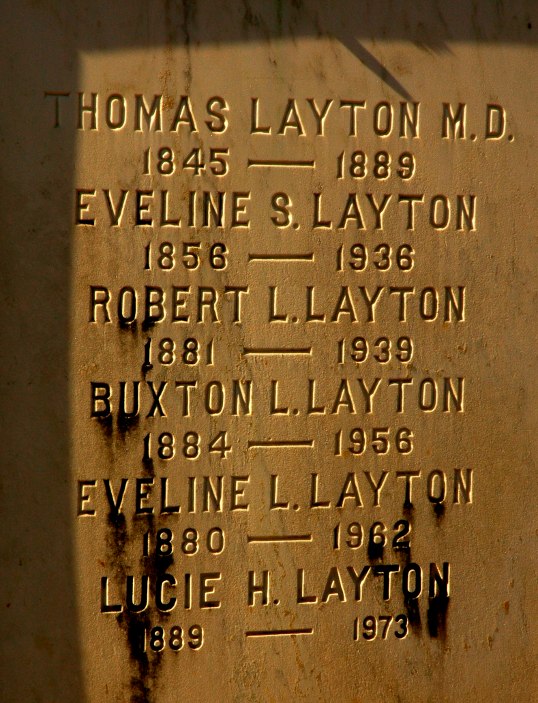
This is repeated as long as necessary. Some of the tombs had dozens of names on them, spanning well over a century.

Some of the details are fascinating. The walls of the cemetery are lined with small “wall tombs.” These are for when, as our guide said, “Somebody dies too soon, before the year and a day. They get stuck in the wall tomb until they can get moved back into the family crypt.”

Our tour guide in front of a typical New Orleans burial crypt.

Our tour guide in front of a typical New Orleans burial crypt.

A street in the City of the Dead. Family crypts on the left, wall crypts on the right.

A street in the City of the Dead. Family crypts on the left, wall crypts on the right.

Older crypts, getting run down.

Older crypts, getting run down.

Wall crypts. Space is at a premium. Look at the tiny spaces at ground level.

Wall crypts. Space is at a premium. Look at the tiny spaces at ground level.

Layton family crypt.

Layton family crypt. Over a century of family members.

Our guide said she was waiting for tomb space to open up and had saved money to buy in. “Space is limited, and in death like in life, it’s location, location location. I don’t want to go to my rest outside the city, I want a tomb in New Orleans.”

When a family dies out, nobody is left to take care of their crypt and it can collapse. Our guide said she had her eye on this spot in case it came up for sale.

When a family dies out, nobody is left to take care of their crypt and it can collapse. Our guide said she had her eye on this spot in case it came up for sale.

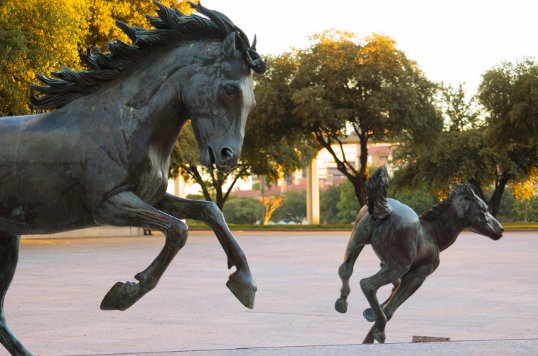
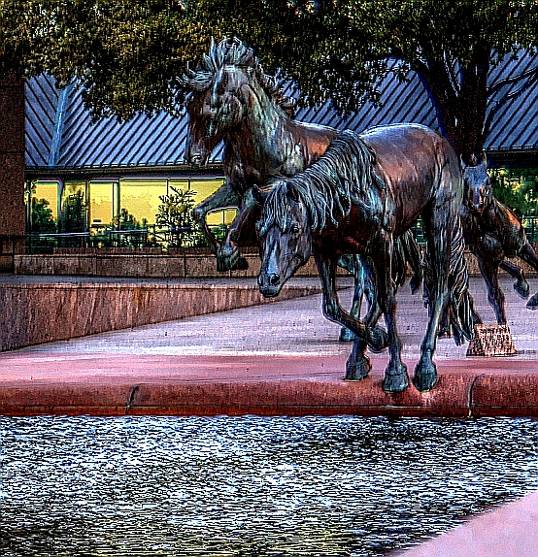
HDR Mustangs

Las Colinas Mustangs, Irving, Texas

mustang_hdr5_w

(Click for a larger and more detailed version on Flickr)

mustang_hdr4

mustang_hdr3

mustang_hdr2_w

(Click for a larger and more detailed version on Flickr)

What I learned this week, December 7, 2012

25 literary girls who’ll break your heart

tender


LINDA_FIORENTINO

30 movie girls who’ll break your heart


5 landmarks you probably didn’t know about in Downtown Dallas

Though I was familiar with four of these (I noticed the hidden Houston street ramp during Ciclovia Dallas) I have never been to Lubben Plaza. I’m going to have to give it a shot – that one sculpture, The Harrow, looks really cool.


When They’re Grown, the Real Pain Begins

All of that changes when they are grown. They fall in love, break their hearts, apply for jobs, leave or lose the jobs, choose new homes, can’t pay the rent for those new homes and question their choice of profession. They forge their way, all just outside of your helping reach. Then, when bad things happen, they need you like crazy, but you discover that the kind of help you’ve spent 25 years learning how to give is no longer helpful.


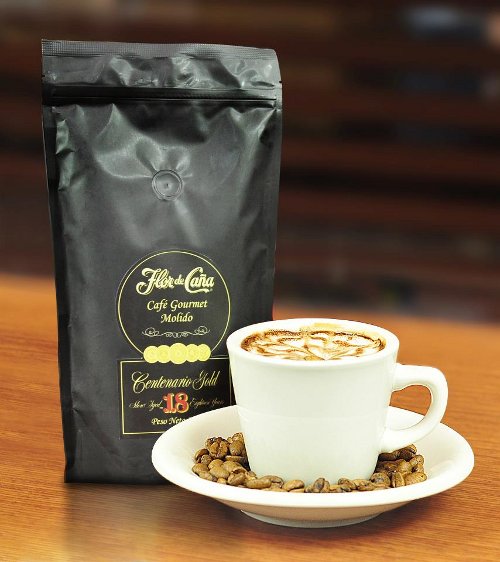
¡Que rico un café Flor de Caña!

Es café macerado en ron, posee todas las propiedades organolépticas del ron, pero tiene grado de alcohol

Es café macerado en ron, posee todas las propiedades organolépticas del ron, pero tiene grado de alcohol

Coffee flavored with Flor de Caña – this is truly the best of all possible worlds.


America Leads World in Energy Revolution

The U.S. is already reaping the benefits of new energy extraction techniques, but other gas-rich nations are having trouble achieving similar results. The basic obstacles are the same everywhere: environmental worries, government hangups, and a lack of technical expertise and infrastructure related to fuel extraction.


The 40 Greatest Villains Of Literature

As always, “Blood Meridian” is up there. Look at it this way, “Blood Meridian” is written by the same guy that wrote “No Country for Old Men.” And the people that made the list included Judge Holden and they left Anton Chigurh off. I’ve read both books… I can see why.

chigurh

Judge Holden (Blood Meridian)

Author: Cormac McCarthy

Year: 1985

Judge Holden is, apparently, a real, historical figure, though evidence is minimal. After reading Blood Meridian, we’d suggest that we hope he was entirely made-up, seeing as Holden is the devil incarnate, leading a pack of criminals into robbery, rape and murder, throwing in a touch of paedophilia along the way. A seven-foot monster, with pale white skin, McCarthy paints him as almost supernatural in ability, but also in badness. A true villain of the peace in every way.


The 40 coolest characters in literature

A great list… and the don’t come any cooler than Ignatius J. Reilly.

Ignatius J. Reilly

Ignatius J. Reilly

Ignatius J. Reilly (A Confederacy of Dunces)

Author: John Kennedy Toole

Quite possibly the funniest character in modern literature, the larger than life Ignatius J. Reilly deplores the modern world and its pop culture leanings. He dresses in a hunting cap, flannel shirt, baggy pants and scarf, and spends the entire novel criticising everyone and everything around him. He would no doubt despise the thought of being considered cool. Such disregard to these conventions makes him, inadvertently, very cool.


$10k college degrees are on to something

Higher education costs are inflated by bloated bureaucracies and bills paid with other people’s money. Universities employ professors too busy with research to spend much time teaching. They sink vast sums into money-losing intercollegiate sports. And they spend lavishly on marketing efforts to build prestige and buck up their college rankings.

Then, after deciding what they need to spend, they price accordingly. Their tuition is a function of this bloat and government’s willingness to subsidize them.