Digitalis

Dallas Blooms, Dallas Arboretum

The Foxglove now in crimson tresses rich
Depends, whose freckled bells to insect tribe
Afford a canopy of velvet bliss.

—-Wordsworth

digit3

A chemical extract from foxglove, digitalis, is both a famous deadly poison and a precious remedy for heart disease. The difference, like everything else in life, is timing and dosage.

In digitalis the gap between poison and remedy is very, very small.

digit1

How did it get its name?

According to the 19th-century book, English Botany, Or, Coloured Figures of British Plants:

Dr. Prior, whose authority is great in the origin of popular names, says “It seems probably that the name was in the first place, foxes’ glew, or music, in reference to the favourite instrument of an earlier time, a ring of bells hung on an arched support, the tintinnabulum”… we cannot quite agree with Dr. Prior for it seems quite probable that the shape of the flowers suggested the idea of a glove, and that associated with the name of the botanist Fuchs, who first gave it a botanical name, may have been easily corrupted into foxglove. It happens, moreover, the name foxglove is a very ancient one and exists in a list of plants as old as the time of Edward III. The “folks” of our ancestors were the fairies and nothing is more likely than that the pretty coloured bells of the plant would be designated “folksgloves,” afterwards, “foxglove.” In Wales it is declared to be a favourite lurking-place of the fairies, who are said to occasion a snapping sound when children, holding one end of the digitalis bell, suddenly strike the other on the hand to hear the clap of fairy thunder, with which the indignant fairy makes her escape from her injured retreat. In south of Scotland it is called “bloody fingers” more northward, “deadman’s bells” whilst in Wales it is known as “fairy-folks-fingers” or “lambs-tongue-leaves”

digit2

The Scottish doctor William Withering, while working as a physician in the 18th Century, had one of his patients come to him with a very bad heart condition and since Withering had no effective treatment for him, thought he was going to die. The patient went instead to a local gypsy, took a secret herbal remedy – and survived and improved. When the doctor found out he searched out the gypsy. The herbal remedy was made from a variety of things, but the active ingredient was the purple foxglove, digitalis purpurea.

Withering tried out various formulations of digitalis plant extracts on hundreds patients, and found that the dried, powdered leaf worked with amazing and successful results. He introduced its use officially in 1785.

What I learned this week, March 22, 2013


Burgers and Beer

Smashburger and Deep Ellum Brewing Co Pairing Menu


Turandot at the Death Star


Creates Device that Harvests Energy From Air


The 8 Most Incredible Stop-Motion Animation Music Videos From The Past Decade


A Dictionary of Similes


Crunchiness

Crunchiness brings wealth. Wealth leads to sogginess. Sogginess brings poverty. Poverty creates crunchiness. From this immutable cycle we know that to hang on to wealth, you must keep things crunchy.


Video: Making a 10,000-Year Clock

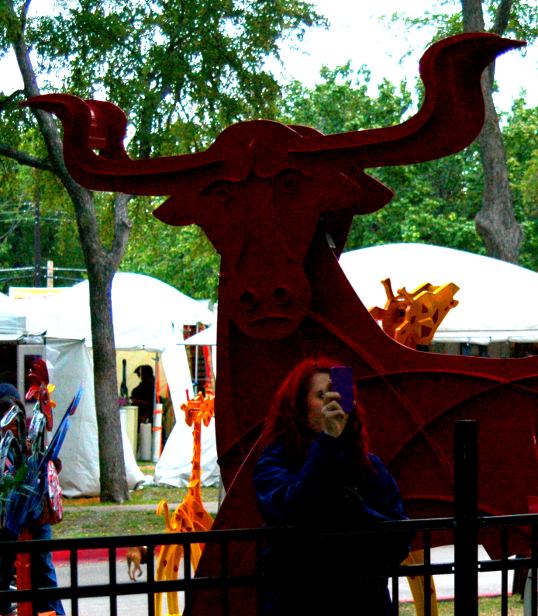
Painted Steel Menagerie

Cottonwood Art Festival, Richardson, Texas

The tree which moves some to tears of joy is in the eyes of others only a green thing that stands in the way. Some see nature all ridicule and deformity… and some scarce see nature at all. But to the eyes of the man of imagination, nature is imagination itself.

—-William Blake

Spider

“There are spiders living comfortably in my house while the wind howls outside. They aren’t bothering anybody. If I were a fly, I’d have second thoughts, but I’m not, so I don’t.”
― Richard Brautigan, The Tokyo-Montana Express

Louise Bourgeois, Spider

The Sydney and Walda Besthoff Sculpture Garden, New Orleans Museum of Art

spide_w
(Click for full size version on Flickr)

“Spider venom comes in many forms. It can often take a long while to discover the full effects of the bite. Naturalists have pondered this for years: there are spiders whose bite can cause the place bitten to rot and to die, sometimes more than a year after it was bitten. As to why spiders do this, the answer is simple. It’s because spiders think this is funny, and they don’t want you ever to forget them.”
― Neil Gaiman, Anansi Boys

“There was less than I’d expected in the rainy-day fund that Mom had kept in the bottom of an underwear drawer in a panty hose egg labeled ‘DEAD SPIDERS.’ As if I hadn’t always known it was there. As if I wouldn’t want to look at dead spiders.”
― Adam Rex

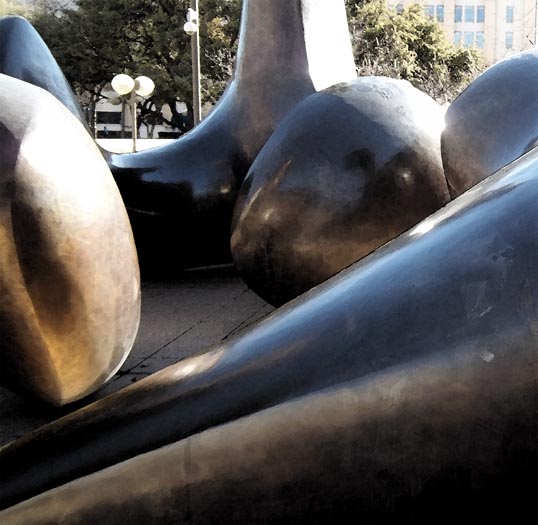
Curves of Metal

The Dallas Piece, Dallas City Hall Plaza
Henry Moore
1978

curve

“How important can it be that I suffer and think? My presence in this world will disturb a few tranquil lives and will unsettle the unconscious and pleasant naiveté of others. Although I feel that my tragedy is the greatest in history—greater than the fall of empires—I am nevertheless aware of my total insignificance. I am absolutely persuaded that I am nothing in this universe; yet I feel that mine is the only real existence.”
― Emil Cioran, On the Heights of Despair

curve2

Egg

 
Near the Lover’s Lane DART station, Dallas, TX
 

egg

“If there is a hard, high wall and an egg that breaks against it, no matter how right the wall or how wrong the egg, I will stand on the side of the egg. Why? Because each of us is an egg, a unique soul enclosed in a fragile egg. Each of us is confronting a high wall. The high wall is the system which forces us to do the things we would not ordinarily see fit to do as individuals . . . We are all human beings, individuals, fragile eggs. We have no hope against the wall: it’s too high, too dark, too cold. To fight the wall, we must join our souls together for warmth, strength. We must not let the system control us — create who we are. It is we who created the system. (Jerusalem Prize acceptance speech, JERUSALEM POST, Feb. 15, 2009)”
― Haruki Murakami

egg1

It’s Not Easy Being Green

DART rail station, Dallas Texas, on the way to the St. Patrick’s Day Parade

St. Patrick's Day

Saint Patrick’s Day

I wasn’t going to the parade... or any other drunken St. Patrick’s day stuff. I wanted to go downtown to meet my friends at Klyde Warren Park for a Writer’s Marathon downtown in the Art Museum. My intention was to ride the DART train downtown with my bicycle and then ride home (with the strong south wind at my back) afterward.

There would be big crowds though, so I intended to go early. Unfortunately, I had a late night, so I didn’t get up and around on time and didn’t leave the house until eight thirty AM or so. To save time, I decided to drive to a train station instead of leaving home on my bike. When I pulled into the Forest Lane Dart Station (the Cottonwood bike trail goes through there, so I could ride back) I saw the parking lot almost full and a thick crowd up on the elevated platform. Most of them were hauling coolers, bags of food, and folding chairs So I knew I wouldn’t be able to get on that train with my bike.

I walked up there, a little disappointed, and waited in line at the ticket machines to get my day transit pass. It took forever – the folks in front of me were not experienced train riders and they had a terrible time figuring out the ticket machines… plus a lot of them seemed to be drinking already, at nine-thirty in the morning. When I finally had my pass in hand (I checked, it took me less than thirty seconds to buy mine) I waited in the growing crowd for a train.

The next two trains came through the station and when the doors opened we were presented with the hellish vision of a compressed cube of green covered humanity. The cars were literally packed full. Not a single person from our station could get on the trains.

So I bailed. There was surprisingly little traffic on the highway and I was able to get down to one of my “secret” free parking spots in Deep Ellum. I could ride my bike over to Klyde Warren from there – won’t be able to get very many miles of exercise in and I’d have to make sure and get back to my car by sundown (I didn’t want to risk these streets after dark on a bicycle with all the celebrants driving).

Now, next year I want to go to the parade with my good camera. I am disappointed that I wasn’t at the opening door on the DART train with my camera ready – that was quite something to look at.

A Well Muscled Aztec Warrior

I remember, once upon a time, a long time ago, in a galaxy far, far away, having a conversation with a cow-orker about art. We were in a bullpen-style office, during a break, and talking about buying artworks, where to find affordable paintings, if affordable, original art was worth the cost for poor workin’ stiffs like us or if we were better off with prints or reproductions… that sort of thing.

All of a sudden, a voice broke in. It was from another worker, one that we never thought would be interested in the subject. He was a good guy, bright enough, but not from the city. You can take the boy out of the backwoods, but you can’t take the backwoods out of the boy. His voice was slightly garbled from the giant chaw of tobacco he had stuck in his lower lip.

He said, “Oh, I just bought an original painting, myself.”

We were a little stunned at this admission. After a few seconds, I regained my composure and asked, “Oh, what did you buy?”

He said, “A painting of a well muscled Aztec warrior on black velvet.”

Not that I have anything against black velvet paintings, but at that time I didn’t really consider them art.

In the intervening decades between who I was then and who I am now… I have changed my mind.

Graffiti in Deep Ellum. This warrior is nothing if not well-muscled... plus he is carrying off his prize of war.

Graffiti in Deep Ellum. This warrior is nothing if not well-muscled… plus he is carrying off his prize of war.