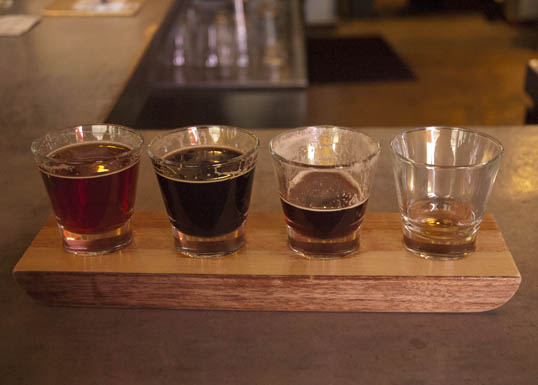
Heavy Hitter beer flight at Luck, in Trinity Groves, Dallas, Texas
From left to right:
Velvet Hammer, from Peticolas Brewing Company – One of my favorites. If you buy, say, a whole growler of this be a little careful. They don’t call it Velvet Hammer for nothing.
The Temptress, from Lakewood Brewing Company – I consider The Temptress to be one of the best things in the world. Not one of the best beers… one of the best things.
Inspiration, from Community Beer Company – Actually, I’m not sure if I remember this one correctly. I do love stuff from Community, especially their Mosaic – my favorite IPA.
Quakertown Stout, from Armadillo Ale Works – I liked this one a lot. You can tell, it’s empty. It’s a new favorite – near the top of the list.
I know the Vickery Meadow area of Dallas very well. When I showed up in Dallas in 1981, unemployed and with twenty-five dollars to my name (Texas was the only place in the country you could find a job in 1981) I stayed with some friends in the Timbercreek Apartments on Melody Lane (they have since been torn out) for a short time. Moving there from the rural plains of Kansas seemed like the height of big city living – and they were pretty cool at the time. We soon moved to Oak Cliff, and then I came back to Lower Greenville when I found a job and saved enough for a deposit.
I loved living down there (especially in the 80’s) but my social life was mostly in Vickery Meadow (and The Village across Northwest Highway). You see, it’s hard to imagine now, but in 1982 interest rates hit sixteen percent. At that rate nobody… and I mean nobody, could afford to buy a house. So all these apartment complexes sprouted up like mushrooms and hordes of young people, and a few not so young people, moved in.
It was a wild social scene. One complex was full of a combination of strippers and Dallas Cowboy Cheerleaders. That was a popular swimming pool on a hot summer afternoon. It was a good time.
But good times never last and this one fell faster than anyone thought possible. When the interest rates came down, many fled the rental complexes for the northern suburbs and the endless expanses of single family homes that were vomiting out across the cotton fields of North Texas. Then, in 1988, the Federal Government started enforcing the Fair Housing Act (making it illegal to exclude families from rental properties) – which doomed the singles apartment complexes that were the lifeblood of the area. That was the death knell. Occupancy rates fell. Rents dropped. And soon the owners couldn’t get enough from their rents to maintain the properties, which fell into disrepair – and the cycle repeated until it fell into a spiral of catastrophe.
Within a few short years the whole area was crack city. Sometimes I would drive through on my way to the Big Main Half-Price Bookstore and I would feel sad – the echoes of such good times gone to bad.
But then Vickery Meadow made a comeback of sort. Not one of wealth – quite the opposite – but one of culture. The area had fallen so far that the only people that would live there were the ones that could not afford to live anywhere else – the immigrant, the tired and poor, the huddled masses, yearning to breathe free.
And now Vickery Meadow is a dense package of diverse humanity. It is still dirt poor, but it feels different. It feels like there might be a little hope in the most unlikely of places.
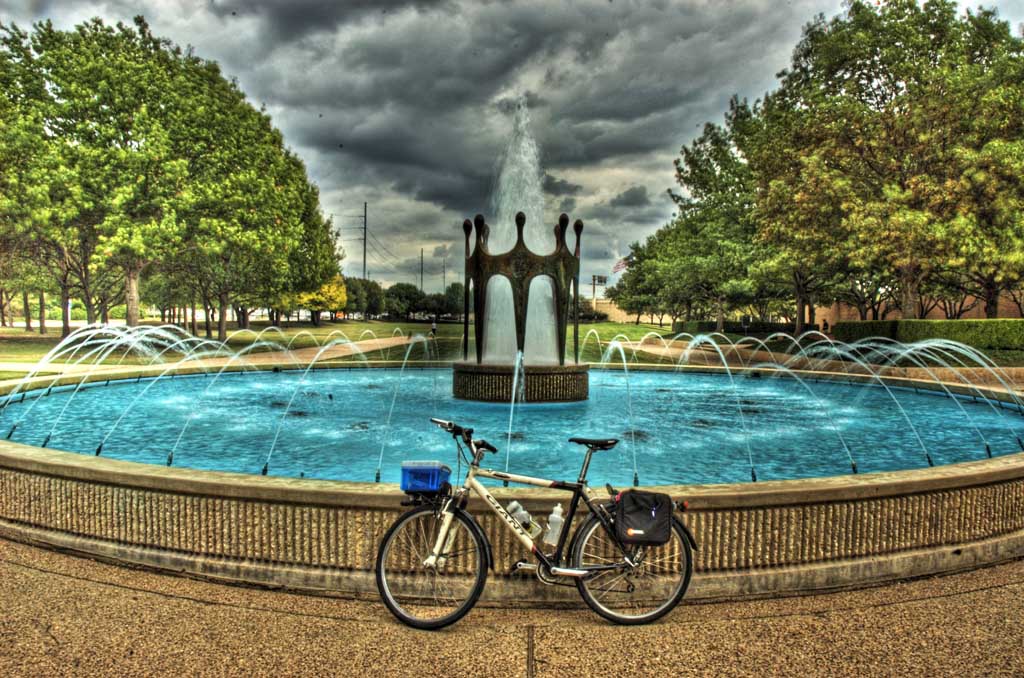
The tenth, and, for me, the last exhibition of the Nasher XChange works was a pop up market called Trans.lation by Rick Lowe. I had missed the first few dates and February 22 was my last chance. As always, I had my commitment to visit all ten sites without using a car. This one was easy. I rode my bike down to the Arapaho and caught the Red Line down to the Park Lane station and fought my way across Greeville Avenue and on into Vickery Meadow.
I was immediately struck by that odd layering of strong old memories with the present that has changed – but not enough that it does not stir ancient echoes. Many of the apartment buildings that contained some of my best friends, places I spent a lot of time, have been torn down and replaced by sprawling school campuses to accommodate the children of the new residents. I rode up to the heart of Vickery Meadow – a complex bustling intersection called “Five Points.”
My memory isn’t as good as it should be and I took the wrong one of the five roads and pedaled out down Park Lane instead of Ridgecrest. By the time I realized my error and looped back up another memory was brought back to me – the streets there can be very steep. I remembered exercising my way up these hills on a road bike back in the day. Unfortunately, I’m not twenty-five years old any more, and I had to wait a bit to catch my breath.
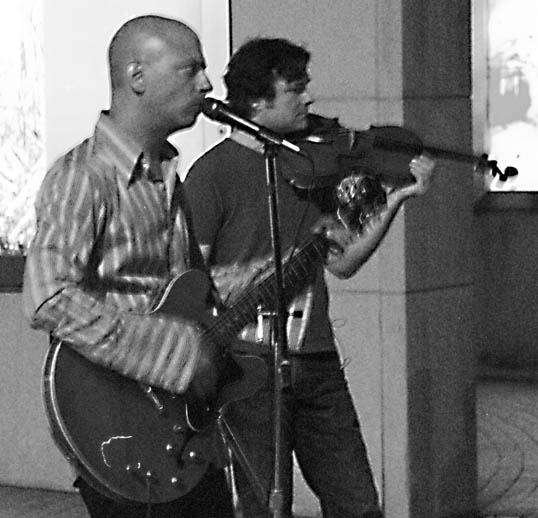
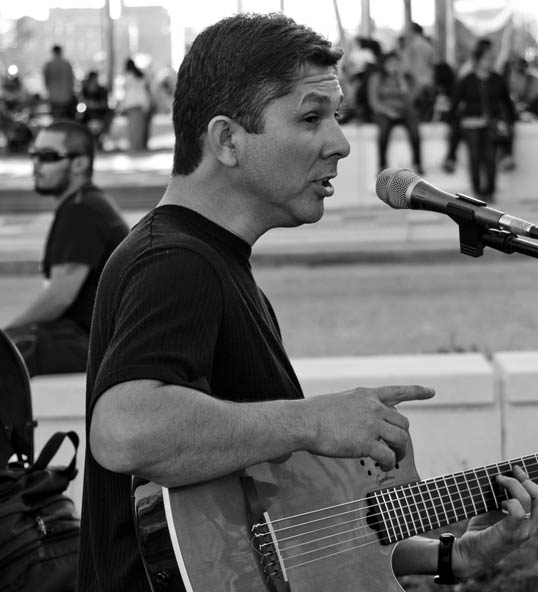
Finally, I picked the right road and found the market. I locked my bike up to a fence and went in – enjoying the arts and crafts for sale… I especially loved the music coming from the stage. There were a lot of people of every age and nationality you could imagine and everyone was having a great time.
That was something I will remember for a long time.
Trans.lation Market: Vickery Meadow
Trans.lation Market: Vickery Meadow
Trans.lation Market: Vickery Meadow
Trans.lation Market: Vickery Meadow
Trans.lation Market: Vickery Meadow – There were three pop up art galleries along the street featuring neighborhood artists and concerns.
“Walked up Ellum an’ I come down Main,
Tryin’ to bum a nickel jes’ to buy cocaine.
Ho, Ho, baby, take a whiff on me”
—- Leadbelly, Take a Whiff on Me
“Soon it got dusk, a grapy dusk, a purple dusk over tangerine groves and long melon fields; the sun the color of pressed grapes, slashed with burgandy red, the fields the color of love and Spanish mysteries.”
― Jack Kerouac, On the Road
Deep Ellum, Dallas, Texas (click to enlarge)
“A large drop of sun lingered on the horizon and then dripped over and was gone, and the sky was brilliant over the spot where it had gone, and a torn cloud, like a bloody rag, hung over the spot of its going. And dusk crept over the sky from the eastern horizon, and darkness crept over the land from the east.”
― John Steinbeck, The Grapes of Wrath
When you go down on Deep Ellum,
Put your money in your socks
‘Cause them Women on Deep Ellum
Sho’ will throw you on the rocks.
—-Leadbelly, Deep Ellum Blues
The raw material for bronze in antiquity was copper ore that, unknown to the metalworkers of the day, contained enough tin to make the alloy. In many place, bronze and copper must have been thought of as distinct metals. There was no quest for the elements and no incentive to try to separate bronze into ingredients since it was already the superior metal for so many purposes. In a few places, pure tin was smelted from its own ore, cassiterite, and, too soft for weapons and utensils, wsa formed into ornaments. Where tin and copper were obtained from separate ores, it was naturally not long before bronze was being made purposely by putting the two metals together. Once it was known that bronze could be made in this way rather than relying on ores that happened to contain the right proportions of copper and tin, the hunt was on for the miraculous metal which had the power to make copper both more useful and more beautiful.
—-Periodic Tales: A Cultural History of the Elements, from Arsenic to Zinc – Hugh Aldersey-Williams
The past and current green space plans for downtown Dallas aren’t thinking comprehensively about how development nor economics of urban spaces work. They’re band-aids to cover up mistakes rather than generate real value.
It’s not about the nail
“Don’t try to fix it. I just need you to listen.” Every man has heard these words. And they are the law of the land. No matter what.
If The Wind Rises is indeed the final film from Hayao Miyazaki—the animation master has both announced and rescinded his retirement—he leaves us with a moving, meaningful farewell. Based on Miyazaki’s own manga, this Oscar nominee for Animated Feature Film plays the gentle notes of a Japanese countryside against the impending horror of World War Two, Miyazaki seeing it all through the myopic eyes of a budding aeronautic engineer.
Examples of past Miyazaki genius:
Spirited Away trailer
Castle in the Sky trailer
Nausicaa trailer
For the last few decades one of the things I marked my life with was the release of each Hayao Miyazaki film… from Totoro to Mononoke, on to Spirited Away (a masterpice) with Nausica and Laputa and Howl’s Moving Castle and more and more thrown in for good measure. It gave me a feeling of periodic genius.
It looks like this has come to an end (really this time – he has threatened retirement before) and I will miss it – but the collection of work is stil out there.
Might be time to rewatch a few.
top ten underrated Studio Ghibli Films
The #1 movie on this list is Grave of the Fireflies – the most heartbreaking film I’ve ever seen.
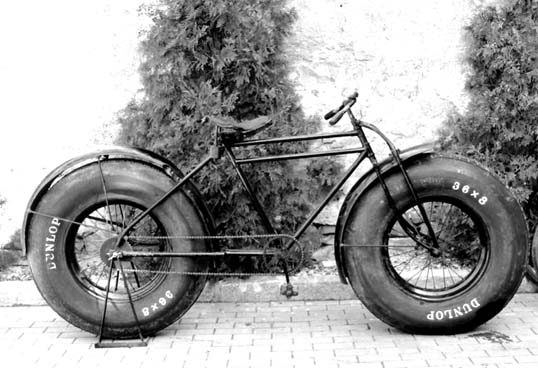
I like some of the new Fat Bike designs – but this is a little much… maybe a lot much.
Should You Buy a Fat Bike?
If you’re not familiar with fat bikes like theSalsa Mukluk or Surly Moonlander, think of a two-wheeled monster truck with you as the motor.
“Fat bikes allow people to ride bicycles in places that previously were simply not possible,” says Peter Koski, product development engineer at Salsa.
Math Explains Likely Long Shots, Miracles and Winning the Lottery [Excerpt]
Why you should not be surprised when long shots, miracles and other extraordinary events occur—even when the same six winning lottery numbers come up in two successive drawings
I always say that in terms of entertainment, espectially visual, thriller-type entertainment, it’s not the hero that’s important… it’s the villian. Give me an interesting, complex villian over some goody-two-shoes anytime.
What could be more Texas than this? Rice grown in Texas fields first planted by settlers more than a century ago, processed by a Texan in the heart of the capital, Austin, and sold under the product name “Rising Star.”
Welcome to the world of the Texas Sake Company, almost certainly the first – and most certainly the only – commercial brewer of the Japanese rice wine operating in the Lone Star State.
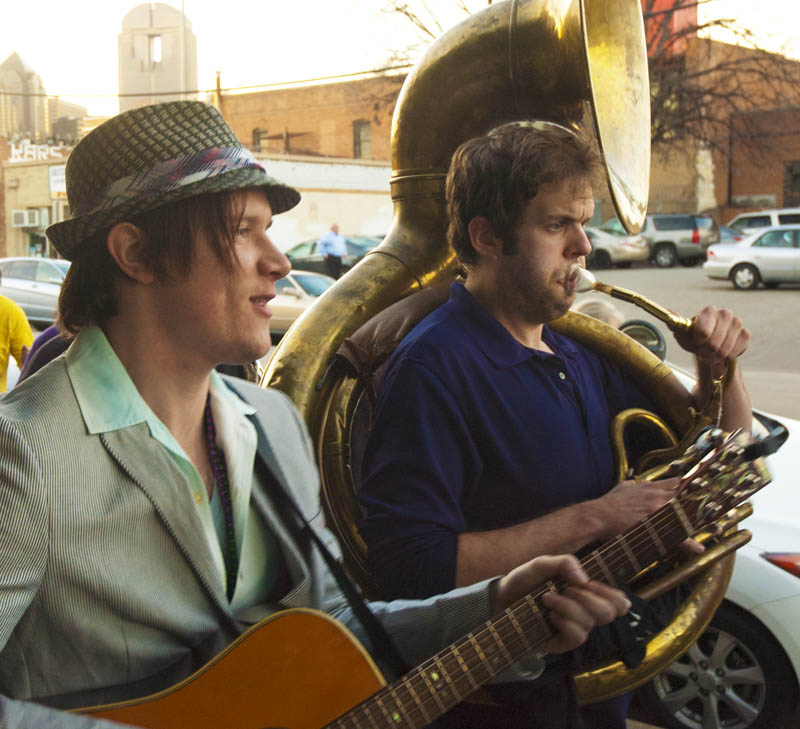
I was riding my bike around downtown, and ended up in Deep Ellum in time for the First Annual Deep Ellum Mardi Gras Parade. I’ve been to Mardi Gras in New Orleans a couple times as well as the Bishop Arts version the last couple years – and Deep Ellum has a way to go to meet those standards – but it was still a blast and a great start.
Everyone met up at The Free Man and set out down the sidewalk playing Louisiana music and having a lot of fun. The sun was setting and I had a long way to go to get home on my bike, so I wasn’t able to stay for all the festivities. I’ll plan better next time.
Insomnia is an exquisite torture. Life must be boring for those who sleep well.
There is a different world in the wee hours of the morning – a world of offbeat television. I grew up with only three television channels – plus maybe a PBS station if you lived near a big city. Then I discovered those channels that you had to use a funny circle of wire antenna screwdrivered into little posts labeled UHF. The kind that you had to tune in by hand – no clicking channel selector. One UHF channel featured old monster movies. All night long. I’d watch them in the pitch black kitchen on a tiny portable television.
Now there are a thousand digital channels – and after a certain time, the channel matrix guide simply says “Paid Program.” Everything is for sale….
Once I saw an infomercial for a product that appeared to be a pointed delta-shaped piece of metal with a large plastic handle attached. You would plug in in, add water through a tiny port, and then rub it over a wrinkled garment. The wrinkles would disappear.
“It’s a miracle,” the pitchman would exclaim.
“It’s an iron,” I’d shout at the television. “They’ve been around for centuries.”
The next exhibition in the series of Nasher XChange works was the one that required me to go the least distance. I basically had to roll over and look at the television.
Denton’s Good/ Bad Art Collective filmed a 28 minute infomercial in a downtown office building. They had a call for volunteers, but I wasn’t paying enough attention and missed the casting call. That was the first part of the exhibition. The next was a static display of the studio they had built on an empty floor of the skyscraper. I had ridden my bike past this many times, but decided (for no real reason) not to stop and look. I wanted to see the infomercial blind, in its native habitat, so to speak, the bedroom television.
My DVR wasn’t working, so I set my alarm for the middle of the night, on a worknight, but it wasn’t needed. Like Gregor Samsa, after a night of uneasy dreams, I awoke, reached over, groggy, but conscious, and pawed the button before the buzzer was able to do its duty.
I clicked the remote and then waited for the Good/Bad Art Collective’s promised subversive infomercial to start. Instead, there was Deborah Norville and Inside Edition. What was this? I watched while Deborah talked about the freaky, the hopeless, and the lurid – a parade of freaks moving between strange eccentricity, and eccentric strangeness. It left me wanting to rinse my eyeballs and afraid of falling asleep – what dreams would this stuff bring?
Maybe I was too early, so I watched the next half-hour. Here, suddenly, was Larry King, selling Omega XL – a miracle material made from green mussel lips (instead of fish) or something like that. The claims were so outrageous and odd – this is truly another world, where truth is lies and money is king.
And that was all I could take – I reset the alarms, mashed the remote and before I knew it, was on to work the next day.
Checking the Good/Bad page the next day I learned there was a mistake, a lack of communication and the mock infomercial was delayed for 24 hours.
So I woke again and watched the real thing. There was the sleazy announcer in front of a bank of multicolored draperies. Every now and then there was an interlude with the volunteer actors and a phone number (What walks on four legs in the morning, two legs in the afternoon, and three legs in the evening) – I should have called the number, I’m sure it was something Good/Bad subversive – but I didn’t.
Something was wrong with the pitchman – he would stumble and clutch his head. Finally, he collapsed, apparently deceased. His feet protruded from the curtains.
The funny thing is, I have no idea what the man said. I was paying attention, I heard him clearly. It seemed to make some sort of sense at the time, but that is another world, that time of night, and the ideas don’t make the transition to the light of day.
Insomnia is an exquisite torture. Life must be boring for those who sleep well.
Good/Bad Art Collective is a Denton, Texas based group of artists that created well over 250 events in Texas and New York from 1993-2001. For the Nasher XChange exhibition, the Good/Bad Art Collective is creating a project entitled CURTAINS that will be part one-night event, part exhibition and part television broadcast exploring notions of viewership and interaction. The Collective’s XChange project will be their first major project in more than 10 years, and coincides with the 20th anniversary of the group.
In the months leading up to the opening of XChange, the Collective will produce a 28-minute infomercial, which will be filmed in a newly created television studio on an empty floor of Bryan Tower, a downtown Dallas highrise managed by Spire Realty. At the one-night opening event on Saturday, October 19, 2013, attendees will be given the opportunity to participate in the filming of the infomercial. Visitors throughout the run of XChange will be able to walk the space in which the infomercial was filmed and see sculptural elements used as props during the opening and in the finished infomercial, as well as select edits of video documenting the one-night event. The finished infomercial will be broadcast on late night and early morning television timeslots in local, regional, and national markets.
Throughout its ten year history over 110 artists and creatives were members of the Good/Bad Art Collective, developing unique one-night events of art, music, and film programming at a break-neck pace, resulting in what The Village Voice described as “Fluxus with ADD.” Partly inspired by conceptual art programs at the University of North Texas offered by artist Vernon Fisher, the group created installations and events that were often interactive, humorous, and thought-provoking.
Past large-scale projects include Very Fake, But Real (1997), a one-night-only event at DiverseWorks Art Space, Houston, in which they built an exact replica of their Denton studio inside the gallery and used the surrounding interior space as a roller skating rink and concert hall; and We’re On Our Way to Dinner, But We Have to Pick Up Something First (1999) for a photography exhibition at the Arlington Museum of Art in which they transformed the mezzanine of the museum into a 1970s-style garden apartment building and used one of the spaces to throw impromptu surprise parties for each of the guests at the opening, installing the polaroid photographs on the apartment refrigerator for the duration of the exhibition
I had a cycling route picked out from the Audubon Center to Paul Quinn College, where the next Nasher XChange installation was located. It involved a trail through the Great Trinity Forest across the Trinity River. I was a little nervous about that – the green lines were clear enough on the Google Maps Cycling Layer, but I wasn’t sure the trails were finished or even if they went exactly where the map said they did. Documentation on trails when they are finished is light and unreliable and I was going to be alone and a long way from home.
…Shouldn’t have worried – the route through the forest was a beautiful ride. New, smooth, level trail, gentle winding, and that feeling that, in only a few feet, you have left a giant city for some remote wooded wilderness. Of my entire ride that day, this is the part I will return to. There are more trails under construction – hopefully there will eventually be a complete complex that can be used for recreation and transportation.
The forest was, of course bare, the sky leaden and gray – but the promise of green spring isn’t very far away. There will be a narrow sliver of time between when the vegetation comes alive yet before the killer summer heat slams home. I’ll have to plan a trip in that window – maybe a picnic somewhere. On this day I had it all to myself and it’s hard to imagine other people down in that isolated forest – but maybe someday.
As I emerged from the trail system onto Simpson Stewart Road I began to see some familiar landmarks. I was surprised at how far south I had ridden. Off to the side was an incongruous mountain rising from the tabletop flat river bottom lands – a treeless smooth, undulating highland beginning to cast a long shadow over the winter afternoon. This is the McCommas Bluff Landfill – a gigantic pile used to dispose of the city’s detritus – a massive hidden cache of flotsam and jetsam.
Then I rode past a building, the city’s Eco Park structure. I had been there several times for meetings or educational events – and had always looked at the abandoned roads stretching out into the floodplain and wondered about riding a bike there. I was surprised to find myself coming the other way.
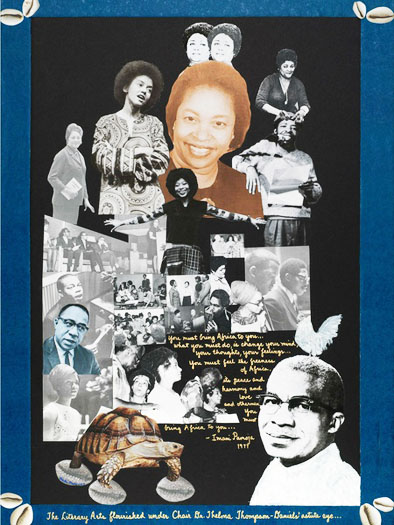
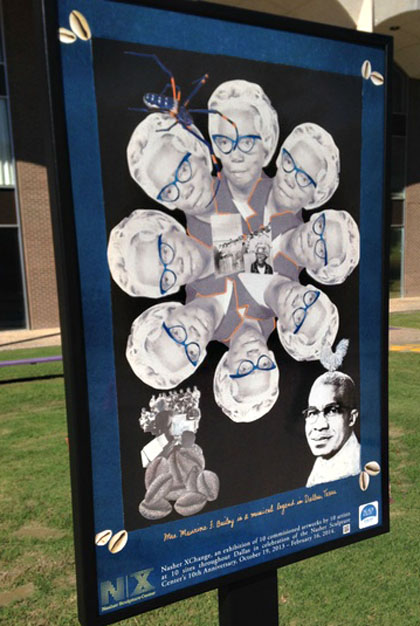
At that point I arrived back into civilization… and road traffic. There was a nasty steep hill leading up to the entrance to Paul Quinn College and the next stop on the Nasher XChange tour – Vicki Meek’s Black & Blue: Cultural Oasis in the Hills. The exhibition is a series of artworks posted around as signs that illustrate the history of Bishop College – a historic educational institution that sat on the site.
I was exhausted from the hill climb and running late, so I wasn’t able to take the time or energy to find all of the exhibit or to give it proper thrift – but I could feel the history, the promise, and the difficulties that an institution like Bishop College offers or offered and faces or faced.
I still had miles to go, another XChange site to visit – and after that a train station to find and two trains to take home. I was getting tired and slowing down more and more. Nothing to do but keep pedaling.
Vicki Meek, Black & Blue: A Cultural Oasis in the Hills
Vicki Meek, Black & Blue: A Cultural Oasis in the Hills
DALLAS, Texas (August 16, 2013) – The Nasher Sculpture Center is pleased to reveal the plans for a newly commissioned work by artist Vicki Meek that will be located on the campus of Paul Quinn College. The work is one of ten commissions for the Nasher’s 10th anniversary, city-wide exhibition Nasher XChange, which will be on view October 19, 2013 through February 16, 2014.
Entitled Black & Blue, Cultural Oasis in the Hills, Vicki Meek plans to celebrate Bishop College’s role in the intellectual and cultural life of Dallas through a series of historical markers commemorating important people and moments from the college, and which will also include an interactive web component and video interviews. Bishop College was a historically black college founded in Marshall, Texas in 1881 that moved to southern Dallas in 1961 and closed in 1988. The campus is now occupied by Paul Quinn College.
To develop her project, Vicki Meek is working with former Bishop College faculty and alumni, and members of the Highland Hills and Singing Hills neighborhoods around the school. Bishop College played a significant role in the development of academic and cultural life in Dallas, giving birth to important cultural institutions such as the African American Museum and the Dallas Black Dance Theatre.
She describes the motivation behind her work as a desire, “to reclaim African American history, restore our collective memory and illuminate critical issues affecting the Black community through visual communication.”
Meek, a native of Philadelphia, PA, is a nationally-recognized artist residing in Dallas, Texas. Trained as a sculptor, she has focused on installation art for the past 25 years that asks for direct engagement from the viewer in an effort to foster dialogue on often difficult subject matter. Meek’s work is in the permanent collections of the African American Museum in Dallas, The Museum of Fine Arts in Houston and Norwalk Community College in Norwalk, Connecticut. She was awarded three public art commissions with the Dallas Area Rapid Transit Art Program and was co-project artist on the largest public art project in Dallas, the Dallas Convention Center Public Art Project. In addition, Meek is an independent curator and writes cultural criticism for her blog, Art & Racenotes. Meek is currently the Manager of the South Dallas Cultural Center and serves as Chair of the Board of Directors for National Performance Network.










 Bill Chance