Donnie: Why do you wear that stupid bunny suit?
Frank: Why are you wearing that stupid man suit?
—-Donnie Darko

Large Leaping Hare
Barry Flanagan, 1982
Northpark Center
Dallas, Texas
Donnie: Why do you wear that stupid bunny suit?
Frank: Why are you wearing that stupid man suit?
—-Donnie Darko
Large Leaping Hare
Barry Flanagan, 1982
Northpark Center
Dallas, Texas
Pioneer Plaza
Dallas, Texas
Taken during the DART to Art, Rail & Ride

Bronze Fly at Pioneer Plaza, Dallas, Texas
The giant bronze sculpture of a cattle drive at Pioneer Plaza in Dallas is a very popular tourist attraction. Hordes of snap-happy folks mill around posing while raising their phones to get something to upload. The stationary wave of metal cattle forever guided by three cowboys is an impressive bit of public art – one that simultaniously awes the throng while reinforcing every Dallas Stereotype (cattle, cowboys, size, tackiness, gaudy, cliche) in the book.
When I visit I always climb to the cowboy on the top of the rise (that the herd of Longhorns is plunging from – down and across a draw) to look at something very small on the hidquarters of his horse. There is a bronze horsefly stuck there – a tiny detail donated by the sculptor to the more observant art fan.
I must not be the only one. The patina is worn fron the little fly-shaped lump of metal – giving it a virgin bronze color. The rubbing hands of crowds of tourists keep the horsefly gleaming in the afternoon sun.
Barbara Hepworth
Sea Form (Atlantic)
Bronze, 1965
Dallas Museum of Art, Sculpture Garden
Dallas, Texas

Sea Form (Atlantic)
Barbara Hepworth
(click to enlarge)
“The sculptor carves because he must. He needs the concrete form of stone and wood for the expression of his idea and experience, and when the idea forms the material is found at once. […]
I have always preferred direct carving to modelling because I like the resistance of the hard material and feel happier working that way. Carving is more adapted to the expression of the accumulative idea of experience and clay to the visual attitude. An idea for carving must be clearly formed before starting and sustained during the long process of working; also, there are all the beauties of several hundreds of different stones and woods, and the idea must be in harmony with the qualities of each one carved; that harmony comes with the discovery of the most direct way of carving each material according to its nature.”
—- ‘Barbara Hepworth – “the Sculptor carves because he must”‘, The Studio, London, vol. 104, December 1932
“I have always been interested in oval or ovoid shapes. The first carvings were simple realistic oval forms of the human head or of a bird. Gradually my interest grew in more abstract values – the weight, poise, and curvature of the ovoid as a basic form. The carving and piercing of such a form seems to open up an infinite variety of continuous curves in the third dimension, changing in accordance with the contours of the original ovoid and with the degree of penetration of the material. Here is sufficient field for exploration to last a lifetime.”
“Before I can start carving the idea must be almost complete. I say ‘almost’ because the really important thing seems to be the sculptor’s ability to let his intuition guide him over the gap between conception and realization without compromising the integrity of the original idea; the point being that the material has vitality – it resists and makes demands.”“I have gained very great inspiration from Cornish land- and sea-scape, the horizontal line of the sea and the quality of light and colour which reminds me of the Mediterranean light and colour which so excites one’s sense of form; and first and last there is the human figure which in the country becomes a free and moving part of a greater whole. This relationship between figure and landscape is vitally important to me. I cannot feel it in a city.”
—-Barbara Hepworth ‘Approach to Sculpture’, The Studio, London, vol. 132, no. 643, October 1946
Tony Cragg
Stevenson, Bronze, 1939
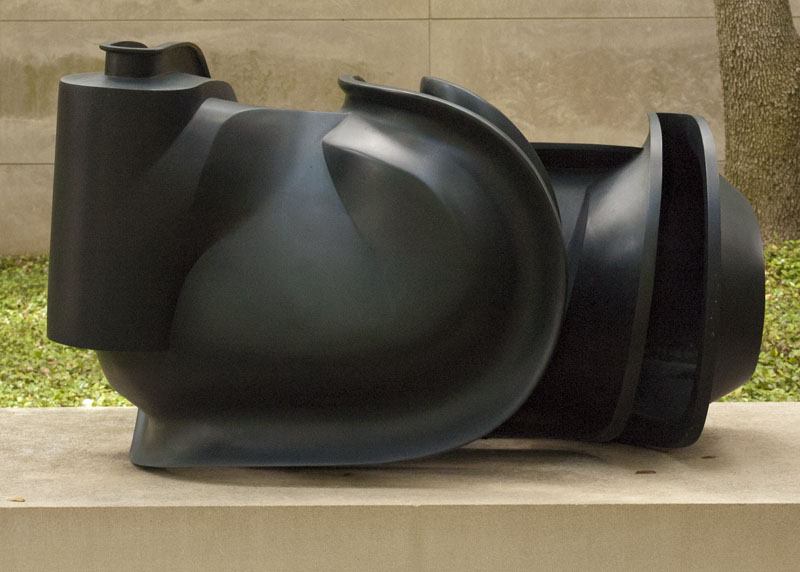
Tony Cragg, Stevenson, Dallas Museum of Art
(click to enlarge)
I’ve been a big fan of Tony Cragg ever since I visited his exhibition at the Nasher. It made me happy to discover this fantastic bronze in the garden of the Dallas Museum of Art.
“The aim is to balance the terror of being alive with the wonder of being alive.”
― Carlos Castaneda
“The stars are reflected from within the black water in the cistern. I find comfort in the omen I glean from this: light in the darkness, truth when it seems there is none.”
― Alice Hoffman, The Dovekeepers
David McCullough, Dallas
Quanta: Celtic Spirit Catcher
2000, Acrylic, F6 Cement, Foam, Wire
Frisco, Texas
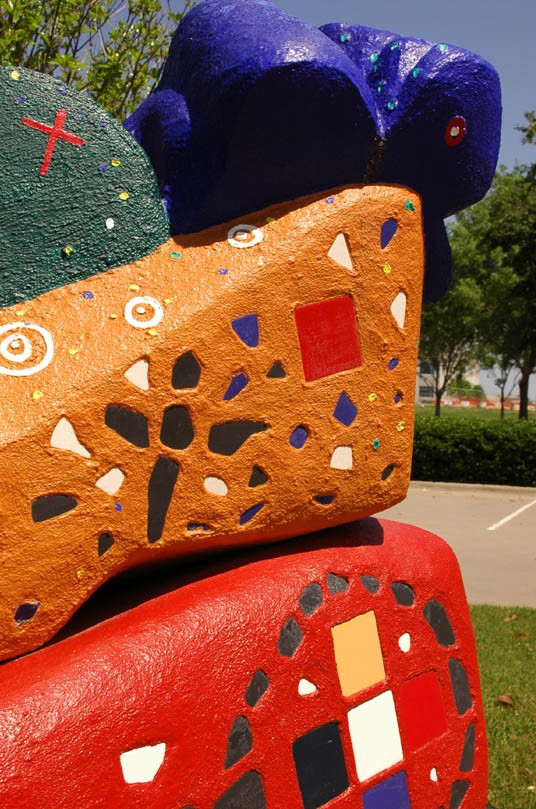
David McCullough, Dallas
Quanta: Celtic Spirit Catcher

David McCullough, Dallas
Quanta: Celtic Spirit Catcher
“I understood that fate could not be eluded forever; it came on leathery wings, swooping through the darkness like the bats in the orchards.”
― Alice Hoffman, The Dovekeepers
Zeke: It’s a twister! It’s a twister!
—The Wizard of Oz
Art Shirer, Dallas
The Wiz, 2001, Steel, Paint
Frisco, Texas
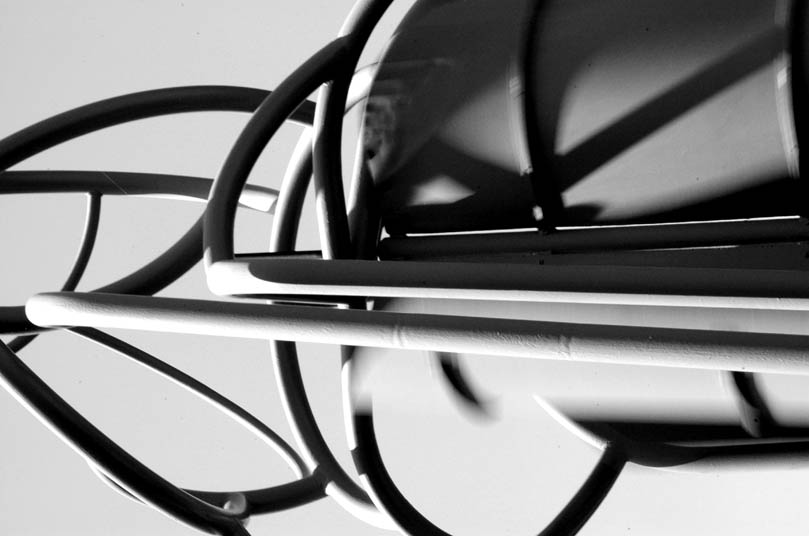
Art Shirer, Dallas
The Wiz
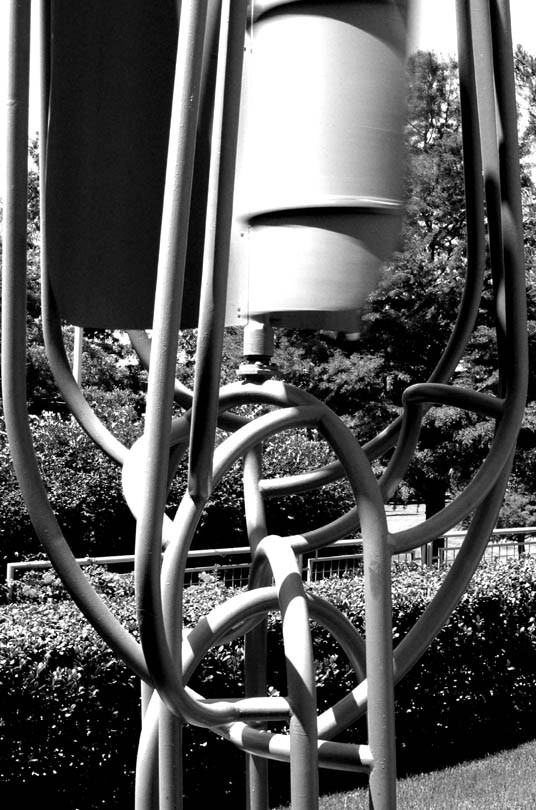
Art Shirer, Dallas
The Wiz
“Even as a small child, I understood that woman had secrets, and that some of these were only to be told to daughters. In this way we were bound together for eternity.”
― Alice Hoffman, The Dovekeepers
Michelle O’Michael, Houston
La Mujer Roja
2000, Steel, paint
Frisco, Texas

Michelle O’Michael, Houston
La Mujer Roja
(click to enlarge)
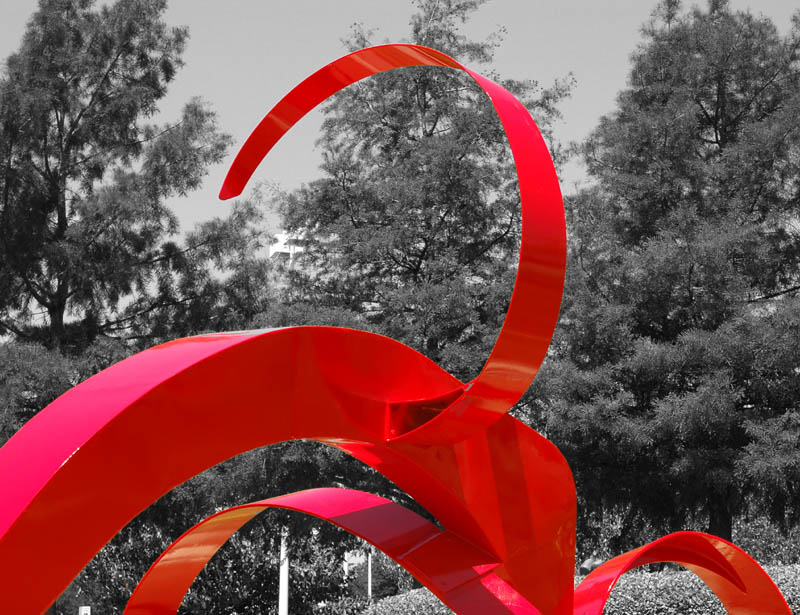
Michelle O’Michael, Houston
La Mujer Roja
(click to enlarge)
Previously in the Nasher XChange series:
Lara Almarcegui
Buried House
2226 Exeter Ave.
Oak Cliff Gardens
I began to feel old, out of shape, and drained as I worked my way north from Paul Quinn College to the third and final Nasher XChange exhibition on my bike ride through South Dallas. It was only a 12.5 mile ride – but these were tough miles. The last half of the route was hilly, the road was rough, and I had to stop every block, fighting my way through the traffic.
But once I rode up to Lara Almarcegui’s Buried House, I realized that here, more than any of the other sites, really begged to be seen by bicycle. I simply can’t imagine what it would be like to drive up to the now-vacant lot in an SUV, step out for a minute or two, then pile back in and drive home. It wouldn’t be the same… you would miss the point.
The work is meaningless without experiencing the surrounding neighborhood.
It is a tough part of town. The streets and sidewalks are in bad repair, cracked and heaving. Trash pickup is spotty at best. The modest homes are a varied melange – a torn up shack here, a burned hulk there, but there are also well-cared, decorated homes that are obviously a great source of pride to an unassuming owner.
And there were plenty of other vacant lots – most littered with junk and sprinkled with empty bottles.
You don’t see the details from a car… but you do from a tired, slow-moving bicycle.
Ironically, this is the second blog entry this February where I found myself taking a photo of a vacant lot. The other one, Arcady, was in the most tony enclave of Highland Park. That neighborhood is the polar opposite of the rugged Oak Cliff Gardens district where Buried House is located.
Destruction, renewal, the inevitable ultimate victory of chaos and entropy… rich and poor, our fate is already written.
After I left the site I had a a short ride on neighborhood streets until I reached the DART Kiest Station and after a short wait, caught the Blue Line downtown, where I switched to the Red line to Richardson and home.

Lara Almarcegui
Buried House
From the Nasher Website:
Buried House
2226 Exeter Ave.
Oak Cliff Gardens
The buried remains of a house offer an opportunity for reflection on the transition
and rebirth of one of Dallas’s oldest neighborhoods: Oak Cliff Gardens.
Almarcegui’s project for Nasher XChange, entitled Buried House, involves working with Dallas Area Habitat for Humanity on a house in Southeast Dallas already slated for demolition. After the demolition is finished, the artist will bury the house’s remains on the property, creating a sort of memorial site that nonetheless retains the building’s actual substance and provides a “free space” for reflection on the neighborhood’s past, present and future.
Almarcegui is working in Oak Cliff Gardens, a neighborhood in East Oak Cliff, with a history almost as old as Dallas itself. Near the site of the first stop for stagecoaches headed out of Dallas for Central Texas, the area surrounding the intersection at Lancaster and Ann Arbor roads became the small town of Lisbon, which was in turn annexed by the city in 1929.
Today, Oak Cliff Gardens is a neighborhood in transition. Many derelict, often vacant, homes will undergo renovations, thanks to the help of organizations such as Habitat for Humanity. These “wastelands” in the neighborhood embody a significant historical moment of possibility when anything might happen. Almarcegui hopes to draw attention to this area and make people in Dallas aware of its rich and varied character, before it is changed forever.

From Google Maps Streetview – what the house looked like before the demolition.
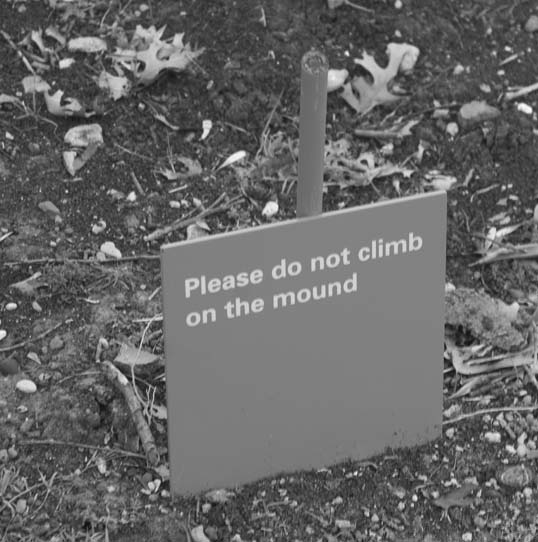
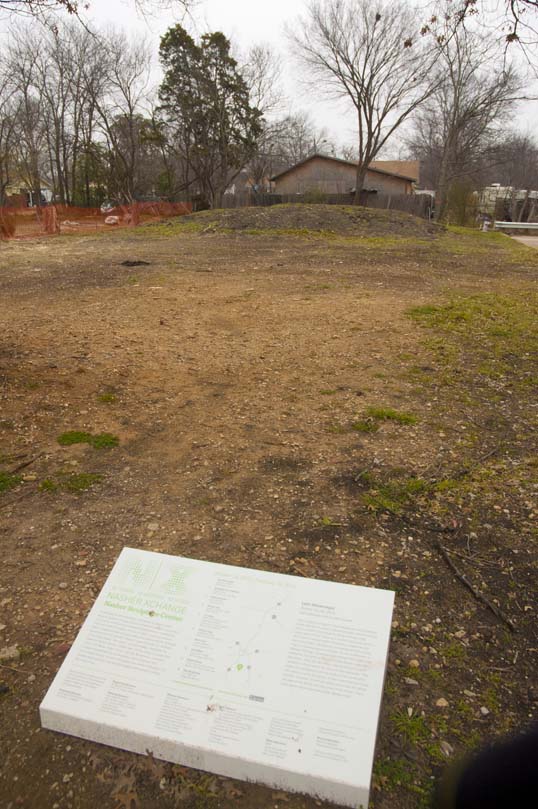
Lara Almarcegui
Buried House
Label Text:
Lara Almarcegui
Buried House, 2013
Demolished and buried house
Born in Spain and based in The Netherlands, Lara Almarcegui brings attention to places most people pass without noticing, such as derelict, abandoned buildings and seemingly vacant plots of land.
Working in environments and places in the midst of transformation, Almarcegui researches and documents them, developing unconventional and creative ways of drawing attention to them. As her contribution to Nasher XChange, Almarceguui has worked with Dallas Area Habitat for Humanity to locate a house already slated for demolition. After the demolition, she buried the house’s remains on the property. As the artist has explained, “This project is a sculptural work that is about the construction that used to stand, the history of the house and how it was erected. However it’s not just about the house, but about the past of the terrain and the future of the terrain. It is a work about construction and urban development.”
Previously in the Nasher XChange series:
Rachel Harrison
Moore to the point
Dallas City Hall, Dallas, Texas
Ever since I first moved to Dallas in 1982, I was fascinated by the Plaza in front of Dallas City Hall. It seemed so modern, so stark, so big city. As a public space, as the years went by, everyone realized it was not all that successful – that it was too sterile and artificial and people didn’t like hanging out there. Still, it always amazed me.
There was that sculpture too, that famous piece, The Dallas Piece, by Henry Moore.
The funny thing is… the first time I saw Dallas City Hall Plaza and the Henry Moore sculpture, it was in an obscure PBS made for TV film of an Ursula K. Le Guin novel – The Lathe of Heaven. It was shown once on the little screen before disappearing for decades (now it has arisen from the dead… it is even available on Youtube). I happened to catch it and it made a huge impression on me. Enough that there was a real thrill in visiting the Dallas locations.
Now, when she was looking at the site for the Nasher XChange, looking at The Dallas Piece, Rachel Harrison noted that the sculpture had a fence, a barricade, around it. That bothered her, a work of art like that should be exposed and available, not locked up.

Henry Moore’s Dallas Piece, barricaded for the Turkey Trot.
I had seen the fence… when I saw it the thing had been erected for the massive crowds that throng the place for the Turkey Trot run. The rest of the time, it isn’t there.
Still, she has a point… and the point is what she built.
This was a very easy sculpture to get to. We rode over to City Hall Plaza right after hearing the lecture at the Nasher. I rode on to the Hyatt Regency then, catching the Red DART line back home.

Rachel Harrison
Moore to the point
Dallas City Hall, Dallas, Texas

Amanda Popken, in front of Moore to the point
(click to enlarge)
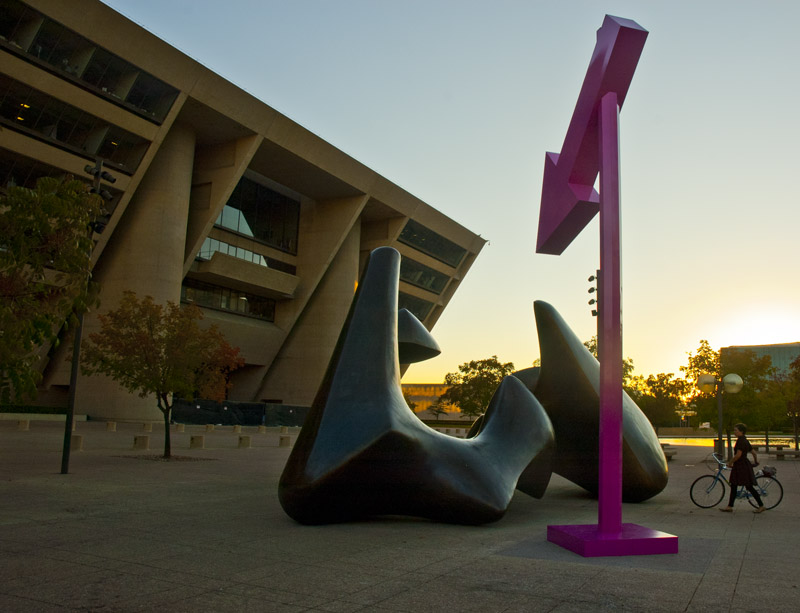
Rachel Harrison
Moore to the point
Dallas City Hall, Dallas, Texas
(click to enlarge)
From the Nasher Website:
Rachel Harrison
New York, New York
Moore to the point
1500 Marilla St.
City Hall Plaza
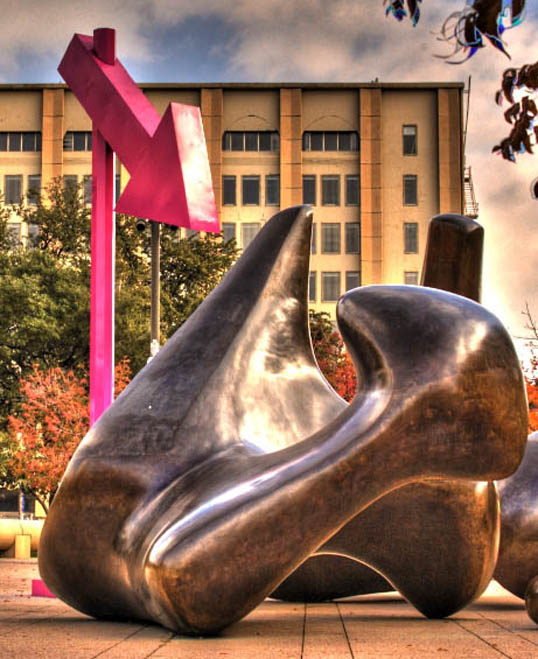
A giant arrow pointing to Henry Moore’s sculpture, Three Forms Vertebrae (The Dallas Piece), calls attention not only to the work but to the conditions that frame our encounters with works of art.
For Nasher XChange, Harrison has fabricated a giant pink arrow to be installed in City Hall Plaza in downtown Dallas. The arrow points to an existing sculpture at the site, Henry Moore’s sculpture, The Dallas Piece. Harrison’s project grew out of a recent visit to Dallas City Hall during which she was surprised to see Moore’s outdoor sculpture encircled by metal barricades. For Harrison, the barricades recalled the metal stanchions now commonly found surrounding sculptures in museums, a feature Harrison has sometimes referred to in her own work.
Although the barricades have been removed, most visitors still walk around the sculpture, rather than moving through it as Moore had intended. Harrison’s giant arrow calls attention not only to Moore’s often-overlooked piece but to the conditions that frame our encounters with works of art.
Rachel Harrison
Moore to the point
City Hall Plaza

Rachel Harrison
Moore to the point
City Hall Plaza
(click to enlarge)

Rachel Harrison
Moore to the point
City Hall Plaza
(click to enlarge)
Previously in the Nasher XChange series:
Charles Long
Fountainhead
Northpark Center, Dallas, Texas
In keeping with my project of going to all ten of the Nasher XChange sites without using a car, after work I rode my commuter bike over to the nearest DART station, locked it up in a Bike Lid, and took the train down to Park Lane station.
I walked across Central Expressway to get to the shopping center. That felt really strange – Northpark is the cold dark center of the Dallas upper crust car culture. Swarms of honking, smoking metal carapaces jammed themselves along the frontage roads while a thick stream clogged the freeway lanes below.
There were other people on the sidewalks, working their way to or from the mall. A thin trickle of what were obviously employees – from retail, cleaning crew, restaurant workers – dishwashers to waiters, all wearing weary uniforms, trudging home or dragging their way to work, shift after shift.
I waited a long, long time for a walk signal, then crossed the penultimate road. I reached the other side and was moving on down the sidewalk when I heard the distinctive squeal of brakes and skidding rubber on concrete. Then came that awful sound of expensive sheet steel rending – a pop and crunch. A thin rancid cloud of burnt tire treat floated by.
I turned and looked into the mass of automobiles to see the horde slowly sorting itself out with the green light. One young man in an old sedan sporting a very fresh dent in the front grille came slowly sorting himself out of the fray, winding from lane to lane until he escaped the traffic. He made a right turn and I expected him to pull over and wait for his victim, but he suddenly accelerated and then, he was gone… like a fart in the wind.
A hit and run.
It was all too fast for me to think. No chance to make a note of a license, I’m not even sure of the color, let alone the model of the car.
While I walked away I saw a shiny Lexus SUV pull over with its back end smashed. A couple of other cars pulled up beside, and a clot of women piled out, all standing on the sidewalk and gesticulating.
I turned and began to cross the vast parking lot into the cavernous mall on foot.

Fountainhead
Charles Long
Northpark Center
Dallas, Texas

Virtual money flowing across the surface of the sculpture.
Fountainhead
Charles Long
Northpark Center
Dallas, Texas
From the Nasher Website:
Charles Long, a Long Branch, NJ native, currently resides in Mt. Baldy, CA. His sculptures have explored the abstract autonomous art object as a psychological investigation into the nature of self and others and have been made from diverse media such as coffee grounds, rubber and hair from Abraham Lincoln.
For his Nasher XChange commission, Long plans to create an interactive, waterless fountain entitled Fountainhead that extends his ongoing investigation into the viewer/artwork relationship through the use of new technologies. The installation performs every function of a traditional fountain, only virtually.
Projected images of sheets of dollar bills move serenely down the surface of a sculpted monument, flowing like water, instantly adapting to every nook and curve, accompanied by a serene soundtrack scored especially for it. Three kiosks topped with interactive screens face the monolith and offer an opportunity for visitors to donate money to one of the three designated charities, much like the coins tossed into the Trevi Fountain are donated to charity. After payment is tendered, visitors are encouraged to flick a virtual coin off of the screen toward the sculpture resulting in an exuberant splash of dollars going in every direction. The three designated charities were selected by the artist and Nasher Sculpture Center director, trustees and staff.
“In creating this new work for Nasher XChange I was conscious of the social role that sacrifice has played throughout history. In Fountainhead, I sought to encourage the passerby to give up something of value before an anticipating audience. It’s a bit of harmless fun, yet it echoes ancient public sacrificial ceremonies and it seems pertinent to be doing this kind of sacrifice today in this very popular shopping center where visitors have been seeing public art for decades,” said artist Charles Long. “One of my interests as a sculptor has been to play with the image of value and art, and in this work I wanted to see what a massive fountain of money issuing endlessly forth might feel like as a public spectacle. There is decadence, but then there is this social act of giving. I chose charities proximally close to the lives of the participants so that their giving had a more tangible meaning.”
Nasher XChange will extend the museum’s core mission beyond its walls and into Dallas’ diverse neighborhoods, alongside key community partners, to present advances in the rapidly expanding field of sculpture, raise the level of discourse on the subject within the city, and contribute to broader national and international conversations on public sculpture. As the only institution in the world exclusively dedicated to collecting, exhibiting, and researching modern and contemporary sculpture, the Nasher Sculpture Center is uniquely positioned to investigate this growing practice of sculpture in the public realm.
Nasher XChange also references the history of the Nasher Collection itself: from the time of its early formation, major works from it were displayed at NorthPark Center, the indoor shopping mall created in 1965 by Raymond Nasher, and that tradition of making museum-quality art available for everyday enjoyment continues today. Millions of people every year have the opportunity to experience this fascinating and significant art located throughout NorthPark Center.
Long has been interested in the intersection between art, sound, and viewer participation since he collaborated with the band Stereolab in the mid-90’s to create sculptures with sound components that could be accessed through headphones. In his latest public art piece, Pet Sounds, Long evolved his ideas as new technological possibilities were developed with a special focus on activating sound through touch.
Long is an internationally exhibited artist with more than thirty solo shows at such venues as Site Santa Fe; St. Louis Art Museum; Orange County Museum of Art, Newport Beach; Sperone Gallery, Rome; London Projects, UK; and Tanya Bonakdar Gallery, NYC. Long has taught at California Institute of the Arts, Art Center College of Art and Design, Otis College of Art and Design, Harvard University and currently is faculty and chair of the UC Riverside Department of Art.

Fountainhead
Charles Long
Northpark Center
Dallas, Texas

I donated five dollars to the North Texas Food Bank. You swipe your credit card, push the button. The cash projected on the fountain swirls around in a virtual splash
 Bill Chance