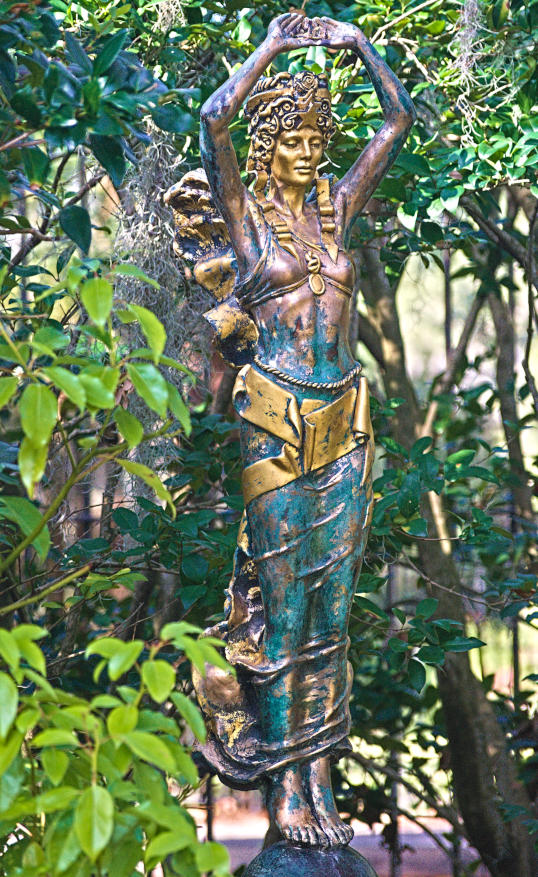
Hard to Photograph

“Even chance meetings are the result of karma… Things in life are fated by our previous lives. That even in the smallest events there’s no such thing as coincidence.”

― Haruki Murakami, Kafka on the Shore
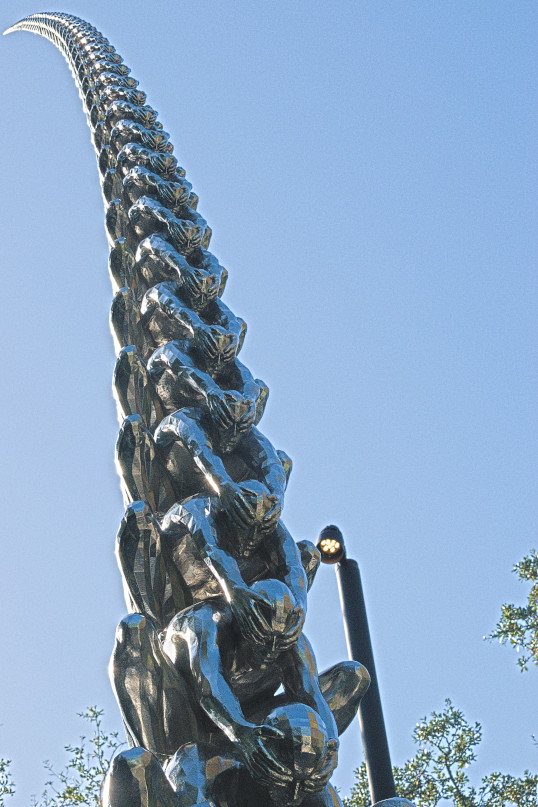
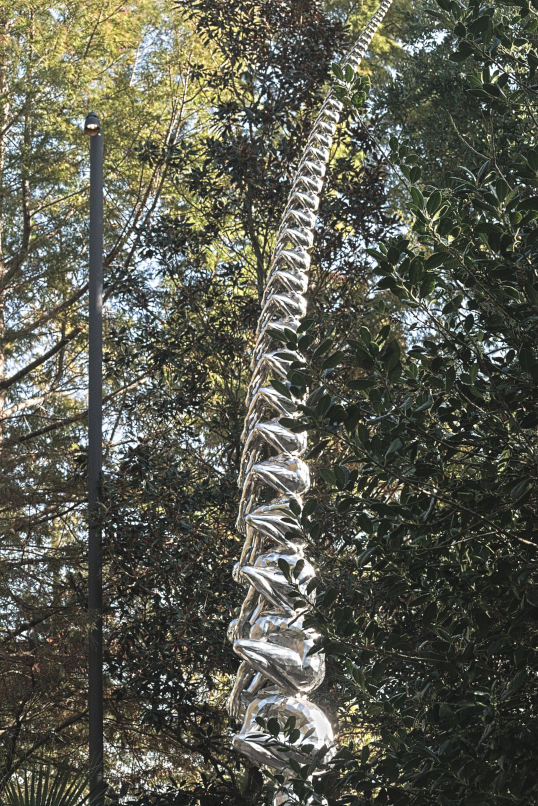
Karma, Do-Ho Suh, 2011. Korea, Brushed Steel with Stone Base, The Sydney and Walda Besthoff Sculpture Garden

The most arresting sculpture in the Besthoff Sculpture Garden in New Orleans is Do-Ho Suh’s Karma. A faceted, polished steel man stands with another squatting on his shoulders, with his hands over the man’s eyes, blinding him. Another squats on the squatter’s shoulders, and one on his, so on and so forth. They get a little smaller as they go up and curve a little. The sculpture is only twenty three feet high or so, but it looks like it stretches to infinity.

I discovered it is hard to photograph properly. Especially, since I had ridden my folding bicycle there from Downtown New Orleans I had not brought any extra lenses (no wide-angle) to save weight, space, and danger of damage. I should have known – I have seen it before.

The sculpture looks very different from different angles – so here are a few:

Karma, Do-Ho Suh, 2011. Korea, Brushed Steel with Stone Base, The Sydney and Walda Besthoff Sculpture Garden

Liver of Love

“The opposite of love is not hate, it’s indifference. The opposite of art is not ugliness, it’s indifference. The opposite of faith is not heresy, it’s indifference. And the opposite of life is not death, it’s indifference.”

― Elie Wiesel

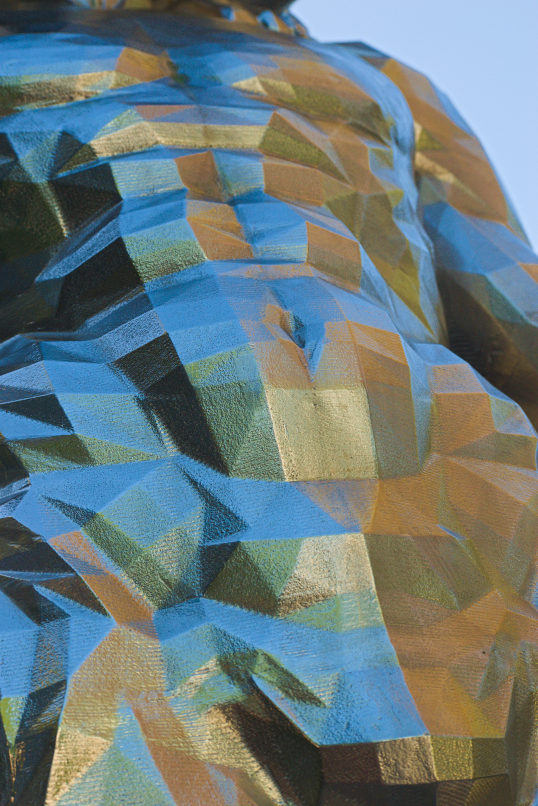
Liver of Love (detail), Georg Harold, 2013, Lacquered bronze, Sydney and Walda Besthoff Sculpture Garden

I wanted to add the description below because, if for no other reason, it contains the phrase “mythical gigantomachy.”

from ARTUNER:

Georg Herold’s monumental sculptures remind of the mythical gigantomachy, the battles between colossal beings. ‘Liver of Love’ is a highly seductive work of art, which charms the viewer into caressing its surface with their gaze. However, there is little softness in this figure: the tension and unhuman angularity of its limbs suggest the intensity of inner struggle. Indeed, Herold himself spoke of the sculptures’ reticence towards their maker: like a diffident lover, they hesitate to yield in submission.

Herold aims to find essential forms, unbound from existing associations. It is particularly important for him to explore questions volume and corporeal presence, privileging the physical, mistrusting notions of authoritative meaning. He sees a rupture between language and appearance, and favours multiple, non-exclusive readings of his art. Indeed, ‘Liver of Love’ denies any simple reading, deceiving the beholder with a seemingly ‘easy’ title. It is a work full of ambiguity, alluding to a cataclysmic strife, and yet displaying great balance and composure.

The Mete of the Muse

“We seldom realize, for example that our most private thoughts and emotions are not actually our own. For we think in terms of languages and images which we did not invent, but which were given to us by our society.”

― Alan Watts

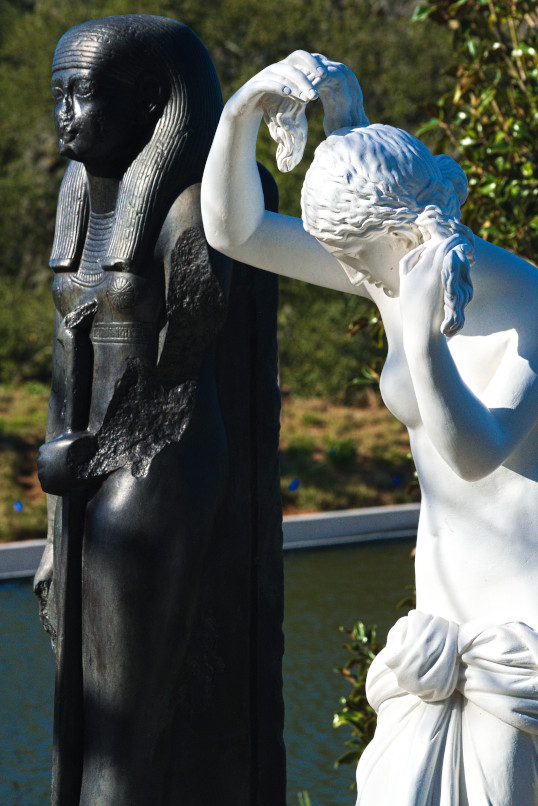
The Mete of the Muse by Fred Wilson, Sydney and Walda Besthoff Sculpture Garden

From the New Orleans Museum of Art Website:

The Mete of the Muse juxtaposes an ancient Egyptian female figure painted with a black patina with a figure of a Greco-Roman woman, painted white. The work reflects on commingled histories of Europe and Africa, placing works from African and European cultural lineages side by side in order to “put in relief” and highlight the systemic privileging of European history stemming from racial and cultural biases ingrained in museum display. To create this work, Wilson bought plaster cast copies of ancient sculptures and had them cast in bronze. Like the histories they represent, these copies of copies have gone through so many transitions and translations that they have become completely untethered from their original meaning and context. When Wilson presents these sculptural works, he often includes a wall label and text that simply labels them “African Figure” and “European Figure” in order to show how racial and cultural biases often create sharp divides between black and white, despite the constantly shifting narrative these sculptures represent. As Wilson says, “I find that how things shift under our noses is really fascinating.”

Venus and Hercules

“Live like a hero. That’s what the classics teach us. Be a main character. Otherwise what is life for?”

― J.M. Coetzee

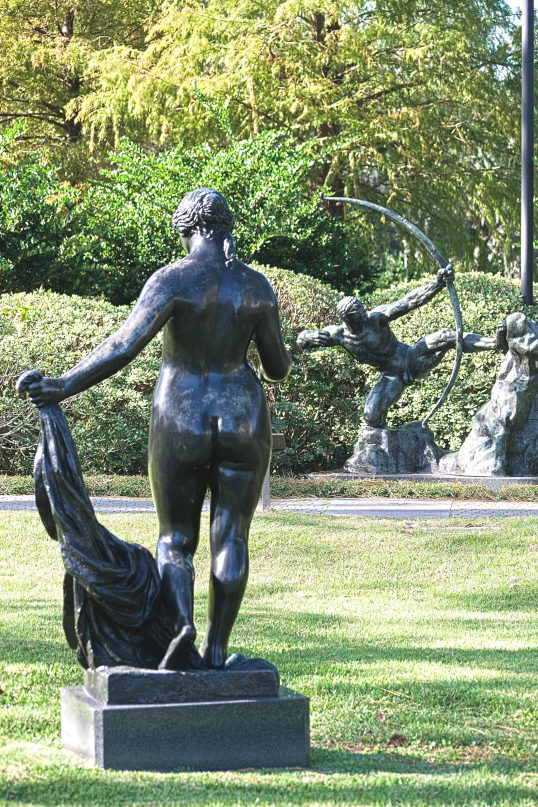
Venus Victrix (The Judgement of Paris), Pierre Auguste Renoir & Hercules the Archer, Antoine Bourdelle, Sydney and Walda Besthoff Sculpture Garden

At the entrance to the Sydney and Walda Besthoff Sculpture Garden there is a wonderful ellipse of lawn under tall trees, bordered by thick vegitation and smattered with large, classic bronze sculptures. It is an awesome area – the feeling of time and genius distilled into molten metal and molded into immortal human shapes.

I wish I could spend every morning in a space like that, thinking about my day.

Ruth and Naomi

“Do not urge me to leave you or turn back from you; for where you go, I will go, and where you lodge, I will lodge. Your people shall be my people, and your God, my God.”

― Ruth 1:16

Ruth and Naomi, Leonard Baskin, 1979, Bronze, Sydney and Walda Besthoff Sculpture Garden, New Orleans

This wonderful sculpture is in the same little woodland alcove as yesterday’s Civitas.

Civitas

““If you’re going to try, go all the way. Otherwise, don’t even start. This could mean losing girlfriends, wives, relatives and maybe even your mind. It could mean not eating for three or four days. It could mean freezing on a park bench. It could mean jail. It could mean derision. It could mean mockery–isolation. Isolation is the gift. All the others are a test of your endurance, of how much you really want to do it. And, you’ll do it, despite rejection and the worst odds. And it will be better than anything else you can imagine. If you’re going to try, go all the way. There is no other feeling like that. You will be alone with the gods, and the nights will flame with fire. You will ride life straight to perfect laughter. It’s the only good fight there is.”

― Charles Bukowski, Factotum

Civitas, Audrey Flack, 1988, Patinated and gilded bronze with cast glass flame and attached marble base, Sydney and Walda Besthoff Sculpture Garden

I found this attractive sculpture tucked away in a cool little alcove, framed by lush vegetation.

In looking it up online, I discovered that it was supposed to have a glass flame in her hands, over her head.

I like the sculpture without it – but I wonder what happened.

Travelin’ Light

“The object of terrorism is terrorism. The object of oppression is oppression. The object of torture is torture. The object of murder is murder. The object of power is power. Now do you begin to understand me?”

― George Orwell, 1984

Travelin’ Light, Alison Saar, Bronze, Sydney and Walda Besthoff Sculpture Garden

I have photographed and written about this sculpture before. I had forgotten what I had said, so I guess it’s OK to use my words again. Can you plagiarize against yourself?

From November 15, 2012:

Travelin’ Light presents a formally dressed man, hanging by his bare feet, a powerful but dignified reference to torture and abandonment. Saar has made the figure into a bell. When the chain on its back is pulled, a sonorous sound is heard, ringing for all victims of violence and terror.

I looked at Traveln’ Light and walked around it. I read the little nameplate and the blurb in the guidemap and discovered it was a bell. I thought about reaching out to the metal chain inside the hollow of the hanged man’s head and giving it a ring, but my reticence to actually touch artworks on display was greater than my curiosity as to its sound. A few minutes later, while I was a third of the way around the little pond, some guy with a gimme cap on backwards walked up to it and was ringing away with abandon. It had a dolorous sound, not bright like a church bell, more of a dull peal.

No human beings more dangerous than those who have suffered for a belief: the great persecutors are recruited from the martyrs not quite beheaded. Far from diminishing the appetite for power, suffering exasperates it.

—-Emil Cioran

Travelin’ Light, Alison Saar

Overflow

“The sweetness of this content overflowing runs down the walls of my mind, and liberates understanding.”

― Virginia Woolf, The Waves

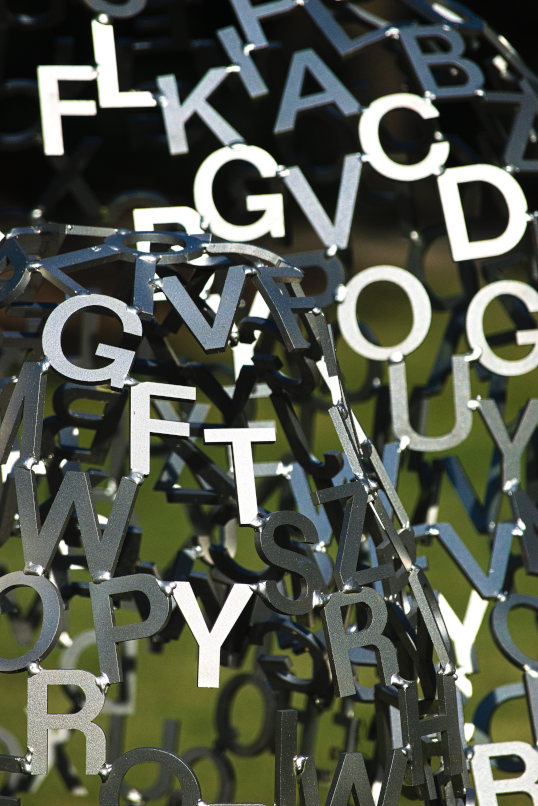
Overflow (detail), Jaume Plensa, 2005, Stainless Steel, Sydney and Walda Besthoff Sculpture Garden, New Orleans

Words fail me tonight.

Great Seated Cardinal

“Man is tormented by no greater anxiety than to find someone quickly to whom he can hand over that great gift of freedom with which the ill-fated creature is born.”
― Fyodor Dostoevsky, The Grand Inquisitor

Great Seated Cardinal (Grande Cardinal Seduto), Giacomo Manzù, 1983, Bronze, Sydney and Walda Besthoff Sculpture Garden, New Orleans

A detail photograph of Another cool sculpture from the Besthoff Sculpture Garden in New Orleans.

Tomorrow, I go back to work. In this weirdest and worst of all possible years I haven’t been off because of COVID – I am considered “essential.” As a matter of fact, up until two weeks ago I have been very busy at work – under plenty of pressure. Then, it let up a bit and I had a big backlog of PTO hours I had to take so, along with the Thanksgiving Holiday, I was off for two whole weeks. I haven’t done that on purpose for a long time (I was off for two weeks last year, but I was in the emergency room for a few days and recuperating until I felt strong enough to make it back home – so that doesn’t really count as vacation).

It feels odd – so wish me luck. I can’t remember any of my myriad passwords – so there will be some calls right off the bat.

11 Acute Unequal Angles

“In the various arts, and above all in that of writing, the shortest distance between two points, even if close to each other, has never been and never will be, nor is it now, what is known as a straight line, never, never, to put it strongly and emphatically in response to any doubts, to silence them once and for all.”

― Jose Saramago

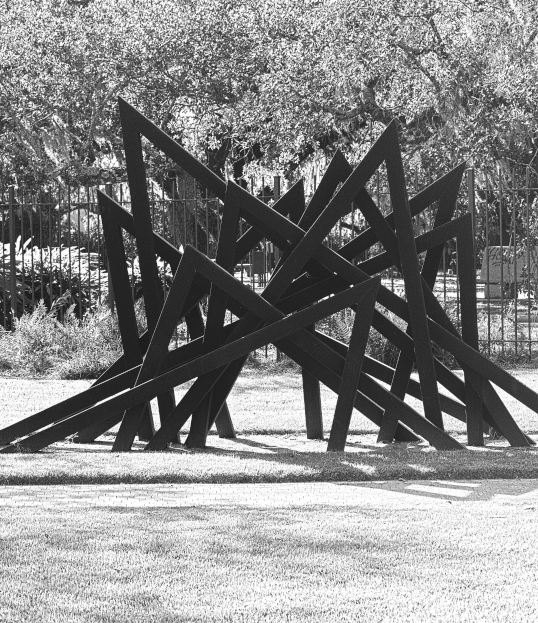
11 Acute Unequal Angles, Bernar Venet, 2016, Cor-ten steel, Sydney and Walda Besthoff Sculpture Garden, New Orleans

11 Acute Unequal Angles, Bernar Venet, 2016, Cor-ten steel, Sydney and Walda Besthoff Sculpture Garden, New Orleans