Everybody knows that the boat is leaking Everybody knows that the captain lied Everybody got this broken feeling Like their father or their dog just died Everybody talking to their pockets Everybody wants a box of chocolates And a long-stem rose Everybody knows
—-Leonard Cohen, Everybody Knows
Mia Kirshner as Christina in Atom Egoyan’s Exotica
This weekend I had time to sit down and pick a movie from The Criterion Collection. I decided on a film I had seen before – but many years ago and one that I didn’t remember… really… at all. It was Exotica, directed by Atom Egoyan.
I always viewed this film as sort of a bookend to Egoyan’s masterpiece – the fantastic and shattering (and very hard to watch) The Sweet Hereafter. Exotica was made three years before The Sweet Hereafter and contains many of the same themes of survival, guilt, and disaster – but in a different and less focused form.
I don’t think I paid close enough attention the first time I watched it – the movie was very, very good (a notch below The Sweet Hereafter, though the comparison isn’t really fair). Exotica is the name of a strip club where much of the action takes place – though the term and idea of Exotic is one of many themes that soak and permeate the film.
The structure is circular and there are many things that keep reappearing in different ways. Watch for:
Handing money to someone (often in a long envelope)
One way mirrors (also the murky green glass in the pet store)
Parrots
The brittle nature of exotic beauty
People watching other people, with more than a little bit of threat and danger
Contracts, where each person gets a little bit of what they need/want
Be sure and watch until the end. The movie misleads you about what is going on – it plays on your fears and expectations. In the end, it is all explained and the final third of the movie is a fantastic payoff and worth waiting for.
I did a little research about the film – and found an amazingly misleading publicity campaign. It came out roughly at the same time as Showgirls and Striptease… and as it is set in a strip club the movie was billed as another erotic thriller. Look at this trailer:
This trailer is so bad. So bad and misleading I suspect it isn’t a real trailer – someone’s satire.The movie is not exciting or overly sexual, it is a carefully tuned meditation on loss and what it takes to get through disaster and people trying to help each other in any way they can.
Of course, there is the strip club, and the unique and memorable dance by Mia Kershner to a Leonard Cohen song. It actually appears in the film twice (with subtle differences).
So, if you have some time and a decent streaming service – sit down and take a look at Exotica. It may take an open mind and some patience, but it pays off in the end.
“Every balcony is a poem, a chant — a muscle! But whoever lives with that extra blueprint luxury of a balcony lives on the wrong side of a cross-section, on the busy, narrative-addled side of something like an ant-farm window, a brazen architectural arrangement selling cheap peeks into the naked sideshows of the quotidian — even the grisly. Step right up! Behold! A ten story wall of solid twitching muscle!”
—-Director Guy Maddin in Paste Magazine on his short film Accidence
Manor House Balcony, downtown Dallas, Texas
After watching and enjoying The Forbidden Room I was working through the selection of Guy Maddin films streaming on The Criterion Channel. And I now have a new favorite movie.
It’s a nine minute short called Accidence. It is an obvious homage to Hitchcock’s Rear Window. The entire film is a continuous take (zoomed in and out with a bit of panning) of the side of an apartment block – thirty units in all. There is a view of the balconies, some windows into the apartment interiors, and a glimpse of things moving up and down the stairs.
Ok, so it’s only nine minutes long… but you can’t watch it only once. On first viewing it is a confused ant-like cacophony of people on and off of their balconies. But as you watch it again and again, patterns emerge and a story is created. It is a story of doppelgangers, violence, families, boredom and drama. And a fuzzy white dog.
Who is the murderer? Who is the victim? Are they the same person?
I have watched it maybe forty times and will watch it many more. I still see new things. Watch the balloon for example. There is a red ghost that appears against the brick a couple of times – I think I figured out who that is.
I just respect audiences to understand that that’s what goes on in movies. I just try to make movies that respect the intelligence of the audience. Respect that they understand that the narrator is always unreliable and respect that they understand that the medium can do whatever it wants.
—-Guy Maddin
Filming a Mexican Music Video in Klyde Warren Park.
The last few days I’ve been perusing the depths of the streaming service from The Criterion Collection – more specifically, looking at the films that are going away at the end of July.
I have discovered a director that I had never known before – a Canadian named Guy Maddin. He makes very unusual and unique films – many of which are done in a style that looks a lot (at first glance, at least) like something made in the early part of the twentieth century – high contrast, black and white or oversaturated color, little dialog with occasional title cards…. such as that. Very odd and crazy stuff.
One film that I watched and really, really liked was The Forbidden Room. After a brief introduction from Marv, who talks about how to take a bath – the plot begins on a doomed submarine carrying a cargo of unstable explosives. There is a knock on a hatch and a woodsman is revealed – drenched in fresh water – and neither he nor the crew can figure out how or why he is there. And then things get really weird.
The structure of the movie is like a series of Russian nesting dolls. Stories inside of stories inside of stories. It is surprisingly consistent about working its way back out again.
There is even a song “The Final Derriere” from a favorite band of mine from decades ago, Sparks.
I was able to look beyond the weirdness and had a good time watching it. In the trailer above, Sight and Sound magazine said, “Has more ideas in ten minutes than most filmmakers have in their entire oeuvres.” And that is what I liked – the interesting concepts, themes, and characters come from the screen like bullets from a machine gun.
Guy Maddin has some other work on the channel that go back into the ether in a few days. Have to get crackin’.
I was an architect, she was an actress. I drew the Eiffel Tower upon her dress. So we could see the world… The flash burnt our shadows right into the wall. But my best friend and I will leave them behind in Hiroshima. I will keep her secrets, I will change my name. My sweetheart and I are saying goodbye to Hiroshima.
—-My Favorite, Burning Hearts
The opening of Hiroshima Mon Amour
I have been taking too much pleasure in the NBA playoffs and as always happens when you take too much pleasure in something it all went to shit. My team, after a fantastic start, crashed and burned and went down to humiliating and ignominious defeat.
My lesson learned, again, I turned the game off and switched over to the always reliable backup – The Criterion Channel (the best streaming money you can spend). I cruised through the copious selection of marvelous and recherché moving picture shows and settled on a classic that I have never seen, Alan Resnais’ Hiroshima Mon Amour.
Resnais had made his reputation with a string of documentary films, including the first-rate Night and Fog, about the Nazi death camps. He was approached to make a similar nonfiction work about the Hiroshima bomb and traveled to Japan to start work. He realized that he could not make a simple documentary about that horror, especially for Western audiences (who, in the 1950’s, generally thought of the bomb as the end of the war) and proposed he make a fictional film instead.
He hired the novelist Marguerite Duras to write the screenplay and made a groundbreaking film. The surface plot is about a French actress (played by the luminous Emmanuele Riva) in Hiroshima to make a documentary about the bombing – she has a brief but intensely passionate affair with a Japanese architect (played by the equally riveting Eiji Okada). They have only thirty-six hours before she must go back to Paris.
But time in the film isn’t the same as it is in the real world. The story is told in conversations between the couple, in flashbacks, in dream sequences, in bits of newsreel footage.
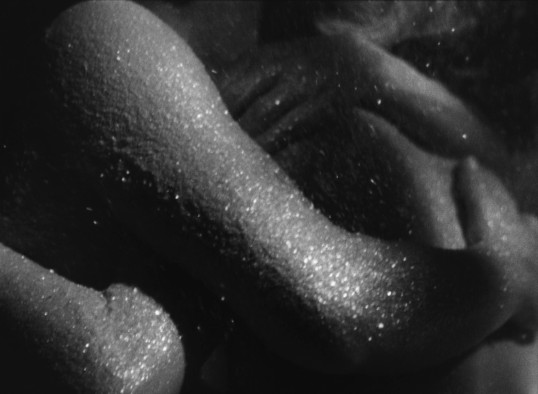
The fourteen minute opening sequence is an amazing kaleidoscopic montage surrounding a scene of two naked bodies writhing in passion while radioactive dust falls from the sky and sticks to their sweat-drenched skin.
The film is full of questions, symbolism, conundrums wrapped in enigmas, doubling (the actress has had forbidden affairs with soldiers of both of the West’s enemies in WWII) and all the other accouterments of the French New Wave.
Despite all this, the film is watchable to anyone tired of the MCU. If nothing else, you can look at Emmanuele Riva and her expressive face (at eighteen and thirty four) as she is buffeted by history, war, the past, and the passion of today.
Emmanuele Riva in Hiroshima Mon Amour
Decades ago I stumbled across an obscure New York band called My Favorite. I have been a bit of a fan ever since. Watching the movie I realized that one of their “popular” songs, Burning Hearts, was inspired by the movie. Cool.
“When King Lear dies in Act V, do you know what Shakespeare has written? He’s written “He dies.” That’s all, nothing more. No fanfare, no metaphor, no brilliant final words. The culmination of the most influential work of dramatic literature is “He dies.” It takes Shakespeare, a genius, to come up with “He dies.” And yet every time I read those two words, I find myself overwhelmed with dysphoria. And I know it’s only natural to be sad, but not because of the words “He dies,” but because of the life we saw prior to the words. I’ve lived all five of my acts, Mahoney, and I am not asking you to be happy that I must go. I’m only asking that you turn the page, continue reading… and let the next story begin. And if anyone asks what became of me, you relate my life in all its wonder, and end it with a simple and modest “He died.” ― Dustin Hoffman
New Orleans
I rarely remember my dreams – but last night I had a dream so realistic I woke up convinced it had really happened. I dreamed that Dustin Hoffman had died. I remember reading the word “Suddenly” in the article. It was so vivid that when I woke up I had to look it up to see if it had happened. I’m glad he’s going to appear in “Our Town” once Broadway opens back up.
Why did I dream of Dustin Hoffman? I have no idea. While I respect his impressive body of work, I never was a particular fan (I actually didn’t like Tootsie).
I do remember reading that because of his death Ishtar had shot to the top of the streaming charts.
Yesterday I had time to watch another movie on The Criterion Channel so I scrolled through the offerings and found one I wasn’t expecting. It was called Smooth Talk and was made in 1985. It was directed by Joyce Chopra and featured Laura Dern in her first starring big screen role (a year before Blue Velvet).
I have no idea how I have missed this movie over all these years. You see it is loosely (actually not all that loosely) based on one of the most crackerjack of short stories – Joyce Carol Oates’ ” Where Are You Going, Where Have You Been?”.
And there was “Where Are You Going, Where Have You Been?”. I first read this as a teenager and it made a huge impression on me. I have re-read it every few years and it hasn’t lost its power.
The story is based on the true story of “The Pied Piper of Tucson” – a serial killer that seduced and eventually murdered teenage girls in that desert town. Oates read the story in Life magazine (she refers to the killer as a “Tabloid Psychopath”) and then wrote the story as “Death and the Maiden.” She was especially fascinated by the fact that the Tucson teens didn’t realize this monster was a man in his 30s attempting to look young and many went along with the killings, keeping his secret.
During revision she made the story less about the killings and more about the teenage girl. The ending is ambiguous, though you get the feeling that it’s not going to end well.
I remember thinking that the story was unfilmable – it has too many phantasmagorical elements, an enigmatic conclusion, and too much inside the girl’s head. But it looks like I was wrong.
The movie follows the short story surprisingly well. Obviously, it has to expand on the story quite a bit. Rereading the story, there is a lot to it that is spread out in the first half of the film. The girl’s mother has a bigger, more nuanced part – though a lot of that may be due to the genius of Mary Kay Place. Laura Dern has the young, beautiful, flighty, 15 year old, self-obsessed, stubborn, teenager-y, Connie down perfectly. The story moved up into the 80’s where it fits better anyway, and the setting of a mall and big teen hangout hamburger stand across a busy road is dead-solid right.
****Spoiler Alert****
But at its mid-point the story and the movie take a sudden, terrifying turn. An odd, dangerous man named Arnold Friend (A Friend) shows up in an old Gold landyacht convertible with mysterious writing on it. He proceeds to talk to Connie, left at home alone, and tries to talk her into going for a ride with him.
That is the first big difference, to me, between the story and the movie. In the story Arnold Friend is a borderline supernatural force, odd and mysterious (Is he wearing a wig? What is it with his boots? How does he know so much?). It is that character that I considered to be unfilmable. Treat Williams plays him in the movie and he is a bit too good looking and slick – though he does convey his own aura of danger and dread. I guess seeing the devil made flesh was going to be a letdown – but the movie was still interesting and harrowing.
And then, at the end, unlike the story, you find out, sort of, what happened after Connie went off for a ride with Arnold Friend. He doesn’t kill her, he brings her back. In both versions it is implicit that her going with him was an act of heroism – she went to save her family from danger. Once she returns she seems to have grown a backbone. She tells Friend firmly that she never wants to see him again and then has a reconciliation with her sister. That is not how the story is leading – but it is a valid take and an interesting, almost happy, ending.
She agrees with me on the short story being ultimately unfilmable:
“Where Are You Going, Where Have You Been?” defines itself as allegorical in its conclusion: Death and Death’s chariot (a funky souped-up convertible) have come for the Maiden. Awakening is, in the story’s final lines, moving out into the sunlight where Arnold Friend waits:
“My sweet little blue-eyed girl,” he said in a half-sung sigh that had nothing to do with [Connie’s] brown eyes but was taken up just the same by the vast sunlit reaches of the land behind him and on all sides of him—so much land that Connie had never seen before and did not recognize except to know that she was going to it.
—a conclusion impossible to transfigure into film.
And she acknowledges the choice used in the different ending:
The writer works in a single dimension, the director works in three. I assume they are professionals to their fingertips; authorities in their medium as I am an authority (if I am) in mine. I would fiercely defend the placement of a semicolon in one of my novels but I would probably have deferred in the end to Joyce Chopra’s decision to reverse the story’s conclusion, turn it upside down, in a sense, so that the film ends not with death, not with a sleepwalker’s crossing over to her fate, but upon a scene of reconciliation, rejuvenation.
Serial killer inspires brilliant terrifying short story which is developed into a movie about a flighty young girl finding herself and her place and purpose. This is truly the best of all possible worlds.
It is a restless moment. She has kept her head lowered… to give him a chance to come closer. But he could not, for lack of courage. She turns and walks away.
—- Kar-Wai Wong, In the Mood for Love
The other day I watched Chunking Expresson my streaming Criterion Channel. The movie was not what I expected (though I’m not sure what I was expecting) but enjoyable when taken on its own terms.
Over the weekend I was able to sit down and watch another Kar-Wai Wong film, one that is possibly even more well-known than Chungking Express – In the Mood for Love.
The English title of the film comes from the Bryan Ferry song (though the song does not make an appearance in the movie – only the trailer)
The song was originally recorded in 1935, and there are many versions – this is the best:
Again, the film was unexpected – but enjoyable. Be forewarned – not much actually happens in the film, it’s definitely a movie where you sit back and let it wash over you. It is a beautiful film, with beautiful people wearing amazing costumes. It is a film of mood, of things not said, of ultimate regret.
The ending is a departure from the style (and location) of what comes before – but like the best of endings that take a turn (if not a twist) in the last few minutes, thinking about it, there is no other way it could end.
I have had a visit to Angor Wat on my bucket list for a long time. Now I really want to go there. Who knows what secrets are locked up between those ancient stones?
Also, I wish I wasn’t on a low-carb diet… I want to carry around an old dented green steel vacuum bottle full of hot noodles.
We’re all unlucky in love sometimes. When I am, I go jogging. The body loses water when you jog, so you have none left for tears.
—-Chungking Express
I saw an interview with Martin Scorcese a while back where he described the Marvel movies as “Theme Park Movies.” He went on to say that if you enjoy them, good for you, but don’t let them crowd out “real” movies from the limited screen real estate.
I agree. I am superheroed out. Maybe, some day, I’ll watch another comic book movie… but right now I don’t think I could make it all the way through. Life is too short.
Yesterday I made time to sit down and watch Chungking Express – a Hong Kong comedy/drama/romcom by director Wong Kar-wai. I’m not going to write a full review, mostly because a review pretty much always contains spoilers and in my latter years I try really hard to see films spoiler-free. I want to give anyone coming to my site the same consideration.
I knew nothing about Chungking Express (for some reason, I thought it was about a train) and was very, very pleasantly surprised. It has a unique structure – it is not a theme park movie – yet it is very enjoyable and not hard to watch.
It is one of Quentin Tarantino’s favorite movies (the structure has some resemblance to Pulp Fiction). He has an excellent YouTube video about the film – it’s divided into two parts. You are supposed to watch the first part before seeing the film, then come back and watch the rest (though even the second half is pretty spoiler-free).
A great movie – and Tarantino does know of what he speaks.
After seeing this movie I’ll never buy a can of pineapple without looking at the expiration date… and never listen to California Dreaming the same way.
And I discovered there was a movie made when I was one year old from the book The Brothers Karamazov. I didn’t want to watch the movie until I finished the book, but I did watch the trailer.
And now that I’ve finished the book I went searching through the streaming channels and found it on Turner Movie Classics.
The movie was surprisingly good. Of course there is no way to cram an eight hundred page novel into one movie, but it was still enjoyable. The philosophical content was pretty much gone – no mention of The Grand Inquisitor or of the torture of children. What was left behind was melodrama rather than great art – but good melodrama nonetheless.
A couple of points:
Grushenka was played by the actress Maria Schell who had starred in Gervaise, the adaptation of Zola’s L’assommoir which I wrote about last year. I was disappointed in her Grushenka (probably my favorite character in the book) – her beauty was put to good use, but she grinned and hammed her way through the part. I think she missed the depth and pathos of Grushenka.
One shock when you see the trailer is that Alyosha (Alexei) (the so-called “hero” of the book) is played by an impossibly young William Shatner. It’s crazy to see Captain Kirk in a monk’s habit and haircut. Alexei is the quiet, reserved, and religious brother – not exactly Kirk material. The shocking thing is how good a job he does with the part. It is nice to see Shatner in a part where he is not chewing the scenery.
The story is concentrated on Dimitri. It’s a shame that Ivan gets such little screen time. He is in many ways the more interesting brother. But there isn’t time for more and to a great extent the more Yul Brynner the better.
And finally, the ending is completely changed. Gone is the bittersweet and ambiguous ending of the novel and in its place, a Hollywood happy ending.
A disappointment, I guess, but it is Hollywood, not a vast Russian tale of subtle philosophical ideas after all.
I have written before about my love for the streaming wonderfulness of The Criterion Channel. So tonight I sat down and watched the 1938 film by Jean Renoir, his version of Zola’s La Bête humaine.
It was very good – though very different than the book. The plot was significantly trimmed down – most of the murders were gone (only the two key homicides were left). The big set pieces were cut too, for time and also, probably for budget – the special effects cost for train wrecks and blizzards has to be enormous.
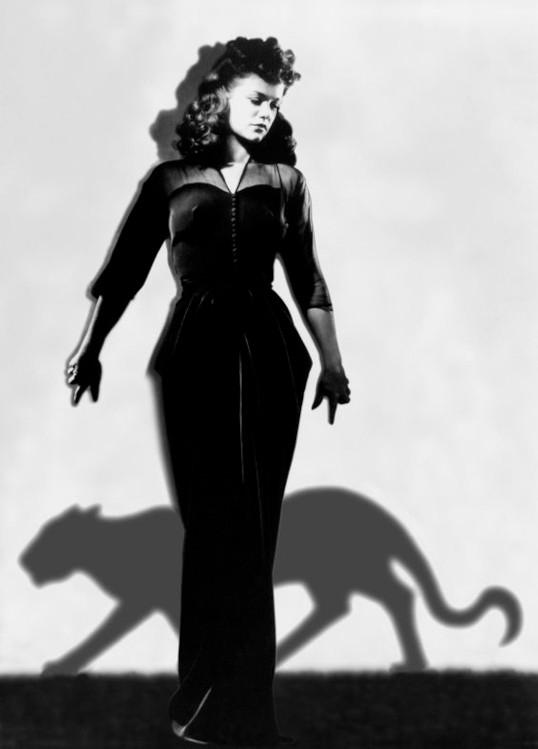
What is left is a more personal story, one of the first examples of film noir – with a femme fatale (Simone Simon – who I recognized from Cat People, filmed a few years later). A love triangle, murder, and Zola’s inherited madness make for a lively time.
Simone Simon, in a publicity still from Cat People
Renoir’s genius is in his ability to make his characters come alive on screen. He also shows a wonderful respect for the working class folks that populate the story. Even at their worst – his characters have their reasons, they are driven by the sins of the past.
It did still have the trains, though. The plot moves along like a hot steam engine on a track. A lot of the film was done on location instead of in studio – which added a gritty realism to the story. The Criterion Channel had an interview with Peter Bogdanovich who said that the original impetus for the film was that the star, Jean Gabin, wanted to make a movie where he got to drive a train.




 Bill Chance