Finally Finished

Well, one thing about writing this thing is that I can get dates. Let’s see here it is, September 17, 2011 is when I started reading the Complete Stories of J. G. Ballard. I finished it this week… so it took me about ten months to get through the whole thing.

By no means is that the only thing I’ve read in the last year. I’d read a few stories and then jump to something else… only to return when that was done. The last week or so, though, I made a concentrated push to get through to the end.

It is a massive tome. Ninety Eight short stories, novellas, and novelettes, ending up one short of one thousand two hundred pages. The paper version weighs about four pounds and would be a real pain to carry around. Inside my Kindle, though, the weight of all those bytes is barely noticeable.

I had read a lot of these stories before. In high school, in the 1970’s I discovered his short fiction and gobbled up what I could get my paws on. What was cool about reading this now is that the stories were arranged in chronological order – so I revisited what I remembered and then continued to cruise right on past, on into the future (which now is the relatively recent past). I would look at the dates on the later stories and think of myself sitting there in 1973, and realizing what I was reading wouldn’t be written for another decade.

Since this is his complete body of work, in order, you can’t help but notice the continuing themes. The lonely, wealthy woman living alone in a crumbling estate, exerting an inexorable influence on the protagonist and the people living around him. The abandoned decadent tourist destination. The desiccated sea with dry sand waves and coral canyons. Empty swimming pools. Nature, time, and technology intersecting and reacting in unexpected, beautiful, and horrific ways…. And many more.

Near the end there are three longer works: News from the Sun, Memories of the Space Age, and Myths of the Near Future. These three, read consecutively, are fascinating companions to each other. They are essentially the same story, told with tiny shifts in attitude and points of view. They deal with the theory that man’s ventures into outer space have set loose a change in the very nature of time itself and the entire human race, in a series of events centered on the now long-abandoned Florida NASA launch sites is becoming unstuck in time. It is never clear whether this is a disaster – a punishment for shaking off our bonds, or a further leap in evolution where the human race is able to exist within and without time itself. The strong impression is that it is both.

Fascinating. Especially powerful in that, within these vast movements of irresistible forces the central theme of the stories remains the human relationships of the protagonists and how they struggle to maintain their place, their loves, their very lives.
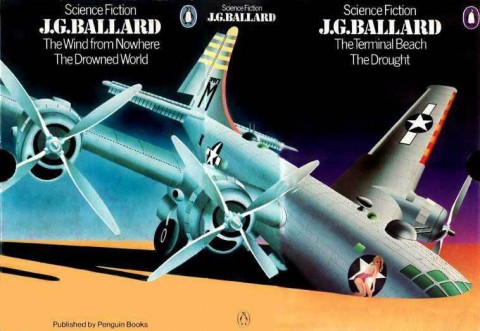
Ballard writes:

I just tend to write whatever comes mentally to hand, and what I find interesting at a particular time. These decisions as to what one’s going to write tend to be made somewhere at the back of one’s mind, so one can’t consciously say: ‘that’s what I’m going to write’. It doesn’t work out like that! (interview in ‘J. G. Ballard: The First Twenty Years’, 1976).

I’m barely aware of what is going on. Recurrent ideas assemble themselves, obsessions solidify themselves … (interview in ‘The Paris Review’, 1984).

I feel that the writer of fantasy has a marked tendency to select images and ideas which directly reflect the internal landscapes of his mind, and the reader of fantasy must interpret them on this level, distinguishing between the manifest content, which may seen obscure, meaningless or nightmarish, and the latent content, the private vocabulary of symbols drawn by the narrative from the writer’s mind (‘Time, Memory and Inner Space’, 1963).

Some of the stories, especially some of the later ones are more experimental pieces… a skilled author showing off what he can do – pushing the boundaries of fiction. Some of these work better than others.

Vermilion Sands

Vermilion Sands

Still, I think my favorite are the Vermilion Sands stores – especially The Cloud-Sculptors of Coral D. Something about that decadent vacation spot really gets to me.

Now, the tough question. What to read next?

  • 1 • Prima Belladonna • [Vermilion Sands] • (1956) • shortstory
  • 12 • Escapement • (1956) • shortstory
  • 23 • The Concentration City • (1957) • shortstory (aka Build-Up)
  • 39 • Venus Smiles • [Vermilion Sands] • (1957) • shortstory
  • 50 • Manhole 69 • (1957) • shortstory
  • 68 • Track 12 • (1958) • shortstory
  • 72 • The Waiting Grounds • (1959) • novelette
  • 96 • Now: Zero • (1959) • shortstory
  • 106 • The Sound-Sweep • (1959) • novelette
  • 137 • Zone of Terror • (1960) • shortstory
  • 150 • Chronopolis • (1960) • novelette
  • 169 • The Voices of Time • (1960) • novelette
  • 196 • The Last World of Mr. Goddard • (1960) • shortstory
  • 208 • Studio 5, The Stars • [Vermilion Sands] • (1961) • novelette
  • 235 • Deep End • (1961) • shortstory
  • 244 • The Overloaded Man • (1961) • shortstory
  • 255 • Mr F. is Mr F. • (1961) • shortstory
  • 267 • Billennium • (1961) • shortstory
  • 279 • The Gentle Assassin • (1961) • shortstory
  • 289 • The Insane Ones • (1962) • shortstory
  • 298 • The Garden of Time • (1962) • shortstory
  • 305 • The Thousand Dreams of Stellavista • [Vermilion Sands] • (1962) • shortstory
  • 321 • Thirteen to Centaurus • (1962) • novelette
  • 339 • Passport to Eternity • (1962) • shortstory
  • 355 • The Cage of Sand • (1962) • novelette
  • 373 • The Watch-Towers • (1962) • novelette
  • 395 • The Singing Statues • [Vermilion Sands] • (1962) • shortstory
  • 405 • The Man on the 99th Floor • (1962) • shortstory
  • 412 • The Subliminal Man • (1963) • shortstory
  • 426 • The Reptile Enclosure • (1963) • shortstory
  • 435 • A Question of Re-Entry • (1963) • novelette
  • 459 • The Time-Tombs • (1963) • novelette
  • 472 • Now Wakes the Sea • (1963) • shortstory
  • 480 • The Venus Hunters • (1963) • novelette
  • 504 • End-Game • (1963) • novelette
  • 521 • Minus One • (1963) • shortstory
  • 530 • The Sudden Afternoon • (1963) • shortstory
  • 541 • The Screen Game • [Vermilion Sands] • (1963) • novelette
  • 559 • Time of Passage • (1964) • shortstory
  • 569 • Prisoner of the Coral Deep • (1964) • shortstory
  • 574 • The Lost Leonardo • (1964) • shortstory
  • 589 • The Terminal Beach • (1964) • novelette
  • 605 • The Illuminated Man • (1964) • novelette
  • 628 • The Delta at Sunset • (1964) • shortstory
  • 641 • The Drowned Giant • (1964) • shortstory
  • 650 • The Gioconda of the Twilight Noon • (1964) • shortstory
  • 658 • The Volcano Dances • (1964) • shortstory
  • 663 • The Beach Murders • (1969) • shortstory
  • 669 • The Day of Forever • (1966) • shortstory
  • 683 • The Impossible Man • (1966) • shortstory
  • 697 • Storm-Bird, Storm-Dreamer • (1966) • shortstory
  • 711 • Tomorrow is a Million Years • (1966) • shortstory
  • 720 • The Assassination of John Fitzgerald Kennedy Considered as a Downhill Motor Race • (1966) • shortstory
  • 722 • Cry Hope, Cry Fury! • [Vermilion Sands] • (1967) • shortstory
  • 735 • The Recognition • (1967) • shortstory
  • 755 • The Cloud-Sculptors of Coral D • [Vermilion Sands] • (1967) • shortstory
  • 757 • Why I Want to Fuck Ronald Reagan • (1968) • shortstory
  • 760 • The Dead Astronaut • (1968) • shortstory
  • 769 • The Comsat Angels • (1968) • shortstory
  • 781 • The Killing Ground • (1969) • shortstory
  • 788 • A Place and a Time to Die • (1969) • shortstory
  • 795 • Say Goodbye to the Wind • [Vermilion Sands] • (1970) • shortstory
  • 806 • The Greatest Television Show on Earth • (1972) • shortstory
  • 811 • My Dream of Flying to Wake Island • (1974) • shortstory
  • 820 • The Air Disaster • (1975) • shortstory
  • 828 • Low-Flying Aircraft • (1975) • shortstory
  • 841 • The Life and Death of God • (1976) • shortstory
  • 849 • Notes Towards a Mental Breakdown (1976 version) • (1976) • shortstory
  • 856 • The 60 Minute Zoom • (1976) • shortstory
  • 864 • The Smile • (1976) • shortstory
  • 873 • The Ultimate City • (1976) • novella
  • 925 • The Dead Time • (1977) • novelette
  • 940 • The Index • (1977) • shortstory
  • 946 • The Intensive Care Unit • (1977) • shortstory
  • 953 • Theatre of War • (1977) • novelette
  • 968 • Having a Wonderful Time • (1978) • shortstory
  • 972 • One Afternoon at Utah Beach • (1978) • shortstory
  • 982 • Zodiac 2000 • (1978) • shortstory
  • 989 • Motel Architecture • (1978) • shortstory
  • 1000 • A Host of Furious Fancies • (1980) • shortstory
  • 1010 • News from the Sun • (1981) • novelette
  • 1037 • Memories of the Space Age • (1982) • novelette
  • 1061 • Myths of the Near Future • (1982) • novelette
  • 1085 • Report on an Unidentified Space Station • (1982) • shortstory
  • 1090 • The Object of the Attack • (1984) • shortstory
  • 1101 • Answers to a Questionnaire • (1985) • shortstory
  • 1105 • The Man Who Walked on the Moon • (1985) • shortstory
  • 1116 • The Secret History of World War 3 • (1988) • shortstory
  • 1124 • Love in a Colder Climate • (1989) • shortstory
  • 1130 • The Enormous Space • (1989) • shortstory
  • 1139 • The Largest Theme Park in the World • (1989) • shortstory
  • 1145 • War Fever • (1989) • novelette
  • 1161 • Dream Cargoes • (1990) • shortstory
  • 1173 • A Guide to Virtual Death • (1992) • shortfiction
  • 1175 • The Message from Mars • (1992) • shortstory
  • 1184 • Report from an Obscure Planet • (1992) • shortstory
  • 1189 • The Secret Autobiography of J.G.B. • (1981) • shortstory (aka The Secret Autobiography of J. G. B******)
  • 1192 • The Dying Fall • (1996) • shortstory

Knockemstiff

After I finished Volt I moved right on into another book of short stories set in the gray area between doomed small-town America and the outskirts of hell. This one is called Knockemstiff, by Donald Ray Pollock. The eighteen stories take place from the sixties to the nineties and contain a lot of interconnected characters – all living (if you can call it living) in a small Ohio town with the odd name of Knockemstiff. It seems like a stretch of literary license to make up a name like that for a set of stories like this – but the town used to exist. The author actually grew up there. There is even a map in the front of the book – like a trailer park trashy Lord of the Rings. One woman that shows up in several stories has KNOCKEMSTIFF as a tramp-stamp tattoo.

The author says that some of the events in the stories were inspired by stuff he saw – but the real inspiration was the decades he spent as a blue collar worker  – a meatpacking plant and thirty years at a paper mill. After three marriages and four stints in rehab he quit work to write.

The first story, about a boy with a drunken, violent father, who gets the both of them in a nasty fistfight in the concession stand of the Torch Drive-in movie theater during a showing of Godzilla. It was pretty horrific in its details – the kid’s father drinking whiskey from the car’s ashtray and wiping the sweat off his head with a paper bag – but it was well-written and effective and not too over the top.

Now then, though, the second story, Dynamite Hole… well, to say it was over the top is a bit of an understatement. These are not stories for the easily offended or the weak of heart. Dynamite Hole is a true journey to the heart of perversion and hopeless doom. Do not read this book if you don’t have a strong stomach and a good sense of the separation between fact and fiction.

Now, I really liked this book. That does not make me a bad person. This is a fiction, these are lies. Even if the town once existed – this stuff did not really happen like this (I hope). It is a set of horrific tales about the dregs of human scum… all of which somehow end up in the same tiny hamlet – soon to become a well-deserved ghost town. Maybe sharing a read with these folks makes me feel a little bit better about my own flaws… I don’t know. It’s well written, interesting, entertaining – that’s good enough for me.

Even the titles of the stories seem to seep with quiet disaster.

  • Real Life
  • Dynamite Hole
  • Knockemstiff
  • Hair’s Fate
  • Pills
  • Giganthomachy
  • Schott’s Bridge
  • Lard
  • Fish Sticks
  • Bactine
  • Discipline
  • Assailants
  • Rainy Sunday
  • Holler
  • I Start Over
  • Blessed
  • Honolulu
  • The Fights

Minor characters in one story turn out to be the protagonists in another. I thought of going through one more time and making a chart of who was related to whom and who did what and what nasty end they came to. But before I could get started, I decided I didn’t really want to spend that much time with these people… at least not right now.

Despite the deep horrific lives these folks live – the Bactine huffing, the living for years in abandoned cars out in the woods, the tons of stuff I won’t even write them down here – there are moments of hope and redemption. In one of the last stories, Blessed, a father is driving with his family into the city so his wife can sell some blood (he can’t sell any because of the hepatitis). The father’s promising burglary career as a second story man was destroyed when he fell off the roof of a pharmacy in the middle of the night. The little family road trip goes about as horribly wrong as possible. What really bother’s him, though, is the fact that he has come to realize that his son is mute. When they return home, his wife won’t let him back into the house until he cleans up (for well-deserved reasons).

As he peers into the window, he sees and hears his son talking excitedly to his wife, the boy’s mother. He isn’t mute – he only refuses to speak in the presence of his dad. The father takes this as a good sign and determines to go on, as best he can.

Such is life in Knockemstiff.

 Gothic Hillbilly Noir?

Winosburg, Ohio

‘Knockemstiff’ Writer Pulls No Punches

REVIEW OF KNOCKEMSTIFF BY DONALD RAY POLLOCK

Volt

I had a little money left over on an Amazon.com gift card and began to choose some Kindle books. I picked up a couple of short story selections, Knockemstiff, by Donald Ray Pollock and Volt, by Alan Heathcock. Pretty much by a flip of the coin, I read Volt first.

Volt has eight semi-connected longish short stories. Right off the bat, the description of a farmer accidentally killing his son while tilling a field resonated with me. I’m a father and have spent a little time on a tractor seat bouncing in the heat and dust, watching a mile-distant fence line slowly, inexorably approach.  That awful scene was enough to justify the price of the book and the time to read it. I thought that first story could have ended after those two pages.

It didn’t though, as the father, destroyed by the accident and jolted by a near miss with a freight train – runs away. And runs and runs and runs – putting Forest Gump to shame. He ends up wiping his life away and building a new one, of sorts. It’s a journey worthy of Odysseus, and likewise, he finds that home is not what it used to be. Too much water under the bridge.

The stories are all small-town Gothic. They are set in the hopeless wide-spot-in-the-road of Krafton… an imaginary town. Trust me as one who knows – there are a lot of Kraftons out there. One hell of a lot. These are forgotten hamlets where everyone with any ambition or brains left town long ago – leaving the impression that the remaining conscripts – imprisoned by tradition, lack of imagination, and ennui – exist simply to work their way back down the evolutionary chain. There is even a Biblical Flood – though plenty of unworthy survive.

There is one hopeful character, Sheriff Helen Farraley, a plump middle-aged former grocery store manager pressed into service to combat evil no mortal should have to face. Her decisions seem insane, until you try to see her world through those eyes.

At the end of the finely crafted book, I felt I knew the doomed citizens of Krafton, and hoped somehow, someday they find the redemption that they deserve, even if they don’t see it or don’t chose it for themselves.

Now, on to Knockemstiff.

New York Times Review – Stories of Small-Town Strife

‘Volt’ writer Alan Heathcock’s internal duality fuels his gripping prose and creates his epic stories

‘Volt’: Stories for Mourning, After A Nameless Loss

BOOK REVIEW: Alan Heathcock

Bookslut – VOLT BY ALAN HEATHCOCK

The Best American Noir of the Century

The Kindle is like crack. Every day I get an email with the “Deal of the Day,” and every day I need to figure out how I am going to resist. It isn’t the money – these books go from ninety nine cents up to, say four bucks. It isn’t the space, either. My Kindle can hold a small library in its memory and what it won’t hold Amazon will store out in the clouds. It’s simply time. There are too many books and life is too short and time is running out too fast.

Sometimes, though, I can’t resist. I buy and I read.

One temptation given in to was a big book that came in for a one-day sale… I think it was $1.99 or so.

I love big, thick anthologies of short stories. Especially with time so short and life so mixed-up and confusing, the ability to scrape up a few spare minutes and read a whole story – complete in and of itself – no remembering galaxies of characters, confused clusters of settings, and subtle plot threads that weave and waft through the delicate tapestry of a novel… one shot, simple, fast, powerful. Give me a tome with twenty or thirty or more of these miniature jewels and I’m a happy camper.

The buck ninety-nine deal came in over the ether for purchase of the Best American Noir of the Century. Couldn’t resist – hit the “buy with one click” button and it was mine.

Reading it took a little longer. It had 39 stories, so it took a few days to plow through. The stories covered about 83 years and were in chronological order. Noir isn’t really a genre, more like an attitude, and you could feel how the stories changed over time.

The book is 800 pages… which made me glad that it was only some bits stored in the Kindle memory. That’s a lot lighter.

There is a lot of criticism of this anthology… mostly concerning the meaning of the term Noir. A lot of folks take Noir to be a hardboiled detective novel. They are disappointed because, although there are some classics in the collection, it takes a broader view of Noir and includes some stories with supernatural elements and other borderline tales.

That’s fine with me. I was surprised to find that I liked some of the more offbeat, longer, and modern riffs. I recommend the anthology highly… it’s the kind of thing you will like if you like that kind of thing.

Like any group of thirty nine tales, the offerings can be a little uneven. Some folks will like stories I didn’t… but here are a few that stood out in my mind:

Harlan Ellison: 1993: Mefisto in Onyx – Harlan Ellison, not surprisingly, comes up with a loose, weird, caterwauling tale that isn’t what it seems to be and then it turns out not to be that either. Surprising and entertaining.

Ed Gorman: 1995: Out There in the Darkness – Inspired the book and film, “The Poker Club.” The opposite of Mefisto in Onyx… a tale of four ordinary guys, folks you know and love trapped in a cycle of escalating violence.

Elmore Leonard: 2002: When The Women Come Out to Dance – Fantastic tale about a relationship between two women that turns out to be the opposite of what it seems.

Christopher Coake: 2003: All Through the House – One of the best stories I’ve read in a while. A unique structure, told in a series of short, clear scenes in reverse chronological order. Despite it descending into the past, every new section brings an unknown revelation. At the end, you are left devastated by what you know will come to destroy the innocent doomed characters.

Steve Fisher: 1938 You’ll Always Remember Me – Probably my favorite of the older works. A classic Noir.

Joyce Carol Oates: 1997: Faithless – A dark tale that, not surprisingly, reads like the best literature.

Oh, and there is a lot more, famous authors: James M. Cain, Mickey Spillane, Jim Thompson, Patricia Highsmith, James Ellroy, James Lee Burke. Each story is prefaced with a biography of the author – these can be as great a revelation as the fiction.

It makes me want to read more from some of these folks. Thats more like heroin.

The Quest for the “Blank Claveringi”

Illustration by Jean L. Huens for the Saturday Evening Post. Done for the short story “The Snails,” by Patricia Highsmith.


A while back, viewing a hyper-realistic sculpture of hundreds of snails climbing a beer stein to their doom jarred loose an ancient flake of memory from the cobwebby and calcified ruins inside my skull. It was a memory of a short story from my childhood. It’s funny how strangely strong, yet distorted, these moth-eaten impressions can be. I remembered a story about a man on an island looking for giant man-eating snails and coming to a bad end.

Little bits, which may or may not be accurate… I remembered reading it in a magazine; I remembered an illustration showing the snail; I remembered a long, slow battle to the death between the man and the snail. Oh, I did remember being shocked at the ending. I think the story was written in the first person and I was confused at the death of the protagonist… who was telling the tale?

Now that the memory was jarred loose, it had to be teased out or it would drive me nuts. So, off to the Internet. It didn’t take too many crude search queries to quickly realize that many people had been looking for this same story. It didn’t take much more work to find the name of the story, “The Quest for the ‘Blank Claveringi.’”

I was surprised to read that the story was by Patricia Highsmith, the Forth-Worth born (though she fled quite effectively to Europe) author of “The Talented Mr. Ripley” and “Strangers on a Train.” The author had a particular affection for snails – from the book Snail, by Peter Williams:

So attached was the author Patricia Highsmith to snails that they became her constant travelling companions. Secreted in a large handbag or, in the case of travel abroad, carefully positioned under each breast, they provided her with comfort and companionship in what she perceived to be a hostile world.

The story was included in an Alfred Hitchcock collection of tales for youngsters, “Alfred Hitchock’s Supernatural Tales of Terror and Suspense.” That must have been where I read it, not in a magazine. The only problem is that the book seems to have first come out in 1973 and I felt like I was younger than that when I read it. But again, memories are funny, I must have got it wrong.

A quick check of the Richardson Library’s website and I found the book. So I went down there, grabbed it off of the shelves (It was odd looking for the book in the children’s section – it was such a horrific story) and I sat down and read it.

That was the story from my childhood. Of course, a lot of it I didn’t remember, but there can’t be too many tales set on an island with a scientist fleeing from a man-eating snail. If you wonder about the title – “The Quest for the ‘Blank Claveringi,’” the protagonist, Avery Clavering, is fantasizing about getting the new species of giant snail, about the size of a Volkswagen, named after him… though he can’t decide on the genus (thus the “Blank”).

I was wrong about the story being in first person. It is told from the protagonist’s point of view and does go inside his head – that must have been what threw me. The horror of the story is real – the snail is slow, of course, but relentless. The hero can walk faster than the snail, but the island is small and the thing will eventually catch up. He has to sleep sometime.

I enjoyed the story and made a note of reading some more Highsmith. Looking in the front of the book, I discovered that the story was part of a collection called, “The Snail-Watcher and other stories.” The library had that one too, and I checked it out. That collection has at least two horrific snail-related tales… I guess the woman did have a thing for slimy mollusks.

In the front of that collection I found another clue – it said, ““The Quest for the ‘Blank Claveringi’” originally appeared in slightly altered form in The Saturday Evening Post, as “The Snails.”

Back to the Internet. A little searching found that the story was in the June 17, 1967 issue of The Saturday Evening Post. I would have been ten years old then… and that felt about right. I checked the library archive, and they had the 1967 ‘Post in bound form in the archives. The woman at the information desk didn’t seem to understand what I wanted (“Yes, we have magazines… 1967?”) but eventually I was able to get her to go back and retrieve the volume for me. I had to sign a form and give up something (my library card) as collateral to get the tome, and I did.

It was really cool to sit down at a library study station and look through a set of forty-five year old magazines. The ads, the photographs, the illustrations…. pretty damn cool.

I found the story, with an excellent illustration by Jean-Louis Huens. In the white space above the title, someone had written in pencil, “This is what I wanted you to read.” So, I am not the only person on a quest for this story, not even the only one to end up in the archives of the Richardson Public Library.

I took a photo of the illustration with my phone and then sat there and read the story again. Since I had cruised through the Alfred Hitchcock version only a few minutes before, I immediately began to notice differences in the text. At first they seemed minor, only polishings, or rearrangements of phrases. But as I neared the end, the story veered and suddenly it was a completely different tale altogether.

This was probably the version I had read as a ten-year-old child. I seemed to remember another person on the island, and that was only true on the Saturday Evening Post Version. Though the only real significant difference between the two is in the last handful of paragraphs, the thrust of the two plots diverged completely. While the Hitchcock version was an existential tale of the futility of man against the inexorable power of nature, the second was a revenge tale of murder and madness.

I really don’t know why the story was rewritten so savagely, though I think I did like the Hitchcock version (which I assume is the revised tale) a tiny bit better.

At any rate, I checked out two of her books of short stories – The Snail-Watcher and other stories, and Little Tales of Misogyny (a slim volume of very short works about very bad people). I really should not read this kind of stuff. What I am reading is a very strong influence on what I am writing and these stories play into my natural tenancies toward repulsive scribbling.

But it is what it is. As a matter of fact… I have to write something tomorrow for my Sunday Snippets…. Maybe something about giant Volkswagen-sized man-eating snails…. maybe a sequel. What would happen if someone brought a snail back to the mainland?

Snails can reproduce frighteningly fast under the right conditions, you know.

Sunday Snippet – The Revenge of the “Blank Claveringi”

La Desperada

A few weeks ago I read a book that I ordinarily would not have read. This isn’t surprising, I’m not the target audience for this genre of fiction. I volunteered to read and review the new book by the teacher of a fiction class I took a few years ago, Patricia (Pooks) Burroughs. It’s a historical romance novel called La Desperada.

I didn’t want to put this up until the book was available – you can buy the ebook here. Go ahead, get it… you know you want to. I guarantee that this is the sort of thing you will like if you like this sort of thing.

This is the second romance novel I’ve read. The first was a random thin paperback Harlequin I picked up maybe thirty years ago and read out of sheer curiosity. Don’t ask the title, it’s long lost in my memory, along with the plot, characters, theme… or anything at all about the book except my visceral reaction to it. I remember that I read it in a couple of hours, although I’m not a particularly fast reader. I was able to crank through it so quickly because, First – I had the feeling I knew what the next sentence, paragraph, scene, chapter, all of it – was going to be. And I was always right. Second, I could read it fast because there was nothing there.

I did not become a fan of the genre after that first taste.

So now I am faced with La Desperada and writing a review of a book in a genre that I simply don’t read. Luckily, La Desperada is a much, much better book that that old Harlequin. It is a Romance, but there is much more going on between the pages, and it is written with a lot more ambition, excitement, and skill.

I went to school in Lawrence, Kansas. On days when the weather was nice, I used to walk from my dorm across Iowa Street into an ancient cemetery for a nice quiet place to sit outside and study. Sometimes I would even lean against an old tombstone with a textbook in my lap. Over time, I read most of the stones – they were all victims of Quantrill’s raid – where in a prelude to the civil war a band of Missouri based outlaws came across and burned Lawrence, slaughtering a good many of the residents.

I’m familiar with the history and passion of those days of violence and banditry and was glad to read that the prologue of La Desperada was set in Clay County, Missouri and that the heart of the conflict was born from the evil that spread across the land in those days.

Then the real story begins in West Texas – the town of Cavendish in 1881. Civilization had a tenuous hold on that wild land. There was still a place for men like Clayton Dougherty – men representing the law though they were at best barely on the right side of it – and too often, on the wrong. The uneasy, unstable, and ultimately cataclysmic triangle of Clayton, his intelligent and virtuous but scarred brother Joel, and Joel’s wife Elizabeth is thrown into violence and death when an outlaw, Boone Coulter shows up.

Once the story gets going, Boone and Elizabeth are on the run together, trying to escape their doom fleeing through the rugged desert and mountains of far West Texas and the untamed frontier towns of New Mexico.

I’ve driven North from Van Horn, Texas, along the valley east of the Sierra Diablo and felt the silent menace of those ragged cliffs and heat blasted salt flats. It looks wild and dangerous, and is so, even from a minivan. I’ve hiked up McKittrick Canyon in the Guadalupe Mountains (which must be the location of Boone’s hidden cabin hideout) and seen the magical beauty that a little water and shade can create in the high desert. My favorite aspect of La Desperada is the effort, imagination, and attention to detail that Patricia injects into the romance to pay homage to the setting and the landscape. West Texas, for good and bad, becomes another character in the story, and that is a very good thing.

That is the skill and effort that elevates the story above the run-of-the-mill romance. There is a real story here, real danger, real complexity. The romantic storyline is intact and moves as expected, but beyond that there is plenty of meat to sink your teeth into.

My only complaint with the book was the sex scenes. They arrive periodically and predictably and I found myself simply skipping these sections. This is not due to any prudishness on my part – I’m up for a little titillation without any qualms. I simply found the sex scenes in La Desperada clichéd and, I’m afraid, simply unexciting. I don’t know if that is a requirement of the genre (Bodice Ripping in the Old West) or not. At any rate, jumping over a page now and then didn’t damage the story at all – so it was all good.

When you are writing about someone else’s work, it is usually a bad idea to opine about what you would like to see done differently. You should write about what the book is, not what it is not. In this case, however, I want to give my opinion; I can’t resist. There is a secondary character that works to move the story forward – he has a doomed relationship with the the outlaw’s sister – his name is Miguél Obregón. I found this flawed, dangerous, evil, yet honorable in his own way character to be the most interesting thing in the book. I would love to read a book written about the love story between him and the sister from his point of view.

That would be something.

Links:

Sample Chapter

Review from Book Babe

Review from Journey of a Bookseller

Fresh Fiction

The Wasp Factory

“I had been making the rounds of the Sacrifice Poles the day we heard my brother had escaped. I already knew something was going to happen; the Factory told me.” – Iain Banks, The Wasp Factory, opening lines.

The Wasp Factory is the first novel by Iain Banks, published in 1984, and the minute I saw the opening sentences I knew I would read the whole book. He had plenty of time to think through the opening, and it is crackerjack. How can you not be irresistibly intrigued by a first person narrator (probably unreliable), “Sacrifice Poles,” an escaped brother (escaped from what?), and a “Factory” (capitalized) that foretells the future.

I had seen mentions of the book here and there – mostly associated with strings of adjectives such as: dark, disturbing, violent, disgusting, hard to read, gruesome, grotesque, unparalleled depravity, monstrous, shocking… and plenty more. Well, so far so good. Then I found it mentioned in a book titled 500 Essential Cult Books. That was enough for me to move it to the front of my to-be-read queue.

Always, when I read a first-person work of fiction, I like to start to work out how reliable the narrator is. In “The Wasp Factory” the protagonist, Frank Cauldhame, is surprisingly honest, reliable, and self-aware. Especially considering he is a sixteen year old serial killer (though he claims his days of killing human beings are over) eunuch, living on an isolated island with his father, trying to deal with life through an endless series of violent, cruel, and depraved rituals – a litany of horrific obsessive compulsive behaviors that, while nasty and disgusting, are the only defense that he has against the hopeless situation that he is trapped in.

As the book goes on Frank’s constructed mythology begins to make internal sense. His series of altars, rites, and symbolic defenses begins to come together as a terrible religion that he has developed in response to a hostile world. For me, one of the surprisingly disturbing sections was a relatively innocent night Frank spends drinking at a pub on the mainland with a friend of his. He drinks way too much and struggles through a horrible night of sickness and vulnerability. It serves as a reminder of how helpless he is once he ventures away from his carefully constructed bulwarks of ritual.

It is a first novel, however, and sometimes you can almost hear Iain Banks thinking, “Let’s see – how can I up the horror a little bit more, what to do next? What taboos can I break now? What will crawl out from under this next rock?” It’s a harrowing ride, but if you are willing to go along with it – there are rewards. Frank is an undeniably unforgettable character and one that you will be glad you met in fiction – because you certainly won’t want to meet him in real life.

Don’t invite him to your family picnic.

The novel picks up momentum, unveiling secret after mystery after shocking revelation. Frank’s brother is on his way home, his father is beginning to seriously unravel, and even the island itself seems about to unleash some final cataclysmic horror as the novel comes to a terrifying climax.

It is at this point that the novel did let me down a little bit. The promised Götterdämmerung never does arrive. Instead there is a “twist” ending – which, although it certainly isn’t expected and does explain more than a few mysteries – for me, it failed to really satisfy the promise of the earlier story. It left me flat – which is a shame, because the rest of the novel was really something – though I’m not sure exactly what.

If nothing else, The Wasp Factory is a unique and polarizing piece of literature. A lot of people have written about the book, with a lot of widely varied opinions. I spent way too much time surfing around looking at WordPress Blogs that discuss The Wasp Factory. Read through some of these – you might learn something.

Blog Reviews of The Wasp Factory

The Complete Stories of J. G. Ballard

I’ve written about J. G. Ballard before. I mentioned his collection of short stories, Vermilion Sands, as an influential part of my youth. Also, not too long ago, I read his novel, High Rise, and gave it praise.

Now, a collection of Ballards complete short story oeuvre has fallen into my grimy paws and thought I know better, I keep reading away at it. We are talking about ninety eight stories here and a single page short of twelve hundred in total. That is a lot of words. This is no small feat. This is a long-term reading task. I have better things to do.

But I can’t help myself. I do so love his writing. His strange, aloof characters. His horrific, yet familiar, dystopian societal landscapes. The way he never really quite explains exactly what’s going on (this is especially true of his short stories – his novels are much more straightforward). He also has a way with titles – all the way from “The Cloud Sculptors of Coral D” to “Why I Want to Fuck Ronald Reagan.”

There is also the fact that I read a lot of these when I was a kid. The stories are in the book in chronological order and I can feel years of my life falling away as I remember when I first came across these.

Some made a big impression on my. I remember “Manhole 69” as being a claustrophobic tale of three men that had been surgically altered so that they did not need to sleep. Slowly their world began to pull in around them until they were trapped in a tiny space… the manhole. It creeeped the bejeebers out of me when I read it in high school. So now I reread it and… well, my memory was pretty much spot on.

There was the novella “The Voices of Time.” It too left me with a strange uneasy feeling that has persisted for forty-odd years. I remember a strange mandala cut into the bottom of an abandoned swimming pool and animals mutating in very odd ways (frogs growing lead shells, a sea anemone developing a nervous system) but little else. This time I’m reading more carefully, taking a few notes, reading with decades of literary experience…. I think it was better the first time – complete with the veil of mystery. Well, it didn’t make that much difference… there is still plenty of mystery.

So, I don’t think I’ll keep going to the end unstopped. But the stories will always be there and if I have an hour or so I’ll crank through another. Maybe in a year or so I’ll have read them all.

That’s an interesting idea – an entire prolific life’s worth of short stories, read in order. You feel like you get to know a man that way.

The Alchemist

“Don’t forget that everything you deal with is only one thing and nothing else. And don’t forget the language of omens. And, above all, don’t forget to follow your destiny through to its conclusion.”

—- Paulo Coelho, The Alchemist

Working cranking through my reading list – on a race with death – so many books, so little time – I queued up Paulo Coelho‘s The Alchemist. It’s a famous book, and has been recommended. I was happy to see that it was a slim volume – all the better for getting there in time.

You can say that the omens instructed me to read the book. I never cross the omens if it is at all possible.

The book is in the form of a fable… actually, it is a fable. It bears a strong resemblance to “The Man Who Became Rich through a Dream” from 1001 Nights (a folktale of Aarne-Thompson-Uther type 1645).

Is this a bad thing? I don’t think so. There are a lot of folk tales out there – any story told has been told before. I need to work on a list of these archetypal tales – I wonder how many can be updated into the big, evil city? Can I kill people in them?

I was of two minds reading the Alchemist. It’s a simple tale and I wanted more. But maybe that was simply my prejudice – I wasn’t expecting a fable, so I wasn’t satisfied with a fable.

But I’ve been to the desert and I know how it talks to you. I’ve never seen the pyramids but I can imagine what they would look like towering over the dunes by moonlight.

Now that I’m done, though, and moving on – I’m glad I read the thing. I’m not sure if I learned that much… I’ve heard it before. I wonder about the people that say, “This book will change your life,” – I guess that depends on what your life was before… but if a tale of symbols, omens, and following your own special destiny is a new and revolutionary concept for you … good luck with all that.

I wonder if an Alchemist has to learn Physical Alchemy? I’m a regular chemist, and p-chem almost killed me.

Oh, one more thing… even if it is a fable, it is one hell of a well-written one.

So, what do the omens tell me to read next…. maybe some nice, crude, violent crime noir. Something where some people die, people that don’t deserve it – people that follow their destiny to its conclusion… usually in some dark cold alley somewhere.

High-Rise

“Later, as he sat on his balcony eating the dog, Dr Robert Laing reflected on the unusual events that had taken place within this huge apartment building during the previous three months.”

—- Opening Line, High-Rise, by J. G. Ballard

It’s getting tough to decide on the next book to read. While I was considering the options I came across a few interesting articles comparing and contrasting the fiction of the late J. G. Ballard and the recent London riots.

I have been a fan of Ballard’s work for decades. It didn’t take me long to decide to dive in, especially when I discovered a copy of one of his classic works, one that I had never read, High-Rise.

About forty years ago, Ballard wrote three hyper-real novels about the relationships between society, technology, urban life, disaster, sex, and the monsters of the id. I have already read the excellent, interesting, and underrated Concrete Island and the infamous Crash. So I decided to complete the hat trick.

There are three minor characters and also the hero of High-Rise. The point of view circulates among Dr. Robert Laing, a medical school instructor that seems to be fleeing from the responsibilities of being a real doctor – Richard Wilder, a maker of documentaries that becomes overly attached to his video camera, and Anthony Royal, an architect that lives in a luxurious penthouse apartment.

These three live in a single forty-story condominium tower. It’s a brand-new building, part of a series of skyscrapers going up in a half-built complex on the outskirts of London. The three characters are representatives of the three classes in the building… that map out to their height above the ground. Wilder is from the second floor, where the lower classes live – although in this case they aren’t actually poor – they are made up of airline pilots, stewardesses, and television workers – wealthy enough all in any other setting. The middle part of the building, the largest section, from the shopping mall on the 10th floor up to about the swimming pool on the 35th and are represented by Laing- all professionals and respected members of the city at large.

Only the super-wealthy business tycoons occupy the top floors. At the very apex is Royal, who is credited with designing the building, though in reality, he only did the children’s playground on the roof and a few elevator lobbies.

The hero, the true protagonist is the building itself. It has a life and evil all its own… you can almost hear it speaking.

Pretty quickly, it becomes obvious that all is not right in this brave new world. There are obvious frictions between the three classes which spill out when the children of the lower floors try to use the swimming pool on the upper levels. The real trouble begins with parties. The innocent hedonism quickly becomes out of control, with plenty of illicit sex and bottles being thrown from balconies.

The three classes start out going to war with each other, complete with raiding parties and running battles over which group controls the important resources, such as the elevators and the garbage chutes. This is no Marxian polemic, however, and the three groups quickly lose their cohesion until it’s floor against floor, then small groups of apartments, then… well… let’s just say, things don’t end well.

Which, of course, is how I like it. I really enjoyed the book.

Ballard writes about such horrific descents into evil and madness with an almost geometric precision and symmetry. The building is designed just so, the cars are parked in a careful order, the balconies are arranged so everyone can see into everybody else’s’ business… once you think about it, the horrific events are not only understandable, they are inevitable.

It’s the sort of thing someone that had spent his childhood in a Japanese prisoner of war camp might have written.

A film is being made of the book, done by the director that made Cube – an interesting horror film with the best idea for efficient use of a simple filming set ever made.

He seems to be doing the film with the tower set in the middle of an ocean. I’m not sure if that is a good choice – one of the most interesting aspects of the novel is how, as things became worse and worse in the high rise, the residents became more and more insular, until they became, by choice, completely cut-off from the outside world. Also, in the book, there are more high-rises going up. Laing watches the one in front of his apartment being finished and then occupied. Near the end, he sees power going off in several floors over there – it is implied that the same horror that has infected his tower is spreading to the next. Set the building out in the ocean and you lose these details.

But… little concern. I’ll still go see the thing. I doubt if they can come up with a way to give it a happy ending. At least I hope not.