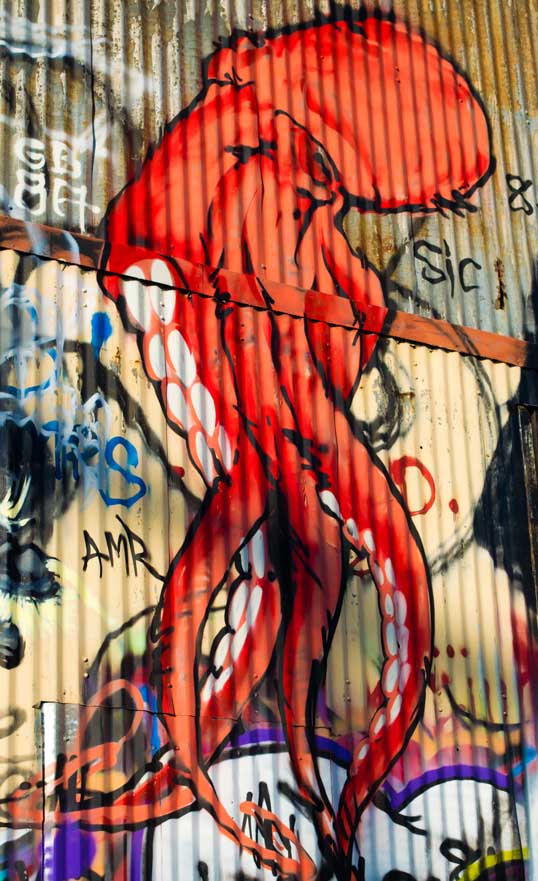
In their brief time together Slothrop forms the impression that this
octopus is not in good mental health, though where’s his basis for
comparing? But there is a mad exuberance, as with inanimate objects
which fall off of tables when we are sensitive to noise and our own
clumsiness and don’t want them to fall, a sort of wham! ha-ha you hear
that? here it is again, WHAM!
Yet for all his agonizing all Pointsman will score, presently, is an octopus – yes a gigantic, horror-movie devilfish name of Grigori: gray, slimy, never still, shivering slow-motion in his makeshift pen down by the Ick Regis jetty … a terrible wind that day off the Channel, Pointsman in his Balaclava helmet, eyes freezing, Dr. Porkyevitch with greatcoat collar up and fur hat down around his ears, their breaths foul with hours-old fish, and what the hell can Pointsman do with this animal?
Already, by itself, the answer is growing, one moment a featureless blastulablob, the next folding, beginning to differentiate….
“Graffiti is one of the few tools you have if you have almost nothing. And even if you don’t come up with a picture to cure world poverty you can make someone smile while they’re having a piss.”
― Banksy, Banging Your Head Against a Brick Wall
Inside, The Fabrication Yard, Dallas, Texas
This is a tough time of year for me. I suffer terribly from allergies from the evil Mountain Cedar Trees in South Texas – the clouds of pollen destroy me. The worst is the inability to get an effective night’s sleep. I go into awful hacking coughing fits every fifteen minutes or so.
That makes for long and unprofitable nights.
It was cold today, cold enough that I didn’t want to go outside. But as the day went on, the sun peeped out a little, and I decided to git. I wanted to go take some photographs somewhere, and after a bit of web searching, I found a candidate. There’s a place in West Dallas, near Trinity Groves, called The Fabrication Yard. It’s some old abandoned warehouses that the city lets taggers spray graffiti all over.
I packed my camera and drove down there. The highway had a big cluster of fire trucks and miles of traffic – luckily for me going the other way – but I made a note for the trip home.
When I pulled up I could smell the telltale tang of scorched soybean oil alkyd and solvent left by fresh aerosol paint. There were obvious drug deals in the street, pulsing music from one shed where someone was shooting a rap video and one guy painting a wall – otherwise pretty deserted – while I wandered and shot some pictures.
“It is almost startling to hear this warning of departed time sounding among the tombs, and telling the lapse of the hour, which, like a billow, has rolled us onward towards the grave.”
― Washington Irving, The Sketch Book
Large Bell, Edo Period, Crow Collection, Dallas, Texas
Large bells such as this were common in the Edo period to mark time for communities. They were often paid for by collecting coins from parishes and locales, and then melted down for the metal. These bells are clapper-less and were struck with a large wooden beam. With the introduction of Western clocks into Japan, fewer large bells, like this one, were needed. Modernity also called for replacing the traditional calendar based on the zodiac with a January to December year. Bells continued to be made, but their use was more commemorative and ceremonial than practical.
As sure as Kilimanjaro rises like Olympus above the Serengeti
—-Toto, Africa, the most awkward song lyrics
Yesterday, I wrote about three colossal, iconic works of art that I hope to see after they are finished. Today, I found out about a small work of art in a very remote location that I’m certain never to see.
It seems pretty silly – but that oh-so-familiar music wafting around those dunes while the wind blows sand through the scene – it has a strange beauty.
My only complaint is the “forever” part. Those boxes, wiring, and speakers don’t look very indestructible. The first sandstorm roaring past will scatter everything.
If it were my installation I would put it in an armored canister buried in the sand with only the speakers and solar panels exposed. That might last at least a couple weeks, if not “forever.”
As a matter of fact, I would bury it, hide it, and add a sensitive motion detector that would turn off the sound if anyone approached. It would only make sound if nobody was there to hear it. I would call it “A Tree Falls In the Desert.“
Writer’s block results from too much head. Cut off your head. Pegasus, poetry, was born of Medusa when her head was cut off. You have to be reckless when writing. Be as crazy as your conscience allows.
—-Joseph Campbell
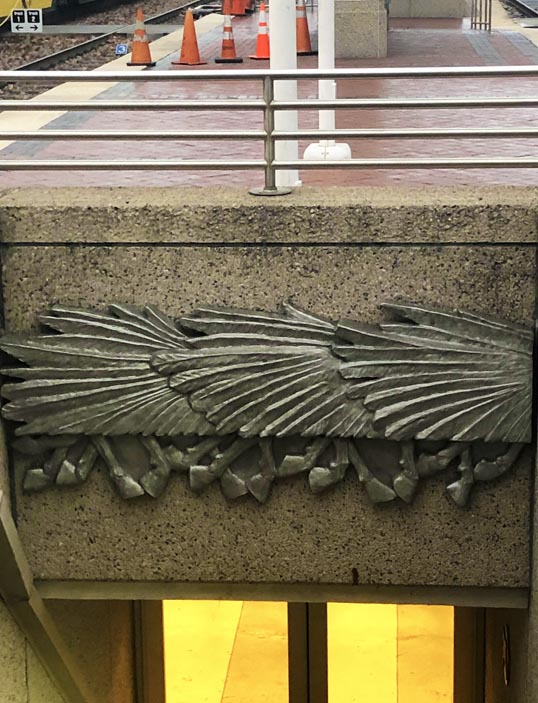
Metal bas-relief in a stairwell at Union Station, Dallas, Texas
There is amazing art all around you, where you least expect it. All you have to do is look.
It was cold and raining tonight as I left the DART train line at Union Station to walk over to the Bishop Arts Streetcar… but I stopped and took a photo of an amazing bas-relief… it looked like aluminum over a concrete wall over a stairwell leading to the underground tunnel under the station platform. It’s an obvious reference to Pegasus – one symbol Dallas uses to refer to itself. I don’t know the history or the artist – will have to do some research.
“Thus, when I say about myself that I am a genius, it is not self-praise, but a statement to describe a type of mind that: whatever it does in any field, it does well. A mind that peruses in many fields will comprehend better, and many things more, than one that is absorbed in only one. It becomes a universal mind.”
—–Stanislav Szukalski
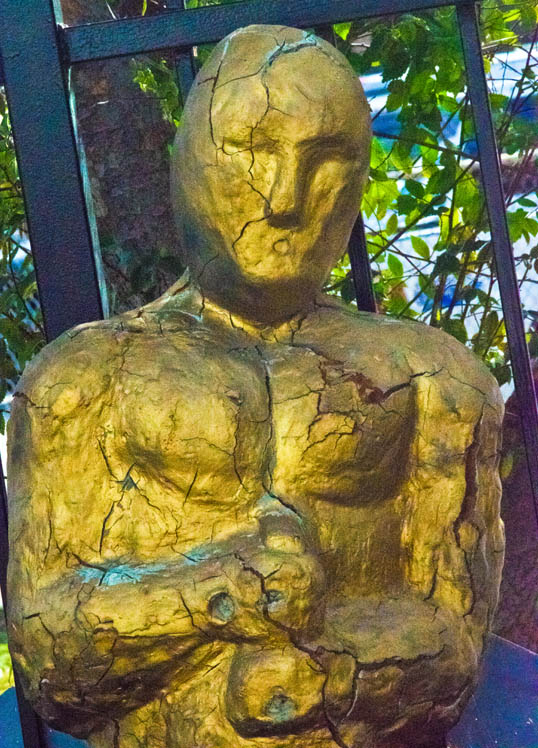
Struggle, a sculpture by Stanislav Szukalski
We cut the cord today. Bye Bye to cable television. Good riddance. I have watched the Boob Tube… the Idiot Box too much all my life.
I still watched too much – there is still Netflix… and Amazon Prime Video…. and Sling… and a multitude of crazy channels available through the Roku … and even the antenna. I finished off an episode of Doctor Who (I have a strange yet slight crush on the New Doctor, as long as I don’t watch too much) and an episode of The Alienist.
Then, checking the documentary section of Netflix, I chose a Netflix Original Documentary, Struggle: The Life and Lost Art of Szukalski.
Holy Moly… what a rabbit hole.
Stanislav Szukalski was a sculptural prodigy born in Poland in the late eighteen hundreds who showed great promise even though he was partially blind from staring at the sun. At 12 he moved with his family to Chicago.
This began a bifurcated life – of an eccentric artist in the United States and a fervent nationalist in Poland. He developed an unfortunate streak of racism and anti-antisemitism in Poland in the 1930’s. He became well known and successful until everything was destroyed in the German bombing of Warsaw in 1939. Other than a few small sculptures in American hands – his entire body of work, thousands of sculptures, drawings, and other artworks – was destroyed. He and his wife escaped at the last minute with only two suitcases and moved to Los Angeles.
Penniless, he survived on doing odd jobs for the film industry, and became friends with famous screenwriter Ben Hecht and the family of George DiCaprio, Leonardo DiCaprio‘s father. In 1971 Glenn Bray, a publisher and collector of oddball art, became fascinated with the story and work of Szukalski and was stunned to find out he was not only still alive but living 5 miles away from him. They became fast friends, Bray introduced him to a circle of artists, mostly underground comics illustrators, and began to film extensive, lengthy interviews with him.
And now, all this has led to Leonardo DiCaprio producing this Netflix Documentary using a lot of Bray’s interview footage. It’s a wild and woolly tale, with references all the way from the Nazis to Zap Comics to The Church of the Subgenius to DiCaprio to Easter Island.
Yeah, Szukalski thought that all human civilization originated in Easter Island and that all evil was the result of interbreeding with the Yeti. Really.
Not a big fan of his ideas here – but I love his art. There isn’t much out there – one bronze has been recently cast, but so much of his work was destroyed in the destruction of Warsaw. He whole life, ideas, and artistic output was warped beyond recognition by the terrors of the twentieth century.
Shame really – there is real talent there… eccentric talent, to be sure… but enough artistic genius to go around. I would like to see his work. Maybe a trip to Chicago – there is some stuff at the Polish Museum of America there.
“the cracked plate has to be retained in the pantry, has to be kept in service as a household necessity. It can never be warmed on the stove nor shuffled with the other plates in the dishpan; it will not be brought out for company but it will do to hold crackers late at night or to go into the ice-box with the left overs.”
― F. Scott Fitzgerald, The Crack-Up
“This is what comes from the wrong kind of attentiveness. People get brain fade. This is because they’ve forgotten how to listen and look as children. They’ve forgotten how to collect data. In the psychic sense a forest fire on TV is on a lower plane than a ten-second spot for Automatic Dishwasher All. The commercial has deeper waves, deeper emanations. But we have reversed the relative significance of these things. This is why people’s eyes, ears, brains and nervous systems have grown weary. It’s a simple case of misuse.”
― Don DeLillo, White Noise






 Bill Chance