Fiddleheads

Sometime, somewhere, somehow, while perusing the ‘net on a day when, though I don’t remember the details, I most certainly should have been doing something more worthwhile, I came across some sort of magazine article or web page that was extolling the delicious risk of eating fiddlehead ferns. I’m not sure exactly where it came from, but there’s a lot out there… here’s a quick sample for reference purposes:

It is always tempting to put out a link to the Wikipedia entry on Fiddlehead Ferns. Except… how useless – everyone knows how to look something up on Wikipedia. To me, that reminds me of my childhood, when everyone would start their school essays with the phrase, “Webster defines (insert subject here) as (insert dictionary definition here). How lazy can you get? It was especially common with oral reports. If you had five minutes to kill, you could get a good forty seven seconds out of the way with ol’ Webster. I always wanted to start a report with, “Webster defines cunnilingus as (insert definition here) – which has nothing to do with my report on the petroleum industry in Venezuela. Ooops, I’m getting off-subject here. The Wikipedia Definition of Fiddlehead Fern.

The unwritten ethic among fiddlehead foragers is to take three violin tops. A fern produces five to nine fronds per growing season, so harvesting more than three can jeopardize the plant’s survival. Found Food | Fiddlehead Ferns

Think of fiddlehead ferns, those tightly coiled, emerald-green symbols of spring, as ferns interrupted. Fiddlehead-Fern Bruschetta

The ostrich fern is the safest fern to eat, even though it, too, can contain toxins. The fiddleheads of cinnamon fern (Osmunda cinnamomea), lady fern (Athyrium filix-femina), and bracken fern (Pteridium aquilinum) can also be eaten, but all are at least mildly toxic and can cause nausea, dizziness, and headache, so it’s probably best to avoid them. Fiddlehead facts 

When the Spiceman is in, you can buy a fistful of exotic Tokyo longs to dazzle the pants off your in-laws (or maybe just your spouse). Best Fiddlehead Fern Finder: Tom “Spiceman” Spicer of F.M. 1410

Fiddleheads have a bright, earthy flavor that calls to mind asparagus, artichokes, and green beans. Fiddlehead Ferns

It fascinated me for a good three minutes. The idea of eating foraged food is cool – the idea of eating foraged food that is toxic if not gathered or prepared properly is even more cool. I could almost taste the slight bitterness and feel the crunchy texture of the boiled coils.

After these slight impressions collected somewhere in my useless mess of gray matter I was on to other tasks, probably working on remembering things like where did I leave my car keys and what is my bank account pin number.

My thoughts on fiddlehead ferndom lay dormant somewhere in there until I was walking around the Dallas Arboretum with my writing group taking photographs of the Chihuly exhibition when I overheard a woman talking. She was staring intently at a guide to the exhibit which I had neglected to obtain at the entrance. She was rattling off the names and locations of the colorful glass sculptures and I heard her say, “It says here he did some sculptures called Fiddleheads but I haven’t seen them yet.”

And that set off the memories. The rest of the day I couldn’t help but keep my eye out for some glass fiddlehead ferns. Finally, in the last garden at the end of all things, there were the fiddleheads sticking up amongst the greenery.

Now I can die in peace.

Fiddlehead fern fiddleheads
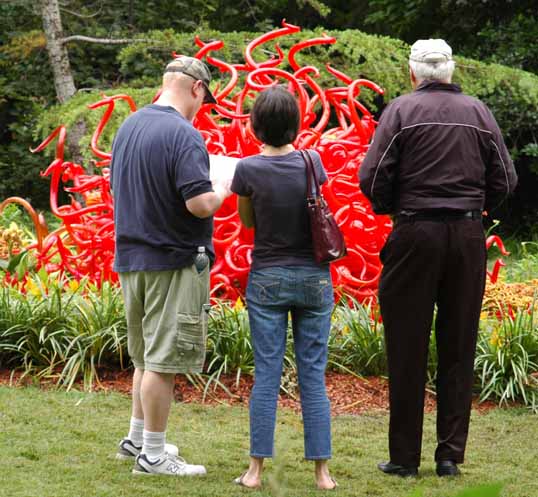
In case you think I’m full of shit when I write this stuff, here’s the woman I overheard asking about the fiddleheads. This was taken an hour later, and you can see, she is still looking at her guide book. She is now so tired of looking at it that she has her husband holding it for her. Or maybe that’s her husband on the other side and that’s her pool boy holding the guidebook. Or maybe the three aren’t related at all – maybe they are three technical writers that get together on the weekends to go various place and critique the guidebooks.
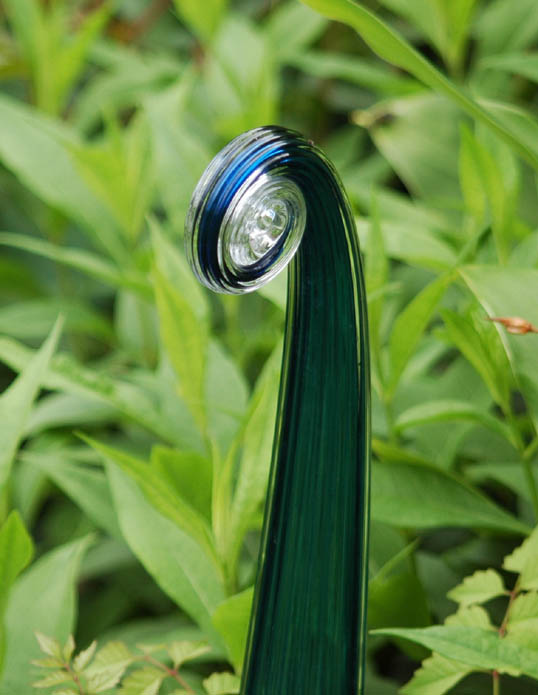
a Chihuly Fiddlehead
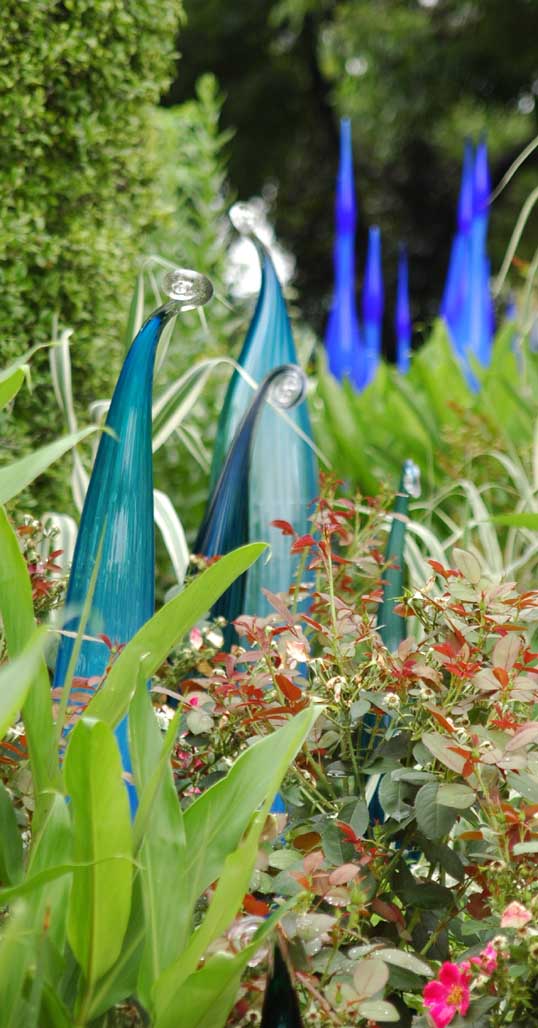
The glass ferns were growing in a bed of greenery.

A fly enjoying the Chihuly Sculpture. I bet he didn’t have to pay to get in.

All the Information in the World

In my surfing a few days ago I came across, as I’m sure you did, the news that after 244 years Encyclopedia Britannica was giving up on its print edition.

We never had Britannica in our house – it was too expensive. We had a cheaper, more “modern” looking set… I don’t remember the brand. Of course, my schools – every school (I went to… I think twelve different ones)  library had a set of Britannicas. I wasn’t a big fan of them; they seemed too stuffy for my taste. I loved the top-line World Book (which looks like it is still in print) – I remember when I discovered the transparent acetate pages that showed the human anatomy in several layers. It seemed like amazing information luxury to me.

Most kids used the various encyclopedias to plagiarize their school reports, usually cribbing the short paragraphs out verbatim.  I, on the other hand, used to read encyclopedias cover to cover, from AA, through Z, and on to devour each annual update and addendum. I loved reading them. I’d read my books at home, then I devour the ones in the school library, then on to the history sets (I loved these because they were in chronological order) and finally the long shelves of Time/Life educational books.

Sitting here, writing this, I remember the hours spent turning the pages, the slight fungus odor of the old paper, the weight of the editions as they came off the shelf, the nasty paper cuts – I remember following the footnotes and then the memory of getting to the same article in alphabetical order. I retained a surprisingly large amount of information – not sure how much good it did me. The tomes were good on dry facts but not so much on wisdom.

I am not overwhelmed with wistful nostalgic sadness, though. Plenty of people are full of woe that an age has passed and they lament the disappearance of such a totem of their youth. My thoughts run in a different direction. What I think about is what a kid that, in a vain attempt to satisfy his unquenchable curiosity, was forced to read encyclopedias cover to cover, volume to volume, could have done if he had been born a few decades later and had access to the internet. It would have been like drinking from a fire hydrant.

I’ve been seeing headlines like, “Encyclopedia Britannica killed by Wikipedia!” That is not true at all – Wikipedia is a great thing, but sometimes you want information that wasn’t written by nineteen-year-olds. There will always be a place for the verified truth.

“This has nothing to do with Wikipedia or Google,” Encyclopaedia Britannica Inc. President Jorge Cauz said. “This has to do with the fact that now Britannica sells its digital products to a large number of people.”

The top year for the printed encyclopedia was 1990, when 120,000 sets were sold, Cauz said. That number fell to 40,000 just six years later in 1996, he said. The company started exploring digital publishing in the 1970s. The first CD-ROM edition was published in 1989 and a version went online in 1994.

The final hardcover encyclopedia set weighs 129 pounds and is available for sale at Britannica’s website for $1,395.

An entire set costs more than an iPad. A low-end tablet is half that.  There is an iOS app which is free, but has a $1.99 a month subscription for unlimited content.

If you went back in time to, say 1969, and said, “Hey, for half the cost of that shelf full of heavy books, I’m going to give you a little book or pad, about the size of a magazine, that you can take anywhere with you and when you touch it, the content you are looking for will appear on it, more or less instantly. It will be in full color, with sound and full-motion television, when appropriate. You’ll have to throw the old, paper ones away, though. To keep it updated you’ll have to pay two dollars a month. Oh, and if you need a break you can play Angry Birds on it too.”

What do you think the reaction would have been? It makes me think of Arthur C Clarke’s third law- Any sufficiently advanced technology is indistinguishable from magic. A fully loaded iPad would have looked like magic in 1969. And that’s 1969! I remember 1969. I was twelve. I was reading encyclopedias in 1969.

I wish I had had an iPad.

This is me in 1969 (or so). I look like a kid that read encyclopedias cover to cover.

#Britannica

No More Encyclopedia Britannica

The Death of the Encyclopedia

Encyclopedia Books–The End of an Era

Throw the book at ‘em

Encyclopedias and Wikis

Goodbye Britannica, We Will Miss You!

Death of a Salesman Part 2: Encyclopaedia Britannicas Going Out Of Print

Encyclopedia Britannica going 100% Digital

Britannica encyclopedia out of print but the bibles still going strong

Encyclopedia Britannica to end print editions

No More Print edition of Encyclopaedia Britannica

Encyclopaedia Britannnica RIP

WILL YOU MISS THE ENCYCLOPEDIA?

No more Encyclopedia Britannicas in book form

The World on a Shelf

Encyclopedia Britannica is going digital only.

Encyclopedia Britannica to End Print Editions

No More Encyclopaedia Britannica Books

My Encyclopedia Britannica Set is Dusty but Not Forgotten

Encyclopedia Britannica

Encyclopaedia Britannica To Stop Publishing Books After 244 Years

Goodbye Encyclopedia Britannica

My thoughts on a lost era: Encyclopedia Britannica to stop printing books

Closing the Book: Encyclopedia Britannica Goes All Digital

read / end of an era

Encyclopedia Britannica ends publication after 244 years

CHECK OUT SOME THINGS THAT ARE GOING BYE BYE

End of an encyclopedic era

Wikipedia and the Internet just killed 244-year-old Encyclopaedia Britannica

Rule Britannica

Encyclopedia Britannica Goes Out of Print

ENCYCLOPAEDIA BRITANNICA, PRINTED NO MORE

Encyclopaedia Britannica To End Print Editions

Encyclopaedia Britannica wiped out by Wikipedia, selling final print edition

Encyclopedia Britannica Goes Out of Print