A Month of Short Stories 2014, Day 18 – Araby

A year ago, for the month of June, I wrote about an online short story each day for the month. It seemed like a good idea at the time. My blog readership fell precipitously and nobody seemed to give a damn about what I was doing – which was a surprising amount of work.

Because of this result, I’m going to do it again this year.

Today’s story, for day eighteen – Araby, by James Joyce.

Read it online here:

Araby

When I read Araby… re-read, actually. Of course I’ve read it before… many times. It is part of Dubliners… and reading that is necessary to life, sort of like oxygen or water. I’ve read it many times and every time I read it I discover something new.

When I read Araby I thought of Harry Potter. I thought of The Hunger Games. I though of why I don’t like to read Young Adult Fiction very much.

You see, the overarching idea of Young Adult fiction is to portray an ordinary young person, one usually somewhat downtrodden but mostly terribly ordinary, and reveal that they are something special. The world opens up, and through struggle, shows how important the young person is, how necessary, and how extraordinary things will be from now on.

It isn’t hard to understand how attractive that is. It is escape, it is fantasy, it is hope. Everyone dreams of being a special person with special talents and a special destiny. A Young Adult work of fiction puts a structure on that hope and shows the way (through plenty of challenges) into a bright shining future.

It is, of course, complete bullshit.

“You are not special. You’re not a beautiful and unique snowflake. You’re the same decaying organic matter as everything else. We’re all part of the same compost heap. We are the all singing, all dancing crap of the world.”
― Chuck Palahniuk, Fight Club

And that is where literature comes in, real literature. Like Araby. It shows the truth.

Araby tells the story of a young man in the thralls of his first love. It is something we all experienced and all remember. He does not completely understand what is happening to him.

He does not understand what will happen in the future but decides to go with it anyway. He does not understand what will happen.

But he finds out.

The young lady changed the position of one of the vases and went back to the two young men. They began to talk of the same subject. Once or twice the young lady glanced at me over her shoulder.

I lingered before her stall, though I knew my stay was useless, to make my interest in her wares seem the more real. Then I turned away slowly and walked down the middle of the bazaar. I allowed the two pennies to fall against the sixpence in my pocket. I heard a voice call from one end of the gallery that the light was out. The upper part of the hall was now completely dark.

Gazing up into the darkness I saw myself as a creature driven and derided by vanity; and my eyes burned with anguish and anger.
A Month of Short Stories 2014, Day 17 – Black Box

A year ago, for the month of June, I wrote about an online short story each day for the month. It seemed like a good idea at the time. My blog readership fell precipitously and nobody seemed to give a damn about what I was doing – which was a surprising amount of work.

Because of this result, I’m going to do it again this year.

Today’s story, for day seventeen – Black Box, by Jennifer Egan
Read it online here:

The Tweets that comprise the story Black Box collected at Paste Magazine

I’ve been a fan of Jennifer Egan ever since reading (and writing about) A Visit From the Goon Squad. I had avoided that book because I didn’t like the look of the title, but once I dove in I loved the idea of interconnected short, short stories. The stories are arranged in a web across time, space, and a diverse group of characters. Fun.

The sort of thing I would like to do.

I have never been a big fan of Twitter. I send out notices of my journal entries and I use it to locate food trucks and things to do – or web sites to visit. I don’t like the fact that so many celebrities and, especially, politicians use it almost exclusively to send out their thoughts and ideas.

140 characters is simply not enough for the complexity and subtlety of the human condition. Mass communication using Twitter is laziness.

A couple years ago these two things came together. Jennifer Egan wrote a short story and sent it out, 140 characters at a time, over Twitter. it ran over ten nights on the New Yorker‘s NYerFiction account. Now, that’s interesting.

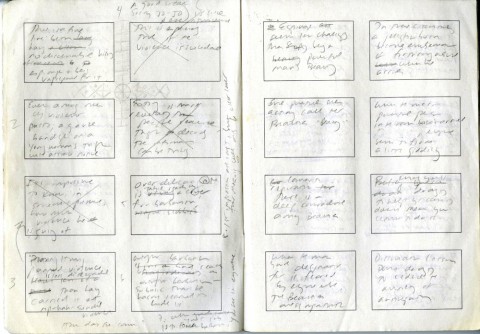
Especially when I looked into it and saw how much work she put into the project. It took her a year to write the piece – writing it out in longhand in Japanese notebooks printed with little boxes.

Jennifer Egan's handwritten version of the Twitter Short Story "Black Box."

Jennifer Egan’s handwritten version of the Twitter Short Story “Black Box.”

It’s a hypermodern spy story – chopped up with high tech gadgetry, a bevy of beauties, and a luxurious terrorist hideout.

I’m not sure if this experiment is an unqualified success. I wish I could have read it on its original ten-night airing – all those tweets in one sitting is a bit much. Still, it’s pretty cool and I’d like to consider how to break up a story into such tiny bites.

Here’s some more ordinary fiction from Jennifer Egan – if you like:

Safari

Ask Me If I Care

The opening of Jennifer Egan's Twitter Short Story "Black Box."

The opening of Jennifer Egan’s Twitter Short Story “Black Box.”

A Month of Short Stories 2014, Day 16 – Good People

A year ago, for the month of June, I wrote about an online short story each day for the month. It seemed like a good idea at the time. My blog readership fell precipitously and nobody seemed to give a damn about what I was doing – which was a surprising amount of work.

Because of this result, I’m going to do it again this year.

Today’s story, for day sixteen – Good People, by David Foster Wallace

Read it online here:

Good People

Good People is the first published excerpt from David Foster Wallace’s posthumously published incomplete novel The Pale King. Wallace hanged himself in 2008, at age 46. His father said that he had been suffering from depression for years and his medication had ceased to work. In the last few moments of his life, Wallace arranged his notes and computer files so his wife could find them.

His friend and editor Michael Pietsch took that material and molded it into its final published form. Despite being incomplete, the novel runs to over 500 pages.

I enjoyed this fragment (which, like a lot of David Foster Wallace’s novel chapters, stand fine on its own) because it contains a respect and fondness toward characters of faith – flawed as they are. The text is rough and rambling, reflecting the confusion in Lane’s mind.

The details – the uprooted tree, the man in the suit, the fishermen across the water – are carefully chosen and add layers of complexity to the simple story.

I wonder how much this piece is an homage to the Hemingway story Hills Like White Elephants? They are both stories about a couple making a choice where the word Abortion is never uttered.

A point not expressly made in the story, but one that comes to my mind is the one-way nature of time. Our past feels like a three dimensional cloud – full of inevitability, coincidences, and luck (good or bad). But the future feels like a set of steel rails where your only hope is to stay on the tracks, come hell or high water.

But neither did he ever open up and tell her straight out he did not love her. This might be his lie by omission. This might be the frozen resistance—were he to look right at her and tell her he didn’t, she would keep the appointment and go. He knew this. Something in him, though, some terrible weakness or lack of values, could not tell her. It felt like a muscle he did not have. He didn’t know why; he just could not do it, or even pray to do it. She believed he was good, serious in his values.

A Month of Short Stories 2014, Day 15 – Train

A year ago, for the month of June, I wrote about an online short story each day for the month. It seemed like a good idea at the time. My blog readership fell precipitously and nobody seemed to give a damn about what I was doing – which was a surprising amount of work.

Because of this result, I’m going to do it again this year.

Today’s story, for day fifteen – Train, by Alice Munro

Read it online here:

Train

There is no greater master of the short story than Alice Munro. I’ve pretty much read everything she has written (more or less) and, although I didn’t remember specifically reading today’s entry, Train, once I was a few paragraphs in, I remembered reading it – though it, like all of her work, is complex and subtle enough it was as good the second time around.

As a matter of fact, it is a story that I think needs to be read twice… with a gap of time in between. It is a story that is told in the details – details conveyed in otherwise throwaway lines of text, lines you won’t notice the first time through.

I have been thinking about one aspect of the story – one that bothers me a little. That’s the idea of a coincidence.

A lot of stories have coincidences – old friends meet, an important item goes unseen until it is needed, disparate paths cross…. That’s fine – you can always say, “the coincidence is needed, without the coincidence there is no story.” Coincidences happen.

However, I think that by this rule, you are limited to one coincidence. One coincidence makes a story – two or more make a manipulation by the author trying to drive a plot.

And I think this story might have two.

There is the big, obvious one. Jackson is working at the apartment building when Ileane comes by looking for her daughter. Read the story to find what the connection between the two is – it’s the relationship that drove the opening scene in the story. This sort of time-shifting and echoes happening across entire lifetimes are specialities of Alice Munro.

But, earlier in the story, Jackson stumbles across Belle. They are two of a kind and end up in a strange relationship that lasts decades. The two of them meeting like that might be a second coincidence.

Or maybe not – because if they were not so oddly and tragically well-fitted for each other Jackson would have simply passed by. I guess that is good enough.

Still, that second coincidence stuck in my craw a bit – a tiny flaw in an otherwise wonderful tale. I shouldn’t think about it so much. No use picking nits in the presence of a master.

There was a road running by. A small fenced field in front of the house, a dirt road. And in the field a dappled, peaceable-looking horse. A cow he could see reasons for keeping, but a horse? Even before the war people on farms were getting rid of them, tractors were the coming thing. And she hadn’t looked like the sort to trot round on horseback just for the fun of it. Then it struck him. The buggy in the barn. It was no relic, it was all she had.

For a while now he’d been hearing a peculiar sound. The road rose up a hill, and from over that hill came a clip-clop, clip-clop. Along with the clip-clop some little tinkle or whistling.

Now then. Over the hill came a box on wheels, being pulled by two quite small horses. Smaller than the ones in the field but no end livelier. And in the box sat a half dozen or so little men. All dressed in black, with proper black hats on their heads.

The sound was coming from them. It was singing. Discrete high-pitched little voices, as sweet as could be. They never looked at him as they went by.

It chilled him. The buggy in the barn and the horse in the field were nothing in comparison.

He was still standing there looking one way and another when he heard her call, “All finished.” She was standing by the house.

A Month of Short Stories 2014, Day 14 – Go-Between

A year ago, for the month of June, I wrote about an online short story each day for the month. It seemed like a good idea at the time. My blog readership fell precipitously and nobody seemed to give a damn about what I was doing – which was a surprising amount of work.

Because of this result, I’m going to do it again this year.

Today’s story, for day Fourteen – Go-Between, by Peter Rock
Read it online here:

Go-Between

So many of the stories I have collected in this month of short story writing are by familiar authors that I have read before. Either classic masters of the form, well-known maniacs trying to stretch what’s been before, or modern acclaimed virtuosos at throwing letters on the page.

That will not do.

I wanted something novel, an author I didn’t know – I need a new drug. So I turned to Google and some literary magazines that are willing to stick an occasional piece on the web for free (I’ll pay for it, but will you?) and struck a vein. Luckily it turned out to be gold and not hemoglobin.

The author is Peter Rock and the story is Go-Between.

I wanted mystery – something that left important (the most important) details to my imagination, I wanted clean prose (a little description is fine, but no rococo showing off), and I wanted some oddly off-kilter excitement.

Go-Between fit the bill perfectly.

It’s a sad commentary on my belated position on the mediocre arc of my nondescript life that I felt more of a kinship with the clumsy besuited disheveled stalker than with the attractive young characters trying to figure out where their skinny-dipping habits are about to take them. It is what it is.

So now I have someone new to read… a freshly-dug rabbit hole to tumble down. I don’t know if everything else he wrote is so attuned to what I’m looking for – but I’ll do the work to find out.

“How’s your grandma’s house?” he said. “Is it creepy, at all, living there?”

“I don’t know. It’s nice having all her old things, I guess, but I keep expecting her to be in the kitchen or come down the hallway. I never had to feed myself, there.”

Two long yellow kayaks slipped past. A lady in a bright red hat, a man with a gray beard. Naomi waved, and the man lifted his oar.

“Have you seen Sonja lately?” Alex said.

“We had breakfast this morning. Is that what you wanted to talk about?”

Off to the right was a tangle of bushes and trees, some of them tipping over into the water. Hidden on the other side of those trees, down the river, was an amusement park. Screams rose up every minute or so, every time the people on the rollercoaster made the big drop, headed into the loop.

A Month of Short Stories 2014, Day 13 – The Last Night of the World

A year ago, for the month of June, I wrote about an online short story each day for the month. It seemed like a good idea at the time. My blog readership fell precipitously and nobody seemed to give a damn about what I was doing – which was a surprising amount of work.

Because of this result, I’m going to do it again this year.

Today’s story, for day Thirteen – The Last Night of the World, by Ray Bradbury
Read it online here:

The Last Night of the World

This is the way the world ends
Not with a bang but a whimper.
—-Final two lines of T.S. Eliot’s The Hollow Men

Some say the world will end in fire,
Some say in ice.
—-First two lines of Robert Frost’s Fire and Ice

Bang, Whimper, Fire, or Ice. Today’s story, The Last Night of the World by Ray Bradbury postulates that the world will end with a dream. Everyone will dream the same dream and realize that it is all over… not because of what we have done, really, but because of what we haven’t.

The story was published in Esquire – they say of it, “One of twelve short stories the late science-fiction legend wrote for Esquire. And, weirdly, perhaps the most lasting.”

It’s a calm apocalypse, a soothing end to things. Nobody riots, nobody goes nuts… they simply live the last day pretty much how they lived every other one.

It was written in 1951 and I think of how it resonated in the time. This was the greatest generation, after all, and they should have been reveling in their victory over evil. But what do you do as a follow-up?

The couple in the story has two small daughters. The opening scene is one of tranquil family life with the girls playing blocks on the parlor rug by the light of green hurricane lamps. The couple drinks brewed coffee from a silver pot out of cups with saucers.

That’s not a modern family – time has sped too much. Today they would be gulping Starbucks from paper cups while rushing from soccer practice to dance class while text messaging each other to remember to pick up a frozen microwave dinner on the way home.

The last thing the woman does is go down to the kitchen and turn off the water tap – she left it on after they had done the dishes together. If I had written the story I would have her go down there and turn it on – have her express a desire to leave the water running for eternity. But that’s the difference between 1951 and 2014.

The one thing in the story I don’t understand is the date. It states that the world will end on February 30, 1951 – a date which obviously never existed. I’m not sure what to make of this.

They sat a moment and then he poured more coffee. “Why do you suppose it’s tonight?”

“Because.”

“Why not some night in the past ten years of in the last century, or five centuries ago or ten?”

“Maybe it’s because it was never February 30, 1951, ever before in history, and now it is and that’s it, because this date means more than any other date ever meant and because it’s the year when things are as they are all over the world and that’s why it’s the end.”

“There are bombers on their course both ways across the ocean tonight that’ll never see land again.”

“That’s part of the reason why.”

“Well,” he said. “What shall it be? Wash the dishes?”

A Month of Short Stories 2014, Day 12 – King of Jazz

A year ago, for the month of June, I wrote about an online short story each day for the month. It seemed like a good idea at the time. My blog readership fell precipitously and nobody seemed to give a damn about what I was doing – which was a surprising amount of work.

Because of this result, I’m going to do it again this year.

Today’s story, for day Twelve – King of Jazz, by Donald Barthelme

Read it online here:

King of Jazz

When I was a little kid I played trombone for a while. Actually, I think I was beginging to be pretty good at it. I can’t complain – it has given me an understanding of music that has served me to this day. After a couple of years we moved to a place that had no brass bands open to me and I made the discovery that it is impossible to play a trombone by itself. Probably for the best; it was about this time I learned to type.

So today we have a very short story (as is his wont) about a trombone player by Donald Barthelme. The trombone player is named Hokie Mokie and he is the new King of Jazz… now that Spicy MacLammermoor, the old king, is dead.

I remember when I played trombone in the school band, the most frustrating thing was the challenge system. Anybody could challenge a higher seat and if he won, he would take the place. I was first seat but I had to constantly contend with a bevy of lesser players that would game the system. The fact I was a young freshman made me an especially tempting target. They would practice one single piece until they had it cold, then challenge me with that piece. I was a better player, so I would usually win, but they kept coming and all I had to do is make one mistake and down I went. The bandleader would encourage me to challenge back as soon as possible, but I tired of the game pretty quickly.

In this story Hokie Mokie is challenged right off the bat by a Japanese Trombone player named Hideo Yamaguchi and the title King of Jazz is suddenly up for grabs.

I came upon the writings of Donald Barthelme in an odd, backward way. I stumbled across an article in the New Yorker (Good Losers, March 8, 1999) written by two of his brothers, Stephen and Frederick. It was an eloquent piece about an extremely successful family, the father a famous and influential architect and three sons that were noteworthy writers. The article was about two of them, Frederick and Stephen, who had become terribly addicted to gambling. It was fascinating and horrifying to read how these enormously talented and intelligent men were destroying their lives by driving down to the cheap casinos along the Mississippi coast and blowing all their livelihood on blackjack binges.

During the course of the article the brothers wrote about their older brother, Donald, and his revolutionary genius as an author. That interested me enough to do some research and to start to read his stuff.

Most of what Donald Barthelme writes are very short stories, flash fiction. They are unique and unusual bits of text – not what you are expecting or used to reading. They give up on a regular plot arc and make the reader figure out the meaning from a series of seemingly unrelated, often ridiculous statements, occurrences, or facts.

It’s a bit of an acquired taste. At first it was attractive to me because of its short nature – I figured I could read these little morsels of tales in some spare seconds here or there. But their simplicity turned out to be an illusion. The stories were more complex and deeper than they appeared on the surface. It took longer than I expected and were more work than I was prepared for – the tiny things had to be re-read and thought about.

“What’s that sound coming in from the side there?”
“Which side?”
“The left.”
“You mean that sound that sounds like the cutting edge of life? That sounds like polar bears crossing Arctic ice pans? That sounds like a herd of musk ox in full flight? That sounds like male walruses diving to the bottom of the sea? That sounds like fumaroles smoking on the slopes of Mt. Katmai? That sounds like the wild turkey walking through the deep, soft forest? That sounds like beavers chewing trees in an Appalachian marsh? That sounds like an oyster fungus growing on an aspen trunk? That sounds like a mule deer wandering a montane of the Sierra Nevada? That sounds like prairie dogs kissing? That sounds like witchgrass tumbling or a river meandering? That sounds like manatees munching seaweed at Cape Sable? That sounds like coatimundis moving in packs across the face of Arkansas? That sounds like – ”
“Good God, it’s Hokie! Even with a cup mute on, he’s blowing Hideo right off the stand!”
“Hideo’s on his knees now! Good God, he’s reaching into his belt for a large steel sword – Stop him!”
“Wow! That was the most exciting ‘Cream’ ever played! Is Hideo all right?”

A Month of Short Stories 2014, Day 11 – Mirrorball

A year ago, for the month of June, I wrote about an online short story each day for the month. It seemed like a good idea at the time. My blog readership fell precipitously and nobody seemed to give a damn about what I was doing – which was a surprising amount of work.

Because of this result, I’m going to do it again this year.

Today’s story, for day eleven – Mirrorball, by Mary Gaitskill.
Read it online here:

Mirrorball

Over the years I have read a lot of short stories. A lot of short stories…. Maybe a story every other day (with a lot of gaps, of course) since I was ten years old. That comes out to over eight thousand stories.

Obviously, that’s too high – but still, I have read a lot.

They all get mixed up – I’m always reading something that sort of feels familiar and then when I get to the end I realize I have read it before. I get authors mixed up, collections, anthologies and now with this internet thing… it’s so confusing.

One author that has always stood out is Mary Gaitskill. Her stories are full of desperate characters involved in all sorts of nasty trouble. She seems to know what she is writing about – she claims to have spent time as a stripper and a callgirl. I guess she is best known for writing the short story that the movie Secretary is based on – although the two are very different. She claims the movie was too charming and nice.

I know I’ve read the collection, Bad Behavior, that Secretary was in, but I don’t particularly remember it – I’ll have to read it again.

At any rate, today’s story is very different. This one is from her newest collection. Mirrorball is the story of a woman that has a one-night stand with a second-rate rock star and loses a piece of her soul in the process.

It’s a very unusual piece of writing.

I enjoyed the story, even though it isn’t really my cup of tea. It’s sort of an anti-Hemingway story in that nothing much happens (a couple of sexual encounters… and that’s about it) but a lot of words are spilled upon the page.

It’s a story told of a world inside of yet unknown to the characters; the world of their own souls – split, tortured, stolen, released.

It takes some skilled wordsmithing to go with something as ethereal as that and make it real to the reader. Read it, you decide.

He was a musician, well regarded in his hometown and little known anywhere else. This fact sometimes gnawed at him and yet was sometimes a secret relief; he had seen musicians get sucked up by fame and it was like watching a frog get stuffed into a bottle, staring out with its face, its splayed legs, its private beating throat distorted and revealed against the glass. Fame, of course, was bigger and more fun than a bottle, but still, once you were behind the glass and blown up huge for all to see, there you were. It would suddenly be harder to sit and drink in the anonymous little haunts where songs were still alive and moving in the murky darkness, where a girl might still look at him and wonder who he was. And he might wonder about her.

A Month of Short Stories 2014, Day 10 – How To Talk To Girls At Parties

A year ago, for the month of June, I wrote about an online short story each day for the month. It seemed like a good idea at the time. My blog readership fell precipitously and nobody seemed to give a damn about what I was doing – which was a surprising amount of work.

Because of this result, I’m going to do it again this year.

Today’s story, for day ten – How To Talk To Girls At Parties, by Neil Gaiman

Read it online here:

How To Talk To Girls At Parties

It’s a rare pleasure when you start out reading something and you think you know what it is going to be about – about a third of the way you are still sure and then, all of a sudden, you realize you are lost on a dark road and on the way somewhere unexpected… somewhere interesting and wonderful.

Reading something by Neil Gaiman… well, I should have known better. The title, the opening gambit… a young teenager trying to find his way in the world of women, intimidated by a good-looking, silver-tongued friend who has a way with the ladies. We’ve all read this before… we’ve all lived this before.

Then, all of a sudden….

Read it and find out.

You know when you are sixteen and confused and ignorant and you say to yourself, “I don’t understand any of this. Jeez! These girls all act like they are from another planet.”

Well, be careful….

She looked at me with her green eyes, and it was as if she stared out at me from her own Antigone half-mask; but as if her pale green eyes were just a different, deeper, part of the mask. “You cannot hear a poem without it changing you,” she told me. “They heard it, and it colonized them. It inherited them and it inhabited them, its rhythms becoming part of the way that they thought; its images permanently transmuting their metaphors; its verses, its outlook, its aspirations becoming their lives. Within a generation their children would be born already knowing the poem, and, sooner rather than later, as these things go, there were no more children born. There was no need for them, not any longer. There was only a poem, which took flesh and walked and spread itself across the vastness of the known.”

I edged closer to her, so I could feel my leg pressing against hers.

She seemed to welcome it: she put her hand on my arm, affectionately, and I felt a smile spreading across my face.

“There are places that we are welcomed,” said Triolet, “and places where we are regarded as a noxious weed, or as a disease, something immediately to be quarantined and eliminated. But where does contagion end and art begin?”

A Month of Short Stories 2014, Day 8 – Nirvana

A year ago, for the month of June, I wrote about an online short story each day for the month. It seemed like a good idea at the time. My blog readership fell precipitously and nobody seemed to give a damn about what I was doing – which was a surprising amount of work.

Because of this result, I’m going to do it again this year.

Today’s story, for day Eight – Nirvana, by Adam Johnson

Read it online here:

Nirvana

As I look through the short stories I have chosen for this month, I see that I have been tending to the venerable classics – Hemingway, Salinger, Eudora Welty, Kate Chopin, Willa Cather… only Daniel Orozco could be considered new – the rest are hoary old chestnuts.

So today I’ll add something new, modern, post-modern even. Today’s story is set in the near future and is full of what marks our age – for good and bad. It’s a story of dot-com millionaires, private miniature drones controlled by Google, the newest Apple invention – the iProjector, artificial intelligence, and a mysterious circuit board from India that can crack any cryptography.

The tough nut to crack when writing about such things is to make it human. As interested as we all are in the technology of the time, it doesn’t serve very well at tugging at our heartstrings.

But Adam Johnson pulls it off. He works by giving the story a hear-rending human situation, one that goes so far beyond what technology can affect – all the bells and whistles of today are revealed as mere tinsel and foil, window dressing for the inevitable doom of our lives.

Or is it? As the story progresses the human tragedy and the digital world begin to spiral together in a dance of death and hope – and it the end the human and the artificial meld together in an epiphany of sorts.

It’s quite a thing.

I have to admit that until I read this story I knew nothing of Adam Johnson or his work – even though he won the Pulitzer Prize last year for his novel The Orphan Master’s Son. I think it’s time I read some more.

Charlotte’s mother arrives. She brings her cello. She’s an expert on the Siege of Leningrad. She has written a book on the topic. When the coma is induced, she fills the neuro ward with the saddest sounds ever conceived. For seven days, there is nothing but the swish of vent baffles, the trill of vital monitors, and Shostakovich, Shostakovich, Shostakovich. No one will tell her to stop. Nervous nurses appear and disappear, whispering in Tagalog.